
ServiceNow Lux vs UI Builder and Service Portal: What Enterprises Need to Know
Does Lux replace UI Builder or Service Portal? Short answer: no. The full answer depends on what you are building.
The way enterprises build experiences on ServiceNow is changing. For years, Service Portal has handled employee and customer self-service, while UI Builder has powered modern workspaces and configurable applications.
Now ServiceNow Lux brings a new generation of AI-native experience development, with modern web technologies, reusable components and source-code workflows. That raises three questions:
- Does Lux replace UI Builder or Service Portal?
- Should enterprises migrate existing applications?
- Which framework makes most sense for new projects?
The answer is not simply “choose the newest technology.” Each framework serves different needs, and understanding the differences is essential for a scalable ServiceNow architecture.
What Is ServiceNow Lux?
ServiceNow Lux is a modern, AI-native UI framework for the next generation of enterprise experiences on the ServiceNow AI Platform, introduced with the Brazil release. Built on Lit, Base UI and Tailwind CSS, it aligns ServiceNow development more closely with established frontend engineering practices.
Lux supports source-code workflows and AI-assisted development. Developers use Lux Lab, Visual Studio Code and the Now SDK to create, customize, preview and deploy experiences with familiar tools.
Main capabilities
- AI-native development: AI-assisted workflows and contextual experiences
- Modern web technologies: a foundation on established frontend standards
- Reusable components: shared UI elements across multiple experiences
- Source-code development: code editors, Git and modern engineering practices
- Flexible environments: guided and code-first development options
For a practical walkthrough, see our guide Building ServiceNow Experiences with Lux Lab, VS Code and Now SDK.
Lux is an important shift in ServiceNow development, but it is not an immediate replacement for existing interfaces.
What Is ServiceNow UI Builder?
UI Builder is a visual development environment for creating and customizing experiences in the Next Experience UI Framework. It is best suited to agent and fulfiller workspaces, where users need structured access to records, tasks and operational data.
It provides prebuilt components, data resources, page variants and event-driven interactions, so developers can configure complex interfaces without building everything from scratch.
Typical use cases
- IT Service Management workspaces
- Customer Service Management applications
- Operational dashboards
- Specialized internal applications
Its main advantage is customizing existing ServiceNow workspaces while staying aligned with platform conventions. UI Builder remains an important, supported tool, particularly for configurable workspaces.
What Is ServiceNow Service Portal?
Service Portal is a framework for responsive self-service experiences for employees, customers and other requesters. It gives simplified access to ServiceNow functionality without the full platform interface.
It is built on AngularJS, Bootstrap and ServiceNow widgets. Developers can customize pages, create interactive components and integrate service catalog and knowledge functionality.
Typical use cases
- Employee self-service portals
- IT service request portals
- Knowledge bases
- Customer-facing support experiences
Service Portal stays especially relevant for organizations with established self-service environments, complex catalog functionality or public-facing pages. Its frontend technology is older, but ServiceNow continues to support it.
ServiceNow Lux vs UI Builder vs Service Portal: Key Differences
The table below compares the three frameworks across seven dimensions, based on ServiceNow’s documented capabilities and October 2026 development guidance.
| Capability | ServiceNow Lux | UI Builder | Service Portal |
|---|---|---|---|
| Primary focus | Modern, AI-native experiences | Agent and fulfiller workspaces | Employee and customer self-service |
| Development model | Code-first, AI-assisted | Visual, component-based | Portal and widget-based |
| Core technologies | Lit, Base UI, Tailwind CSS | Next Experience UI Framework | AngularJS, Bootstrap |
| Development tools | Lux Lab, VS Code, Now SDK | UI Builder | Service Portal Designer, Widget Editor |
| Reusability | Modern reusable widgets | Reusable components and page patterns | Reusable portal widgets |
| Best suited for | New custom experiences, AI-oriented development | Configurable workspaces | Established requester portals |
| Adoption consideration | Emerging framework; check release maturity | Established, supported tooling | Established, supported tooling |
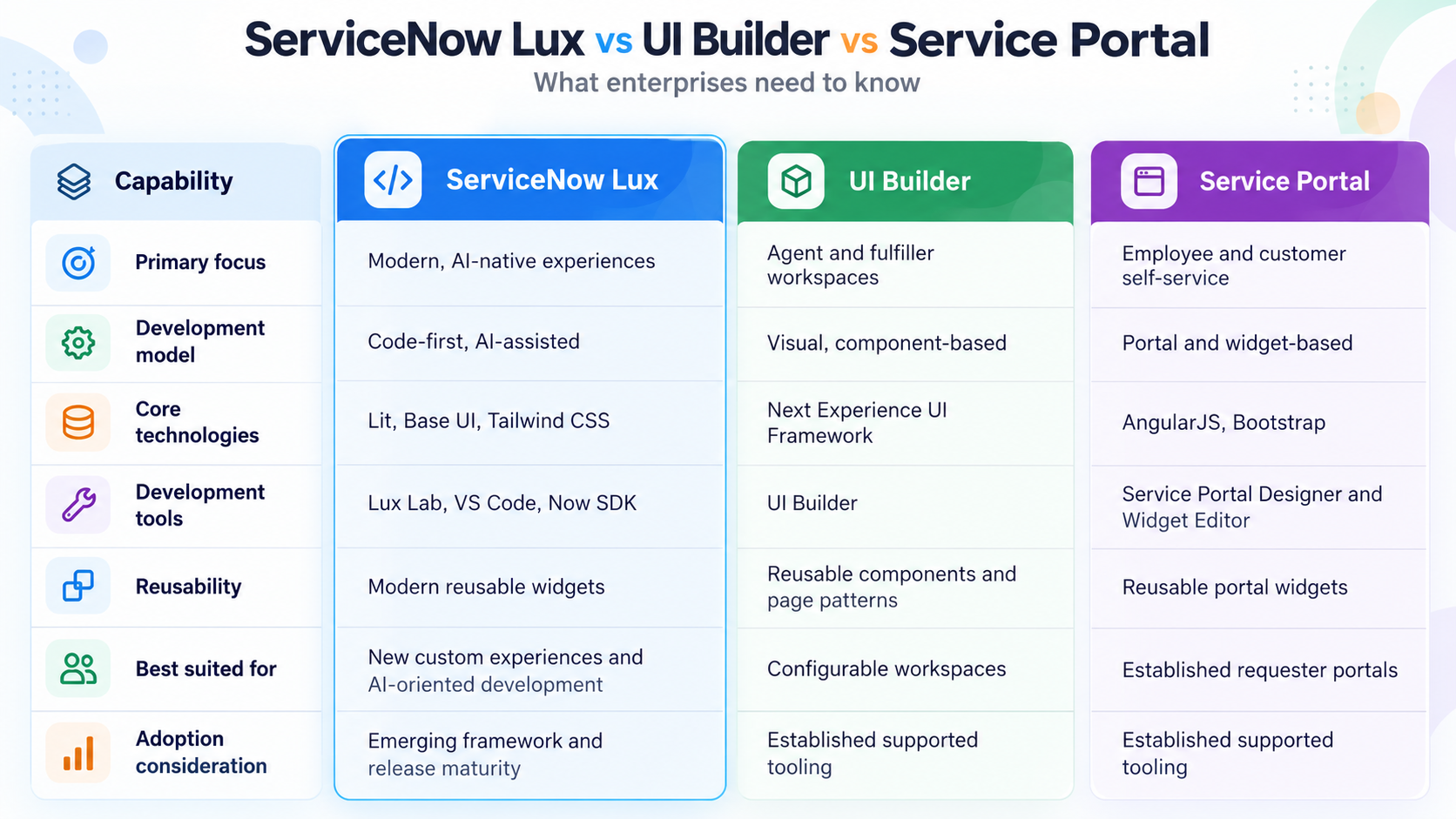
Figure 1. ServiceNow Lux vs UI Builder vs Service Portal at a glance.
In short: Lux emphasizes source-code and AI-native development, UI Builder focuses on configurable operational experiences, and Service Portal supports established self-service. All three can coexist on the same enterprise platform.
Does ServiceNow Lux Replace UI Builder or Service Portal?
No, not automatically. ServiceNow has indicated that configurable workspaces will continue to use UI Builder, and there are no announced plans to deprecate existing Workspaces or Angular-based Service Portals.
Lux expands the development options rather than forcing a platform-wide migration. That gives enterprises room to modernize gradually:
- Keep existing workspaces in UI Builder
- Retain proven self-service functionality in Service Portal
- Evaluate Lux for new use cases where its architecture offers clear advantages
This avoids unnecessary disruption while letting teams adopt modern capabilities strategically.
As of October 2026, ServiceNow guidance points to Lux general availability in Q4 2026, so release maturity and production support are important considerations for new projects.
When Should Enterprises Choose Each Framework?
The right choice depends on business objectives, user expectations, application complexity and long-term maintenance. The decision guide below summarizes the logic.
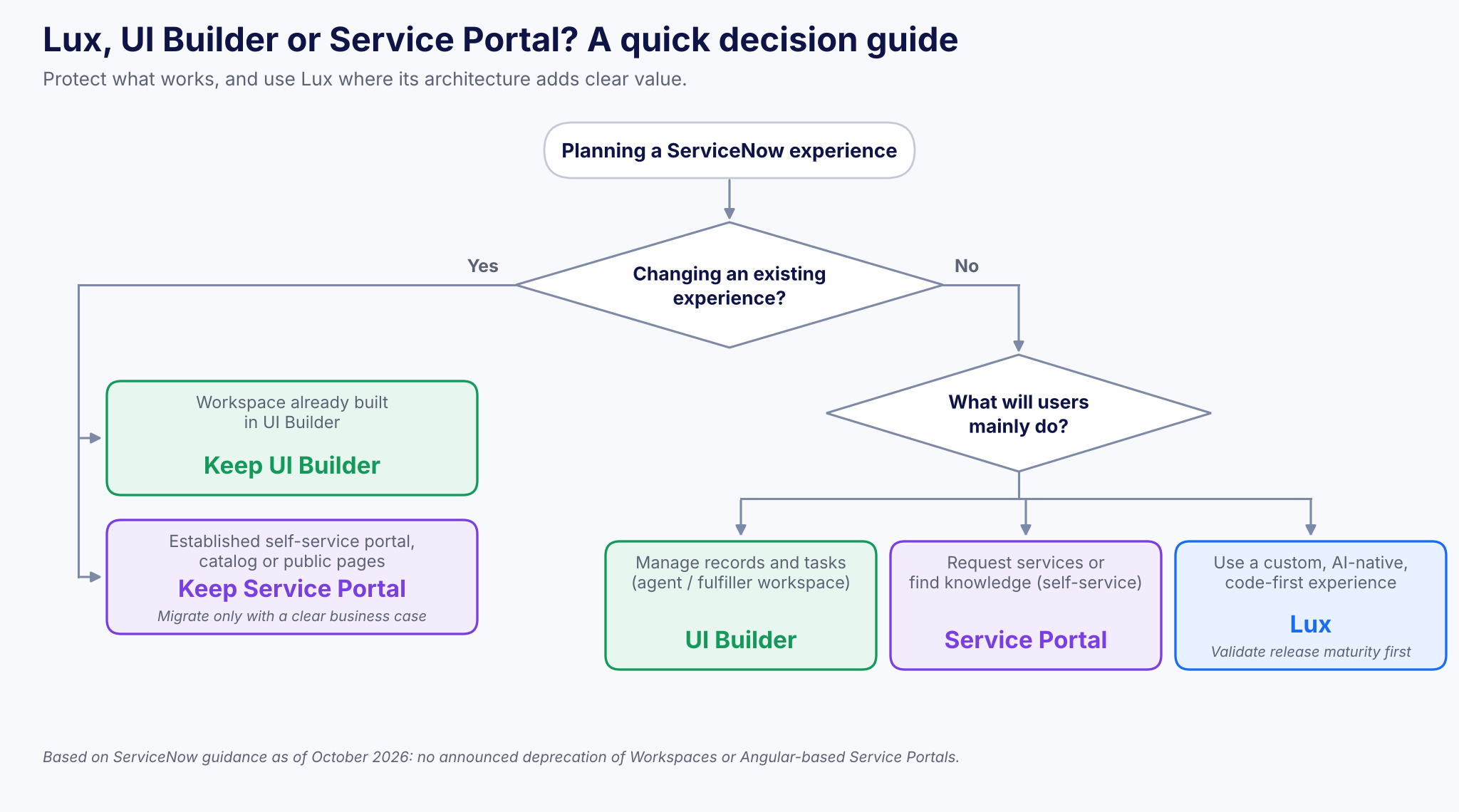
Figure 2. A quick decision guide: protect what works, use Lux where it adds clear value.
Choose Lux for modern, AI-driven experiences
Evaluate Lux for new interfaces that need more customization, reusable frontend components and AI-assisted functionality, such as:
- Custom operational dashboards
- AI-powered decision support interfaces
- Specialized enterprise applications
Lux also suits organizations with Git-based development processes and teams experienced in modern frontend technologies. Validate framework maturity and production readiness before committing business-critical applications.
Choose UI Builder for operational workspaces
UI Builder remains a strong option for customizing ServiceNow workspaces or building structured interfaces for employees managing complex workflows.
Example: a customer service team needs a workspace combining case details, customer information, related tasks and contextual actions. UI Builder’s established components and configuration support exactly this. Replacing it with Lux just because Lux is newer may add unnecessary cost.
Choose Service Portal for established self-service
Service Portal remains relevant for employee and customer self-service, with service catalogs, knowledge access and responsive requester interfaces.
For heavily customized portals, consider migration only with a clear business justification and a suitable alternative that meets existing requirements. Improve the user experience; do not change technology without measurable benefit.
How Lux Fits into Modern ServiceNow Development
Beyond interface design, Lux strengthens development practices. With Lux Lab, VS Code and the Now SDK, developers work with application source code, reusable components and familiar engineering workflows, connecting experience development to version control, testing and deployment automation.
This matters most for organizations already investing in DevOps. Read more in our related articles:
- ServiceNow Source-Code Development Model: how code-first development changes application engineering
- ServiceNow CI/CD with Now SDK and GitHub Actions: how teams improve deployment consistency
- ServiceNow Automated Testing with Now SDK and ATF: how automated validation supports reliable releases
Modern tools do not guarantee better quality on their own. Clear architecture, secure development practices and well-defined release processes remain essential.
How Enterprises Should Prepare for Lux Adoption
Instead of migrating existing experiences, build a structured adoption strategy:
- Assess your applications: identify which experiences use Service Portal, UI Builder or other UI technologies, and map their dependencies, customization levels and business importance.
- Pick a limited use case: choose one where Lux can show value without significant operational risk.
- Check team readiness: decide whether developers need training in Lit, component architecture, source-code workflows or AI-assisted development.
- Set governance standards: define how components are reviewed, tested, versioned and deployed across environments.
- Measure outcomes: track user adoption, development efficiency, maintenance effort and experience quality before expanding.
A gradual approach lets organizations explore Lux while keeping existing ServiceNow environments stable.
Key Takeaways
- Lux is a code-first, AI-native UI framework; UI Builder and Service Portal remain supported
- No deprecation of Workspaces or Angular-based Service Portals has been announced
- UI Builder: operational workspaces; Service Portal: self-service; Lux: new custom, AI-native experiences
- Keep what works and evaluate Lux for new use cases
- Lux GA is targeted for Q4 2026: validate maturity before business-critical use
- Adopt gradually: assess, pilot, train, govern, measure
Frequently Asked Questions
Does ServiceNow Lux replace UI Builder?
No. ServiceNow has indicated that configurable workspaces will continue to use UI Builder.
Is Service Portal being deprecated?
There are no announced plans to deprecate Angular-based Service Portals as part of the Lux introduction.
When should we use Lux instead of UI Builder or Service Portal?
For new, custom experiences that need reusable frontend components, AI-assisted functionality and code-first development, after validating Lux’s release maturity.
Should we migrate existing portals and workspaces to Lux?
Only with a clear business justification. Keep established workspaces and portals that work, and evaluate Lux for new use cases.
How Teiva Systems Can Help
Choosing between Lux, UI Builder and Service Portal takes more than comparing features. It means evaluating your existing architecture, operational requirements, development capabilities and future scalability.
Teiva Systems’ ServiceNow expertise covers custom application development, platform integration, workflow automation and AI-driven solutions. We help organizations:
- Assess modernization opportunities
- Establish maintainable development practices
- Design solutions that balance innovation with reliability
Whether you are optimizing a workspace, maintaining a complex portal or exploring modern experience development, we align technology decisions with your business priorities.
ServiceNow Lux opens a new direction for enterprise application development, but it does not make existing technologies obsolete. UI Builder serves operational workspaces, Service Portal remains important for self-service, and Lux offers AI-native, code-first development.
The most effective strategy is not to replace everything at once. Understand where each framework delivers value, preserve investments that still work, and introduce modern capabilities where they create measurable improvement.
Planning your next ServiceNow development project? Contact Teiva Systems to modernize ServiceNow applications, optimize existing experiences and prepare for AI-driven development.
Oleksii Konakhovych, CTO, Oct 26, 2026
Eager to take the next step? Contact us today!
Latest Articles

Teiva Systems at ServiceNow World Forum 2026 — London
On October 20, 2026, Teiva Systems attended ServiceNow World Forum London at ExCeL London, where industry leaders, technology experts, and the ServiceNow community came together to explore how AI, intelligent automation, and digital workflows are transforming enterprise operations.
read more
ServiceNow Intelligent Approvals: How AI Turns Policies Into Approval Decisions
What if your approval policies could make decisions, instead of sitting in documents waiting for someone to interpret them? For years, approval automation has followed the same pattern. Business teams write policies. Developers translate them into workflow conditions. Employees wait for someone to approve or reject their request, even when the outcome is obvious.
read more
ServiceNow Intelligent Approvals: How AI Clears Approval Bottlenecks Without Losing Control
Your automation is fast. Your approvals are not. Organizations invest heavily in automation, AI and digital transformation. Yet many business processes still stall at the same point: waiting for someone to click “Approve.”
read more