
ServiceNow CI/CD with Now SDK and GitHub Actions: What Changes for Developers
The Now SDK connects ServiceNow application development to GitHub Actions CI/CD pipelines — bringing pull-request quality gates, automated ATF testing, and controlled release governance to a platform that has historically required its own isolated delivery process.
One of the most important changes is the ability to connect the Now SDK with CI/CD pipelines such as GitHub Actions.
For developers, this means moving away from a workflow like:
Build in ServiceNow → manually move changes → test → deploy
toward something closer to:
IDE → Git → Pull Request → Automated Testing → Approval → Deployment
| # | Traditional ServiceNow workflow | Now SDK + GitHub Actions workflow |
| 1 | Build configuration directly in the ServiceNow studio or instance | Write application source code locally in a preferred IDE with TypeScript/JS support |
| 2 | Manually copy or migrate changes between environments using update sets | Commit to Git, open a pull request — CI pipeline triggers automatically |
| 3 | Testing performed manually or after development is considered complete | ATF suites run automatically on every pull request before code review |
| 4 | Release steps rely on individuals remembering the correct promotion sequence | Pipeline executes the same validated steps every time — build, test, publish |
| 5 | Application state lives on the instance; version history is implicit | Git is the source of truth; every change has an author, reviewer, and test record |
| 6 | Deploy to production via manual steps; rollback requires manual effort | Production approval gate with automated rollback capability via SDK commands |
This is more than a new deployment option. It changes how ServiceNow applications can be developed, reviewed, tested, and released.
A More Familiar Development Workflow
Traditionally, ServiceNow development has relied heavily on work completed directly inside the platform.
The Now SDK changes that model.
Developers can increasingly work with familiar engineering tools such as:
- local IDEs;
- Git repositories;
- branches;
- pull requests;
- automated testing;
- command-line tooling;
- CI/CD pipelines.
With ServiceNow Fluent, developers can also define application metadata using TypeScript-based development patterns.
The result is a ServiceNow development experience that looks much more like modern software engineering.
Git becomes the source of truth, the IDE becomes the primary development environment, and CI/CD handles repetitive validation and deployment tasks.
What Now SDK CI/CD Changes
The Now SDK can interact with ServiceNow CI/CD capabilities directly through the command line. This makes it possible to include ServiceNow lifecycle operations inside external pipelines. Depending on the implementation, teams can automate a range of activities — and choosing which ones require human approval is part of the pipeline design decision:
| Operation | When it triggers | Human approval needed? |
| Install application in test instance | Pull request opened or updated | Automated |
| Run ATF test suites | After install completes | Automated |
| Execute regression suites | Scheduled or PR trigger | Automated |
| Validate build | After tests pass | Automated |
| Publish new application version | Merge to release branch | Automated |
| Roll back application | Pipeline failure or manual signal | Automated |
| Promote to staging environment | After version published | 👤 Human gate |
| Deploy to production | After staging approval | 👤 Human gate |
The important part is not simply that these operations exist. It is that they can now become repeatable steps inside tools such as GitHub Actions. Instead of relying on developers to remember every release step manually, the pipeline can execute the same process every time.
What a GitHub Actions Pipeline Can Look Like
Consider a typical development workflow: a developer creates a feature branch, makes changes locally using the Now SDK, and opens a pull request.
That pull request automatically triggers GitHub Actions.
Here is what a structured pipeline looks like from trigger to production:
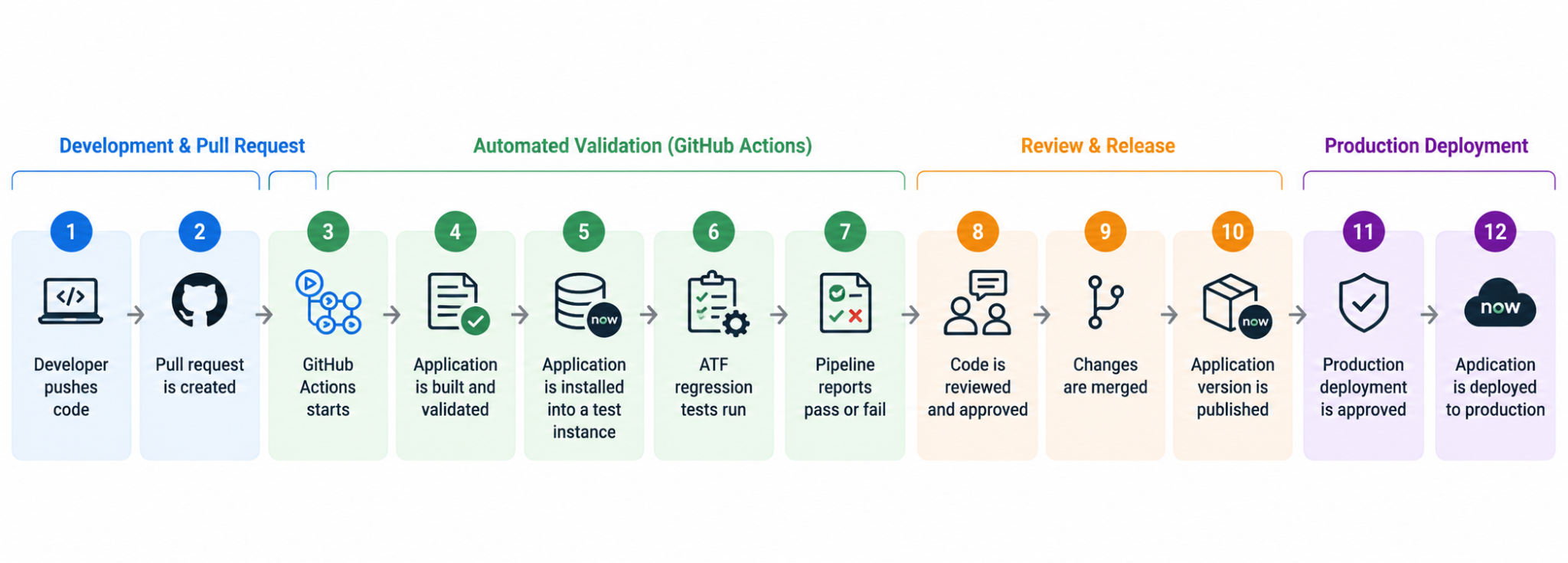
And that is one of the biggest advantages.
ServiceNow development no longer needs to operate as an isolated engineering process.
Pull Requests Become Quality Gates
A pull request becomes more useful when it does more than show code changes. It can become an automated quality checkpoint. Before a developer reviews the code manually, the pipeline can already verify whether:
| Automated checks before human code review: → The application builds successfully from source → Deployment to a test instance works → Required ATF tests pass → The application is ready for further review |
If something fails, the developer sees the result immediately, fixes the issue, and pushes another commit. The pipeline runs again. This creates a much shorter feedback loop and reduces the chance of discovering basic issues during final release preparation.
ATF Moves Earlier in the Development Lifecycle
Automated Test Framework becomes particularly valuable in this model. In a more traditional workflow, testing may happen only after development is considered complete. With CI/CD, testing can happen automatically when a pull request is created:
| Traditional: Development → handoff → testing → bug found → back to development With CI/CD: Development → pull request → ATF runs → immediate feedback → merge or fix |
This shifts automated testing earlier in the lifecycle. For larger ServiceNow teams, that can significantly improve consistency. Instead of relying on someone to remember which regression suite must be executed before every release, the requirement becomes part of the pipeline. Testing is no longer a separate final step. It becomes part of development.
| What happens when ATF is missing from the pipeline: The most common pattern we see in ServiceNow delivery reviews is teams that have written ATF tests but do not run them automatically before releasing. The tests exist. The pipeline does not enforce them. What happens in practice: tests are skipped under time pressure, regressions are caught in UAT or production instead of at the pull-request stage, and over time teams stop maintaining the test suite because it ‘never catches anything in time.’ Moving ATF into the pull-request gate is one of the highest-value pipeline changes a ServiceNow delivery team can make — and it requires very little additional tooling once the Now SDK is in place. |
Developers Spend More Time in Their IDE
Another practical change is reduced context switching. Developers can increasingly remain inside their usual engineering environment: IDE, terminal, and Git.
| How the tooling responsibilities split: → IDE — create and modify the application source code → Git — manage versions, branches, and collaboration → GitHub — manage pull requests, approvals, and pipeline execution → ServiceNow instances — the environments where the application runs and is validated |
This model can also make ServiceNow development easier to integrate into broader enterprise engineering teams where Git, pull requests, and CI/CD standards already exist.
Automation Does Not Remove Governance
CI/CD does not mean deploying every commit directly to production. In enterprise environments, that would often create more risk rather than less. A well-designed pipeline can automate low-risk, repetitive activities while keeping approval gates for sensitive actions.
For example, teams may automatically build the application, deploy it into test, execute ATF, validate the release, and publish a version — while production deployment still requires manual approval.
| “Automate repetitive work while keeping human control over important release decisions.” |
Protected GitHub environments, approval policies, dedicated service accounts, and access restrictions can all become part of the deployment process. The pipeline enforces the process. Humans remain responsible for the release decision.
How Teiva Structures Approval Gates in Enterprise ServiceNow Pipelines
In enterprise ServiceNow delivery, teams often aim to automate as much as possible, including production deployments. However, we recommend a more controlled approach for regulated or business-critical workflows. Specifically, we favor a two-gate pipeline: an automated gate after ATF that prevents faulty builds from progressing and a human approval gate before production that ensures clear accountability for every release.
Furthermore, GitHub’s protected environments help teams enforce these approval requirements without introducing unnecessary manual work. As a result, developers can maintain efficient delivery processes while keeping critical decisions under human control. Most importantly, both gates operate within the same pipeline, eliminating the need for teams to coordinate separate workflows manually. This approach ultimately strengthens governance, improves release consistency, and reduces deployment risks.
Git Becomes More Important
As the Now SDK development model expands, Git moves from being an optional development tool to becoming a central part of the application lifecycle.
Teams can use Git to manage:
- development branches;
- release history;
- code reviews;
- approvals;
- collaboration;
- pipeline triggers.
This also provides a much clearer history of how an application changed over time.
Instead of release knowledge existing mainly in developer documentation or individual experience, the repository and the pipeline become part of the operational record.
What Changes for ServiceNow Teams
For development teams, this shift has several practical consequences:
| Six things that change when you adopt Now SDK + GitHub Actions: → Developers become more involved in the complete application lifecycle, not just feature development → Testing becomes part of the pull-request process — not a handoff step after development → Deployment becomes repeatable — the same pipeline runs every time → Code review becomes easier to standardise across the team → Environment promotion becomes more predictable — no undocumented manual steps → Release processes become less dependent on individual developers remembering the sequence |
This approach becomes particularly important for organisations managing multiple ServiceNow applications across development, testing, staging, and production environments. As the number of applications grows, teams often struggle to maintain consistent manual release procedures. Therefore, CI/CD helps organisations establish a common delivery standard, streamline deployments, and reduce operational complexity.
The Bigger Picture
GitHub Actions represents only one part of this transformation. More importantly, ServiceNow applications can now increasingly follow the same engineering practices that organisations already use across their enterprise technology environments. As a result, teams can create more consistent, automated, and reliable development workflows.
For developers with traditional software engineering backgrounds, this approach offers a familiar experience. Meanwhile, existing ServiceNow developers can reduce manual tasks, simplify collaboration, and organise their development processes more effectively. At the same time, platform owners gain greater visibility, stronger auditability, and more control over release governance.
Ultimately, this shift brings ServiceNow development closer to modern software engineering standards while helping organisations deliver applications more efficiently and confidently.
The goal is not simply to automate everything. The goal is to create repeatable, testable, and controlled ServiceNow delivery. And that is the real change Now SDK and GitHub Actions bring to developers.
Slava Trotsenko, CEO, Oct 09, 2026
Eager to take the next step? Contact us today!
Latest Articles
Why ServiceNow Is Moving Toward a Full Source-Code Development Model
ServiceNow development is converging on the engineering model enterprise teams already use for cloud, integration, and backend services: IDE, Git, CI/CD, and automated release governance. This post explains what that means for CTOs, architects, and delivery leaders.
read more
ServiceNow for the Public Sector: Five Requirements to Address Before Implementation
Public-sector organizations do not implement ServiceNow under the same conditions as a commercial enterprise. Getting the foundation right before development begins can determine whether the platform supports secure, measurable, and scalable public services for years to come.
read more
ServiceNow AI ROI: What Should You Measure After the Pilot?
Your AI pilot worked. That proves the technology can work. It does not yet prove ROI. Here are the six metrics that separate “the demo impressed leadership” from “we can prove measurable business value.”
read more