
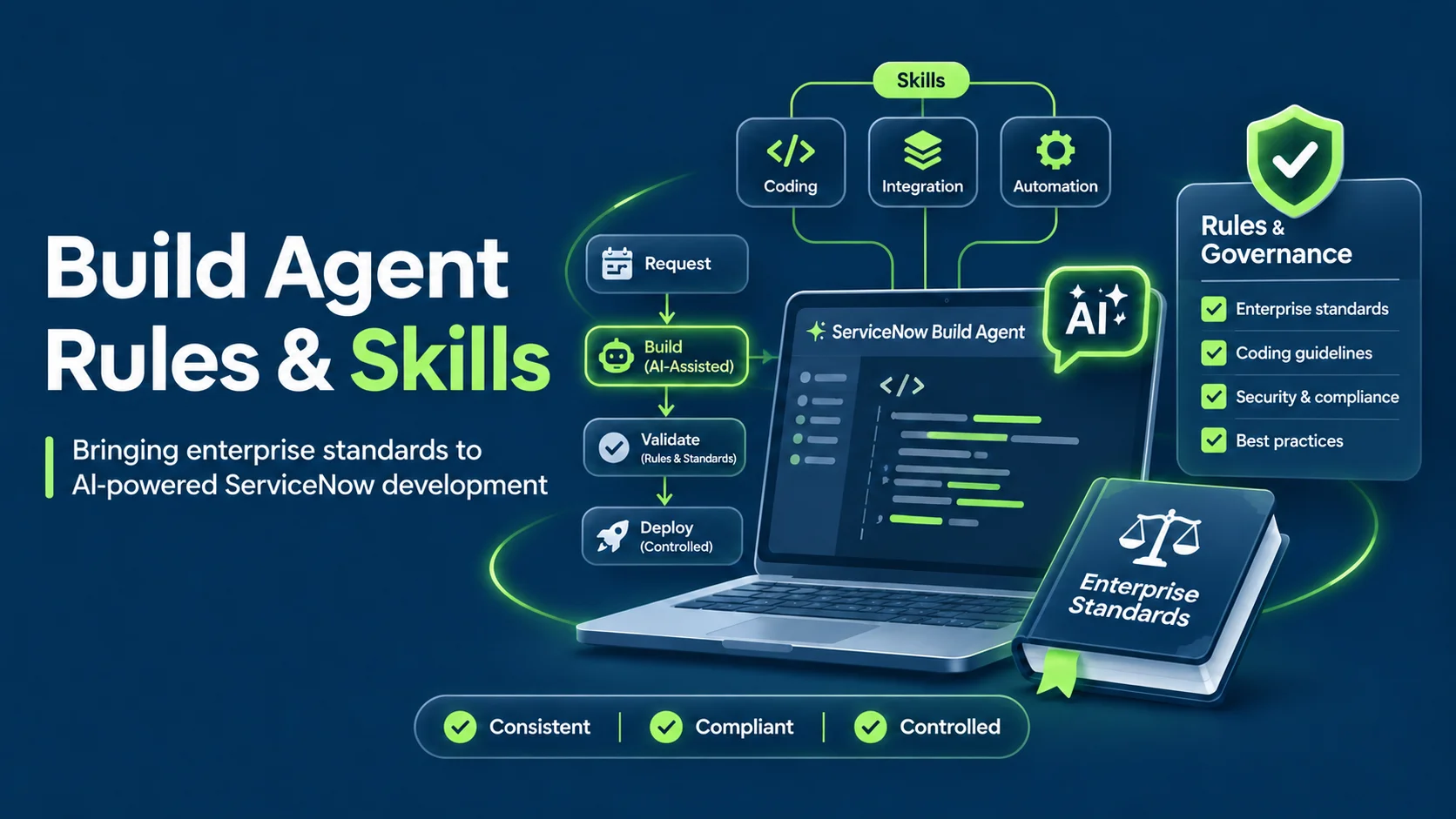
ServiceNow Build Agent Rules and Skills: Bringing Enterprise Standards to AI-Powered Development
AI can generate applications in minutes. But can it follow your company’s architecture, security policies and development standards?
ServiceNow Build Agent’s custom Rules and Skills bring consistency, control and enterprise knowledge to AI-powered development. This article covers:
- Why AI-generated code needs enterprise standards
- What Build Agent Rules and Skills are, and how they differ
- A worked example: the same request with and without them
- Five benefits and a five-step plan to get started
AI Can Write Code. But Does It Know Your Company’s Rules?
Imagine two developers working on the same ServiceNow application. Both use AI. Both describe similar requirements. Both get working code. But:
- One follows the company’s naming conventions; the other creates entirely different structures
- One includes proper access controls and automated tests; the other focuses on getting it working fast
The result: two functional solutions that introduce inconsistency, extra reviews and potentially expensive maintenance. Now scale that across dozens of developers, several projects and many AI-generated applications.
The biggest challenge with AI-powered development is no longer generating code. It is making sure every generated solution meets enterprise standards.
That is the problem ServiceNow is addressing with custom Rules and Skills in Build Agent. Instead of developers explaining company policies in every conversation, organizations provide reusable instructions that guide how the AI approaches development. AI moves from simply writing code to working within your engineering practices.
What Are ServiceNow Build Agent Rules and Skills?
ServiceNow Build Agent is an AI-powered development assistant that creates and modifies applications directly on the ServiceNow AI Platform. It works with tables, scripts, workflows, access controls, user interfaces and test artifacts through natural-language instructions.
Generating components is only part of enterprise development. Organizations also need consistency in how those components are designed, implemented, secured and maintained. Custom Rules and Skills, introduced through Build Agent enhancements in 2026 (see Build Agent Skills and Rules), let organizations tailor AI behavior at the instance, application or user level.
Build Agent Rules: the standards AI should always follow
Rules are persistent instructions automatically included in agent execution at the configured scope, so organizational standards stay part of the development context. An enterprise might require Build Agent to:
- Follow specific table and application naming conventions
- Respect existing application architecture and scope boundaries
- Prefer approved development patterns over unnecessary customization
- Treat access control changes as sensitive operations requiring review
- Follow internal coding practices and documentation requirements
- Consider testing and maintainability during implementation
Instead of repeating these in every prompt, teams define them centrally. Think of Rules as your engineering playbook, available directly to your AI development assistant.
Build Agent Skills: specialized guidance for specific tasks
While Rules set persistent expectations, Skills provide reusable, task-specific expertise. A team could define Skills for:
- Designing secure ServiceNow integrations
- Building and documenting REST APIs
- Creating maintainable Flow Designer automations
- Preparing Automated Test Framework (ATF) test scenarios
- Reviewing application architecture
- Following an internal deployment preparation checklist
Skills supply relevant guidance when the agent needs it, without every project starting from the same lengthy instructions.
Rules vs. Skills: What’s the Difference?
Rules define how the AI should behave. Skills provide guidance for how it should approach a particular job.
| Build Agent Rules | Build Agent Skills | |
|---|---|---|
| What | Persistent behavioral instructions | Reusable task-specific guidance |
| When applied | Automatically, at the configured scope | When relevant to the task |
| Purpose | Consistency across development sessions | Specialized procedures and expertise |
| Example | Follow approved naming conventions | Follow the team’s API integration checklist |
| Best for | Organization-wide engineering expectations | Repeatable technical workflows |
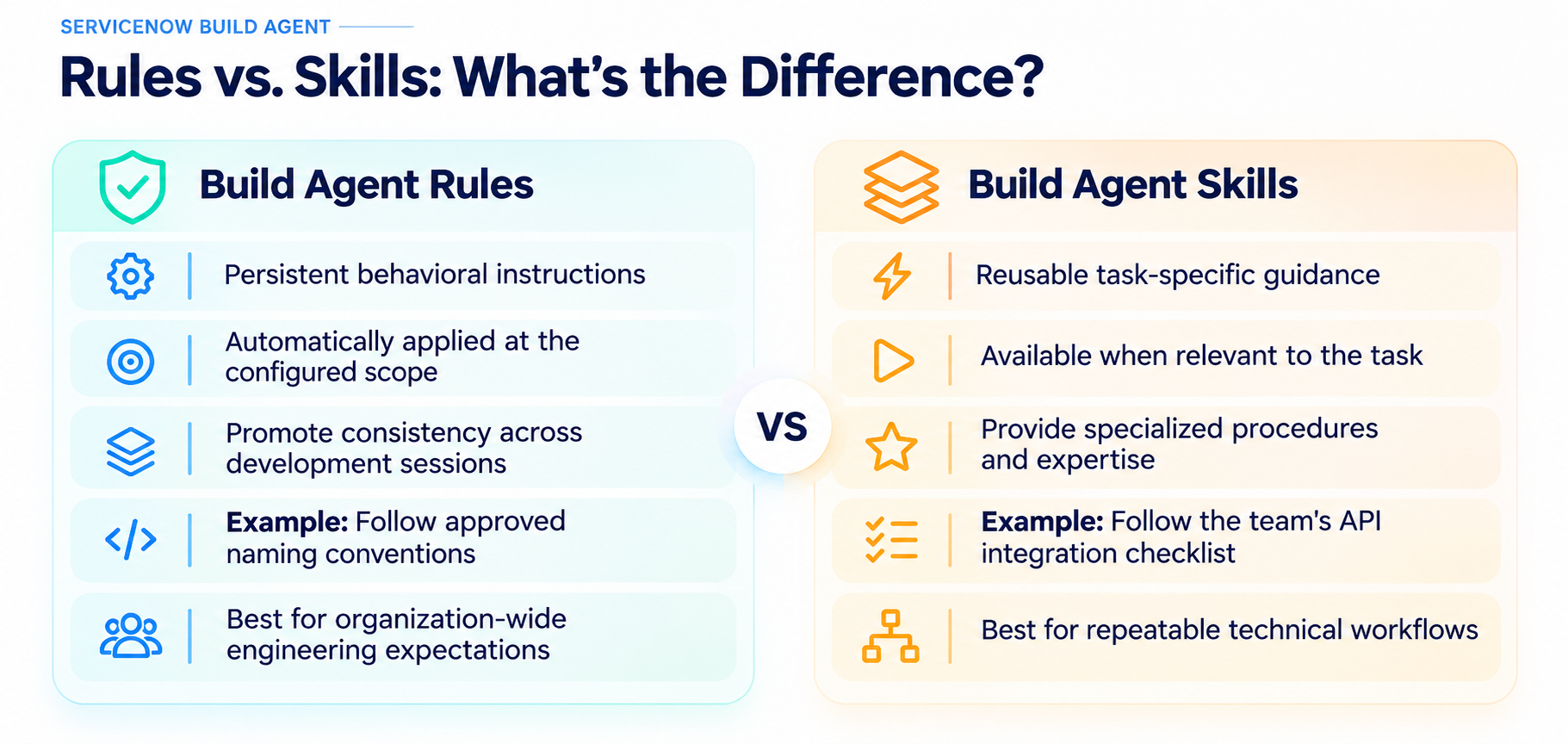
Figure 1. Build Agent Rules vs. Skills.
Together, they give AI-powered development a more predictable foundation.
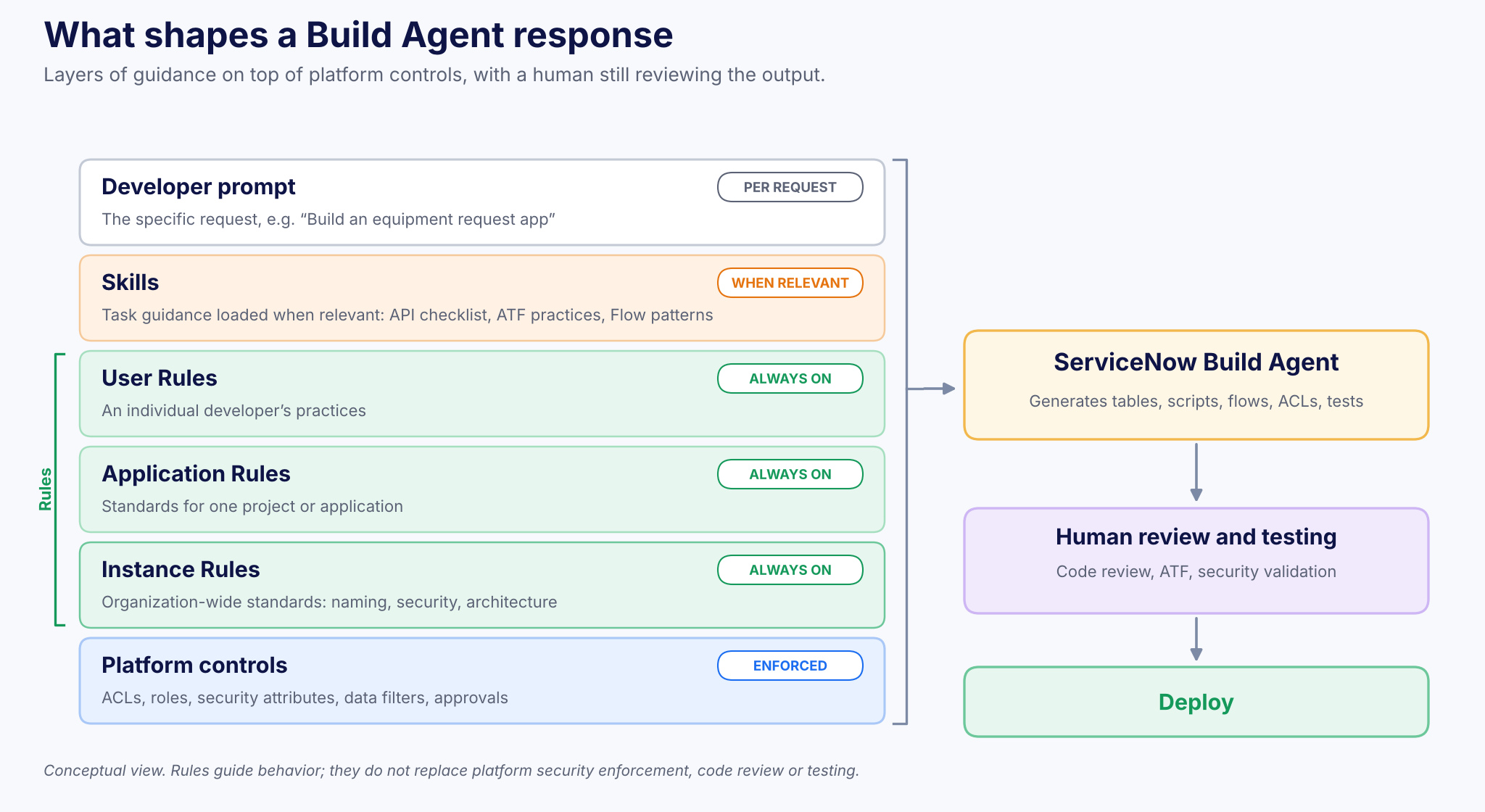
Figure 2. What shapes a Build Agent response: Rules by scope, Skills when relevant, on top of platform controls.
From One Developer’s Prompt to an Enterprise Development Standard
Example: a company needs a ServiceNow application for employee equipment requests. It must let employees request devices, route requests for manager approval, track equipment assignments and integrate with the existing asset management process. Without organizational guidance, a developer might simply ask:
“Create an employee equipment request application with approvals and asset tracking.”
Build Agent can interpret this and generate relevant components. But the prompt says nothing about:
- The organization’s existing approval patterns
- Its application naming conventions
- Its restrictions on modifying shared tables
- Its standards for automated testing
The same request, with Rules and Skills
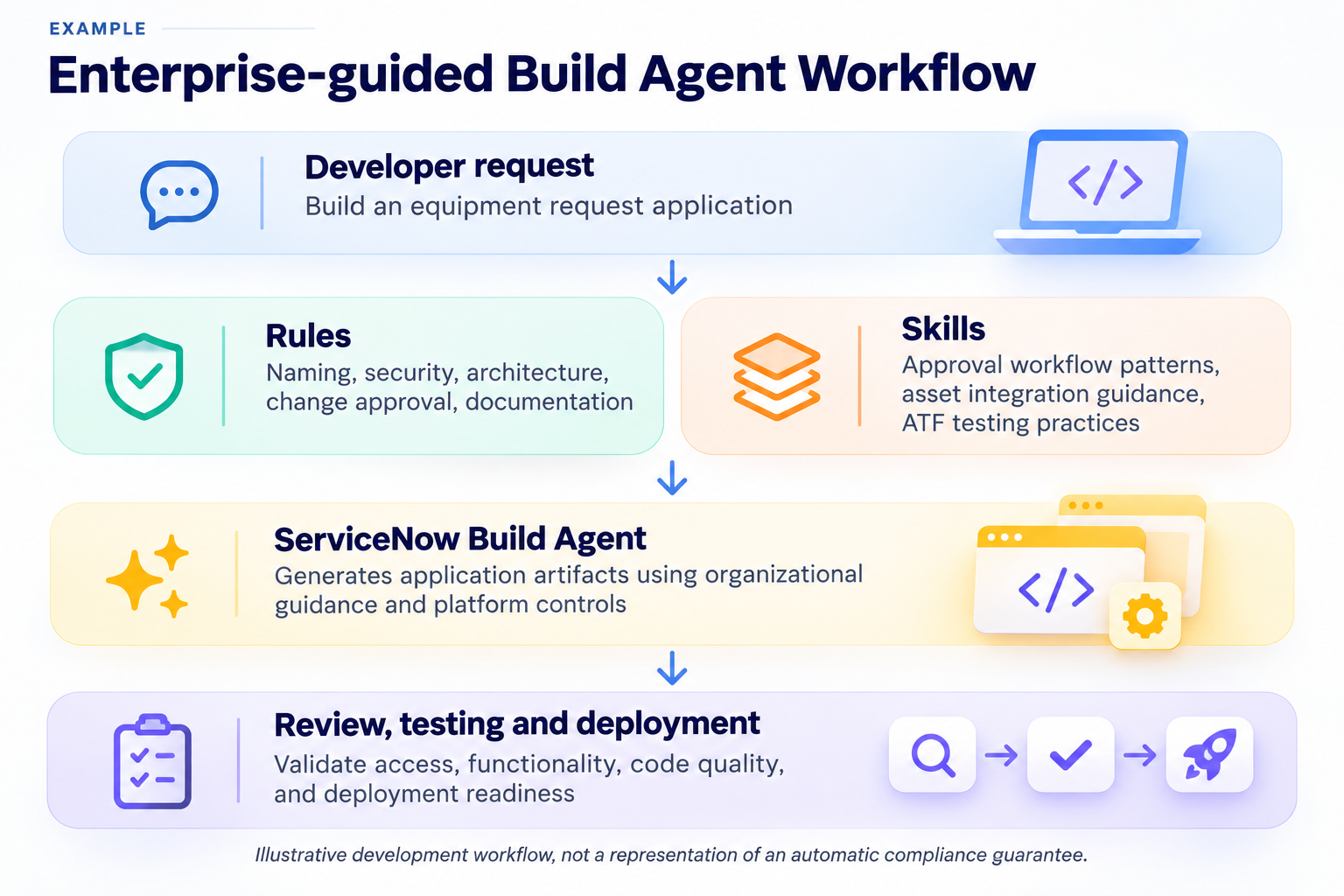
Figure 3. The same request, guided by Rules and Skills.
With the right configuration, Build Agent can be guided to reuse existing data structures, follow established naming patterns and prepare tests in line with team practices. The developer still reviews the result and confirms it meets business and technical requirements.
Instead of repeatedly correcting predictable deviations, the team focuses on the questions that matter: Is the architecture right? Is the workflow efficient? Does it solve the business problem? That is where AI-powered development starts to scale.
Five Ways Rules and Skills Improve Enterprise Development
1. Consistency across teams and projects
Enterprise ServiceNow environments rarely have one developer or one application. Teams build catalog items, workflows, integrations, business rules and custom experiences, and without shared standards, AI-generated implementations diverge quickly. Custom Rules give consistent engineering guidance across sessions and developers, which matters most for large delivery teams that need predictable implementation patterns.
2. Security becomes part of the development conversation
Security cannot be something teams remember just before deployment. Build Agent already supports platform-native controls (ACLs, roles, security attributes and data filters), and its governance framework supports security validation, controlled script execution and approval checkpoints. Custom Rules add organization-specific expectations on top, for example: avoid modifying existing ACLs without explicit review, or document potential cross-scope access requirements.
Rules do not replace security enforcement, code review or testing. They keep security expectations visible throughout development.
3. Less time repeating the same instructions
Every experienced developer has recurring expectations: use this naming format, follow this architecture, avoid unnecessary dependencies, document changes, include testing. With AI assistants they get especially repetitive. Persistent Rules cut the need to restate preferences, and Skills make specialized guidance reusable. The benefit is not just faster code generation, but less effort spent explaining, correcting and standardizing AI-generated work.
4. Organizational knowledge becomes easier to reuse
Engineering knowledge lives in documentation, code reviews and, mostly, senior developers’ heads. What happens when a new developer joins, or a team starts work in an unfamiliar part of the platform? Skills make approved practices available to AI-assisted workflows: a senior architect’s integration checklist becomes reusable task guidance. This does not replace mentorship or architectural reviews; it makes established practices easier to apply.
5. More predictable AI-assisted delivery
For enterprises and implementation partners, predictability matters as much as speed. Customers expect applications that follow agreed standards, support future enhancements and fit existing governance. Shared Rules and Skills give AI-generated changes a consistent starting point, reducing avoidable differences and improving what reaches review. Configuration alone does not guarantee the outcome; teams still need validation, testing and oversight (see ServiceNow Automated Testing with Now SDK and ATF).
How to Get Started with Build Agent Rules and Skills
- Identify your non-negotiable standards: Document requirements for naming, architecture, security, approvals, testing and documentation.
- Configure Rules at the right scope: Use instance-level guidance for shared standards, application-level for projects, and user-level for individual practices.
- Create Skills around repeatable work: Start with high-value activities such as API integrations, workflow development, testing or technical documentation.
- Test against real development scenarios: Run representative tasks in a non-production environment or Developer Sandbox, compare results and review generated artifacts.
- Refine and govern the standards: Assign ownership of Rules and Skills, update them as practices evolve, keep human approval, and validate with code review and ATF testing before release.
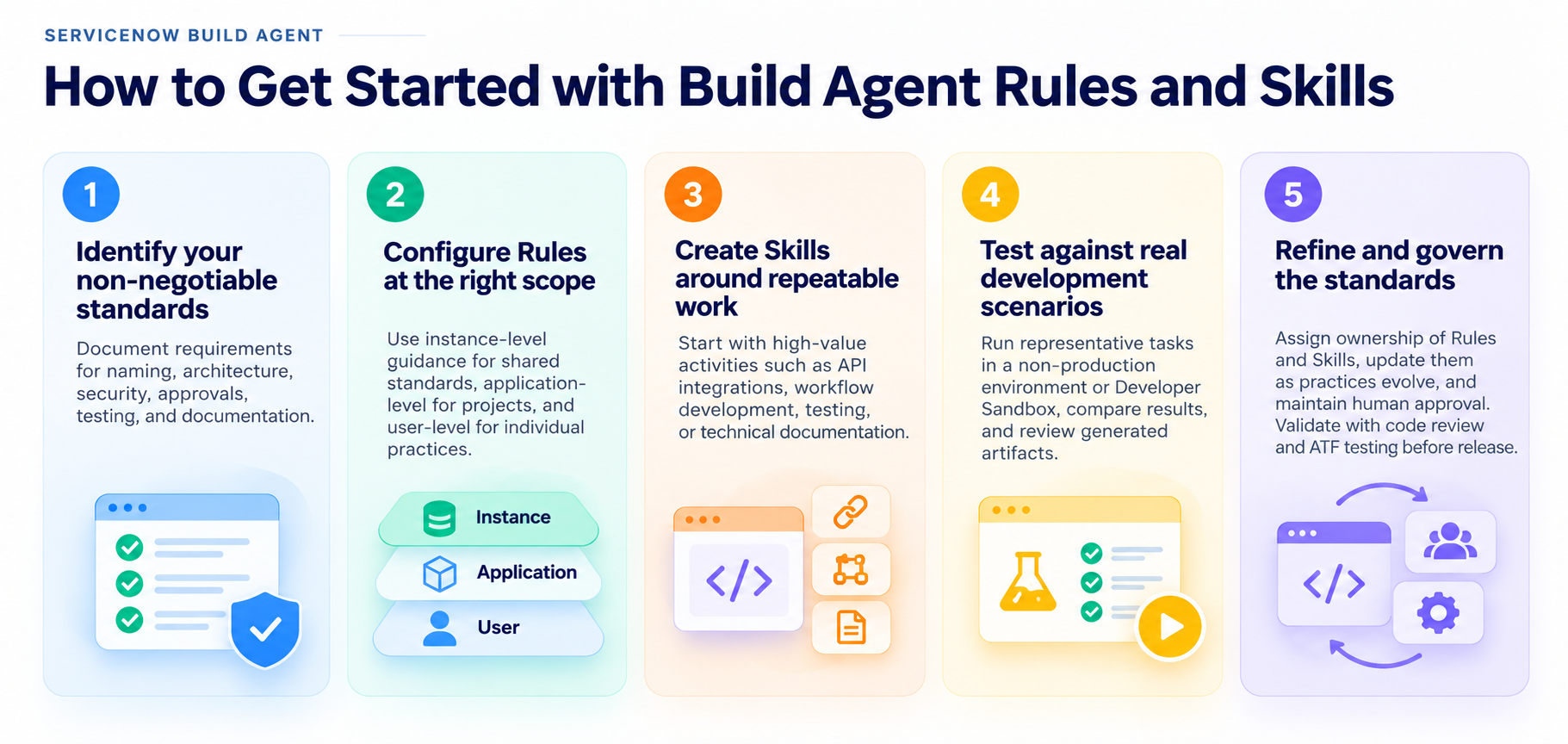
Figure 4. How to get started with Build Agent Rules and Skills.
The Bigger Picture: AI Development Needs More Than Better Prompts
Much of the conversation around AI-assisted development has focused on writing better prompts: more detail, more examples, better context. That still matters. But enterprise development cannot depend on how well one developer phrases a request:
- Standards only in prompts: consistency depends on personal discipline
- Standards as reusable AI guidance: development practices become systematic
The goal is not just giving every developer an AI coding assistant. It is an AI-assisted engineering environment where speed, consistency, security and maintainability work together. Build Agent Rules and Skills are a practical step that way.
What This Means for ServiceNow Development Teams
Adopting Build Agent is only the beginning. The next challenge is making AI-generated solutions compatible with the standards your existing applications already follow. That takes more than a library of prompts:
- Clear development practices
- Reusable technical guidance
- Governance controls (see our Enterprise AI Governance Blueprint for ServiceNow)
- Reliable validation processes, ideally in your CI/CD pipeline (see ServiceNow CI/CD with Now SDK and GitHub Actions)
The most valuable opportunity is not helping developers produce more code. It is helping teams deliver better, more consistent solutions without sacrificing the controls enterprise environments require.
Key Takeaways
- AI can generate working code; the hard part is meeting enterprise standards
- Rules: persistent instructions applied at instance, application or user scope
- Skills: reusable task guidance loaded when relevant
- Rules guide behavior; platform controls, code review and testing still enforce it
- Start with non-negotiable standards, scope Rules carefully, then build Skills
- Test in a Developer Sandbox and assign owners to keep guidance current
Frequently Asked Questions
What are ServiceNow Build Agent Rules?
Persistent instructions that Build Agent automatically applies at a configured scope (instance, application or user), such as naming conventions, architecture boundaries and security expectations.
What are ServiceNow Build Agent Skills?
Reusable, task-specific guidance that Build Agent uses when relevant, such as an API integration checklist, ATF testing practices or Flow Designer patterns.
What is the difference between Rules and Skills?
Rules define how the AI should always behave. Skills provide guidance for how it should approach a particular job.
Do Rules replace security controls or code review?
No. Rules keep standards visible during development, but platform security enforcement, code review and testing are still required.
How Teiva Systems Can Help
Adopting AI-powered development is one thing. Making it secure, consistent and scalable across enterprise teams is another. Teiva Systems helps organizations move beyond AI experimentation and turn ServiceNow’s AI development capabilities into governed engineering workflows:
- Defining enterprise development standards: clear architecture, security, coding, naming and testing guidelines that can become Build Agent Rules
- Configuring custom Rules and Skills: translating requirements and best practices into reusable AI guidance for specific applications, teams and workflows
- Accelerating AI-powered development: using Build Agent and modern tools to streamline application creation, workflow automation and integrations
- Integrating AI into CI/CD: aligning AI-assisted development with automated testing, version control, deployment pipelines and QA
- Implementing AI governance: review processes, approval checkpoints and security controls that keep AI-generated solutions aligned with requirements
- Enabling development teams: helping developers adopt AI tools while keeping consistency, maintainability and long-term quality
Whether you are exploring Build Agent for the first time or scaling AI-assisted development across teams, we help build the technical foundation for sustainable adoption.
Faster Development Is Good. Governed Development Is Better.
AI-powered development is changing how applications are built. Developers increasingly describe requirements instead of building every component, and AI assistants generate workflows, scripts, data structures and tests with far less repetitive work.
Enterprise success needs more than speed. It needs applications that stay understandable, secure, maintainable and aligned with organizational standards. Build Agent Rules and Skills bridge that gap by making development expectations reusable across AI-assisted workflows.
The future of enterprise development is not just AI that knows how to build. It is AI that knows how your organization builds.
Ready to bring enterprise standards to AI-powered ServiceNow development? Connect with Teiva Systems to discuss practical approaches to agentic development, application modernization and AI-assisted engineering.
Oleksii Konakhovych, CTO, Nov 20, 2026
Eager to take the next step? Contact us today!
Latest Articles
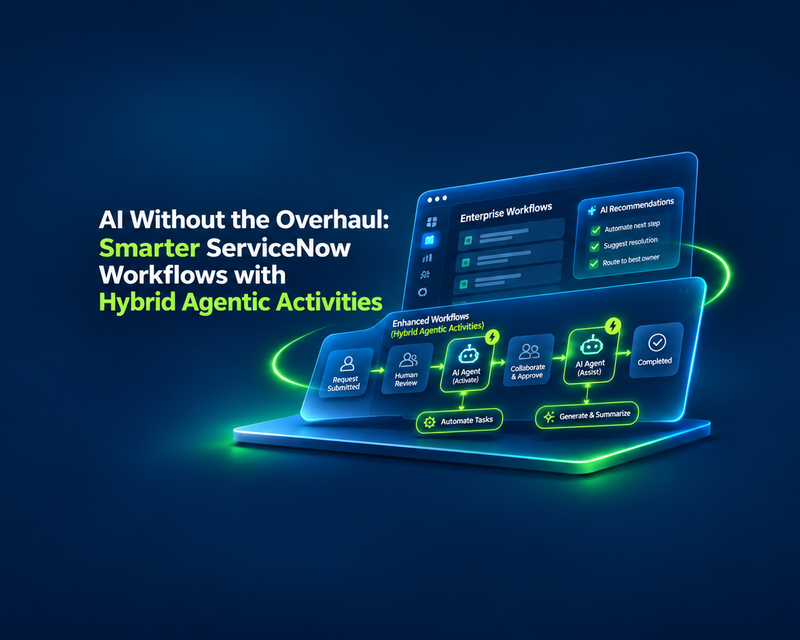
AI Without the Overhaul: Smarter ServiceNow Workflows with Hybrid Agentic Activities
What if making your ServiceNow workflows smarter didn’t require rebuilding them?For years, enterprise automation has followed a familiar formula: define the process, configure the rules, let the system run predictable steps.
read more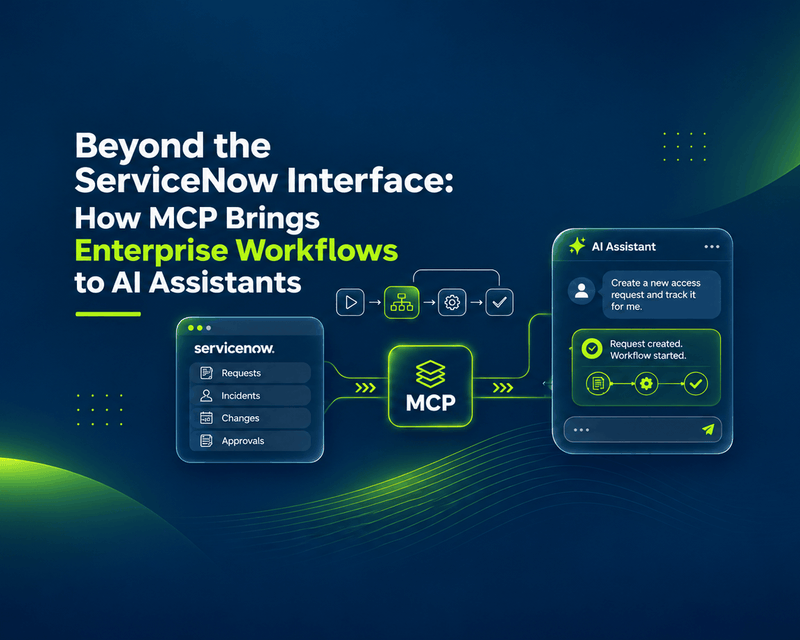
Beyond the ServiceNow Interface: How MCP Brings Enterprise Workflows to AI Assistants
What if your AI assistant could do more than answer questions about your enterprise systems? What if it could actually get work done inside them?
read more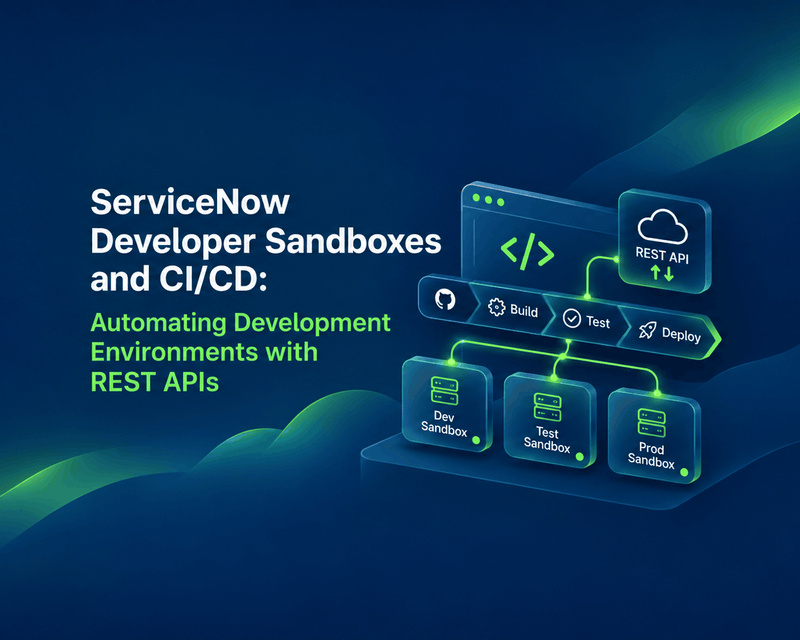
ServiceNow Developer Sandboxes and CI/CD: Automating Development Environments with REST APIs
What if every ServiceNow development task could start with its own isolated environment, connect to a CI/CD pipeline, and disappear when the work is done?
read more