
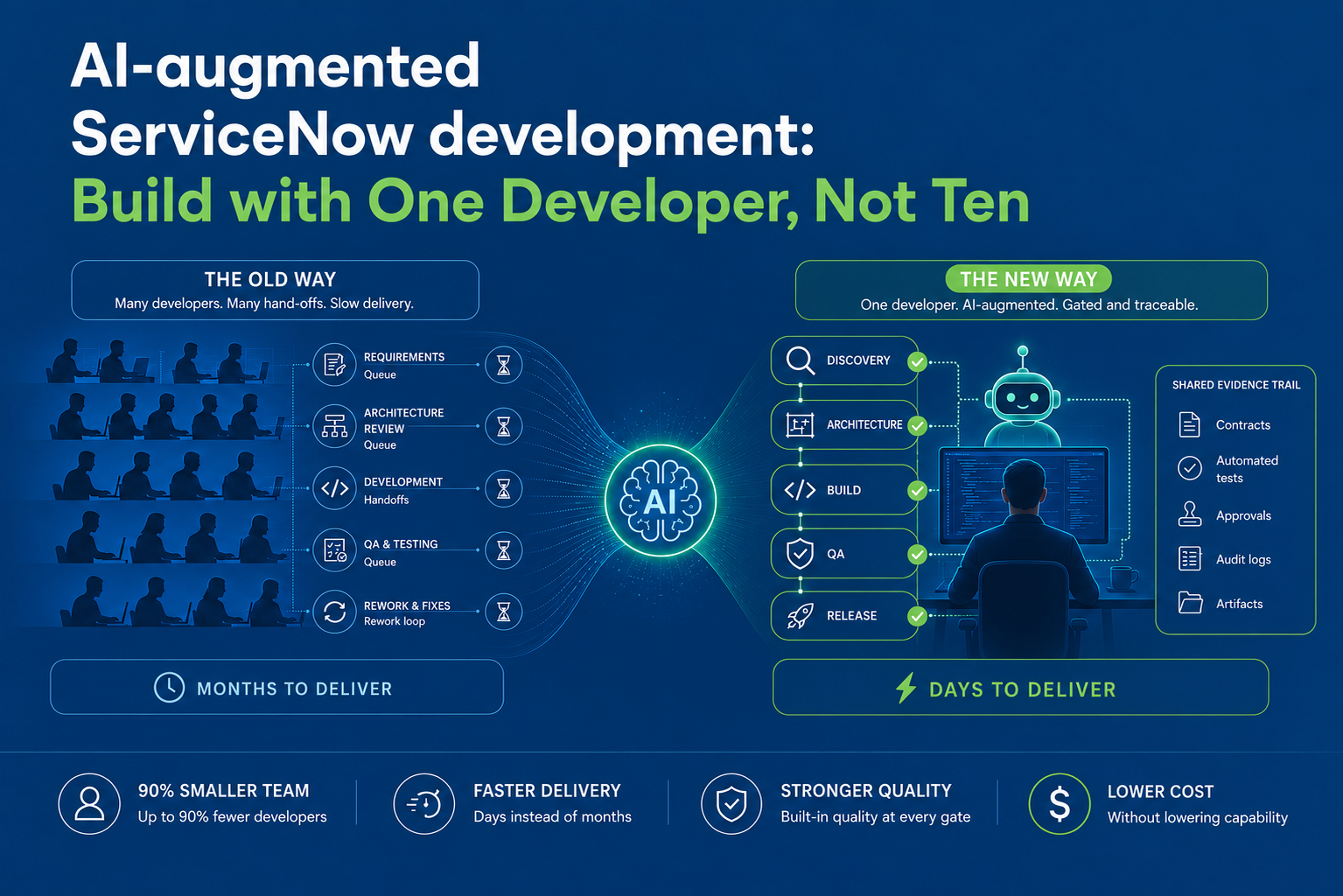
AI-augmented ServiceNow development: Build with One Developer, Not Ten
The real constraint on ServiceNow delivery was never headcount. Here is what a gated, AI-augmented process changes, and where we are honest about what it does not.
On this page
- The constraint was never headcount
- What actually changes for you
- What it looks like in practice
- A real number we can already show you
- Why this works, and why it is safe
- Where to start
- FAQ
The constraint was never headcount
Walk into most enterprise ServiceNow teams and you find them sized for a world that no longer exists. The backlog grows faster than anyone can hire against it, so the response is always the same. Add developers. Ten, twenty, fifty if the estate is large enough. The team gets bigger. The queue barely moves. Every new hire adds coordination cost on top of the work itself.
We looked at this pattern across engagements and reached a different conclusion. The bottleneck was never the number of hands on keyboards. It was the amount of unreviewed, unverified work a small group of senior people could safely stand behind. Fix that constraint, and five developers can ship what fifty used to.
That is not a claim about typing faster. It is a claim about where time actually goes. In a large team, most of the elapsed time on a build is not build time. It is queueing for architecture review, waiting on a hand-off, chasing an update set, re-explaining a requirement, and reconstructing what happened when someone asks. Cut those queues and the work that remains is small enough for a senior team to own end to end.
We wrote up the mechanism in detail in Inside an AI Delivery Team, and the governance argument underneath it in AI SDLC Governance: Why Vibe Coding on ServiceNow Needs More Than Speed. This piece is the short version for someone deciding whether it applies to their estate.
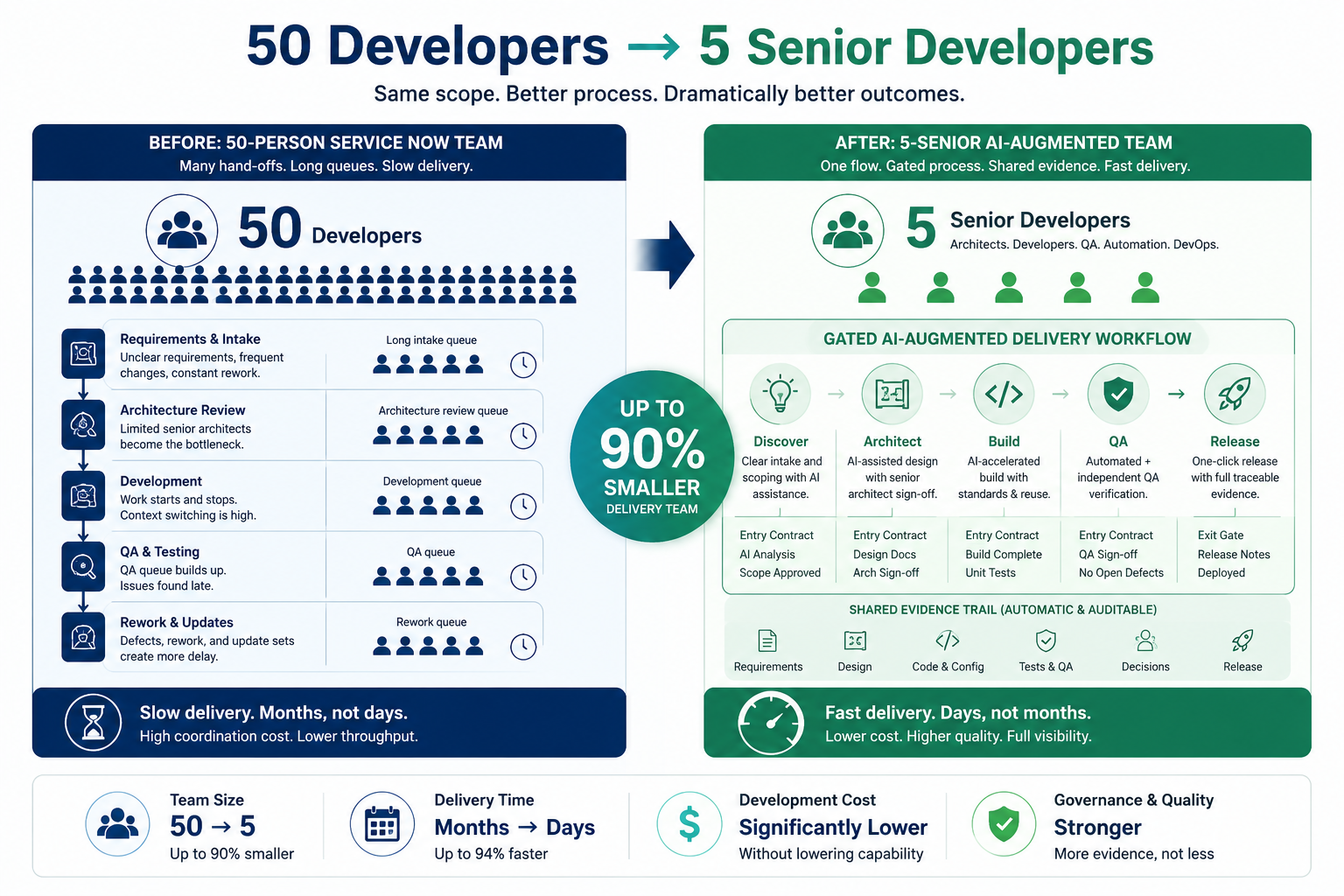
Figure 1. Before and after comparison of a ServiceNow delivery team: a fifty-person team feeding a slow queue, versus a five-person senior team running a gated, AI-augmented loop with a shared evidence trail.
What actually changes for you
Four things move, and none of them require cutting scope.
Your ServiceNow development team shrinks, by up to ninety percent on a large estate, because the layers of hand-off, rework, and status-chasing that a big team exists to absorb are removed rather than staffed.
New workflows and apps ship in days, not months, because design, build, and QA run as one tight gated loop instead of a sequence of separate queues.
Your senior people get their time back for decisions that need judgment. Architects and platform leads stop writing boilerplate flows and chasing update sets, and spend their time on scope, architecture, and integration strategy.
Development cost falls without capability falling with it. The platform still gets governance, testing, and documentation. Arguably more of it, because the process produces evidence as it runs rather than as an afterthought.
If you want the underlying cost model, our ROI framework for ServiceNow AI agents breaks down where the payback comes from and how to prove it before the next budget review.
What it looks like in practice
Here is an illustrative scenario, and we want to be clear that it is illustrative. It is a composite built from patterns we see, not a single named client.
A global enterprise ran a fifty-person ServiceNow development team just to keep pace with demand from the business. The backlog still slipped. A typical build still took months once you counted requirements, queueing for architecture review, build, and UAT.
Rebuilding the delivery model around a structured, AI-augmented process brought that team to five developers, and cut delivery time for a typical build from roughly six months to around eleven days. That is close to a ninety-four percent reduction in elapsed time. Governance did not get thinner to make that possible. It got tighter, because every phase transition now produces a logged, checkable record instead of a status update in a meeting.
Those figures are the order of magnitude we see when a bloated team is replaced by a small senior team running a gated process. They are not a client’s published results. Where we have a real, attributable case with numbers on the record, we replace the composite with it. That distinction matters to us, so we keep it visible rather than blurring it.
A real number we can already show you
We do have one build we can put real numbers against. It is a full-stack, multi-agent delivery system, including its infrastructure and its identity and access layer, built with the same gated, AI-augmented process we sell.
- 116 story points shipped across four sprints in seven calendar days, from 2026-07-17 to 2026-07-24, run by five AI agents covering build, QA, UX, architecture, and orchestration, plus one human architect. Five for the whole delivery stream, not five per feature.
- Sprint velocity of 100 percent on three of four sprints, at 27 of 27, then 29 of 29, then 29 of 29. The fourth landed at 89.7 percent, with the gap logged and carried, not hidden.
- One sprint of four stories and 29 points, planned as a seven-day sprint, closed in 8 hours and 12 minutes, start to QA sign-off, because nothing sat in a queue waiting for a hand-off.
- Zero defects escaped to done. Four bugs were found across 116 points, every one caught by independent QA re-verification rather than by trusting the build report, and fixed the same day. One of them had already passed a prior QA pass, and was caught only because a later story forced a live re-check.
- 88.9 percent first-pass acceptance-criteria pass rate, measured rather than estimated. The rest were fixed in the same sprint, not deferred.
- Real measured latencies, not targets: activity feed at 1.13 seconds against a sub-three-second bar, event propagation at 51 milliseconds, and a WebSocket round-trip at 237 milliseconds.
Every one of those numbers comes from a timestamped, gated record. Sprint rows, QA gate entries, activity logs. Not a retrospective summary written after the fact.
Now the honest limitation, because it is the point. That build is a web application, not a ServiceNow instance. The platform differs. The delivery process and its evidence trail do not. We show you this one because it is ours to show, in full, today. The ServiceNow figures above are still illustrative until a named client lets us publish theirs.
Why this works, and why it is safe
Speed here comes from removing wasted time, not from skipping steps. That difference is the whole safety case.
Governance is built into every build, not bolted on afterward. Each phase, discovery, architecture, development, QA, has a defined entry and exit contract, and nothing moves to the next phase without passing it. Full QA, security, and compliance review happens on every release, not only the ones someone remembers to schedule. Automated test coverage runs through the platform’s own Automated Test Framework, so verification happens on ServiceNow, not around it.
This is a senior team directing the work, not a black box. A small number of accountable people own every decision point, scope, architecture, sign-off. The AI does drafting, building, and checking. Humans decide. Every decision is logged with who made it and why, so nothing is a mystery when an auditor or a future maintainer asks. The identity and access side of that, giving each agent a name, an owner, a defined scope, and a full evidence trail, is covered in Securing Enterprise AI Agents and reflected in how we run AI security on ServiceNow.
This also lines up with where regulation is heading. Under the EU AI Act, systems that matter are expected to keep records you can inspect after the fact. A delivery process that logs every gate decision produces that kind of evidence by construction, rather than reconstructing it in a scramble when an audit arrives. We treat that as a design principle, not a compliance checkbox.
One more point that decides most real engagements. This is proven on complex, highly customized ServiceNow instances, not clean single-scope demo apps. The kind of estate where undocumented customizations and platform-specific sharp edges are the norm. Customization is exactly where teams get burned by copy-pasted, unreviewed AI output, and the gate exists to catch conflicts with existing customizations before they reach production. If you are weighing where an AI build agent helps and where a human still wins, Build Agent vs. Traditional ServiceNow Development draws that line honestly.
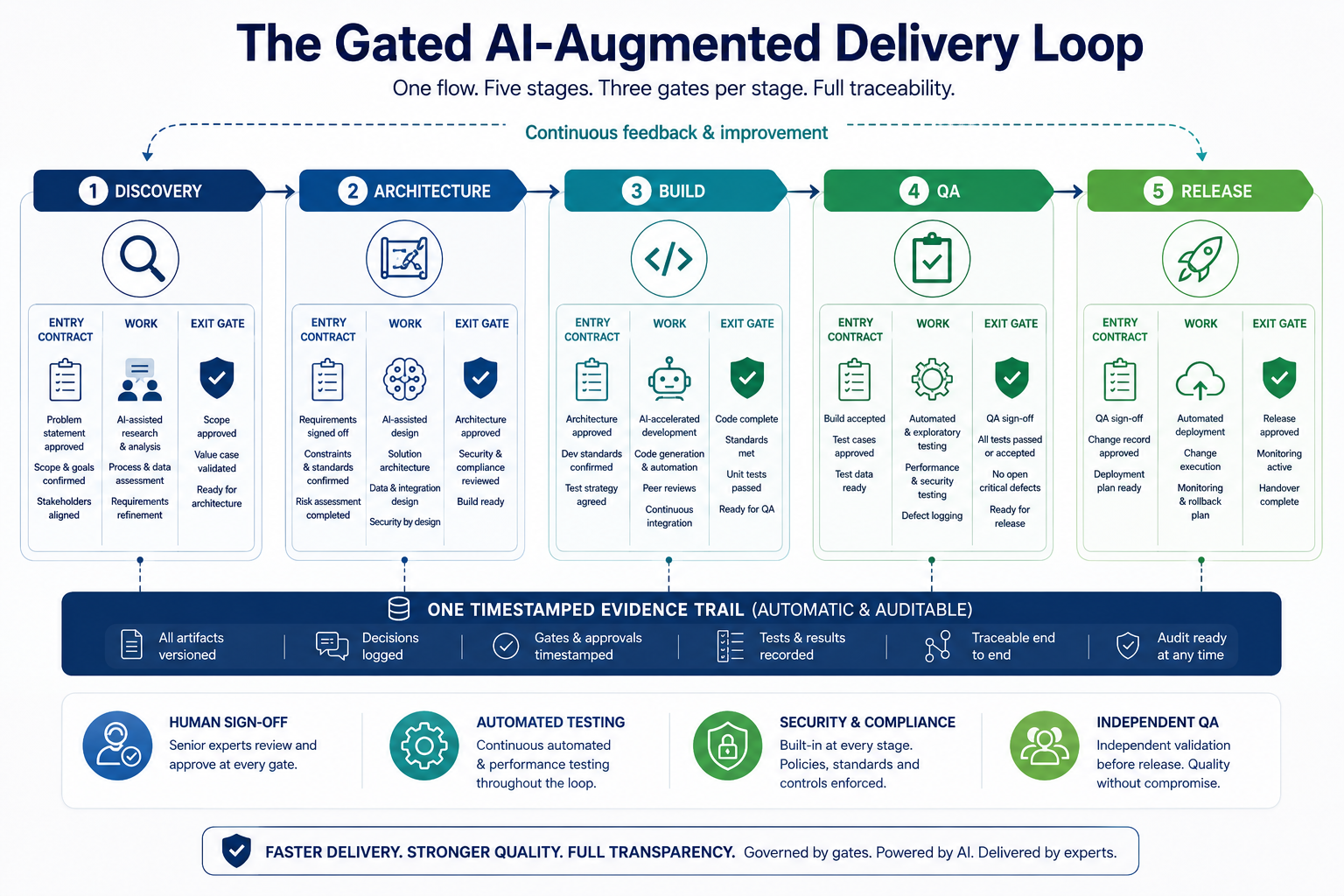
Figure 2. Gated AI-augmented delivery loop showing discovery, architecture, build, and QA phases, each with an entry and exit contract feeding one timestamped evidence record.
Where to start
If your ServiceNow backlog is being managed by adding developers, there is a smaller, faster, better-governed way to run it. You do not have to take that on faith.
Bring us one real item from your backlog. We will show you exactly how it moves through a governed, AI-augmented delivery model, from scope to deployed, tested, and evidenced. You keep the evidence trail either way.
You can see how the wider model fits your estate on our AI for Business and ServiceNow Implementations pages, or start with one backlog item directly.
So here is the question worth sitting with. If a five-person senior team can already stand behind more shipped, tested, evidenced work than a fifty-person team can, what is the rest of the headcount actually buying you?
FAQ
Can a small team really replace a large ServiceNow development team? Yes, on most estates. The reduction, up to ninety percent on a large team, comes from removing hand-offs, rework, and status-chasing rather than cutting scope. A small senior team owns scope, architecture, and sign-off, while AI agents handle drafting, building, and checking under enforced gates.
Will this work with our highly customized ServiceNow instance? Yes, and that is the case it is built for. Customization is where unreviewed AI output causes damage, so the gated process exists specifically to catch conflicts with existing customizations before they reach production. It is proven on complex, heavily customized instances, not just clean demo apps.
What happens to our existing ServiceNow developers? Nothing about this requires layoffs to work. Most engagements redeploy existing developers into higher-value roles such as architecture, platform strategy, and complex integrations. The team gets smaller over time through attrition and reduced hiring, not through a single cut. How you handle that transition is a conversation we have with you directly.
How do you maintain security and compliance at this speed? Speed comes from removing wasted time, not from skipping steps. Every build still passes security and compliance review, at each gate as the work moves, backed by a permanent, timestamped evidence record. That means the audit trail already exists when an audit asks for it, instead of being reconstructed afterward.
How do we start? Bring us one real backlog item. We run it through the governed, AI-augmented model from scope to deployed, tested, and evidenced, so you can judge the process on your own work before committing to more.
Kostya Bazanov, Managing Director, Jul 31, 2026
Eager to take the next step? Contact us today!
Latest Articles
ServiceNow AI Readiness Assessment: 25 Questions to Answer Before Deploying AI Agents
Your AI agent is only as reliable as the environment it operates in. This assessment covers 25 essential questions across five areas to help IT leaders, architects, and platform owners prepare for production.
read more
ServiceNow AI ROI: What Should You Measure After the Pilot?
ServiceNow AI ROI: What Should You Measure After the Pilot? Your AI pilot worked. That proves the technology can work. It does not yet prove ROI. Here are the six metrics that separate “the demo impressed leadership” from “we can prove measurable business value.” Your ServiceNow AI pilot worked. Now what? The chatbot responded correctly. […]
read more
Teiva Systems at ServiceNow World Forum 2026 — New York
Teiva Systems was excited to join the ServiceNow World Forum 2026 in New York, where AI, Agentic AI, and the future of enterprise technology took center stage.
read more