
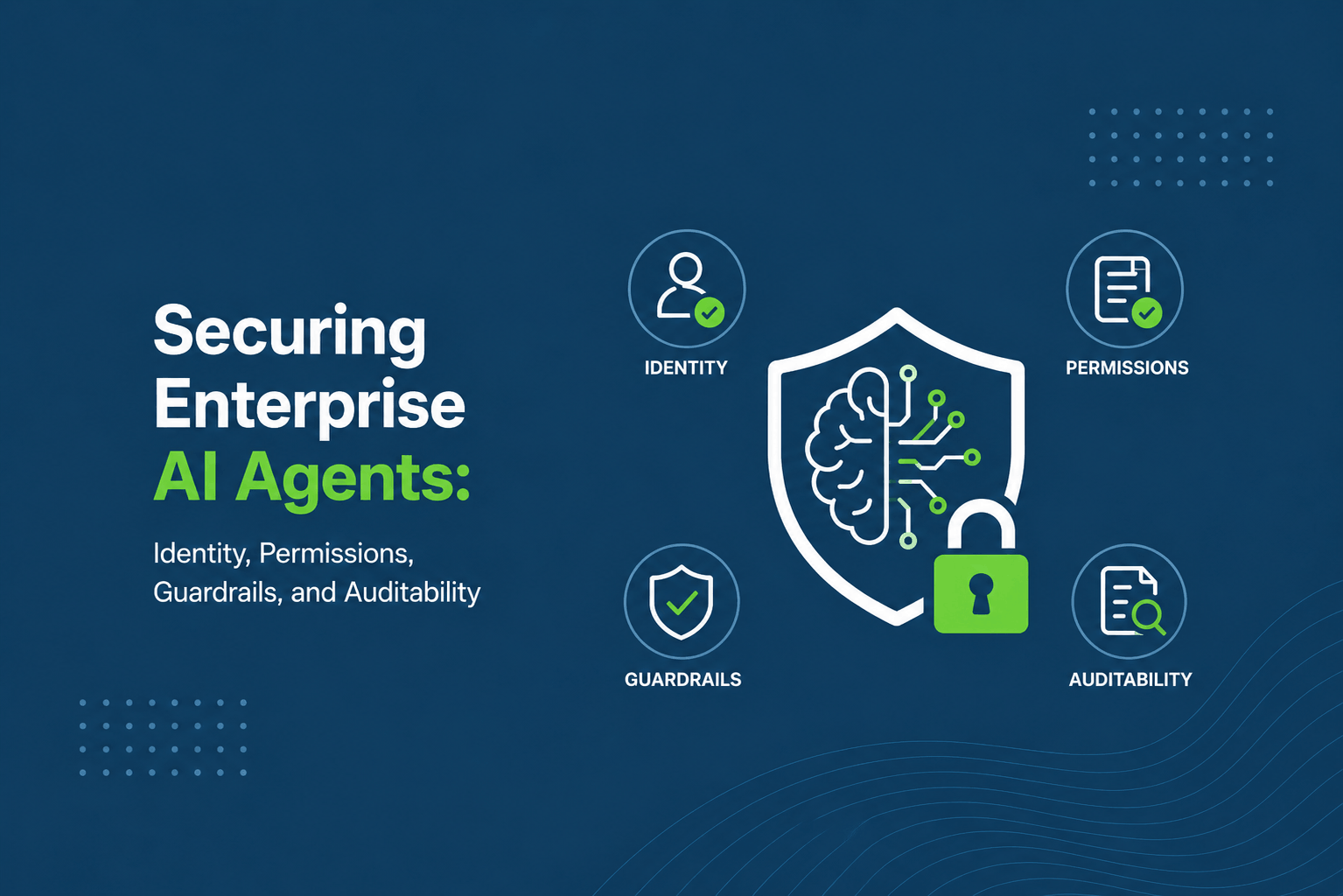
Securing Enterprise AI Agents: Identity, Permissions, Guardrails, and Auditability
An AI agent that can act is an operational identity inside your enterprise. It needs a name, an owner, a defined scope, and a full evidence trail — not just a prompt that asks it nicely to behave. Here is the four-pillar security framework, and exactly how ServiceNow implements each pillar.
“If an AI agent can act, it must have a clear identity, a defined scope, and a full evidence trail.”
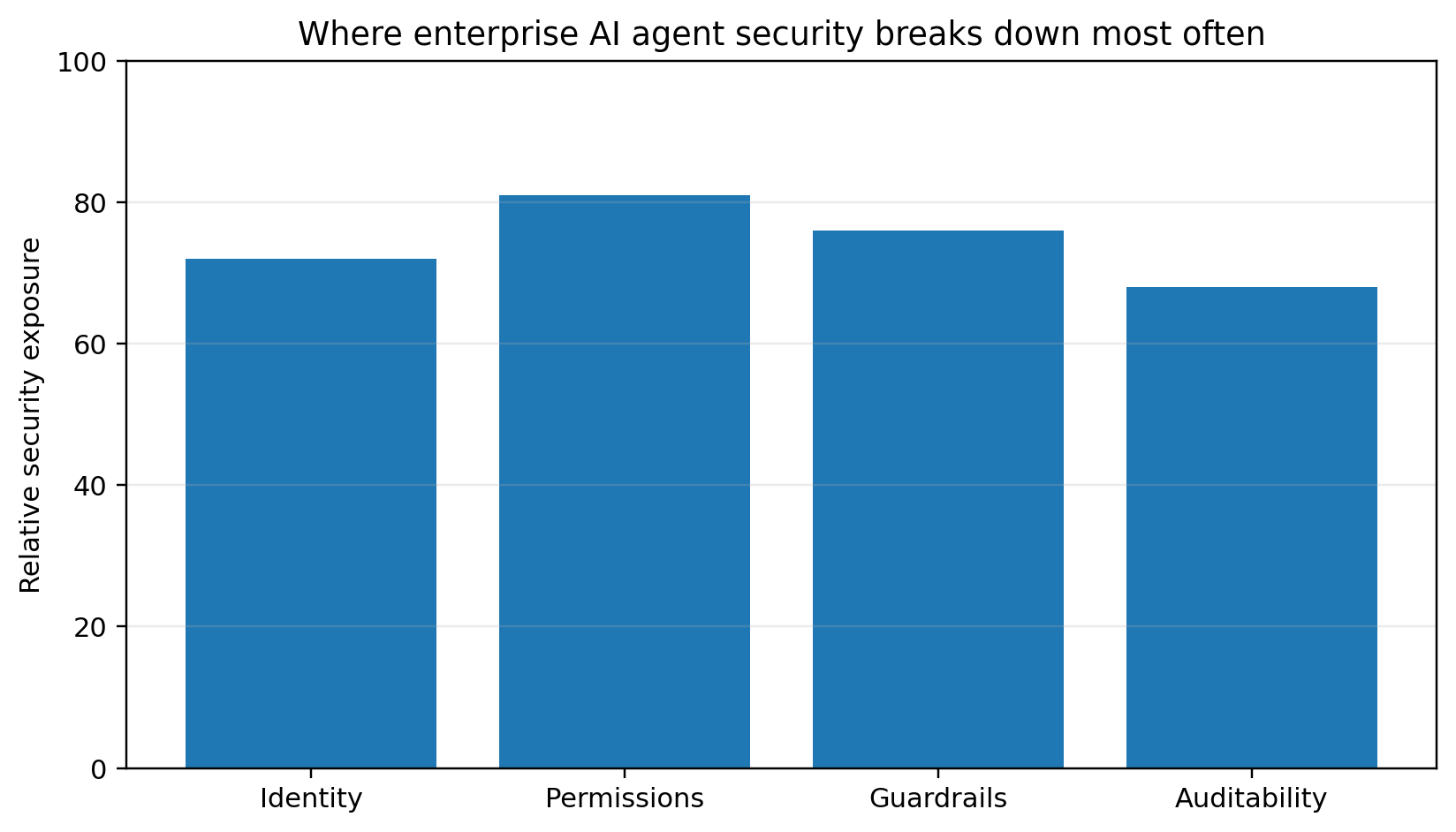
(Identity, permissions, guardrails, and auditability create the core security surface for enterprise AI agents.)
Artificial intelligence is moving deeper into enterprise operations, and the security conversation is changing with it. Early AI rollouts mostly focused on copilots that summarised content, drafted responses, or searched internal knowledge. Today, enterprises are moving toward AI agents that can take action: classify incidents, update records, trigger approvals, call APIs, orchestrate workflows, and interact with multiple systems in sequence.
That shift changes the risk profile completely. A weak summary from a copilot might waste time. A weak agent can create a ticket in the wrong queue, expose sensitive information, trigger a workflow it should never have touched, or act with privileges that nobody realised it had. The enterprise security challenge is no longer just model safety. It is agent security.
The most important mindset shift is simple: an AI agent should not be treated like a smart feature. It should be treated like a new operational identity inside the enterprise.
Why AI Agent Security Is Different from Classic Application Security
Traditional enterprise software usually follows predictable paths. A user signs in, clicks through a controlled workflow, and actions are logged against that user account or service. AI agents introduce a different pattern. They interpret natural language, choose tools dynamically, combine context from multiple sources, and may execute actions across systems without a human clicking every step.
That creates four hard security questions:
→ Who is the agent acting as? — identity
→ What is it allowed to access or do? — permissions
→ What guardrails stop unsafe or out-of-policy actions? — guardrails
→ How do you prove what happened after the fact? — auditability
These questions sound familiar because they mirror identity, access, control, and audit concerns in every mature enterprise security programme. The difference is that agentic systems make those concerns continuous and dynamic.
The most common gap is not model safety — it is identity. Agents deployed against a shared service account with broad table access, no named owner, and no audit trail are the norm in early deployments, not the exception. When we run a security review, establishing individual agent identity and scoping permissions is almost always the first remediation task.
Identity, permissions, guardrails, and auditability: the four-pillar security surface for enterprise AI agents:
| Pillar | Security question it answers | Risk if missing | ServiceNow mechanism | Priority |
| 1. Identity | Who is the agent acting as? | Generic service accounts lose all accountability. Agent actions cannot be attributed. | Action Fabric: OAuth-authenticated identity per agent. AI Control Tower: named owner per registered agent. | Non-negotiable |
| 2. Permissions | What is it allowed to access? | Over-privileged agents become lateral movement paths. Least privilege is rarely enforced at first. | AI Control Tower — Secure: Veza’s 30B-permission access graph. Role-based tool packages per agent. | Non-negotiable |
| 3. Guardrails | What stops unsafe actions? | Model-level guardrails are probabilistic. Prompt injection can override them. Policy must sit outside the model. | AI Control Tower — Observe: real-time anomaly detection, kill switch, prompt injection defense. Tool allowlists. | Critical |
| 4. Auditability | How do you prove what happened? | Without a full execution chain log, you cannot investigate incidents, pass compliance reviews, or prove controls worked. | AI Control Tower: session ID, agent identity, action type, records touched, outcome, approval status — full log. | Critical |
1. Identity: Every Agent Needs a First-Class Enterprise Identity
The first mistake many organisations make is deploying agents as extensions of a broad technical account or a shared integration user. That is convenient for a proof of concept, but dangerous in production. If an agent uses a generic service account with wide privileges, the enterprise loses accountability immediately.
A more secure model is to treat every production AI agent as a first-class enterprise identity. That means each agent has its own owner, scope, lifecycle, and approval record. Credentials and secrets should be managed centrally, not embedded in prompts or scripts. If an agent can read knowledge, create requests, trigger approvals, or update records, its identity is no longer an implementation detail. It becomes a security boundary.
Practical rule: if an agent can act, it needs a name, an owner, a scope, and a lifecycle.
Action Fabric authenticates every external agent connection via managed OAuth through the MCP Server Console — meaning there are no anonymous agent actions. Every connection carries an identity that AI Control Tower can verify and log. Registering the agent in AI Control Tower with a named business owner and named platform owner creates the accountability chain that security and compliance teams require before approving production deployment.
2. Permissions: Least Privilege Must Apply to AI Agents Too
Identity alone is not enough. The second security layer is permissions. AI agents often fail secure design reviews for the same reason service accounts do: they are given more access than they need because tight scoping feels slower during implementation.
The safest model is to apply least privilege aggressively: restrict the agent to the exact systems, tables, APIs, and workflows it needs; separate read, write, approve, and admin actions; limit access by business domain or data sensitivity; and re-check permissions at tool-call time rather than assuming a broad one-time entitlement is always valid.
A useful design principle: the agent should never become a shortcut around enterprise access controls. It should inherit and respect them.
AI Control Tower’s Secure dimension is powered by Veza’s 30-billion-permission access graph — providing visibility into what every agent identity can actually access across ServiceNow and connected systems. Role-based tool packages define exactly which tools, tables, and workflows each agent can invoke. This is not a policy document. It is enforced at the moment of each tool call.
3. Guardrails: Keep Intelligence Separate from Control
Prompt-level guardrails are helpful, but they are not enough. Security cannot rely on asking the model nicely not to do the wrong thing. The control layer needs to sit outside the model.
A stronger enterprise pattern is to separate intelligence from execution: the model reasons and proposes actions, while a policy and orchestration layer validates whether those actions are allowed. Tools are called only through approved interfaces, and risky actions can be blocked, routed for human approval, or rewritten into safer alternatives.
In practice, strong guardrails include tool allowlists, schema-validated actions, policy checks, human approval gates, rate limits, spend controls, and prompt injection defences
Why prompt injection is the most underestimated threat — and what the Knowledge 2026 demo proved:
At the ServiceNow Knowledge 2026 keynote, AI Control Tower’s live kill switch demo caught a prompt injection attack in real time as an attacker manipulated an AI agent into attempting to override pricing rules and suppress its own audit logs. This was not a theoretical scenario. Instead, the demonstration showed exactly what model-level guardrails alone cannot prevent. Because the policy enforcement layer operated outside the model, it detected the attack and stopped the agent before it could execute the malicious action. Without that external control layer, the agent would have carried out the request. Ultimately, this demonstration illustrates why organisations must build guardrails into the architecture rather than relying solely on instructions within the model.
4. Auditability: Every Meaningful Action Must Leave Evidence
Security teams must do more than prevent bad outcomes. They also need to reconstruct every step of an incident when something goes wrong. Therefore, auditability plays a critical role in enterprise AI security.
However, logging only the final action is not enough for enterprise AI agents. Instead, organisations need visibility into the entire execution chain, including who invoked the agent, which identity it used, what prompt or context it received, which documents or records it retrieved, which tools or APIs it called, whether a human approved the action, and what final action it performed.
This evidence trail supports security investigations, compliance reviews, incident response, and operational debugging. Moreover, it gives executives, auditors, and security teams the information they need to answer three critical questions after an AI-related incident: What did the agent do? Why did it do it? Which controls governed its actions at the time?
Where control visibility breaks down across the agent execution chain — and what AI Control Tower captures at each stage:
| Execution stage | What happens | What to log | Visibility without AI Control Tower |
| User request | Employee submits a request or trigger | Who, when, which channel | Full |
| Agent reasoning | Agent interprets intent, plans tool use | Prompt, context, model version | Partial |
| Retrieval | Agent reads records, KB, CMDB, APIs | What data accessed, which source | Partial |
| Tool call | Agent calls an API, triggers a flow | Tool name, parameters, timestamp | Full (with Action Fabric) |
| Human approval | Approval gate (if configured) | Approver identity, decision, time | Full |
| Final action | Record created, workflow triggered, access granted | Action, records changed, outcome | Full |
| Post-action anomaly | Policy exception, unexpected scope expansion | Exception type, rule violated | Gaps without Observe mode |
The audit gap that surprises most CISOs:
Most organisations log the final action, such as the record created or the workflow triggered. However, very few capture the retrieval step, including the data the agent accessed during reasoning, the knowledge articles it read, or the CMDB records it queried. As a result, security teams often lose the most valuable evidence during a post-incident investigation or compliance review. Without retrieval logs, they can prove what the agent did but not why it did it. Fortunately, AI Control Tower’s Secure and Observe capabilities capture this information natively, giving organisations the complete execution trail they need for security, compliance, and forensic investigations.
A Practical Security Model for Enterprise AI Agents
For most enterprises, securing AI agents does not require inventing a brand-new security discipline. It requires extending familiar security principles to a new kind of actor.
The practical model is straightforward — and every step maps directly to a ServiceNow capability available today:
| Step | What it means | How it works in ServiceNow |
| 1. Dedicated identity | Assign every production agent a dedicated identity and named owner | Register in AI Control Tower. Configure OAuth per agent via Action Fabric MCP Server. No shared service accounts. |
| 2. Narrow permissions | Scope permissions narrowly; review regularly; check at tool-call time | AI Control Tower — Secure: role-based tool packages. Veza access graph enforces least privilege per agent identity. |
| 3. External policy | Enforce policy outside the model through orchestration and approval layers | Tool allowlists in ServiceNow workflows. Human approval gates via Intelligent Approvals. Kill switch via AI Control Tower Observe. |
| 4. End-to-end audit | Capture full execution chain: prompt, retrieval, tool use, approval, action | AI Control Tower session log: identity, action type, records, outcome, approval status. Audit-ready export. |
| 5. Continuous review | Review agent behaviour, exceptions, and access patterns in production | AI Control Tower — Observe + Measure dashboards. Schedule quarterly re-certification for Tier 3–4 agents. |
The organisations that scale agentic AI successfully will not be the ones that simply add more guardrails to prompts. They will be the ones that treat AI agents as operational identities inside the enterprise security model, with the same rigour applied to privileged access, workflow control, and auditability.
Final Thought
As AI agents become an integral part of enterprise operations, they must also become an integral part of enterprise security. Consequently, organizations should establish identity, permissions, guardrails, and auditability from the very beginning rather than treating them as post-deployment additions. Together, these four pillars determine whether an AI agent delivers trusted automation or introduces new operational and security risks. Ultimately, organizations that embed these controls into every AI deployment will scale AI more securely, confidently, and responsibly.
As enterprises move from copilots to action-taking agents, the security question becomes much sharper: not just ‘Can the agent do this?’ but ‘Under whose authority, under what controls, and with what evidence?’
“The real risk is not that an agent is intelligent. It is that it may act with the wrong identity, the wrong permissions, or no meaningful oversight.”
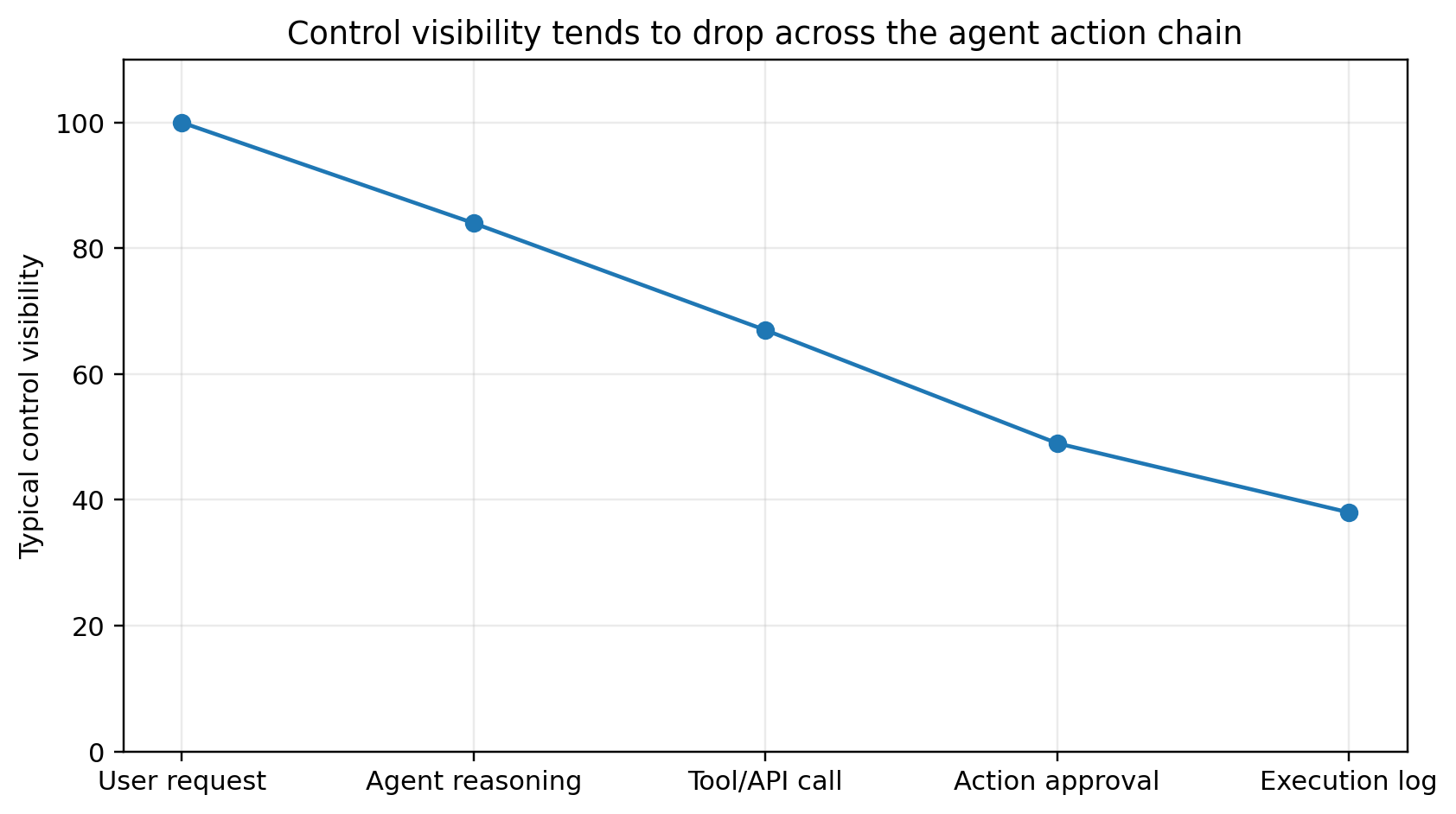
(Control visibility often weakens as agents move from user request to reasoning, tool usage, approval, and final execution.)
Slava Trotsenko, CEO, Jul 02, 2026
Eager to take the next step? Contact us today!
Latest Articles
Teiva Systems at ServiceNow World Forum 2026 — London
On October 20, 2026, Teiva Systems attended ServiceNow World Forum London at ExCeL London, where industry leaders, technology experts, and the ServiceNow community came together to explore how AI, intelligent automation, and digital workflows are transforming enterprise operations.
read more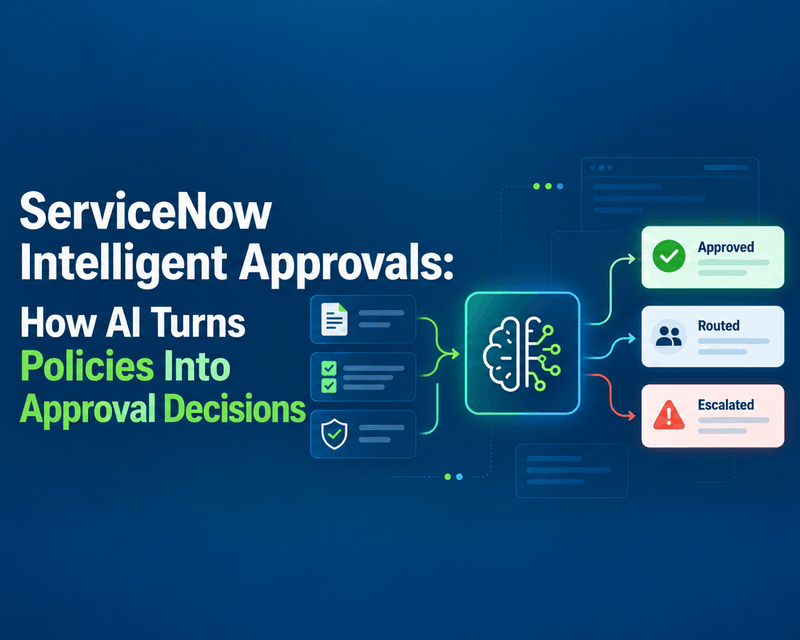
ServiceNow Intelligent Approvals: How AI Turns Policies Into Approval Decisions
What if your approval policies could make decisions, instead of sitting in documents waiting for someone to interpret them? For years, approval automation has followed the same pattern. Business teams write policies. Developers translate them into workflow conditions. Employees wait for someone to approve or reject their request, even when the outcome is obvious.
read more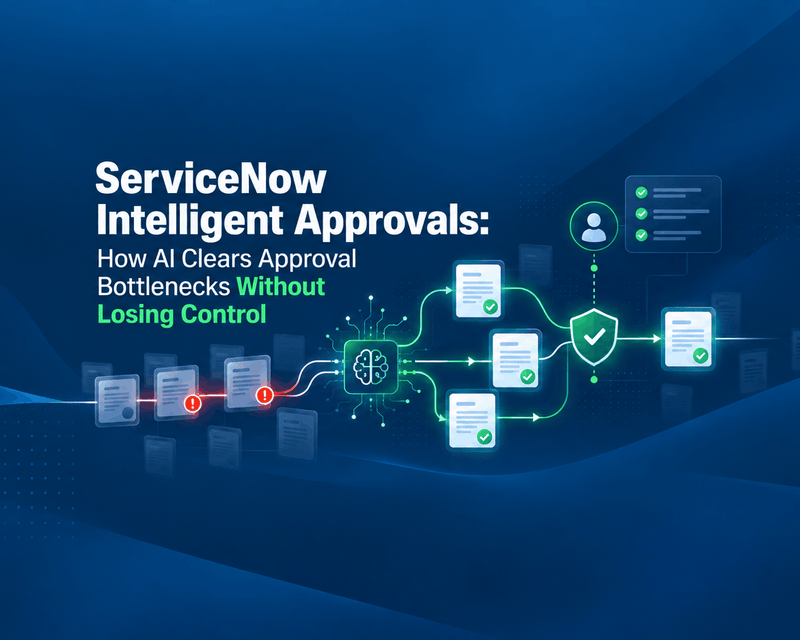
ServiceNow Intelligent Approvals: How AI Clears Approval Bottlenecks Without Losing Control
Your automation is fast. Your approvals are not. Organizations invest heavily in automation, AI and digital transformation. Yet many business processes still stall at the same point: waiting for someone to click “Approve.”
read more