
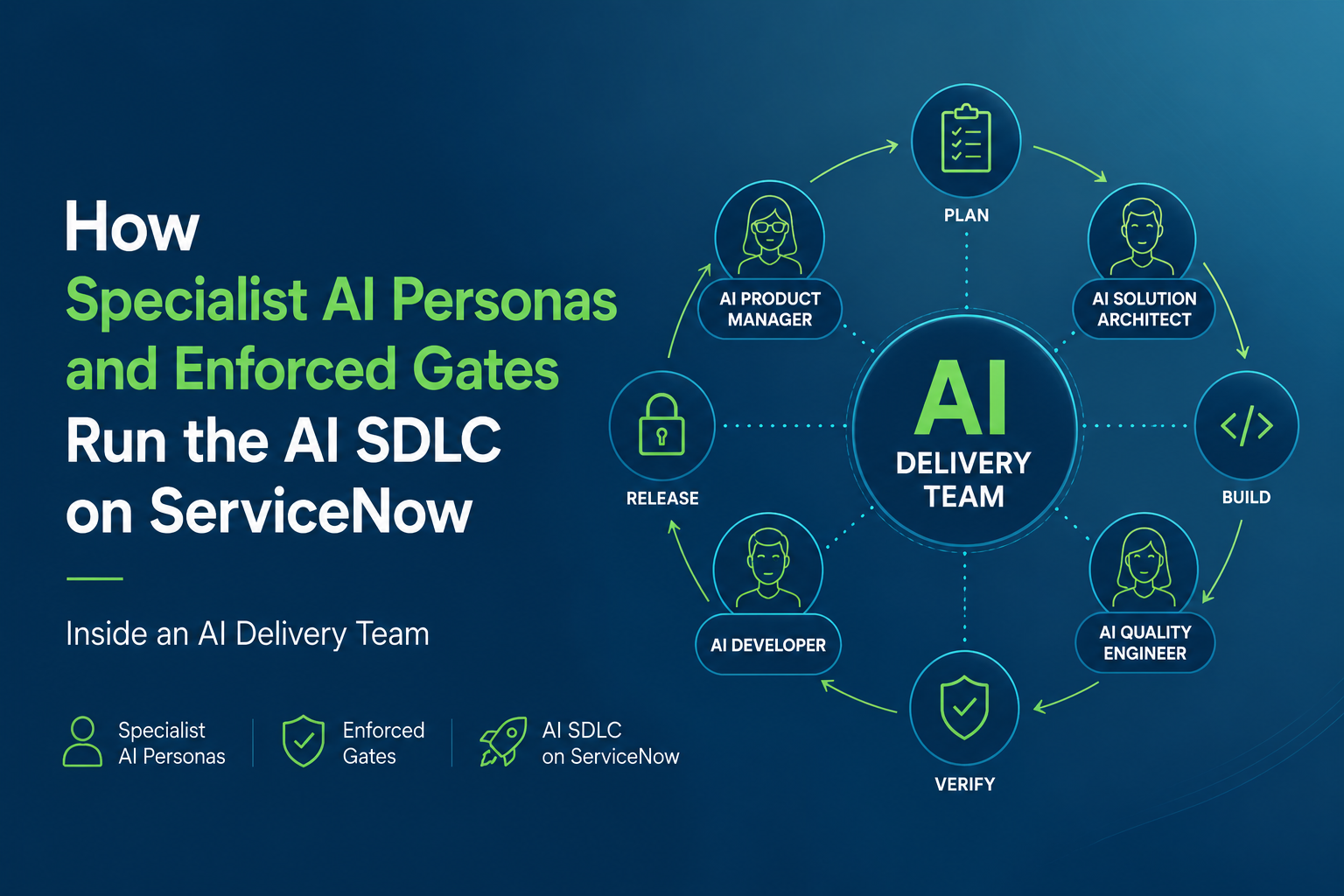
Inside an AI Delivery Team: How Specialist AI Personas and Enforced Gates Run the AI SDLC on ServiceNow
In our article on AI SDLC governance, we argued that the question has shifted from “Can AI write code?” to “Can enterprises govern it?”.
Code generation and App Development are becoming cheap; quality judgment is scarce. Speed without evidence fails every compliance review it meets.
That article was the diagnosis. This one is the treatment.
In the following article you will read about:
- The status quo
- The darf factory (not)
- Why specialist AI persona are better
- A governance and the quality gates
- How the AI SDLC project is structured
- The evidence
- Numbers and learnings
- How the AI teams starts
- FAQ
Over the past year, we have delivered ServiceNow projects through a structured AI delivery team: specialist AI personas operating within enforced quality gates on live engagements. This is neither a copilot layered onto a human process nor a fully autonomous “dark factory.” Instead, AI drafts, builds, and validates, humans make the decisions, and the process produces a complete audit trail.
Here is how it works — and what we learned building it.
The problem with bolted-on AI development
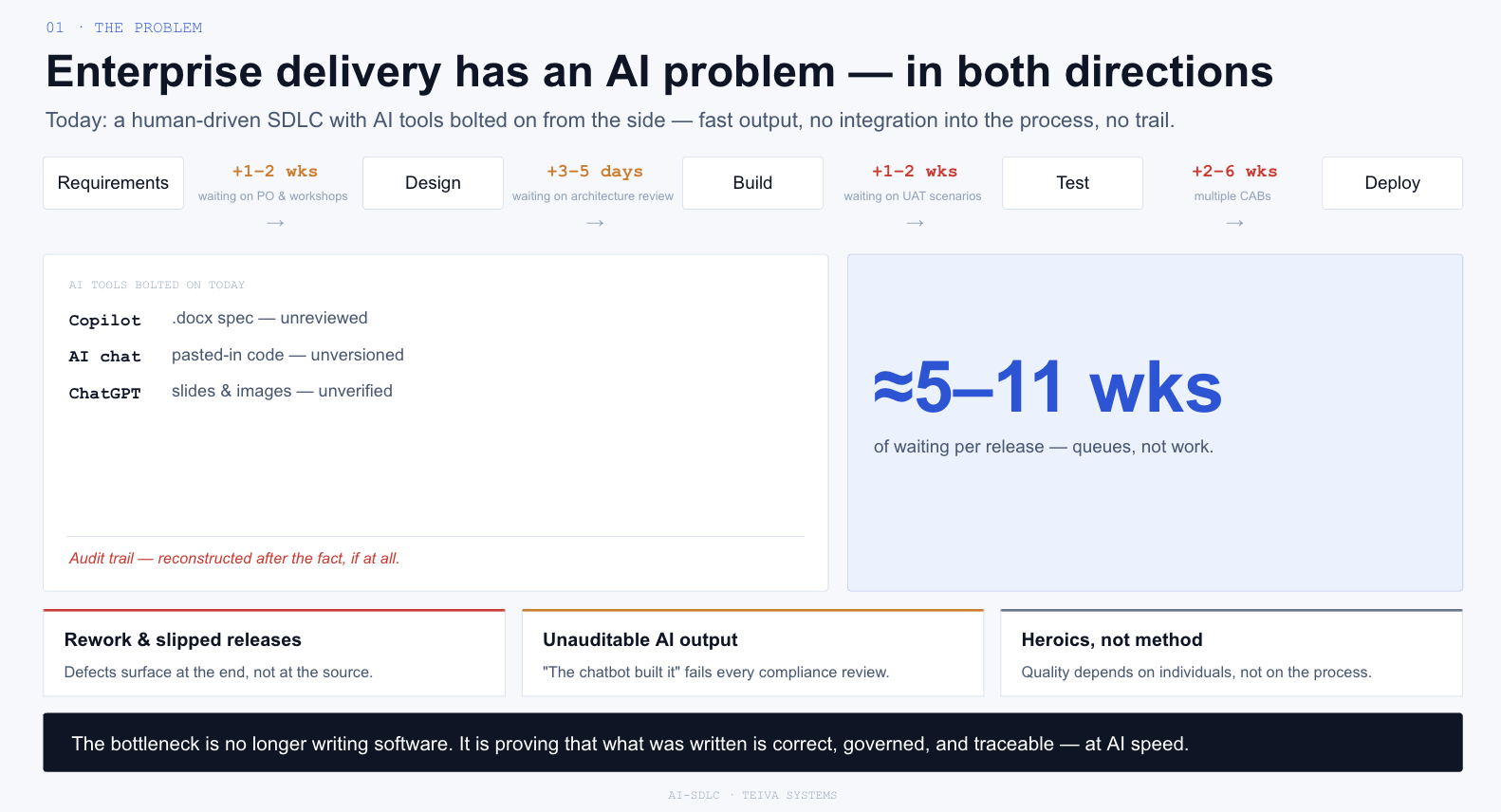
Most enterprises still run a human-driven SDLC with AI tools bolted on at the edges. A Copilot drafts a specification into a Word document that no one reviews against a defined standard. A developer copies chat-generated code into an unversioned update set. A chatbot produces slides and diagrams that nobody verifies. Meanwhile, delivery timelines continue to revolve around queues—product owner workshops, architecture reviews, UAT preparation, and change advisory boards. In a typical release, teams spend five to eleven weeks waiting rather than delivering.
As a result, organizations end up with the worst of both worlds: AI generates work at machine speed while human approval processes move at traditional speed. Teams then scramble to reconstruct the audit trail after the fact—if they can. And when an auditor asks who created a requirement or approved a change, “the chatbot built it” is not an acceptable answer.
More importantly, writing software and developing applications are no longer the primary bottleneck. The real challenge is proving that every requirement, design decision, line of code, and test remains correct, governed, and fully traceable at the same speed AI can produce it.
Not a dark factory: autonomy with the lights on
The industry has a name for the opposite extreme. A dark factory is a software pipeline in which AI agents plan, build, test, and ship code with no human review at any step. The term borrows from lights-out manufacturing, where a plant runs so fully automated that nobody needs the lights on. In the five-level model of AI coding autonomy now circulating, the dark factory is level five: a specification goes in, deployed software comes out, and no human reads the code in between.
For a well-tested product codebase with a strong evaluation harness, that model is beginning to work. For enterprise platform delivery in regulated industries, it fails a simpler test: who signs? A dark factory produces software. An auditor asks for decisions, rationale, and accountable approvers. “The pipeline decided” is the same non-answer as “the chatbot built it”, only faster.
Our model deliberately stops one level short.
Specialist AI personas, not a general-purpose assistant
The first structural decision was simple: we did not rely on one general-purpose AI assistant to “help with everything.” Instead, we created a team of specialist AI personas—Product Owner, Architect, Developer, UX Designer, Test Manager, and a Delivery Manager that orchestrates the others. Each persona has a versioned identity, clearly defined responsibilities, and strict role boundaries.
Those boundaries are deliberate, not stylistic. The Developer cannot change scope; every scope decision goes to the Product Owner and, ultimately, to a human decision-maker. The Architect owns the solution design, and the Developer cannot quietly redesign it downstream. If the Developer encounters a platform limitation, the process requires them to stop, log the blocker, and escalate the issue instead of creating an undocumented workaround. Every persona knows exactly what it owns, what falls outside its responsibility, and who receives its work next.
This structure follows the same discipline we described in Securing Enterprise AI Agents. An AI agent needs a defined identity, scoped permissions, and clear guardrails before it interacts with production systems. We extended that principle one step earlier in the lifecycle by applying it to the agents that build enterprise systems—not just the agents that operate them.
Here is a concrete example of a silent failure, because the species matters. In a scoped app, reading a display value through a dot-walked reference field — gr.assigned_to.getDisplayValue() — can return an empty string. No exception, no log entry, no warning. The code compiles, the logic looks textbook-correct, and the field quietly renders blank. The reliable pattern is to read the sys_id with getValue(), then run an explicit GlideRecord.get() on the target table and take the display value there. But the lesson is not the workaround — it is the failure mode. A platform that fails silently cannot be trusted on “the code looks right,” whether a human or an AI wrote it. That single fact shapes everything downstream in how we verify.
Gates that actually gate
The second structural decision changes everything downstream: every phase transition in the AI SDLC passes through an explicit PASS/FAIL quality gate.
A gate is not a meeting or a judgment call. It is a structured validation that checks each handover—sender, receiver, artifacts, commit reference, summary, and open items—against the receiving phase’s defined input contract.
The contract for entering the build phase includes nine measurable conditions. For example, the team must confirm the application scope from the live ServiceNow instance rather than invent it. Every table and field in the design must include complete specifications with no blanks. Every row in the build manifest must be complete—no “TBD” and no “see above.” Every platform plugin dependency that the team has not verified must include a specific fallback. Finally, the commit reference in the handover must match the current head of the repository. Each condition has only two outcomes: pass or fail. If even one condition fails, the gate stays closed.
When a gate fails, the process reinforces trust in three ways. First, the build phase does not begin, so an ambiguous specification never reaches development. Second, the gate identifies every missing or incorrect item, giving the sending persona a precise list of issues to resolve. Finally, the system preserves every failure record. No one deletes or edits it after fixing the problem. Instead, the corrected handover goes through the gate again, and the resulting PASS provides a complete, traceable record of the resolution.
That last point surprised us in practice: a failed-then-passed gate is stronger audit evidence than an unbroken row of green checkmarks. It proves the gate is real.
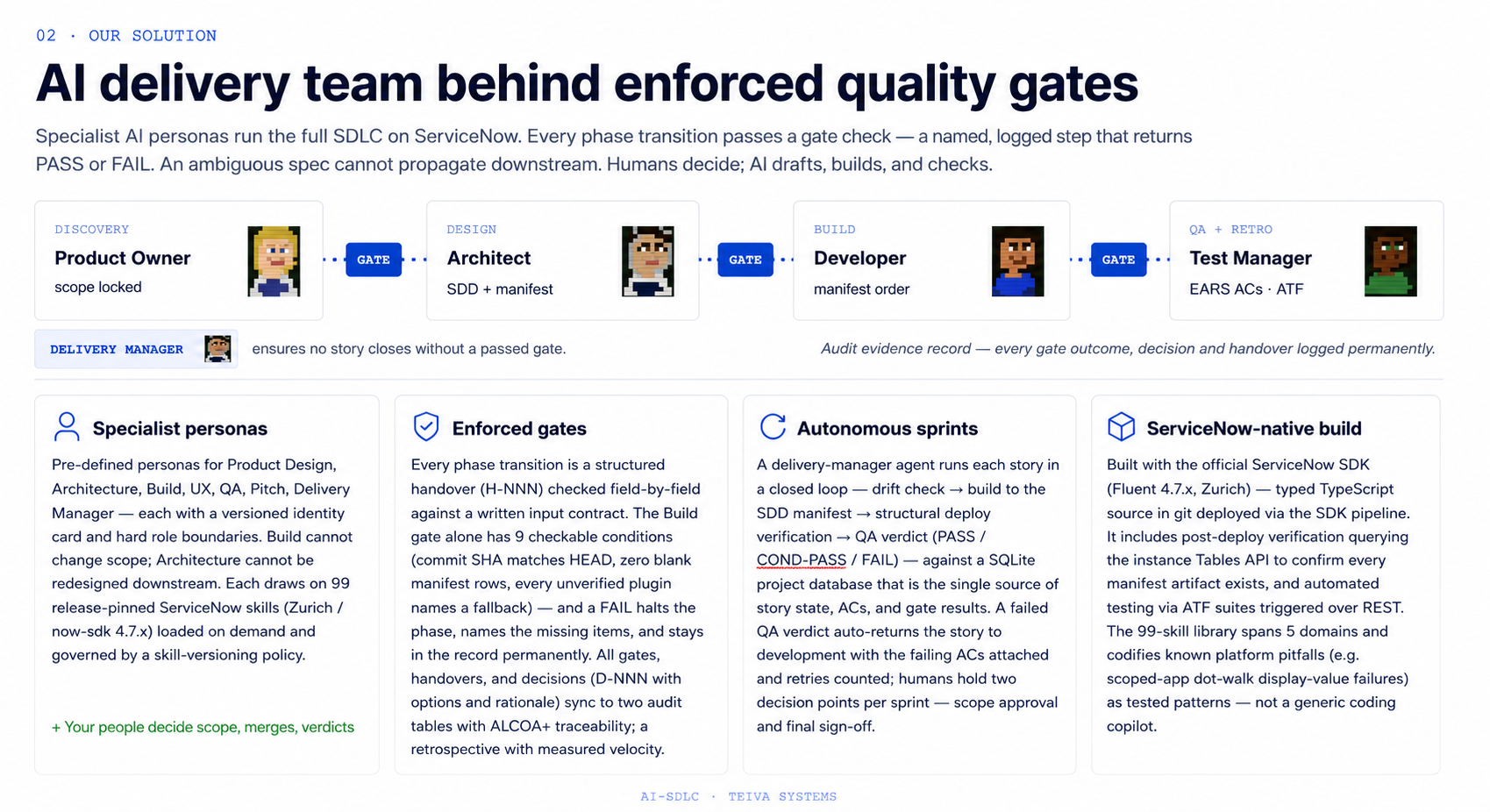
This is our answer to the review bottleneck we described in the governance article. The conventional response to AI-speed output is to review harder after the fact — which doesn’t scale. The gate moves the review to where the defect originates. An incomplete specification is caught at the design gate, in minutes, before it becomes three days of rework in build and test.
Autonomous sprints with humans at the decision points
With specialist personas and quality gates in place, the sprint runs as a closed loop. The Delivery Manager guides every story through the same sequence: confirm that the story still matches the current design through a drift check, build strictly according to the design manifest, verify after deployment that every declared artifact exists in the target instance, and then hand the story to QA for a final verdict—pass, conditional pass, or fail.
The post-deployment verification step is essential, even after a successful deployment. A green deployment confirms that the platform accepted the package, but it does not guarantee that the deployed instance matches the design. In practice, declared source and instance reality diverge in predictable, well-documented ways. For example, the SDK deployment pipeline cannot deploy ATF test records because the platform creates sys_atf_test records directly in the instance. Likewise, Fluent flow configuration cannot activate flows automatically; flows deploy in an inactive state, and someone must activate them later in Flow Designer.
As a result, a successful deployment proves less than many teams assume. It confirms package acceptance, not that every table, field, script include, flow, and other declared artifact exists and functions as intended. That is why the Delivery Manager queries the instance through the Tables API after deployment and verifies every declared artifact against the live environment, one record at a time, before QA begins testing. “It deployed” is simply a claim. A structural verification report generated from the running instance provides the evidence
A failed QA verdict does not generate a meeting. The story is automatically returned to development with the specific failing acceptance criteria attached, and the retry is counted. Every story carries acceptance criteria written in EARS syntax — a structured requirements format that makes each criterion individually testable — so QA verifies against the written criterion, not against opinion. Verification runs through ServiceNow’s own Automated Test Framework, and every application artifact is built with the official ServiceNow SDK: typed source code in version control, built and installed against the instance through the SDK’s own deployment loop — native to the platform, not scripted around it.
“AI just writes the code” underestimates what AI development on this platform actually involves. With the ServiceNow SDK, the type definitions for a custom table do not exist until that table has been deployed at least once: you declare the table in Fluent, build, deploy, pull fresh type definitions from the live instance, and rebuild — only then will a script referencing that table type-check. Get the order wrong and you chase phantom compile errors against types that cannot exist yet. Run deploy without a fresh build and the SDK re-sends the previous, stale package without complaint. An AI developer that does not execute this choreography produces code that is syntactically perfect and practically undeployable. Ours runs the loop as a fixed sequence, because the platform — not the language — decides when code is valid.
All state — stories, acceptance criteria, gate outcomes, verdicts, decisions — lives in a single project record that any persona (or any human) reads before acting. There is no tribal knowledge and no “ask the person who was in the chat.”
Humans are not removed from this loop; they are concentrated where judgment actually matters. On our engagements, a sprint needs fewer than ten human touchpoints — scope approval, blocker resolutions, merge decisions, and final sign-off. Your experts spend their time deciding, not producing artifacts. If you are weighing where an AI build model like this fits against your current delivery approach, our comparison of Build Agent versus traditional ServiceNow app development walks through that decision in detail.
The evidence pack builds itself
In the governance article we introduced the idea of an evidence pack — the documented trail of decisions and approvals that must ship alongside the working solution. The most important property of the model described here is that the evidence pack is not assembled at the end. It accumulates at every gate.
Every decision is logged with its context, the options considered, the rationale, and who decided — persona or human. Every handover, every gate outcome including the failures, every QA verdict, and every retrospective is a structured, timestamped record. The records sync into dedicated audit tables designed for traceability under ALCOA+ principles, which means the same evidence maps naturally onto the structures that GxP, GDPR, NIS2, Automotive SPICE, and ISO 26262 audits expect — because it was captured at the moment of the event, attributable and unaltered, not reconstructed from memory three months later.
Even the retrospective is part of the machine: it is triggered automatically at sprint close with measured metrics — velocity, acceptance-criteria pass rate, test pass rate, blocker count — and its action items land as versioned changes to the framework itself. The process improves the way software should: through committed, reviewable changes. It is a method, not a hero.
What this looks like in numbers
Measured on live engagements — not projections:
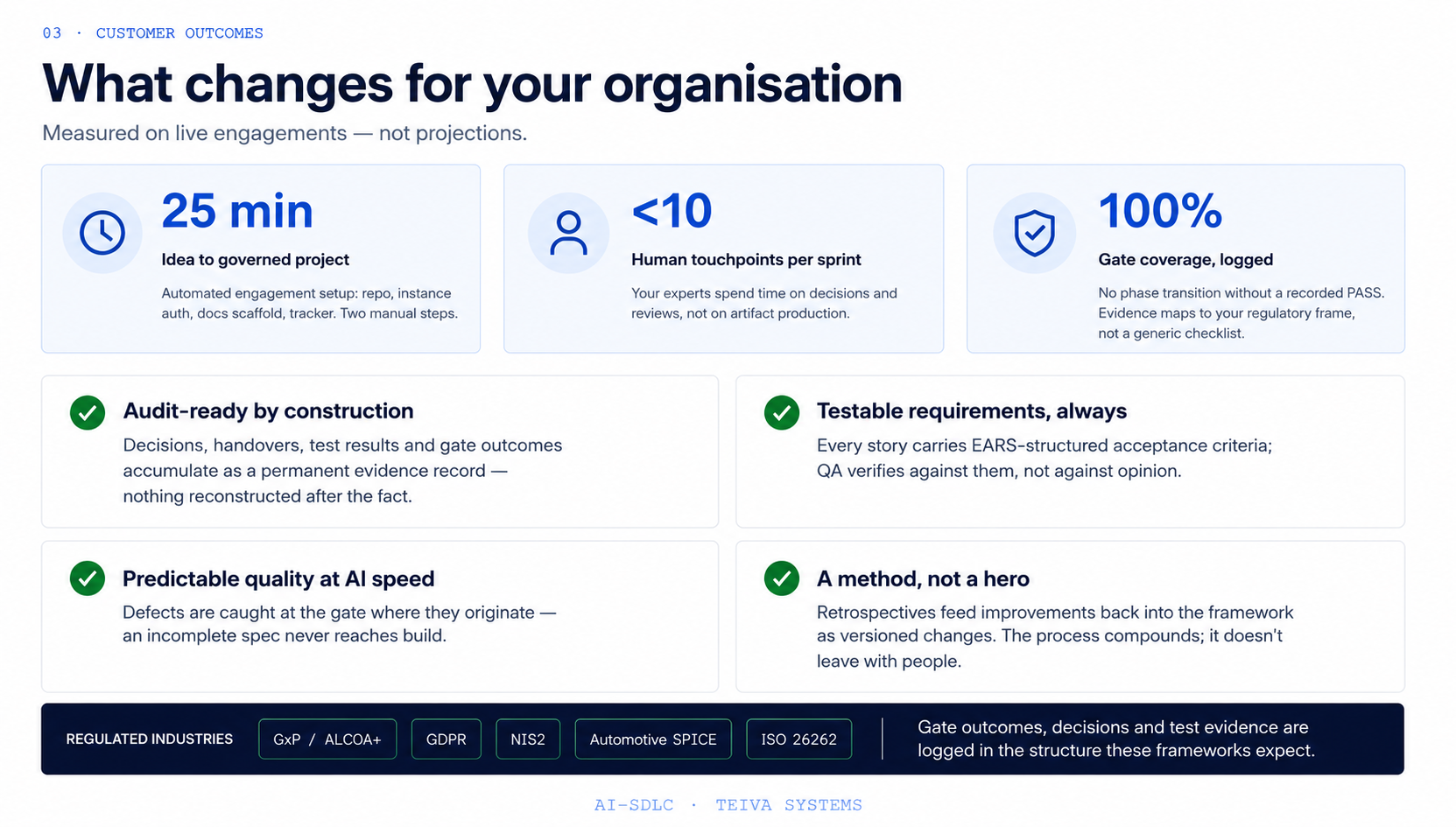
- ~25 minutes from idea to a governed project: repository, instance authentication, documentation scaffold, and tracker set up with two manual steps.
- Fewer than 10 human touchpoints per sprint — decisions and reviews, not artifact production.
- 100% gate coverage, logged. No phase transition without a recorded PASS.
- Audit-ready by construction. Decisions, handovers, test results, and gate outcomes accumulate as a permanent evidence record.
Start with one story
We closed the governance article with a suggestion: pilot one real ServiceNow backlog item through a governed AI SDLC and deliver the working solution and the evidence pack together.
This article is what runs that pilot. Bring us one story — one real item from your backlog — and we will take it from scope to deployed, tested, evidenced delivery through the AI delivery team described above. You will see every gate outcome, every decision record, and every verdict along the way. The fastest way to evaluate a governed AI delivery model is to watch it govern something real.
FAQ: AI delivery teams and the AI SDLC
What is an AI delivery team? An AI delivery team is a set of specialist AI personas, in our model Product Owner, Architect, Developer, UX Designer, and Test Manager, orchestrated by a Delivery Manager persona, that runs the software development lifecycle inside enforced quality gates. AI produces the artifacts; humans hold the decision points; every handover and gate outcome is logged as audit evidence.
How is an AI delivery team different from a dark factory? A dark factory is a fully autonomous pipeline in which AI plans, builds, tests, and ships code with no human review at any step. An AI delivery team keeps the autonomous production loop but adds two things a dark factory lacks: logged PASS/FAIL gates at every phase transition, and named human approvers for scope, blockers, merges, and sign-off. That is the difference between producing software and producing software an auditor accepts.
How does an AI SDLC stay audit-ready? By capturing evidence at the moment of the event instead of reconstructing it later. Every decision, handover, gate outcome, and QA verdict is a structured, timestamped, unaltered record synced into audit tables built on ALCOA+ principles, which maps onto what GxP, GDPR, NIS2, Automotive SPICE, and ISO 26262 audits expect.
How many human touchpoints does an autonomous sprint need? Fewer than ten on our live engagements: scope approval, blocker resolutions, merge decisions, and final sign-off. Humans decide; they do not produce artifacts.
Does this model of AI development work on ServiceNow specifically? Yes, and it has to be platform-specific to work at all. The personas draw on 99 versioned ServiceNow skills, all artifacts are built with the official ServiceNow SDK, verification runs through ATF, and a structural check against the instance Tables API confirms that every declared artifact exists after deployment.
Teiva Systems runs AI-augmented ServiceNow delivery for enterprises in regulated and non-regulated industries. Contact us to scope a pilot.
Kostya Bazanov, Managing Director, Jul 15, 2026
Eager to take the next step? Contact us today!
Latest Articles
ServiceNow Lux vs UI Builder and Service Portal: What Enterprises Need to Know
Does Lux replace UI Builder or Service Portal? Short answer: no. The full answer depends on what you are building. The way enterprises build experiences on ServiceNow is changing. For years, Service Portal has handled employee and customer self-service, while UI Builder has powered modern workspaces and configurable applications.
read more
Teiva Systems at ServiceNow World Forum 2026 — London
On October 20, 2026, Teiva Systems attended ServiceNow World Forum London at ExCeL London, where industry leaders, technology experts, and the ServiceNow community came together to explore how AI, intelligent automation, and digital workflows are transforming enterprise operations.
read more
ServiceNow Intelligent Approvals: How AI Turns Policies Into Approval Decisions
What if your approval policies could make decisions, instead of sitting in documents waiting for someone to interpret them? For years, approval automation has followed the same pattern. Business teams write policies. Developers translate them into workflow conditions. Employees wait for someone to approve or reject their request, even when the outcome is obvious.
read more