

ServiceNow Ends Sidecar AI: What It Means for Every Project You’re Running
Today ServiceNow dropped a platform announcement that changes the calculation for every enterprise AI initiative in motion right now. Not incrementally – structurally.
The short version: AI, data connectivity, workflow execution, security, and governance are now bundled into every ServiceNow product, at every tier. No separate AI SKU. No procurement project. No integration project. It’s all in.
If you’ve been waiting for the right moment to start your AI transformation on ServiceNow, the platform just removed the last excuses.
Let’s break down what actually matters here and why, at Teiva, this announcement doesn’t surprise us at all.
The Three Moves That Matter
1. Context Engine: AI That Actually Knows Your Business
ServiceNow introduced Context Engine: a layer that connects approval chains, asset-to-process relationships, vendor history, and decision lineage to every AI agent decision, in real time. It’s built on Service Graph and Knowledge Graph, and it compounds intelligence with every decision made human or agent.
This is the piece most AI projects have been missing. We’ve written about this directly: AI agents don’t fail because models are weak – they fail because the data underneath isn’t connected, contextualized, or controlled. Context Engine is ServiceNow’s structural answer to that problem.
For Teiva clients, this matters immediately. We’ve been working with Knowledge Graph as part of our App Engine development practice precisely because enterprise context – not raw language model capability is what separates useful AI from impressive demos.
Context Engine formalizes and scales that approach across the entire platform.
2. Build Agent + ServiceNow SDK: The Commoditization of Scaffolding Is Here
Starting April 15, developers can build ServiceNow applications from Claude Code, Cursor, Windsurf, OpenAI Codex, and other AI coding tools and deploy directly to the ServiceNow AI Platform. Citizen developers can describe a workflow in plain language and have a working app in minutes.
This is a significant shift. The mechanical work of app scaffolding, boilerplate, and initial configuration is being automated. What remains and what becomes more valuable is the judgment layer: knowing what to build, for whom, in what sequence, with what governance.
We’ve been building AI-native applications on App Engine for years. Our guide to building AI applications on ServiceNow reflects the approach we’ve always taken: structured, governance-first, with AI embedded into the workflow logic itself rather than bolted on at the edge. Build Agent accelerates the front end of that process. It doesn’t replace the expertise required to architect and deliver solutions that actually work at enterprise scale.
3. ESM Foundation: Mid-Market Now Has a Real Entry Point
ServiceNow is launching Enterprise Service Management Foundation: a bundled offering that brings IT, HR, Legal, Finance, Procurement, and Workplace Services onto the platform – deployable in weeks.
Designed explicitly for mid-size companies that need enterprise-grade service management without months-long deployment cycles.
This is directly relevant to the German Mittelstand market Teiva serves.
The objection we’ve heard repeatedly “ServiceNow is for the big players, not for us” now has a clear, packaged rebuttal:
- Fast ROI
- Scalable foundation
- Included AI
Why This Isn’t Surprising to Us
We’ve been preparing for this moment operationally for some time. Our current work is including agentic AI integrations, App Engine scoped application development, and AI Control Tower implementations- reflects a deliberate bet that the platform would move in exactly this direction.
Our CTO wrote recently about the gap between AI agent hype and production reality. The honest answer has always been: agents work when the data, context, and governance infrastructure underneath them is solid. That’s the work we focus on with clients. Context Engine and the new packaging model are ServiceNow making that infrastructure the default, not an advanced option.
Our CEO wrote about how enterprises are turning ServiceNow into a self-driving platform. The journey from ticket management to autonomous IT operations is now an explicit product motion, not just a consulting vision. The tiered model ServiceNow is launching (AI assistance → agentic automation → fully autonomous operations) maps directly to how we’ve been structuring client roadmaps.
And on the development side, we published a complete guide to ServiceNow AI Skills, Agents, and Workflows because we believe clients need to understand the architecture are not just consume features. Build Agent and the SDK accelerate delivery. They don’t replace the architectural thinking.
The Real Bottom Line
This announcement accelerates the timeline on everything.
Every project. Every operational process. Every business case that was waiting on “the platform to catch up.”
The commoditization of intelligence work – coding, scaffolding, configuration is happening faster than most organizations expected.
Build Agent is one signal.
The inclusion of AI across all tiers is another.
What this means is that the window for competitive differentiation through AI is compressing.
Organizations that move now, with the right architecture and the right partner, gain a structural advantage.
Organizations that wait will be implementing what their competitors already operate.
At Teiva, we’ve always believed that AI-first is not a feature, it’s a delivery philosophy. We build AI-first applications for our clients. We use AI-first development practices internally. We were integrating with AI Control Tower, working with Knowledge Graph, and building agentic workflows on App Engine before these were standard talking points.
The shift from automation to autonomy is no longer a future state. ServiceNow is shipping it. The question for every organization is whether they’re ready to operate in it.
We help companies get there – and stay ahead once they do.
Kostya Bazanov, Managing Director, Apr 14, 2026
Eager to take the next step? Contact us today!
Latest Articles
ServiceNow for the Public Sector: Five Requirements to Address Before Implementation
Public-sector organizations do not implement ServiceNow under the same conditions as a commercial enterprise. Getting the foundation right before development begins can determine whether the platform supports secure, measurable, and scalable public services for years to come.
read more
ServiceNow AI ROI: What Should You Measure After the Pilot?
Your AI pilot worked. That proves the technology can work. It does not yet prove ROI. Here are the six metrics that separate “the demo impressed leadership” from “we can prove measurable business value.”
read more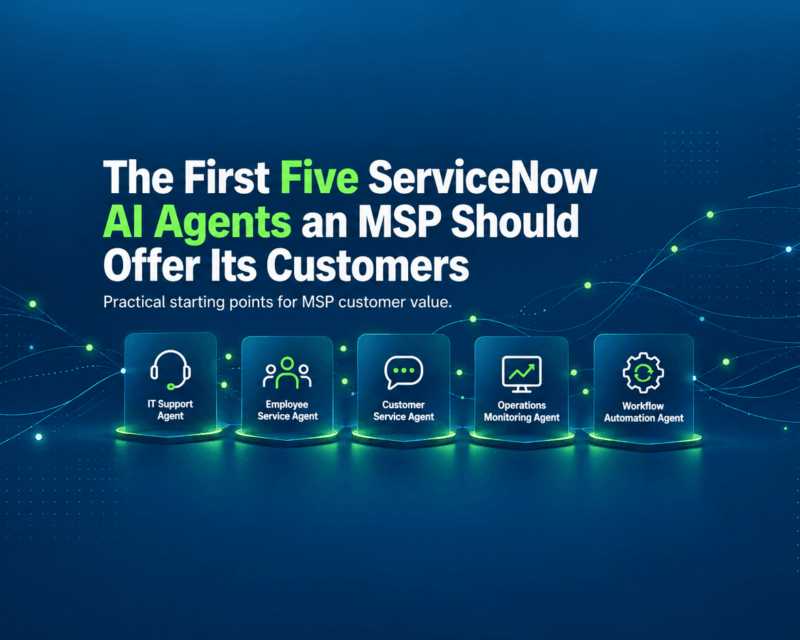
The First Five ServiceNow AI Agents an MSP Should Offer Its Customers
Managed service providers can now package ServiceNow AI agents as repeatable, recurring services — moving from ticket-response capacity to managed outcome delivery. Here is what the first five offerings look like, how each creates value, and what to get right before deploying them.
read more