

From Ticket Chaos to Autonomous IT: How Enterprises Are Turning ServiceNow Into a Self-Driving Platform
Why scaling tickets is not the same as scaling IT – and what leading organizations are doing instead
There was a time when IT success seemed simple: more tickets.
Dashboards were green, queues were cleared. Service Level Agreements were consistently met.
On paper, IT seemed to be working.
In reality, the picture was more complex.
Handling a volume of tickets does not necessarily indicate better IT performance.
In cases, it reflects the opposite:
- increasing friction
- growing confusion
- inefficiencies that are not immediately visible
As ticket volumes continue to rise, a clear pattern emerges:
demand is increasing because something earlier in the process is not functioning as it should.
This is why leading organizations are beginning to ask a question:
What if the ticket never had to exist?
The Ticket Illusion
Tickets often create the impression of productivity.
They are easy to track, measure, and report on.
However, they are not solutions. They are indicators.
- A password reset is rarely a routine task – it often points to a flaw in system design
- Recurring incidents are not events – they typically signal unresolved underlying issues
- Frequent “how do I…” requests usually highlight gaps in user experience or missing knowledge
Despite these signals, many IT teams continue to optimize in the areas.
They invest in:
- routing
- more precise categorization
- additional automation
All aimed at handling the same volume of requests more efficiently.
The result is a system that may perform well operationally, but ultimately continues to scale inefficiencies rather than eliminate them.
From Ticketing to Autonomous IT
A new model is beginning to take shape.
Platforms like ServiceNow are evolving from ticketing systems into intelligent operational platforms.
This approach can be described as Autonomous IT.
- Instead of reacting to issues, systems begin to anticipate them
- Instead of waiting for user input, they guide users toward the right actions
- Instead of escalating problems, they resolve them quietly in the background
This is not an improvement. It represents a fundamental shift:
- from reactive to predictive
- from manual to automated
- from fragmented to connected
What This Looks Like in Practice
Eliminating Demand Instead of Managing It
More advanced organizations are no longer focused solely on optimizing ticket intake.
Instead, they aim to reduce the need for tickets.
They analyze patterns behind requests by asking:
- Why does this request exist?
- Where does the user journey break down?
- What can be improved before the issue even occurs?
The goal is not to process demand, but to remove it at the source.
AI That Actually Works
There is attention around Artificial Intelligence, but real value does not come from visible features such as chatbots.
It comes from intelligence that operates seamlessly in the background.
Effective Artificial Intelligence enables:
- prediction of incidents before they occur
- resolution of common issues
- context-aware recommendations
The most effective Artificial Intelligence is not the one that communicates more.
It is the one that prevents problems from arising in the first place.
Systems That Heal Themselves
In mature environments, IT systems are increasingly capable of resolving issues independently.
- An issue is detected
- The root cause is identified
- A fix is applied automatically
The entire process is documented, without generating a ticket, escalating the issue, or interrupting the user experience.
This is already a reality in organizations that integrate monitoring, automation, and workflows into closed-loop systems.
In this model, IT does more than respond.
It continuously improves.
Designing for Experience, Not Process
From the user’s perspective, internal workflows are irrelevant.
What matters is the outcome.
Modern IT organizations are shifting toward experience-first design, focusing on:
- reducing the number of steps required to complete tasks
- making interactions more intuitive and seamless
- delivering faster or even invisible resolution
In this context, ServiceNow becomes the engine behind the experience, rather than the place where issues are submitted and wait to be resolved.
Why This Matters to the Business
This shift is not an IT improvement. It delivers clear business value.
Organizations adopting this approach are experiencing:
- lower ticket volumes
- higher employee satisfaction
- faster onboarding and improved productivity
- reduced operational costs
Perhaps most importantly:
IT evolves from a support function into a driver of business growth.
Where to Start
This transformation does not require a scale or high-risk initiative.
A practical approach is to begin with high-impact areas:
- identify the primary drivers of ticket volume
- map the actual user journey behind those requests
- address root causes rather than symptoms
From there, organizations can scale successful solutions and expand progressively.
This is not a one-time project.
It is a shift in how IT is designed, delivered, and continuously improved.
The Bottom Line
For years, the focus in IT was on handling tickets:
- increasing throughput
- improving response times
- scaling support teams
Today, a meaningful question is emerging:
why do those tickets exist at all?
Organizations that lead in this space are not those that close tickets faster, but those that reduce or eliminate the need for tickets entirely by addressing root causes and improving overall experience.
This results in a different operating model, where:
- fewer tickets are generated
- issues are resolved before users notice them
- systems operate in a proactive and connected way
- users rely less on support for everyday needs
In this environment, ServiceNow becomes more than a system of record.
It evolves into a platform that actively drives operations and moving closer to a self-sustaining model of IT.
Slava Trotsenko, CEO, Mar 31, 2026
Eager to take the next step? Contact us today!
Latest Articles
ServiceNow for the Public Sector: Five Requirements to Address Before Implementation
Public-sector organizations do not implement ServiceNow under the same conditions as a commercial enterprise. Getting the foundation right before development begins can determine whether the platform supports secure, measurable, and scalable public services for years to come.
read more
ServiceNow AI ROI: What Should You Measure After the Pilot?
Your AI pilot worked. That proves the technology can work. It does not yet prove ROI. Here are the six metrics that separate “the demo impressed leadership” from “we can prove measurable business value.”
read more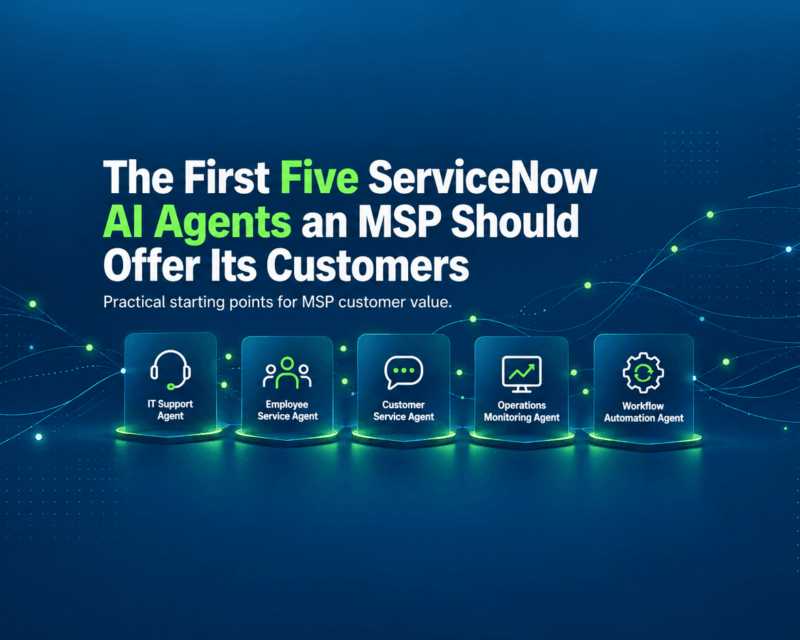
The First Five ServiceNow AI Agents an MSP Should Offer Its Customers
Managed service providers can now package ServiceNow AI agents as repeatable, recurring services — moving from ticket-response capacity to managed outcome delivery. Here is what the first five offerings look like, how each creates value, and what to get right before deploying them.
read more