
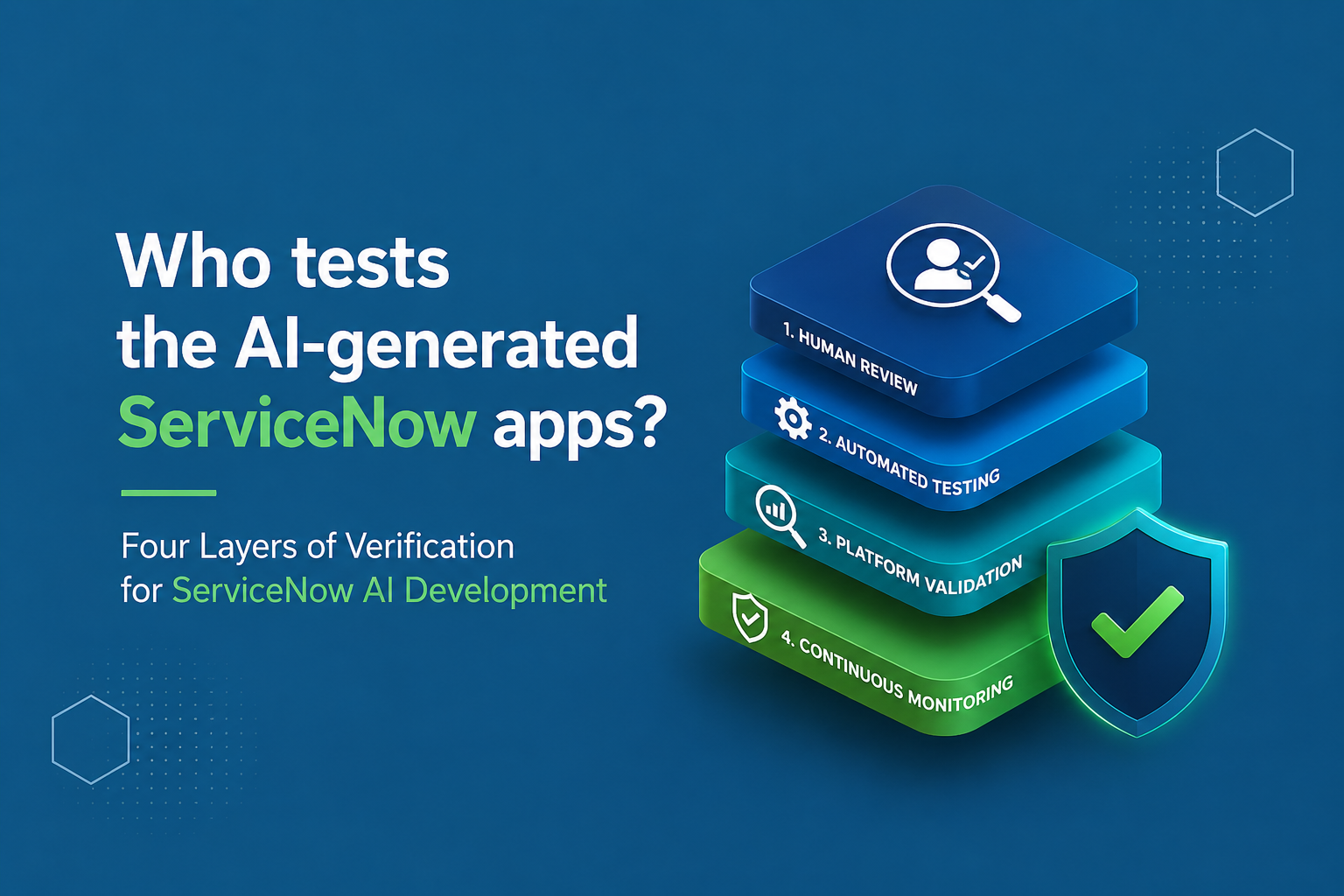
Who tests the AI-generated ServiceNow apps? Four Layers of Verification for ServiceNow AI Development.
AI-generated apps that compiles, deploys, and reads as correct can still be wrong. The question every platform owner should ask an AI SDLC delivery partner is not “do you test?” It’s “who checks the work, and what stops them marking their own homework?”
Third in a series. The first, AI SDLC Governance: Why Vibe Coding on ServiceNow Needs More Than Speed, argued that speed without governance is a liability. The second, Inside an AI Delivery Team, described the specialist AI agents and enforced gates that make governed delivery work. This one goes inside the part of that model most likely to be quietly skipped: verification.
In the following article you will read about:
- The failure mode nobody puts on a slide
- The four layers, in plain terms
- Why four, and why these four
- Layer 1: developer self-check
- Layer 2: independent QA gate
- Layer 3: live browser verification
- Layer 4: the spec-blind panel
- What the spec-blind panel actually found
- What holds it together: evidence that outlives the session
- What this is not
- The question to take to your next vendor conversation
- FAQ
The failure mode nobody puts on a slide
If you own a ServiceNow platform, you have already seen the demo of a Build Agent or an external AI Agent. A prompt goes in, a working table, flow, and portal page come out, and the elapsed time is measured in minutes. It is genuinely fast. It is not the thing that should worry you.
The thing that should worry you is subtler. An AI agent asked to build something, then asked whether it worked, will report success on weaker evidence than a human would accept. This happens under speed pressure and limited context. Not by lying. By collapsing the distinction between “this should work” and “I ran it and watched it work.” Those are categorically different claims. A build log that goes green is the first one. A rendered page that a person actually looked at is the second.
That distinction survives only if the process refuses to let it collapse. “Refuses” has to mean something structural, because instructions alone lose to time pressure eventually. Every mechanism described below is the same design decision applied in a different place: put the guarantee in the system, not in the intentions of whoever is running it. Independence lives in the data model. Isolation is verified, not asserted. Absence of evidence is a recorded state, not an empty field.
Our answer is not a testing phase. It is four independent verification layers, each owned by a different AI agent persona, each catching a class of defect the layer below it structurally cannot see. No story ships on the strength of any one of them. This is what a governed AI SDLC looks like once you take “who checks the work” seriously.
The four layers, in plain terms
| Layer | Owner | What it answers |
|---|---|---|
| 1) Developer self-check | Developer persona, pre-handover | Did this actually deploy, and do the automatable criteria pass against the real instance? |
| 2) Independent QA gate | QA persona, acceptance-criteria-driven | Re-derived from scratch: does the app meet each acceptance criterion, with committed automated coverage? |
| 3) Live browser verification | QA persona, real Playwright session | What does the page actually render when a browser loads it? |
| 4) Simulated UAT | Spec-blind persona panel (via Playwright or similar) | What does a real person, who has never seen the spec, experience when they try to get something done? |
Layers 1–3 must all pass before the QA gate opens. Layer 4 runs after that. It hardens the application before a human ever opens it for UAT.
Why four, and why these four
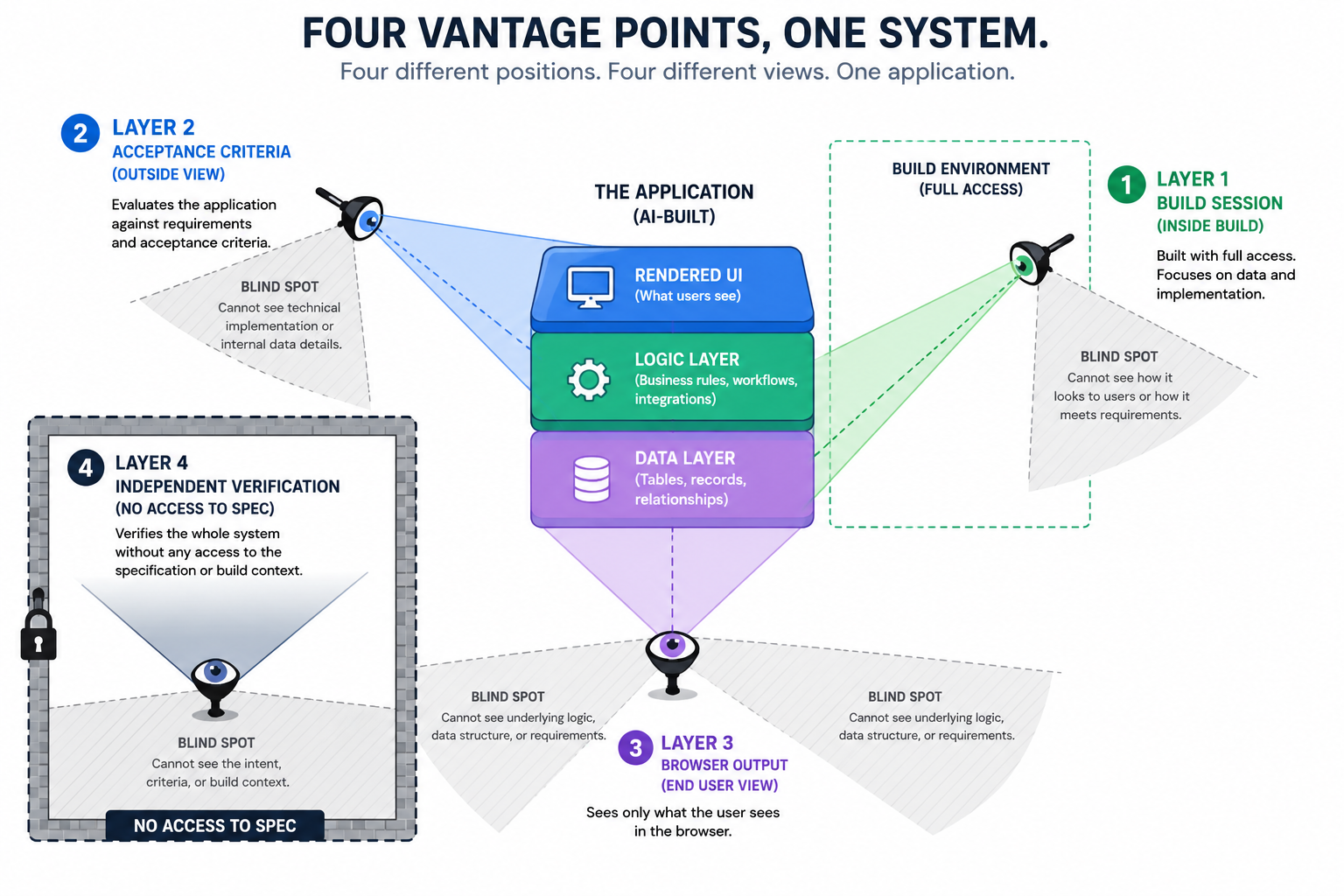
Four is not a thoroughness setting. Each layer is defined by where it observes the system from, and that vantage point determines both what it catches and what it is structurally incapable of catching.
| Layer | Observes from | Structurally cannot see |
|---|---|---|
| 1 | The platform’s own record store, inside the build session | Whether the artifact behaves, and whether the party reporting is a disinterested one |
| 2 | The acceptance criteria, re-derived from scratch | Whether the rendered surface matches the programmatic behaviour |
| 3 | A real rendered page in a real browser | Whether the specified behaviour is the behaviour anyone actually needs |
| 4 | A goal, held by someone with no spec | Everything the spec does cover. It is a sampling instrument, not a regression net |
Two consequences follow, and both are architectural, not procedural.
A blind spot is a property of the vantage point, not of effort. You cannot close Layer 2’s gap by writing more acceptance criteria. More criteria are more observations from the same position. Adding an axis is the only move that changes what is observable at all. That is why, when a third of one engagement’s defects escaped the QA gate, the answer was a new layer rather than a bigger test suite: the existing tests were not missing those defects; they simply could not see them.
Redundant checks only add reliability if their failure modes are uncorrelated. That is a settled result in safety-critical engineering, and it transfers directly: two checks that share a model, a context window, and a source of truth do not fail independently, they fail together, on precisely the inputs where a shared assumption is wrong.
Stack five of them and you have one check with five invoices. Everything that looks fussy about the layers below (the QA persona re-deriving instead of reviewing, the spec-blind panel’s enforced ignorance, running Layer 4 on a different model family) exists to buy decorrelation. It is load-bearing structure, not diligence theatre.
Layer 1: the developer checks their own work, against the real thing
Before a story reaches QA, the developer persona runs two checks against the live target instance, never mocks. A structural check: did the artifacts actually land? (Query the instance directly; a green build log is not evidence of a live artifact.) And a logic check: do the automatable acceptance criteria pass when exercised?
This is deliberately not “did I write tests.” It’s “did I run this against the thing it will actually run against.” We learned that one expensively: unit tests and code review both passed on a service with a dependency-injection bug that only surfaced when a real request was driven through the endpoint. The standing rule since: drive a real request through every new endpoint before calling a story done. Tests and review are necessary. They are not sufficient.
The architectural reason that bug survived two checks is worth naming, because it generalises. Unit tests and code review both operate on the declared wiring, the source as written. The defect lived in the wiring the runtime actually assembled. Any check that reads the artifact rather than exercising it is measuring the design’s intent, and on a platform like ServiceNow the gap between declared and assembled is wide by construction: scope resolution, ACL evaluation, and record-store state are all decided at runtime, on an instance, under an identity.
That is why every layer in this model terminates in a live target environment, and why “it builds” is never accepted as a proxy for “it exists.”
Layer 1 exists to keep obviously-broken work out of the QA queue. It is not a substitute for independence, and structurally it cannot be, because a self-check inherits every assumption that produced the code. It narrows the input to Layer 2. It does not overlap with it.
Layer 2: the QA persona does not take the developer’s word for it
The QA persona does not read the developer’s self-check and nod. It starts from the acceptance criteria themselves (EARS-format, one automated coverage stub per criterion, ATF on ServiceNow) and re-derives the verdict independently.
Three properties make that a genuine second opinion rather than a rubber stamp, and each is worth your attention as a buyer of AI development services:
Coverage is owed, not optional. Any UI-facing criterion without a committed automated spec gets one written during the QA pass. “We checked it manually” is not a disposition. We have paid for that already, in a story that cost a full round-trip because an improvised check couldn’t be re-run the next session to confirm anything.
Coverage has a number, not a vibe. 80% of acceptance criteria covered by the automated tool is the target. 60–79% (or up to two P2 deferrals with no open P1) is a conditional pass. Below 60%, or any open P1, is a fail. Every verdict—pass, conditional pass, or fail—goes into a structured store that drives sprint velocity and retrospective metrics instead of disappearing into prose in a chat log.
QA cannot fix what QA finds. This is the hard one, and it is enforced under pressure. Found a defect, even a one-line fix you’re certain of? It goes back to the developer with file, line, and diagnosis, never applied directly. We made this a named standing rule after a QA persona patched and deployed a one-liner during a live incident. The moment you are confident enough to fix it yourself is exactly the moment the role separation matters most. Verification loses its value the instant the verifier can also silently correct the record.
Read that as an access-control decision rather than a professional courtesy and it stops sounding like bureaucracy. A verifier that can write to the artifact under test is not an independent observer of the system, it is part of the system, and its verdict now covers work it performed itself.
The separation is mirrored in the data model rather than left to good behaviour: the build-side verdict and the QA-side verdict are two distinct fields on the same story record, written by two different personas, and neither can overwrite the other. Independence has to be a property of the schema. If it lives only in the prompt, it survives right up until the first deadline.
There’s a corollary rule that platform owners will recognise immediately. A byte-comparison of deployed source against the repository proves the code shipped. It does not prove the widget or client script consuming it renders correctly. So the first time any backend surface gets a real UI consumer, Layer 2 requires at least one rendered-page check. That rule exists because a reference field once shipped rendering a raw sys_id instead of a display name, invisible to every structural check, obvious the moment somebody loaded the page.
Layer 3: somebody actually opens the browser
For most of this framework’s history, “verify the UI” meant one of two things: a curl check, which proves the route returns 200 and nothing about what’s inside it, or a structural check against the platform’s own record store, which proves the artifact exists and nothing about what a user sees. Neither observes a rendered page. Every engagement accumulated a backlog of acceptance criteria marked cannot verify for exactly that reason.
Layer 3 closes it with a real browser session, Playwright, driven through a tool server, that loads the page, clicks through it, and reads what came back. Same evidence bar a human QA engineer would use.
The distinction it introduces is not “more thorough.” It is the difference between reading a system’s configuration and observing its output. A record store can confirm that a widget exists and is bound to a page, but not what the user actually sees after server-side templating, client scripts, and browser rendering. Checks before and after those boundaries therefore measure different things.
On its first production run, the browser layer exposed a defect the previous checks could not: a public disclosure page returned HTTP 200 with the correct route and backend logic, yet rendered empty—no data or required disclaimer. A curl check passed; the browser revealed the failure.
The team has now filed and tracked the defect with a scoped fix story and marked the earlier conditional pass on that page as corrected rather than silently superseding it. The record also explains why the earlier verdict missed the issue.
Layer 3 is a judgment call, not a ritual. A UI rendered live for the first time weighs heavier than a tweak to an already-verified one; public and unauthenticated surfaces weigh heavier than internal ones; a backend-only story doesn’t need it at all. And it reports its sampling honestly: a navigator with 23 modules across 6 groups, time-boxed to one click-test per group, is reported as exactly that—a partial sample, not rounded up to “the menu works.”
Because it is a judgment call, the omission has to be recorded as deliberately as the run. Every story resolves to one of three states: ran, skipped, with the reason, or defect found, with the reference. There is no fourth state where the field is simply blank. That sounds like paperwork and is actually the load-bearing part: a blank means “nobody knows whether anyone looked,” and a blank in a status report is read by every human downstream as a pass. Making absence of evidence unrepresentable is cheaper than trying to remember to chase it.
Layer 4: the panel that is not allowed to read the spec
Here is the structural blind spot in the first three layers, and it is the part most worth your time.
Layers 1, 2, and 3 all verify against the same specified behaviour. They confirm the app does what the spec says. None of them can identify gaps in the spec itself: a real user pursuing a real goal may never reach the intended outcome the way the acceptance criteria assume. On one regulated-industry engagement, human UAT uncovered 33% of all defects only after the QA gate. Not because the earlier layers were sloppy. Because a spec-driven verifier structurally cannot find what the spec never anticipated.
Layer 4, Simulated UAT, closes that specific gap. A panel of AI agents is generated from the application’s real role and ACL model (not a guessed roster from a requirements doc), given outcome-only scenarios that state a goal and a success condition and never a click sequence, and pointed at the live application in a real browser session. Crucially, each panel member is positively denied access to the acceptance criteria, the design document, and the QA record. Isolation isn’t a nice-to-have here, it is the entire mechanism. Weaken it and Layer 4 quietly degrades into a second, redundant Layer 2.
Deriving the panel from the live role and ACL model rather than the requirements document prevents the verifier from inheriting the same assumptions it needs to test. If intended and actual roles differ, that difference becomes a finding. The broader rule: derive verifier inputs from the running system, not the document describing it.
We verify isolation twice: the product owner persona reviews business fit, then a mechanical grep checks the actually assembled session context for spec artifacts immediately before the session opens. The two checks catch different failures: one tests realism; the other detects leaked references.
The second check runs against the assembled context rather than the source card, because material that was clean at rest can introduce leakage during assembly. The property you care about belongs to the artifact that actually enters the model, and that is the only place worth asserting it. On the first live run that check caught two real leaks in cards that had already cleared human review.
Isolation is a claim about every tier beneath you, and it has to be verified at each one. The sharpest lesson of the first run came from getting this wrong. Three separately-contexted panel agents initially ran concurrently, assuming isolated agent context meant isolated browser sessions. It did not: all three shared one browser instance, causing credential autofill, concurrent logins, and actions under the wrong identity.
We caught the issue during the same run and retained affected findings only after an independent session confirmed them. The panel now runs sequentially until we independently verify browser isolation. The lesson is simple: isolation at one tier means little if a lower tier shares state.
The panel also uses a different model family from the build-and-QA loop, providing a more independent signal than having the same model re-grade its own work. Cross-vendor decorrelation would strengthen this further, but tooling constraints currently make it an explicitly accepted limitation.
What the spec-blind panel actually found
First live run, on a clinical-trial disclosure application: 5 panel members, 15 scenarios, one full pass. 9 defects, 2 requirement gaps, 3 UX-friction items, no P0. Checked against that engagement’s seven known historical defects, none re-surfaced. Every substantive finding was net-new.
Two findings are worth stating in full, because together they make the case better than any argument about methodology.
The application promised that nothing reached the public disclosure view without a recorded human decision and that approved content could not silently drift after publication.
Yet the Disclosure Approver, trying to “approve someone else’s pending disclosure request,” found no approval surface anywhere in the application. Independently, the Public Reader, trying to assess whether a disclosure was trustworthy, found that the live page did not match its frozen snapshot.
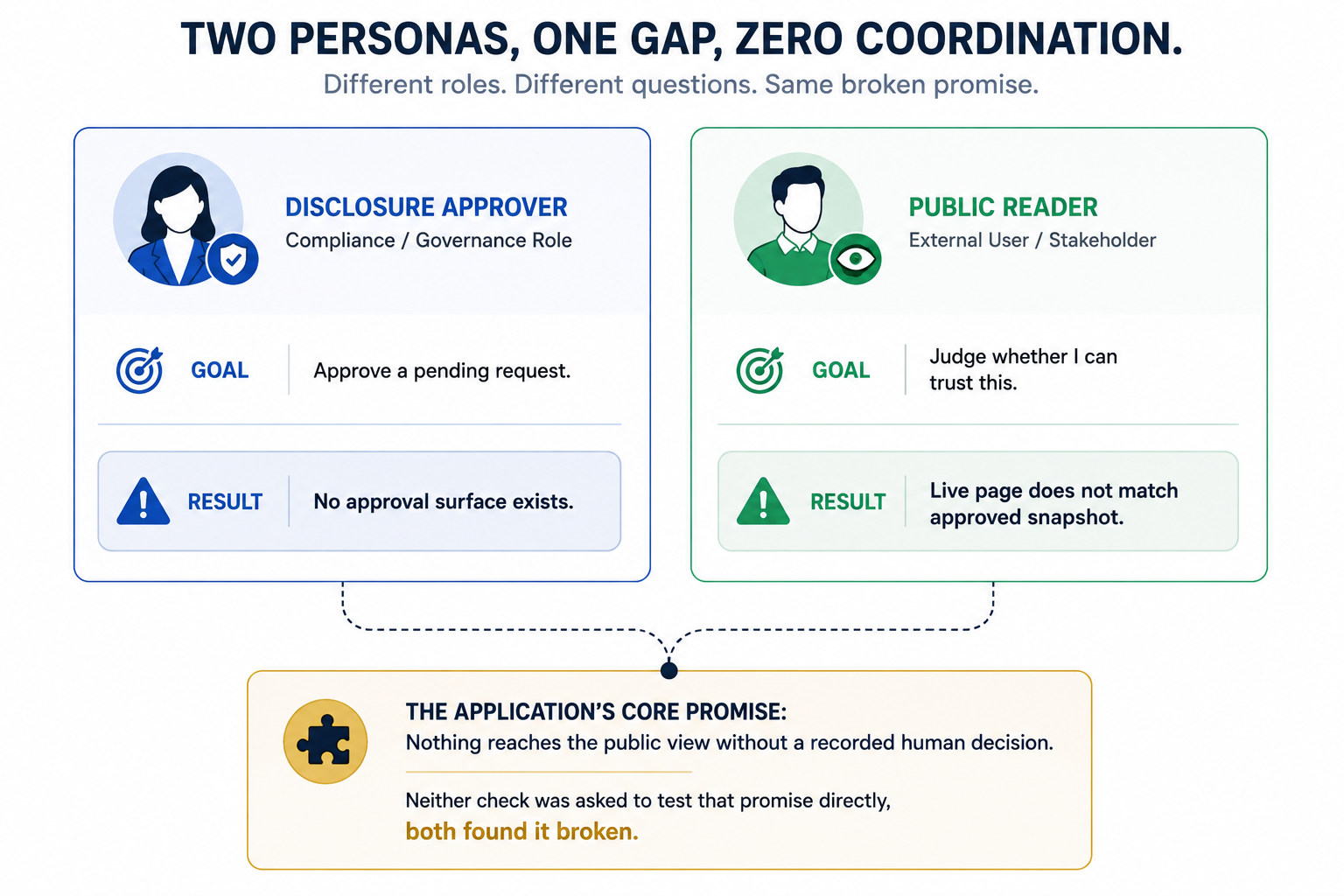
Every automated check assumed an upstream approval process existed. A verifier working from the acceptance criteria cannot challenge that assumption; only a goal-driven verifier without the spec can expose the gap.
The broader architectural lesson is the system invariant: nothing gets published without a recorded human decision, and published content cannot drift from what was approved. It holds across a chain of components; it is not a property of any one of them. But acceptance criteria decompose by component, because that is how stories decompose. Each criterion was individually correct. The invariant was nobody’s criterion.
This failure mode extends beyond AI development and ServiceNow: per-artifact checks can silently lose guarantees that exist between artifacts. Architects therefore need to define the invariants that survive decomposition, while outcome-driven verification checks whether they actually hold.
No P0 was raised and no control was technically bypassed. But the run report recorded the reality: the live build did not uphold the application’s core governance promise. More coverage against the existing spec would never have found that.
What holds it together: evidence that outlives the session
None of this is strategy rather than good intentions without a shared, structured record every layer writes to and reads from, the same evidence-by-construction principle described in Inside an AI Delivery Team.
The QA verdict is a database write, not a chat message: queryable later without re-deriving it from prose, with the build-side and QA-side verdicts stored separately so a disagreement between them is visible rather than silently reconciled. An append-only, timestamped activity log lets a cold session reconstruct exactly what the team tested, how they tested it, and what result they recorded—without relying on anyone’s memory. Handovers between personas specify the target environment, artifact, commit SHA, completed tests, deferred tests and their rationale, while the gate check mechanically enforces every required field.
The architectural commitment underneath all three is one sentence: the interface between AI agents is a schema, not a conversation. Anything that must survive a session boundary—a verdict, defect, deferral, or assumption—goes into a structured store with a defined schema, and the gate refuses to open if any required field is missing.
This matters more with AI participants than with human ones, and for an unglamorous reason: context windows end.
You can still ask a human colleague who forgets a detail. You cannot ask a session once it has closed; if the process did not record something, it effectively did not happen. Every AI SDLC eventually learns this lesson, usually during an argument about what the team agreed three weeks earlier. Designing for it up front is cheaper.
Two properties fall out of that choice rather than needing separate enforcement. Because the log is append-only, a corrected verdict sits beside the original with the reason it changed, instead of overwriting it, so an audit reads the history, not the current opinion, and a superseded pass is visible as a superseded pass.
And because the process routes every finding by type rather than by whoever noticed it—implementation defects to the developer, requirement gaps to the product owner, and friction to design—it prevents teams from closing a requirement gap with a code patch, the most common way to quietly turn a genuine gap into a symptom fix. Ambiguous findings default to the defect queue on purpose: a misrouted item costs minutes to redirect, an unowned one sits indefinitely.
And then the part that compounds: retrospectives turn a miss into a permanent rule. Every rule quoted in this article—the no-self-fix boundary, the first-UI-consumer requirement, the committed-spec-not-someday requirement, and the rule for counting systemic tooling gaps against thresholds—started with a specific incident on a specific story. A retro then identified the root cause, assigned an owner, and turned the lesson into a standing instruction.
Layer 3 went from an improvised session pattern to a codified, reusable skill within the same engagement that discovered the need for it. Layer 4 went from requirements lock to scoped MVP to live first run to a dated retrospective in roughly 24 hours, and the retro’s own fixes were verified live before the retro closed.
That compounding is possible because the process itself is versioned artifacts rather than institutional habit. Persona instructions, gate contracts, and verification procedures live in a repository, under review, with a changelog, so a rule learned on one engagement is not a lesson someone hopefully remembers, it is a diff. The skill library is the distribution mechanism: a technique proven once becomes something any persona on any future engagement loads on demand, with its own prerequisites and failure modes attached. That is the difference between a team that improves and a team whose best session was its best session.
It also closes the loop in the direction that usually stays open. Most delivery processes emit metrics that feed a report. This one feeds its own source: a retrospective’s output is a change to the instructions the next session runs on. The escape rate is not a score, it is the error signal, and the corrective action lands in the artifact that governs behaviour, not in a slide summarising it.
This is the part we mean when we call the whole system a delivery factory rather than a delivery team: four verification layers, one schema, and a retrospective loop that rewrites the process itself, running the same way on the next engagement without anyone having to remember why. That is the mechanism your governance function should be buying. Not a testing methodology frozen at contract signature. A process that measurably gets harder to fool every time something fools it.
What this is not
Not 100% automation. Layer 3 is a session-budgeted, judgment-scoped golden-path check, not a standing regression suite. Converting the highest-value paths into committed, re-runnable specs is the natural next step, and we have not done it yet.
Not free. Every layer costs real time and real compute, tracked per session. The first full Simulated UAT run, requirements lock through live execution and retro, cost $68.62, dominated by the two mechanisms the capability actually runs on: persona dispatch and live browser sessions. The claim is not that testing is costless with AI agents. It’s that the cost of not running an independent, evidence-backed layer is a defect reaching a real user, which is the more expensive failure.
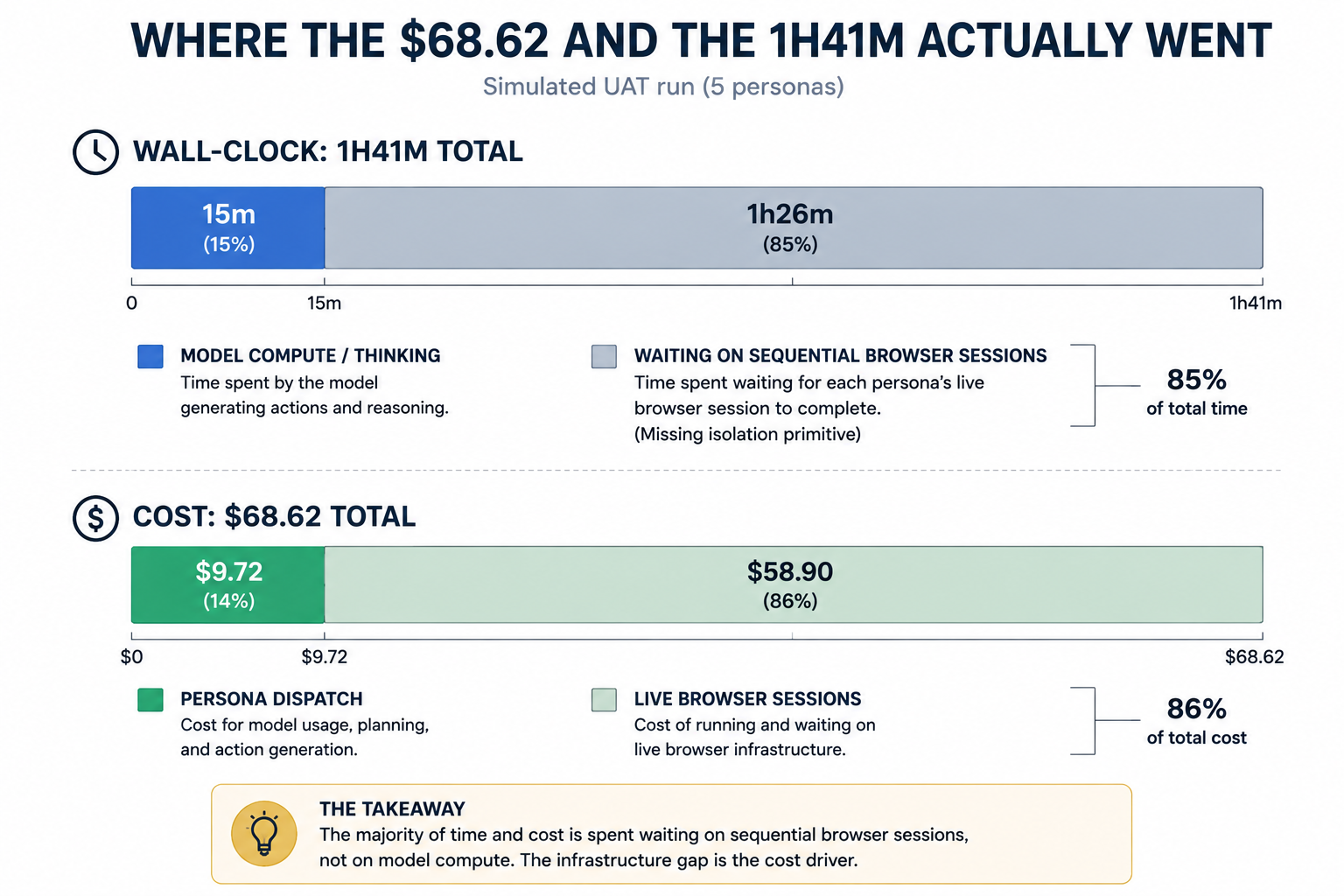
Worth being precise about where that cost sits, because it is not where people assume. On the first run, five sequential panel sessions consumed 1h41m of wall-clock against roughly fifteen minutes of actual model compute. The overwhelming majority of the bill was waiting, a direct consequence of a missing isolation primitive in the browser tooling, not of thinking being expensive.
That is an infrastructure problem with an infrastructure fix, and we are treating it as one. The alternative, relaxing the sequential rule to recover the wall-clock, would trade a real correctness guarantee for a scheduling convenience, which is exactly the trade this whole model exists to refuse.
Not a replacement for human UAT, and never sold as one. Layer 4 hardens the application before a human opens it. It does not remove human sign-off. It also has a known optimism bias worth stating: an AI persona is more patient, more literate, and less likely to give up than a real user, so a panel over-reports success relative to a human. We deliberately defer configurable behavioral traits—impatience, confusion, and skepticism—until we have enough run-over-run data to calibrate them reliably. Until then, Layer 4 is a hypothesis proving itself run by run, not a settled claim.
Not exhaustive, and it says so. The first run covered 5 of that application’s confirmed business roles and named the excluded ones explicitly rather than implying completeness. One finding was retracted in the report itself, not quietly dropped, after QA traced it to its own session-setup error. A run that overstates its coverage or absorbs its own mistakes is worse than no run. It manufactures false confidence exactly where the point is to remove it.
The question to take to your next vendor conversation
If you’re evaluating anyone’s ServiceNow AI development delivery, ours included, the useful questions are not about model choice or lines of code per hour. They’re these:
- Who verifies the work, and can they also change it? If the answer is “the same agent,” you have no verification, you have a self-report. Ask where the separation is enforced: in the data model, or in a prompt that a deadline can override.
- Are your checks independent, or merely numerous? Five checks sharing one model, one context, and one source of truth fail on the same inputs. Ask what is different between any two of them; if the honest answer is “thoroughness,” you have one check billed five times.
- What’s the evidence? A rendered page, a saved screenshot, a database row with a timestamp, or a paragraph of prose in a chat log that nobody can re-run? And when a check doesn’t run, is that a recorded state with a reason, or a blank field that reads as a pass?
- What can catch a gap in the requirements themselves? If every check derives from the spec, nothing in the process can identify when the spec itself is wrong.
- When a defect escapes, what changes? A patch, or a permanent rule the whole team inherits, and is that rule a versioned artifact the next engagement starts from, or a lesson somebody hopefully remembers?
We’d rather be measured against those questions than against a velocity number. If governance and control-tower-level oversight of AI agents in production is on your 2027 roadmap, the related reading is Why Every Enterprise Will Need an AI Control Tower by 2027 and Securing Enterprise AI Agents.
Bring us one story. One real item from your ServiceNow backlog. We’ll run it through all four layers and hand you the evidence pack: the gate verdicts, the coverage numbers, the browser evidence, and the spec-blind panel report, including whatever it finds that the spec didn’t anticipate.
FAQ: AI Verification and Testing on ServiceNo
Isn’t a fourth verification layer just more cost for diminishing returns? It would be if it were more of the same. It isn’t. It’s the only layer positioned to find requirement gaps rather than implementation defects. On its first run every substantive finding was net-new against a set of known historical defects, and two of them described a core governance promise that wasn’t true of the live build. That’s not a diminishing return; it’s the class of finding that otherwise surfaces in front of your business stakeholders during UAT.
How do you stop the AI panel from just agreeing with the AI that built it? Two mechanisms. The system constructs the panel’s session context without the acceptance criteria, design document, or QA record, then verifies that isolation through a business-fit review and a mechanical grep of the assembled context immediately before opening the session. And the panel runs on a different model family from the build-and-QA loop, so it isn’t the same model re-grading its own work.
Does this slow delivery down? It costs real wall-clock, and most of that cost is a solvable infrastructure limit rather than a property of the method: panel sessions run strictly sequentially because the browser tooling exposes no session isolation, so the time goes on waiting, not on thinking. Fixing it means building the missing isolation primitive, not relaxing the rule that currently compensates for its absence.
Layers 1–3 add little to critical path by comparison: they run inside the build-and-QA loop that was happening anyway, and the round-trips they prevent are considerably more expensive than the checks themselves. The process measures, logs, and reports the trade-off openly rather than optimizing it away.
Why four separate layers instead of one very good test suite? Because the failures we’re catching are not all the same kind of failure. A suite, however good, executes a set of assertions derived from a specification programmatically. That is one vantage point, and it is structurally incapable of observing what a browser renders or of questioning whether the specification was right. You can make it deeper, faster, and more comprehensive without ever making it able to see those things. Four layers is not four suites; it’s four different positions to observe the same system from, chosen so that each one’s blind spot is inside another one’s field of view.
How does this fit an organisation that already has its own SDLC and change governance? It slots underneath rather than alongside. Every layer’s output is a structured record, a verdict with a timestamp, a defect with a reference, evidence with a location, which is precisely the input your existing change-approval and audit processes already consume. The layers govern how work becomes trustworthy before it reaches your gate; they do not replace your gate, and they do not ask you to adopt our tooling to read the result.
In practice, the integration question usually runs in the opposite direction from what people expect: not “can your process fit ours?” but “does our current process require evidence from AI-generated work that it was never designed to produce?”
We’re heavily customised. Does any of this survive contact with our instance? Customisation is precisely where structural checks fail and rendered-page checks earn their keep. The reference-field and blank-page findings above both came from real scoped-application behaviour, not clean demo apps. The same point made in AI SDLC Governance applies: gated verification exists to catch conflicts with existing customisations before they reach production, not to assume a clean slate.
Kostya Bazanov, Managing Director, Aug 14, 2026
Eager to take the next step? Contact us today!
Latest Articles
Teiva Systems at ServiceNow AI Summit 2026 — Munich
On October 7, 2026, Teiva Systems joined the ServiceNow AI Summit in Munich, where industry leaders, innovators, and the ServiceNow community came together to explore the next chapter of enterprise AI and intelligent automation.
read more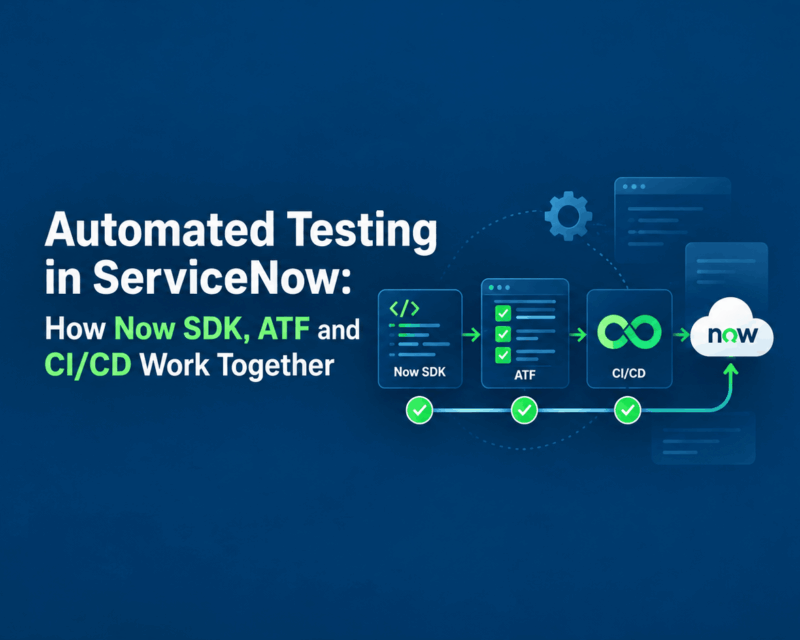
Automated Testing in ServiceNow: How Now SDK, ATF and CI/CD Work Together
Automated Testing in ServiceNow: How Now SDK, ATF and CI/CD Work Together Automated testing in ServiceNow is becoming more important, not because ATF or CI/CD are new concepts, but because the way they can work together is changing the development lifecycle itself. As ServiceNow moves toward a more source-driven engineering model, testing is becoming less […]
read more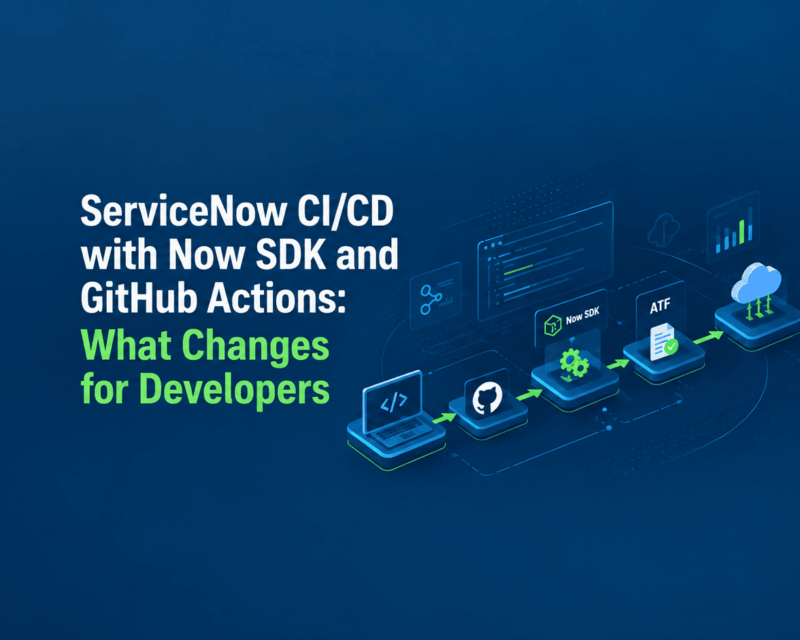
ServiceNow CI/CD with Now SDK and GitHub Actions: What Changes for Developers
The Now SDK connects ServiceNow application development to GitHub Actions CI/CD pipelines — bringing pull-request quality gates, automated ATF testing, and controlled release governance to a platform that has historically required its own isolated delivery process.
read more