
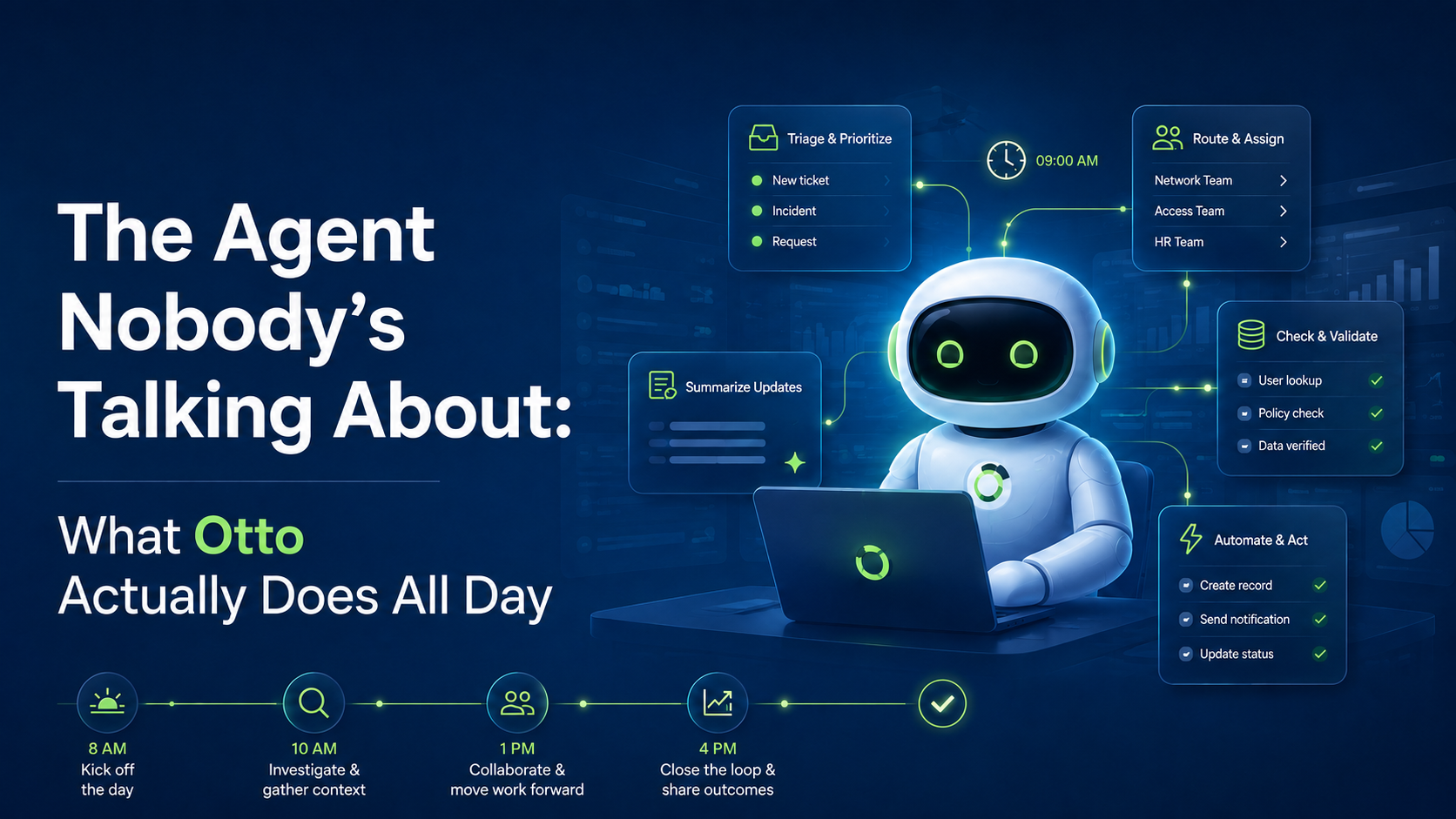
The Agent Nobody’s Talking About: What Otto Actually Does All Day
Discover how ServiceNow’s Otto Release Documentation Agent quietly eliminates one of the most repetitive parts of every release cycle — without changing your development process.
“The best automation isn’t the one everyone notices. It’s the one that quietly removes work you never wanted to do in the first place.”
Every ServiceNow release introduces features that quickly take over conference keynotes and LinkedIn discussions. The Australia release is no exception. AI Control Tower, Action Fabric, L1 AI Specialist, and new governance capabilities have received much of the attention — and for good reason.
Enterprise AI governance matters.
But behind the bigger announcements is a smaller AI agent solving a very practical problem. It is focused, easy to understand, and designed to remove a repetitive task from everyday ServiceNow development.
Meet Otto, ServiceNow’s Release Lifecycle Documentation AI Agent.
Unlike autonomous agents that coordinate workflows or make operational decisions, Otto has one responsibility: generate release documentation automatically.
Generate release documentation automatically.
As part of ServiceNow’s broader AI strategy, Otto demonstrates how practical AI can improve everyday development tasks rather than replacing people. You can learn more about the company’s AI vision on the ServiceNow AI platform.
That may not sound revolutionary — but for ServiceNow developers, administrators, and release managers, it removes one of the most consistently overlooked bottlenecks in every deployment.
Documentation: The Last Task Everyone Rushes
Every ServiceNow development cycle follows a familiar pattern.
Build Feature
↓
Test Changes
↓
Fix Bugs
↓
Validate Update Set
↓
Deploy
↓
❗ Write Documentation
The documentation step almost always happens after the technical work is finished. By then: the developer has already switched mental context, the sprint deadline is approaching, another ticket is waiting, and nobody wants to spend another 20 minutes writing release notes.
The result?
Generic update set descriptions. Missing implementation details. Copy-and-paste documentation. Poor release history. Difficult audits later.
The irony is that documentation becomes most valuable months later — precisely when nobody remembers what changed.
Otto exists to solve exactly this problem.
Otto exists to solve exactly this problem.
What Otto Actually Does
Instead of asking developers to manually explain every update set or release, Otto analyses the implemented changes and generates documentation automatically.
Its responsibilities include:
- Drafting Update Set descriptions
- Creating Release Notes
- Summarizing implementation changes
- Producing consistent documentation language
- Giving developers a review-ready draft
Instead of this:
Description:
“Fixed catalog issue.”
Otto might generate something closer to:
Implemented validation improvements for the Employee
Onboarding Catalog Item.
Changes include:
• Updated client validation logic
• Added mandatory approval conditions
• Improved error messaging
• Fixed duplicate submission behavior
The difference between before and after is immediate:
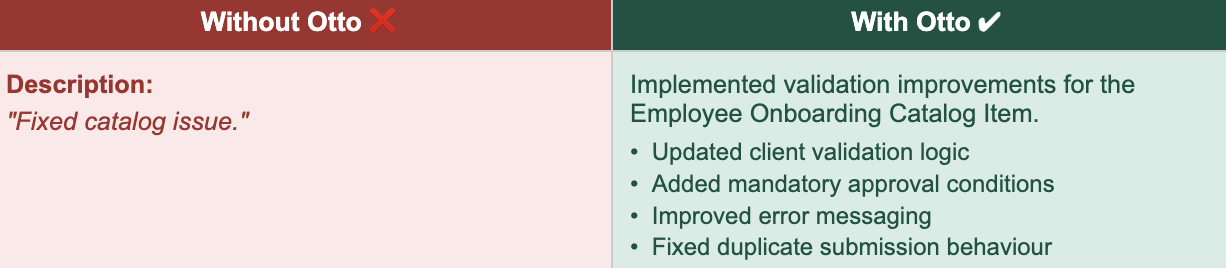
The developer reviews, edits if necessary, and publishes. The blank page disappears.
If your organization follows structured release management practices, ServiceNow provides detailed implementation guidance within the ServiceNow Documentation portal.
Otto Isn’t Replacing Developers
One misconception surrounding AI agents is that they replace technical work.
Otto does not.
It removes administrative friction.
Think of where development hours actually go.
Developer Time Distribution
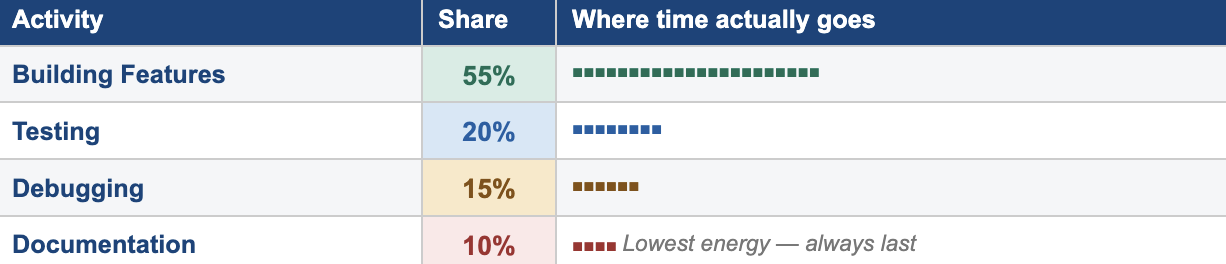
Documentation is not the largest activity. It is simply the one with the lowest energy because it always happens last. Removing even ten minutes from every deployment scales surprisingly quickly.
Small Scope, Big Value
Australia introduces agents capable of coordinating workflows, triggering actions across systems, and supporting enterprise operations.
Otto deliberately does none of those things.
Instead, its scope is intentionally narrow.
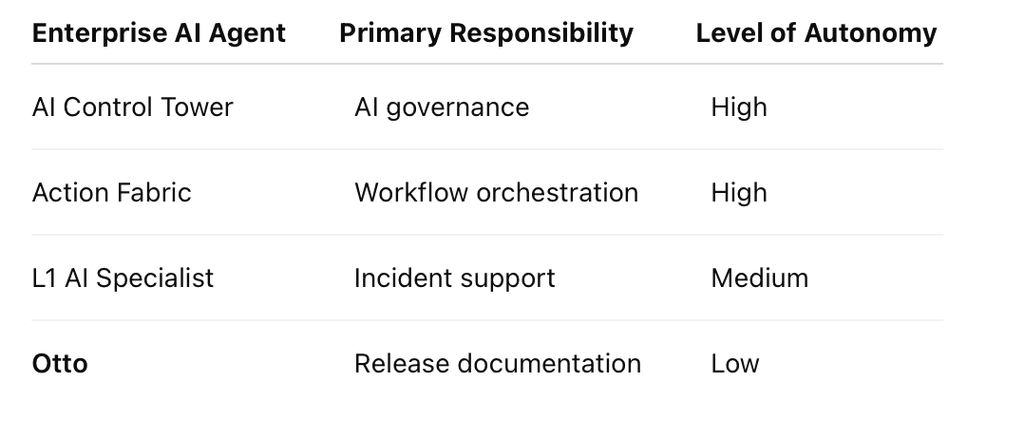
That narrow scope is actually its greatest strength.
Because Otto:
- doesn’t approve deployments
- doesn’t modify records
- doesn’t execute workflows
- doesn’t make business decisions
…it requires far less organizational change to adopt.
Organizations exploring ServiceNow’s growing AI ecosystem can also review the official overview of ServiceNow AI Agents to understand how Otto fits alongside more advanced enterprise agents.
What we see in release management conversations with clients:
Documentation quality is often one of the most delayed parts of a ServiceNow development programme. Teams know it matters and may even track it as a KPI. In practice, however, release notes are often written under pressure as the deployment window approaches.
The result can vary dramatically. Even within the same team and the same sprint, documentation may range from detailed release notes to a simple “Updated form.”
Otto helps reduce that inconsistency. It creates a structured starting point for release documentation without requiring developers to change the way they already work.
Why Scoped AI Often Delivers Faster ROI
One lesson emerging across enterprise AI adoption is that the highest ROI does not always come from the biggest AI projects. Instead, organisations often see measurable productivity gains by eliminating dozens of tiny repetitive tasks.
Imagine this scenario:
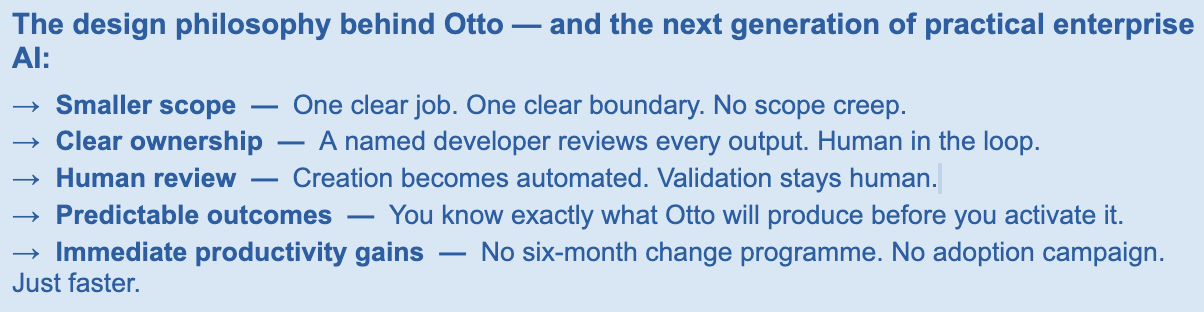
And unlike large AI transformation projects, there is almost no behaviour change required.
Consistency Matters More Than Speed
Speed is only part of Otto’s value. Consistency may matter even more.
Release documentation can vary significantly from one developer to another. Some developers include business impact, technical changes, affected applications, and rollback notes. Others simply write: “Bug fixes.”
Months later, support teams, auditors, and new developers rely on that documentation to understand what changed and why.
“Good release notes become institutional knowledge. Poor release notes become technical archaeology.”
Otto creates a more consistent starting point for every release. Developers still review and validate the content, but instead of facing an empty text box, they begin with a clear, structured draft.
AI as a Writing Assistant — Not an Author
One of the healthiest ways to think about Otto is not as an autonomous agent, but as a specialised writing assistant. Its workflow is simple:
| 1. Developer completes work | Update set validated, ready to deploy |
| 2. Otto analyses changes | Reviews update set contents, scripts, metadata |
| 3. Documentation draft generated | Structured release notes with change details |
| 4. Developer reviews | Edit, approve, or expand — 2 minutes vs 12 minutes |
| 5. Release published | Consistent, structured documentation on record |
Human oversight never disappears. Instead, human effort shifts from creation to review.
That distinction matters. The fastest AI implementations are often those where people remain in control while repetitive preparation work becomes automated.
The Bigger Lesson Behind Otto
Otto may never receive the same attention as AI Control Tower or Action Fabric. It is not flashy. It does not orchestrate enterprise workflows. It does not manage governance policies. It simply removes one repetitive task that almost every ServiceNow developer encounters.
Ironically, that makes Otto one of the clearest examples of practical enterprise AI.
Rather than trying to automate everything, ServiceNow identified a narrow pain point, defined clear boundaries, and delivered an agent that performs one job consistently well. That design philosophy is likely to shape the next generation of enterprise AI:
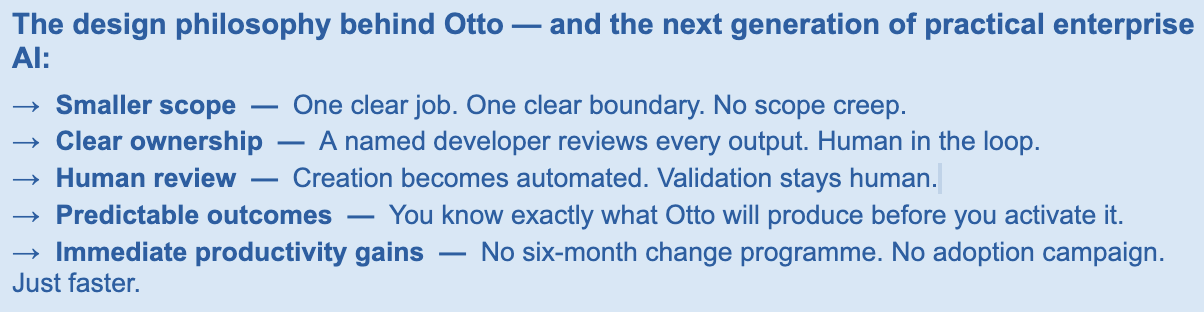
Sometimes the most valuable AI is not the one making headlines.
It is the one quietly finishing the work everyone forgot to do.
To explore additional AI innovations introduced by ServiceNow, visit the official Now Platform AI page and the ServiceNow Product Documentation for detailed product guidance.
These links are integrated where they provide context, which is better for SEO and reader engagement than placing all of them at the end.
Oleksii Konakhovych, CTO, Sep 02, 2026
Eager to take the next step? Contact us today!
Latest Articles
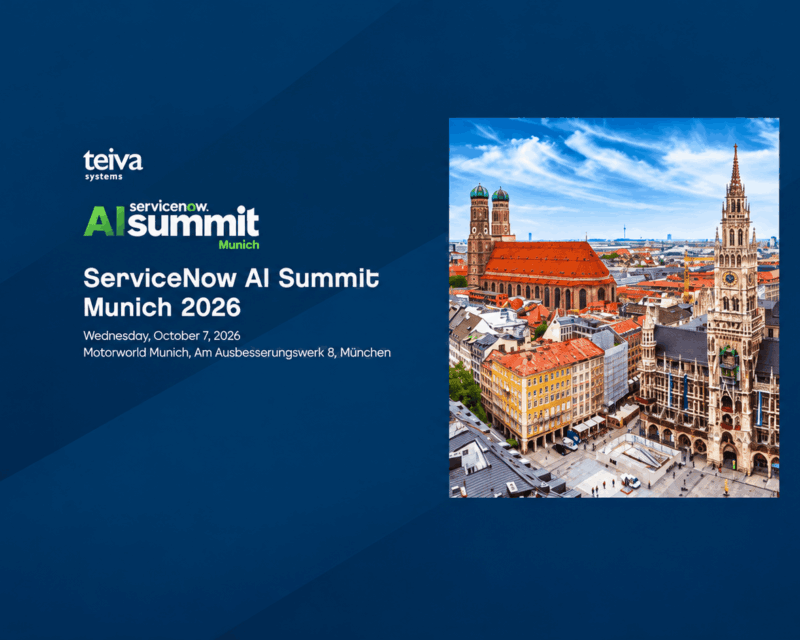
Teiva Systems at ServiceNow AI Summit 2026 — Munich
On October 7, 2026, Teiva Systems joined the ServiceNow AI Summit in Munich, where industry leaders, innovators, and the ServiceNow community came together to explore the next chapter of enterprise AI and intelligent automation.
read more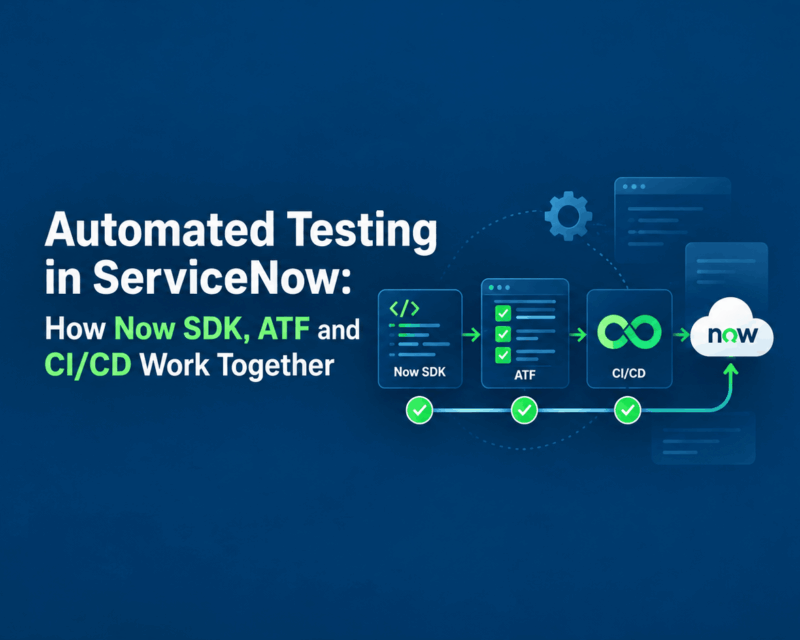
Automated Testing in ServiceNow: How Now SDK, ATF and CI/CD Work Together
Automated Testing in ServiceNow: How Now SDK, ATF and CI/CD Work Together Automated testing in ServiceNow is becoming more important, not because ATF or CI/CD are new concepts, but because the way they can work together is changing the development lifecycle itself. As ServiceNow moves toward a more source-driven engineering model, testing is becoming less […]
read more
ServiceNow CI/CD with Now SDK and GitHub Actions: What Changes for Developers
The Now SDK connects ServiceNow application development to GitHub Actions CI/CD pipelines — bringing pull-request quality gates, automated ATF testing, and controlled release governance to a platform that has historically required its own isolated delivery process.
read more