
What ServiceNow’s Context Engine Means for CMDB Teams
ServiceNow’s AI systems — Otto, the Autonomous Workforce, Now Assist — do not just need data. They need context: which service is affected, who owns it, what depends on it, and what should happen next. Context Engine is how they get it. And the CMDB is what determines whether it is trustworthy.
“In an AI-enabled ServiceNow environment, the CMDB is no longer just a repository of records. It becomes part of the context layer that determines whether AI can understand the enterprise correctly.”
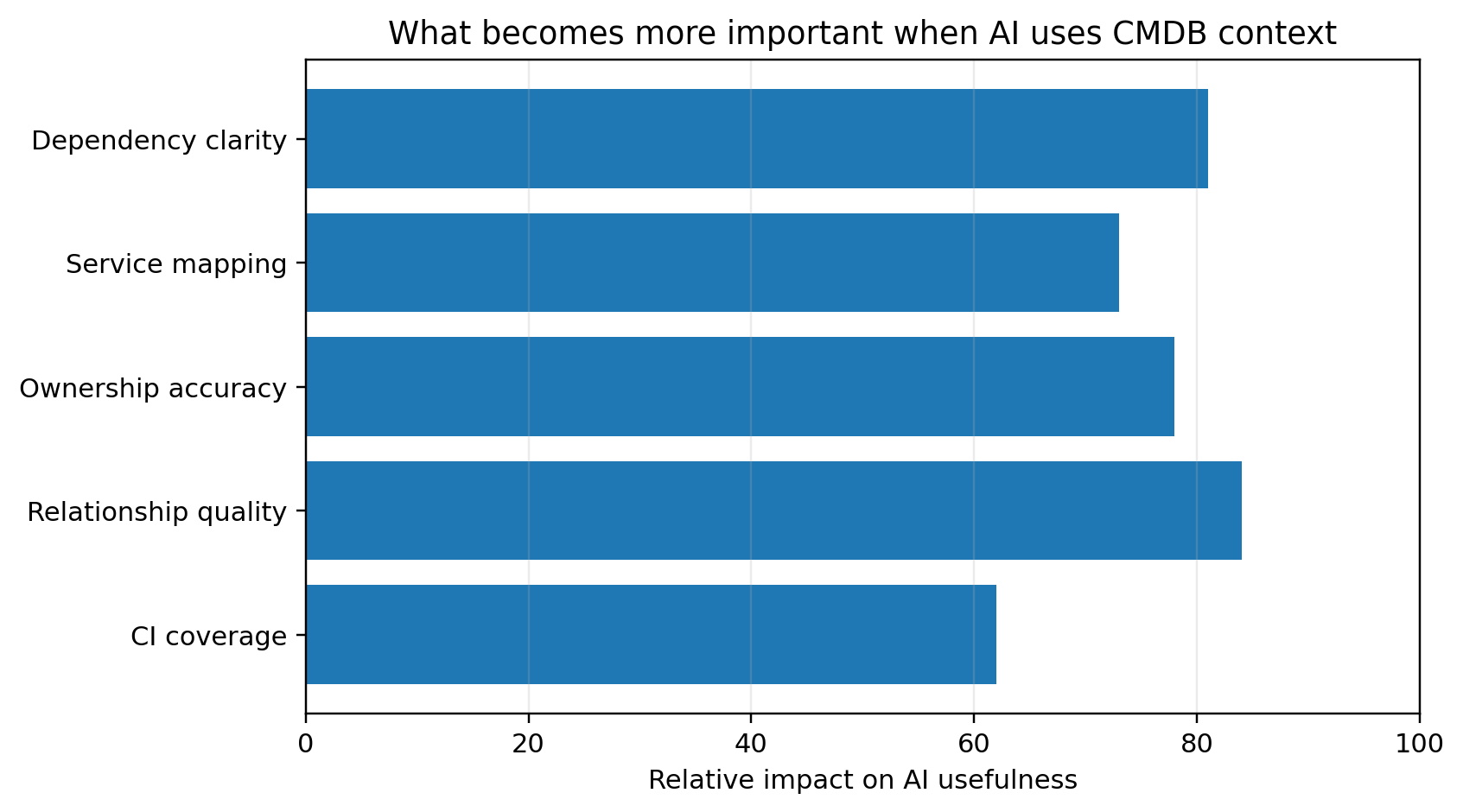
Figure 1. When AI starts consuming CMDB-backed context, relationship quality, ownership accuracy, and dependency clarity become even more important than raw record volume.
What Is the Context Engine? A Technical Anchor
ServiceNow’s AI strategy is no longer focused only on copilots and chat interfaces. The bigger shift is toward giving AI systems the context they need to act effectively inside enterprise workflows — without becoming disconnected, inaccurate, or risky.
That is where ServiceNow’s Context Engine becomes important, especially for CMDB teams.
Before looking at what this means in practice, it is important to understand what Context Engine actually does.
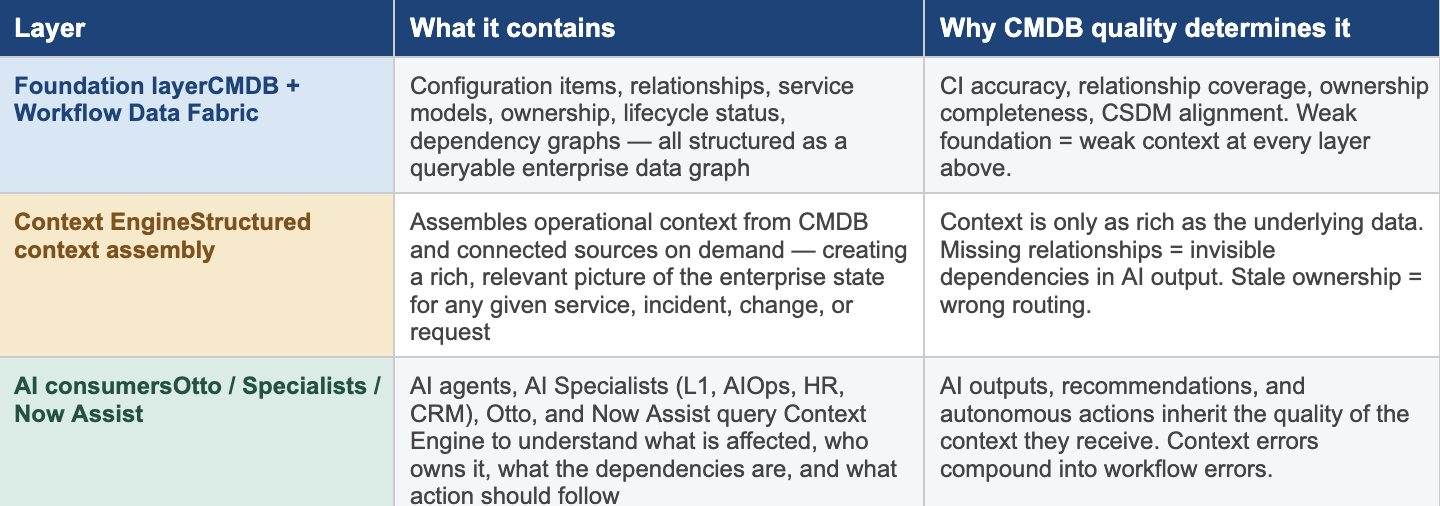
Context Engine operates as part of the Workflow Data Fabric, ServiceNow’s unified data access layer. It sits above the raw CMDB and brings together structured enterprise information such as:
- Configuration items (CIs)
- CI relationships and dependencies
- Service models
- Ownership information
- Lifecycle states
- Operational history
It then organizes this information into a structured context graph that ServiceNow AI systems can query directly.
For example, when an AI agent, AI Specialist, or Otto needs to determine which service is affected by an incident, who owns that service, what other systems depend on it, or how risky a proposed change might be, it can query Context Engine.
Context Engine uses the available enterprise data to assemble the relevant answer and provide the AI system with the context it needs to act.
But there is one important limitation:
The quality of that context depends directly on the quality of the underlying CMDB.
If CMDB data is incomplete, outdated, duplicated, or poorly connected, AI will inherit those weaknesses. As Context Engine becomes more important to ServiceNow’s AI architecture, CMDB quality becomes not just an IT operations issue, but an AI readiness requirement.
Figure 2 — Context Engine sits between the CMDB and the AI consumers that act on enterprise context:
For many organisations, the Configuration Management Database is already one of the most important system-of-record layers in the platform. It connects services, applications, infrastructure, owners, environments, and dependencies. But CMDB teams have also lived with a constant tension: the value of the CMDB depends on context being accurate, current, and usable across multiple workflows, while the reality is often fragmented data, inconsistent ownership, and difficult-to-maintain relationships.
Context Engine makes that tension consequential in a new way. It is no longer just about whether reports look clean or whether audits pass. It is about whether the AI systems your organisation depends on get accurate answers.
Why Context Engine Matters in ServiceNow’s AI Direction
ServiceNow is moving toward a model where AI is expected to do much more than answer questions.
AI is increasingly being used to summarise records, recommend next actions, assist agents, trigger workflows, and support automation across IT, employee, customer, and business operations.
None of that works well without context.
An AI system is only as useful as the operational picture it can see. If it cannot understand which service is affected, which application is involved, who owns it, which environment is impacted, or which upstream and downstream dependencies matter, its recommendations and actions will remain limited.
This is why Context Engine matters.
It is part of ServiceNow’s broader effort to make enterprise context available to AI in a structured, reusable way across different AI experiences.
For CMDB teams, this changes the role of the CMDB.
The CMDB is no longer just a repository used for reporting, audits, or operational visibility. It increasingly becomes part of the context layer that helps AI understand enterprise operations correctly.
That also changes the business case for CMDB investment.
Instead of saying:
“We need better CMDB data for better reporting.”
the conversation becomes:
“We need better CMDB data so AI can make accurate recommendations and act safely.”
That is a materially different argument.
In our CMDB assessments, we are already using this framing by connecting individual data-quality gaps directly to the AI use cases they could block, weaken, or make less reliable.
For example, missing ownership data can limit automated routing. Poor relationship mapping can weaken impact analysis. Incomplete service models can reduce the quality of AI-generated recommendations.
This makes CMDB improvement easier to connect to concrete business outcomes — and often creates a much stronger case for funding and executive attention than generic data-quality initiatives.
CMDB Teams Are Moving Closer to the AI Control Layer
For years, CMDB programmes have been measured using familiar metrics such as CI completeness, relationship coverage, reconciliation quality, duplicate reduction, service mapping accuracy, and governance maturity.
Those metrics still matter. But with Context Engine, their business relevance becomes much greater.
As AI systems begin using CMDB-backed context to support incident management, change decisions, root-cause analysis, risk assessment, and service operations, data quality is no longer just a back-office concern.
It becomes directly connected to AI accuracy, reliability, and safety.
The impact is easy to see:
- If a CI is linked to the wrong business service, an AI assistant may summarise the wrong business impact.
- If ownership information is outdated, an AI-driven workflow may route an issue to the wrong team.
- If relationships are incomplete, AI may miss a critical dependency during impact analysis.
- If service data is inaccurate, an AI recommendation may suggest an action that creates risk elsewhere in the environment.
In other words, weak CMDB data does not stay inside the CMDB. It can directly affect the quality of AI-generated insights, recommendations, and automated actions.
That makes CMDB health increasingly important to the success of ServiceNow AI initiatives.
That is why Context Engine effectively pulls CMDB teams closer to the AI control layer. They are no longer only custodians of platform data. They are becoming stewards of operational context that AI systems rely on.
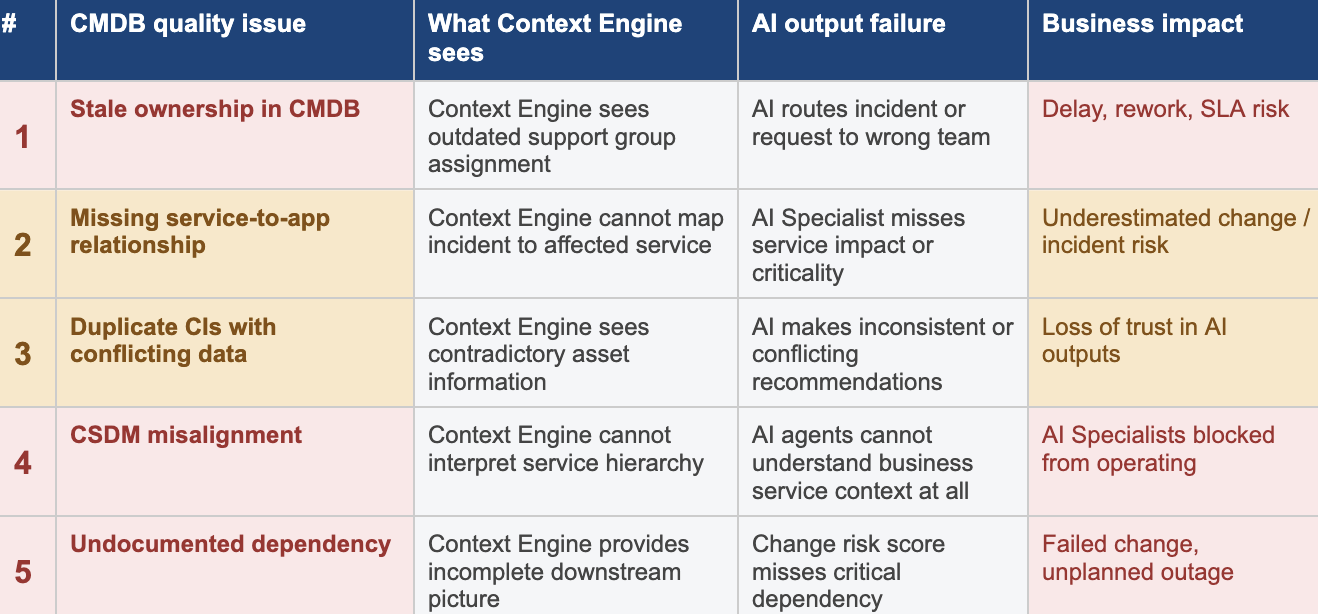
Figure 3 — How CMDB quality issues compound through Context Engine into AI output failures and workflow errors:
What Changes for CMDB Teams in Practice
There are four practical shifts CMDB teams should pay attention to.
| 1 | Data quality becomes more visible |
| In a traditional CMDB conversation, data quality problems may surface in audits, implementation reviews, or failed operational processes. In an AI-enabled environment, bad context becomes visible faster because it appears directly in recommendations, summaries, routing decisions, and automated actions. Poor service relationships or stale ownership will not stay hidden for long if AI is actively consuming that data. In ServiceNow: Now Assist and AI Specialists surface CMDB quality problems in front of end users in real time — as wrong answers, wrong routing, or failed lookups. The CMDB health conversation moves from the platform team to the service desk the moment AI goes live. |
| 2 | Relationship depth matters more than CI volume |
| Many CMDB programmes focus heavily on population coverage: how many configuration items are in the database, how many classes are filled, how much discovery has run. Context Engine shifts attention toward relationship quality and business relevance. AI needs meaningful context, not just more records. Knowing that a server exists is less useful than knowing which business service it supports, which application depends on it, what environment it belongs to, and who owns the service it affects. In ServiceNow: Context Engine cannot assemble a meaningful picture from isolated CIs. It needs the service-to-application-to-infrastructure relationship chain. CSDM alignment is the foundation that makes those chains traversable by AI. |
| 3 | Service context becomes more operational |
| CMDB teams have often struggled to keep service models useful beyond architecture diagrams or reporting. With Context Engine, service context becomes more operational because it can influence how AI interprets incidents, changes, requests, and operational risk. That raises the value of service mapping, ownership accuracy, and dependency clarity. In ServiceNow: AI Specialists for incident management, AIOps, and change risk analysis all query service context directly via Context Engine. A service model that was previously used only in PIRs and architecture reviews now influences live AI decisions. |
| 4 | Governance becomes cross-functional |
| CMDB teams cannot prepare for this shift alone. If the CMDB is becoming part of the AI context layer, then governance needs tighter alignment across platform owners, process owners, security, asset teams, and the teams responsible for AI use cases. The question is no longer just whether CMDB data is technically correct. It is whether it is reliable enough to guide AI behaviour in live enterprise workflows. In ServiceNow: This is the shift we recommend addressing in every CMDB governance conversation: identify which AI use cases will consume which CMDB domains first, and assign an owner for each context domain who is accountable for AI-grade data quality — not just record completeness. |
Where Context Engine Could Create the Biggest Value
For CMDB teams, the real opportunity is not simply that AI can “use the CMDB.” The bigger opportunity is that better context can make ServiceNow workflows more intelligent and more precise.
The five highest-value use cases — and the specific CMDB data quality each one depends on:
| Use case | CMDB data Context Engine needs | CMDB quality threshold |
| Incident triage & impact | Service-to-app relationships, ownership, env | Service mapping must be >80% for critical services. Stale ownership breaks routing instantly. |
| Change risk analysis | Downstream dependencies, business service links | Missing relationships = invisible risk. CSDM alignment required for meaningful downstream scoring. |
| Root-cause investigation | CI relationships, change history, alerts | Relationship depth and recency determine whether AI connects the right dots or misses them entirely. |
| Knowledge & recommendation | Service context, environment, support group | Incomplete ownership and service context produce generic, low-value AI suggestions. |
| Routing & escalation | Support group accuracy, service ownership | Outdated support groups are the #1 cause of AI-triggered misrouting in production environments. |
None of these use cases depend on the CMDB existing in theory. They depend on the CMDB being operationally trustworthy — and on Context Engine being able to assemble accurate, current, relationship-rich context from it on demand.
What CMDB Leaders Should Do Now
CMDB leaders do not need to wait for a perfect future-state architecture before acting. The more practical approach is to assume that ServiceNow AI capabilities will increasingly rely on enterprise context and prepare the CMDB accordingly.
6 actions CMDB leaders should take now — regardless of where Context Engine is in your deployment roadmap:
→ Clean up ownership and support-group accuracy for critical services and applications. Outdated ownership is the most common cause of AI misrouting and the fastest to fix.
→ Improve service-to-application and application-to-infrastructure relationships where operational use cases depend on them most. Start with your top 10–20 business-critical services.
→ Identify which CMDB domains will be consumed first by AI-enabled workflows — incident, change, operations, and support. Prioritise those domains for quality remediation.
→ Tighten governance around stale records, duplicate CIs, and incomplete relationship models. These are the top three causes of context degradation in AI outputs.
→ Align with platform and AI stakeholders to define which CMDB-backed context should be considered trusted enough to drive AI recommendations or automation without human review.
→ Rethink CMDB success metrics: move from coverage alone toward context usefulness — whether the CMDB helps operational workflows make better, faster, and safer decisions.
Context Engine matters for CMDB teams because it raises the strategic importance of operational context inside ServiceNow. The CMDB is no longer only a foundation for discovery, service mapping, and reporting. It is becoming part of the context layer that helps AI understand the enterprise.
That shift puts new pressure on CMDB quality, governance, and business relevance. But it also creates a stronger business case for the work CMDB teams have been trying to drive for years. In an AI-enabled ServiceNow environment, accurate service context is no longer just nice to have. It is part of what determines whether AI recommendations, summaries, and automations can actually be trusted..
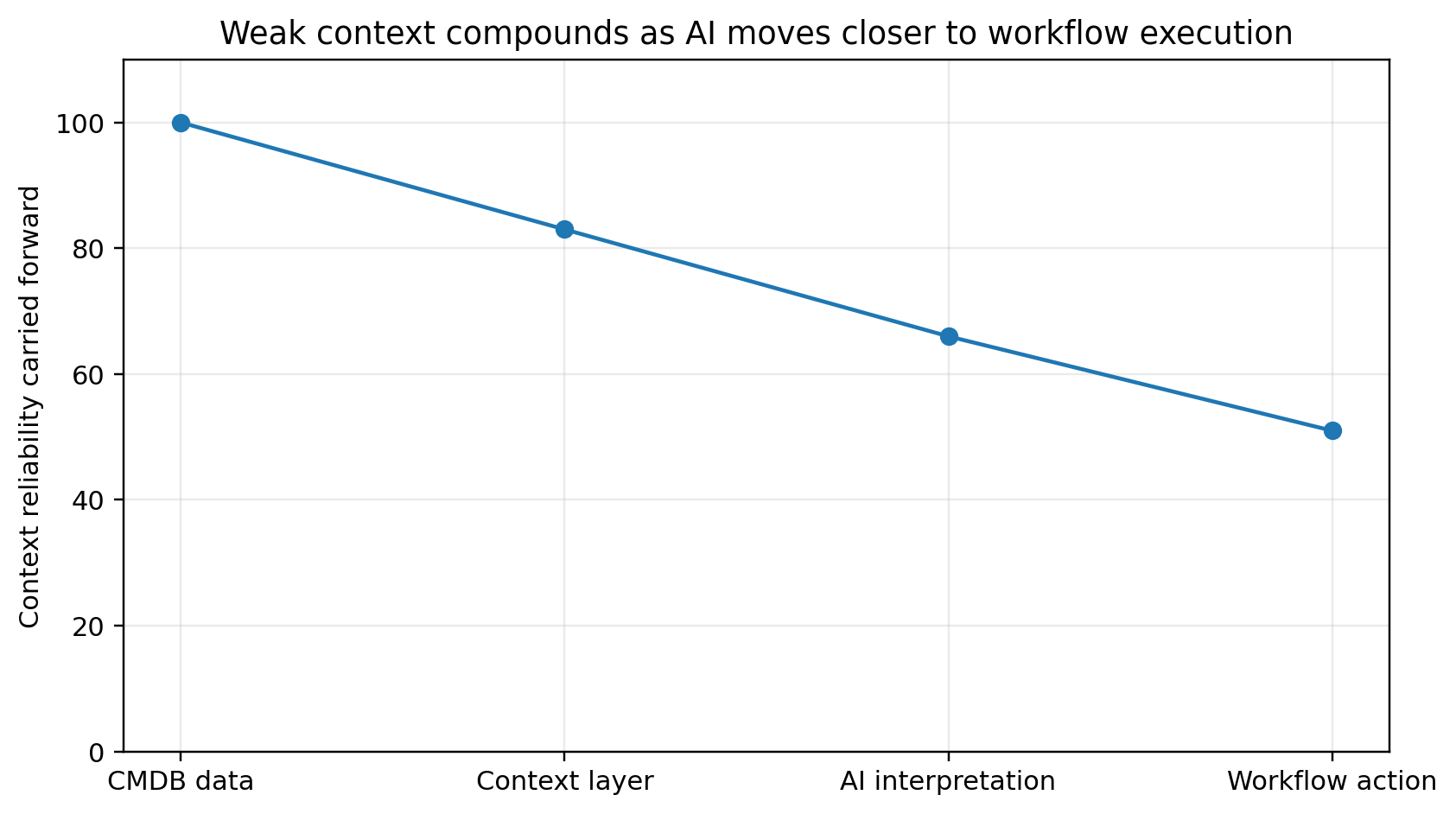
“If AI will use service context to recommend, route, summarize, or automate work, then CMDB quality stops being a reporting problem and becomes an AI trust problem.”
Figure 4. Context quality issues do not stay isolated in the CMDB. They compound as data moves into AI interpretation and then into workflow decisions or automation.
Slava Trotsenko, CEO, Sep 09, 2026
Eager to take the next step? Contact us today!
Latest Articles
Teiva Systems at ServiceNow AI Summit 2026 — Munich
On October 7, 2026, Teiva Systems joined the ServiceNow AI Summit in Munich, where industry leaders, innovators, and the ServiceNow community came together to explore the next chapter of enterprise AI and intelligent automation.
read more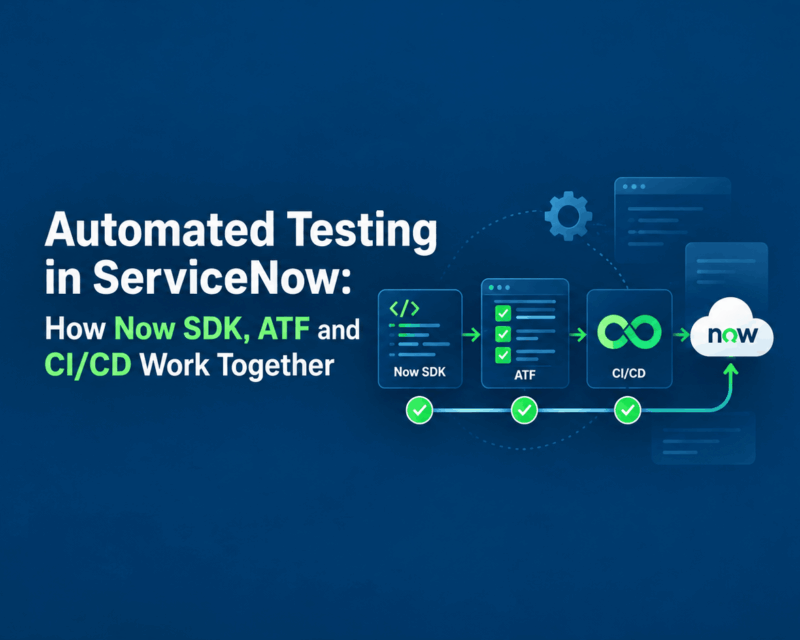
Automated Testing in ServiceNow: How Now SDK, ATF and CI/CD Work Together
Automated Testing in ServiceNow: How Now SDK, ATF and CI/CD Work Together Automated testing in ServiceNow is becoming more important, not because ATF or CI/CD are new concepts, but because the way they can work together is changing the development lifecycle itself. As ServiceNow moves toward a more source-driven engineering model, testing is becoming less […]
read more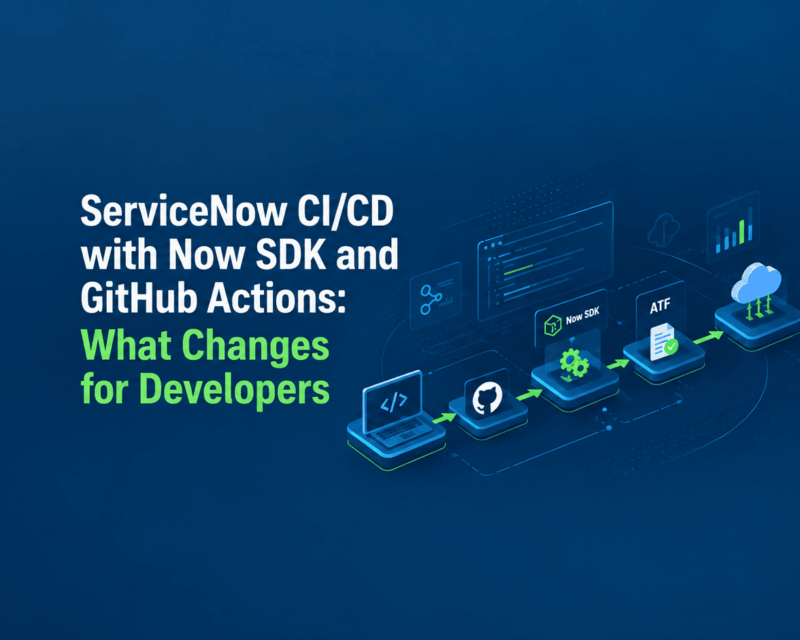
ServiceNow CI/CD with Now SDK and GitHub Actions: What Changes for Developers
The Now SDK connects ServiceNow application development to GitHub Actions CI/CD pipelines — bringing pull-request quality gates, automated ATF testing, and controlled release governance to a platform that has historically required its own isolated delivery process.
read more