
Best Practices for Supporting Enterprise ServiceNow Environments
ServiceNow is a technology platform that automates enterprise-level services, processes, and interactions. However, once implemented, it is frequently abandoned without enough assistance. This leads to decreased efficiency, outages, and scalability concerns. Excellent platform support should be built on tried-and-true techniques and continuous monitoring. ServiceNow support best practices include a clear job model, regular maintenance, thorough documentation, productive analytics, and upgrade readiness.
Roles, Responsibilities, and What Keeps Things Running
Stable support depends not on the number of staff, but on a clear division of responsibilities. A typical ServiceNow support services model includes:
- a system admin is responsible for the instance’s configuration and stability;
- developers who support custom functionality;
- a platform architect who ensures consistency of changes;
- business analysts for communication with end users;
- a support manager who coordinates procedures and changes.
It is also critical to provide ServiceNow go-live assistance throughout the launch phase, when you need to assure continuous operation, quick response to problems, integration checks, and compliance with business requirements.
Do not Wait for Things to Break
ServiceNow instance, health checks should be conducted regularly, preferably quarterly. This allows you to identify technical debts, out-of-date configurations, and problematic elements before they cause outages. Recommended areas of inspection:
- custom scripts and business rules;
- performance of tables and indexes;
- event logs, API queue handling;
- stability and logic of integrations.
This data serves as the base for ServiceNow platform optimization. If performance drops or support becomes problematic, optimization is required. In addition, modifications must be scheduled, tested in a staging environment, and documented, particularly in customized instances. This ensures effective ServiceNow upgrade management.
Documentation: The Support You Didn’t Know You Needed
Lack of documentation makes support critically difficult. Changes in personnel, expansion of functionality, and the launch of new services are all impossible without an up-to-date knowledge base. The documentation should be:
- Technical: instance structure, integrations, execution logic.
- Operational: failure scenarios, known errors, and instructions.
- Management: roles, SLAs, escalation paths, contact persons.
A living knowledge base should include solution templates, instructions, and reference materials, which reduces the workload of the team and increases user satisfaction.
Metrics That Help You Improve, Not Just Report
ServiceNow performance analytics should focus on process performance, not just statistics. Recommended KPIs:
Average response time by request type.
Rate of self-resolution through knowledge base or automation.
The share of manual actions in critical workflows.
The quantity of customized code relative to the platform’s native capabilities.
This type of analytics enables you to make more educated decisions about investment, optimization, and scaling. You don’t need thousands of dashboards for this; just one based on actual goals.
What Good Support Looks Like
You can check the status of support through a checklist:
- Are the key roles defined as administrator, developer, or architect?
- Is the platform regularly audited?
- Are updates in the staging environment tested with documentation?
- Is there complete technical and operational documentation?
- Is there a live knowledge base?
- Are the KPIs related to quality, not just speed of resolution?
- Does the team participate in ServiceNow project management and communities?
If you have three or more negative answers, it is time to reconsider your support model.
Need a partner to ensure your ServiceNow platform never stalls? We offer expert-led support, proactive optimization, and 360° platform management.
FAQ
At least quarterly. High-change environments may need monthly reviews.
Over-customization without documentation. Stick to out-of-the-box where possible and document everything else.
Yes. Start with clear roles, a lightweight health check process, and an internal knowledge base.
Developers, admins, and analysts should update their own sections, owned by the Support Manager.
Modern ServiceNow corporate automation should be built on predictability, knowledge availability, and analytical management. Without consistent support, the platform will be unable to scale, adapt to changes, or provide the promised commercial value. Investing in support is not a cost, but rather the cornerstone for the system’s future growth.
Need a reliable partner to keep your ServiceNow environment healthy and scalable? Discover how we can help enterprises ensure continuous support, proactive monitoring, and expert-driven optimization. Let’s make your ServiceNow work smarter every day.
Oleksii Konakhovych, CTO, Jun 12, 2025
Eager to take the next step? Contact us today!
Latest Articles
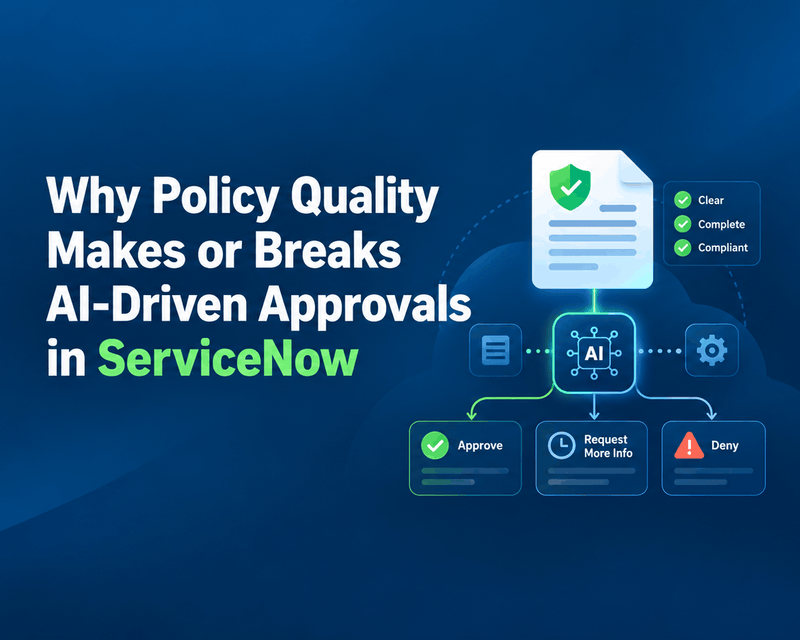
Why Policy Quality Makes or Breaks AI-Driven Approvals in ServiceNow
Why Policy Quality Makes or Breaks AI-Driven Approvals in ServiceNow AI can make approval decisions in seconds. It can also make the wrong ones, consistently, if the policy behind them is vague. As enterprises bring AI-driven approvals into ServiceNow, attention goes straight to automation: faster decisions, fewer manual tasks, shorter approval queues. One factor gets […]
read more
Teiva Systems at ServiceNow AI Summit 2026 — Munich
On October 7, 2026, Teiva Systems joined the ServiceNow AI Summit in Munich, where industry leaders, innovators, and the ServiceNow community came together to explore the next chapter of enterprise AI and intelligent automation.
read more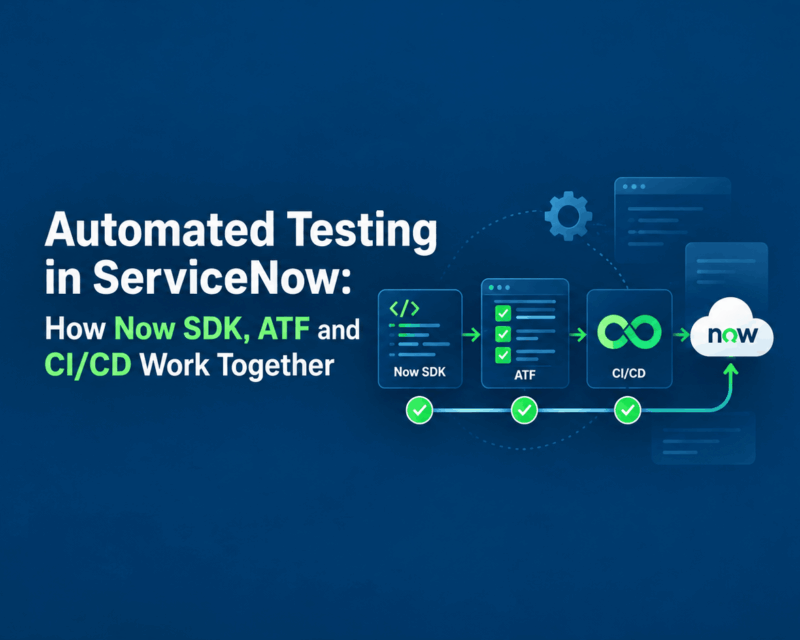
Automated Testing in ServiceNow: How Now SDK, ATF and CI/CD Work Together
Automated Testing in ServiceNow: How Now SDK, ATF and CI/CD Work Together Automated testing in ServiceNow is becoming more important, not because ATF or CI/CD are new concepts, but because the way they can work together is changing the development lifecycle itself. As ServiceNow moves toward a more source-driven engineering model, testing is becoming less […]
read more