
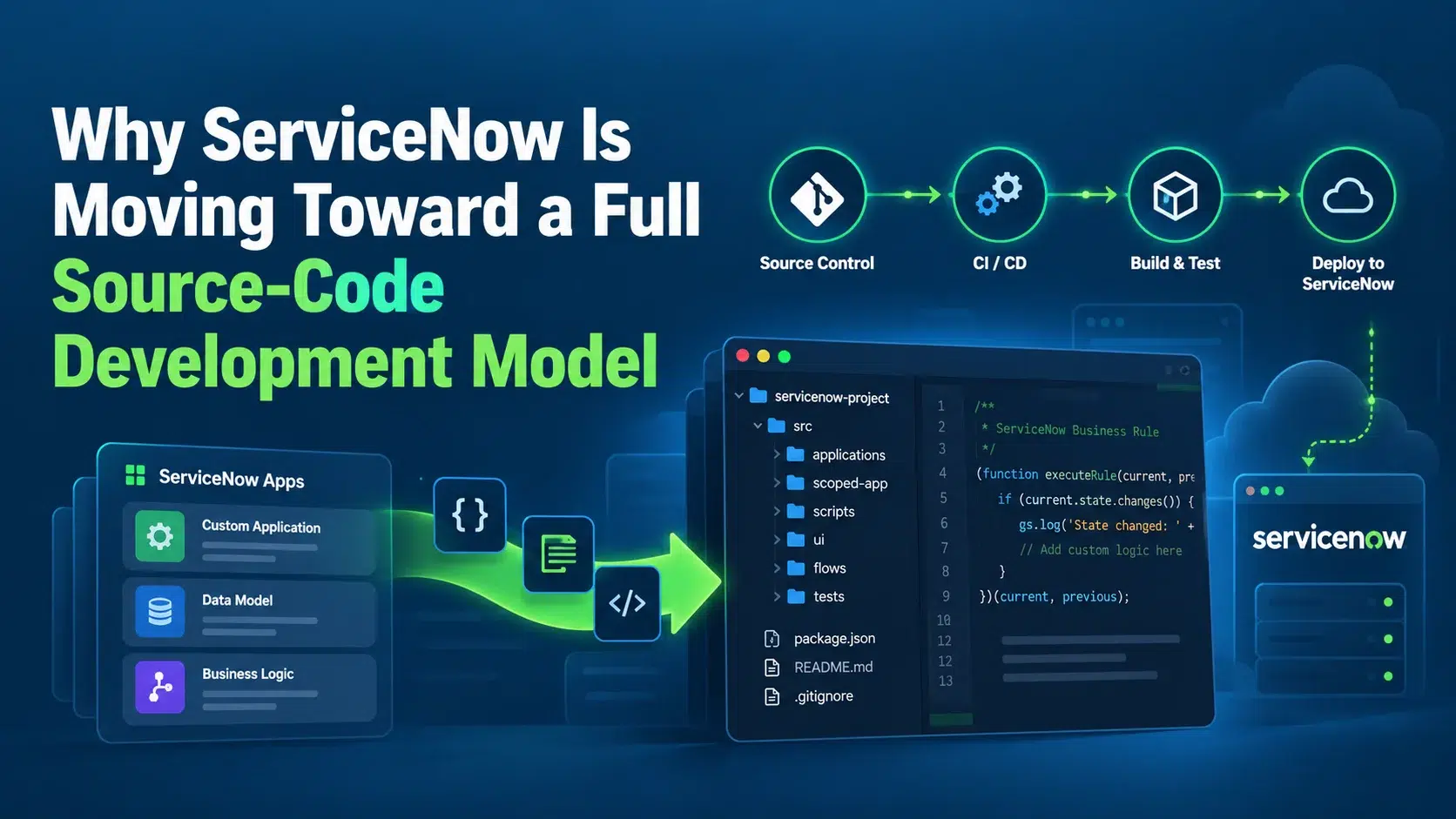
Why ServiceNow Is Moving Toward a Full Source-Code Development Model
ServiceNow development is converging on the engineering model enterprise teams already use for cloud, integration, and backend services: IDE, Git, CI/CD, and automated release governance. This post explains what that means for CTOs, architects, and delivery leaders.
For years, enterprise development teams have followed a familiar model:
| write code locally → commit to Git → review → test → release → deploy through controlled environments |
ServiceNow development traditionally worked differently, with much of the lifecycle tied directly to platform instances and platform-specific deployment processes.
That is changing. With the evolution of the Now SDK, Fluent, Git integration, ATF, and CI/CD, ServiceNow is moving toward a more conventional software engineering model.
This is more than a technical update. ServiceNow is moving from instance-centric development toward source-driven software engineering. For CTOs, architects, platform owners, and delivery leaders, that means stronger governance, better testing, more repeatable releases, and easier integration with enterprise DevOps practices.
The Developer Instance Is No Longer the Center
ServiceNow summarizes the shift clearly:
“Git, not a developer instance, is the source of truth for your application’s state.”
That changes the role of the instance. Instead of being the place where the application effectively “lives,” the Git repository becomes the authoritative source, while ServiceNow instances become environments for building, testing, validating, and deploying the application.
This brings ServiceNow much closer to the way modern teams already build APIs, cloud applications, and backend services.
Explore the ServiceNow SDK documentation
Why Developers Wanted This
Enterprise developers already work with IDEs, Git, pull requests, JavaScript and TypeScript, automated testing, and CI/CD pipelines. So the obvious question is: why should ServiceNow require a completely different development model?
The Now SDK helps close that gap by allowing developers to work locally, manage applications in Git, use familiar engineering tools, and install validated applications into ServiceNow.
Developers should not have to abandon modern software engineering practices simply because the target runtime is ServiceNow.
The New ServiceNow Development Loop
The direction can be summarised as one pipeline. Each stage solves a different engineering problem:
| # | Stage | What it solves |
| 1 | IDE | Developers work in familiar editors with TypeScript/JavaScript, navigation, source-code organisation, and standard dev tooling |
| 2 | Git | Git becomes the system of record. Branches, commits, pull requests, reviews, history, and rollback are part of the lifecycle |
| 3 | Now SDK | Bridges source-code development with the platform. Applications are represented as source, built, and installed on an instance |
| 4 | Test instance | Environments become reproducible deployment targets, not the place where the application ‘lives’ |
| 5 | Automated tests (ATF) | ATF suites verify expected behaviour automatically before the release moves further through the lifecycle |
| 6 | Release version | A successful build becomes a controlled, versioned release artifact — not a collection of changes someone must remember to promote |
| 7 | Production pipeline | Deployment automation takes responsibility for promotion once a version satisfies the required quality gates |
“The goal is not simply faster deployment. The goal is repeatable deployment.”
CI/CD Changes the Story
Local development and Git are only part of a modern software development lifecycle.
The bigger question is:
What happens after the developer finishes the code?
That is where the latest direction becomes particularly important.
During the ServiceNow Developer Passport Brazil session covering the Now SDK and Fluent, CI/CD was one of the major themes.
ServiceNow demonstrated a pipeline in which developers could push source code into Git and allow automation to take over subsequent validation and deployment steps. The SDK’s CI/CD capabilities can participate in standard GitHub Actions workflows rather than requiring a completely separate delivery process.
A simplified model looks like this:
Developer IDE
↓
Git repository
↓
Pull request
↓
Now SDK build
↓
Install into test instance
↓
Run ATF test suites
↓
Validate
↓
Publish application version
↓
Deploy through controlled environments
That is a fundamentally different development experience.
The CI/CD walkthrough published by ServiceNow shows two example workflows.
The first validates a pull request by compiling and installing the application into a test instance and executing specified ATF suites.
The second can begin the process of publishing a version to the application repository and deploying it toward production.
See ServiceNow’s Now SDK and Fluent CI/CD overview
Read the ServiceNow GitHub Actions CI/CD walkthrough
The New ServiceNow Development Loop
The direction can be summarised as one pipeline. Each stage solves a different engineering problem:
IDE → Git → Now SDK → Test Instance → Automated Tests → Release Version → Production Pipeline
Each stage solves a different engineering problem.
IDE
Developers work where professional developers already work.
They gain access to familiar editing, navigation, source-code organization, TypeScript/JavaScript development, and development tooling.
Git
Git becomes the system of record.
Branches, commits, pull requests, reviews, history, and rollback become part of the development lifecycle rather than an external convenience.
Now SDK
The SDK bridges traditional source-code development with the ServiceNow platform.
Applications can be represented in source code, built, transformed into platform metadata, and installed on an instance.
Test Instance
Instead of treating the developer instance as the application itself, environments can increasingly become reproducible deployment targets.
Automated Tests
ATF can provide automated verification before a release moves further through the lifecycle.
Release Version
A successful build becomes a controlled application version rather than simply a collection of changes that someone must remember to promote.
Production Pipeline
Once a version satisfies the required quality gates, deployment automation can take responsibility for promotion.
The goal is not simply faster deployment. The goal is repeatable deployment.
That distinction matters.
Why This Matters for CTOs and Delivery Leaders
This shift may appear developer-focused. Its biggest implications are actually organisational.
| Implication for CTOs & delivery leaders | What changes | What it enables |
| Consistent development processes | Java, cloud, integration, and ServiceNow apps can all participate in the same Git and CI/CD model | Enforceable branch policies, standard code reviews, recognisable enterprise SDLC across all platforms |
| Better version control | Application truth moves from instance state to Git commits | Clear answers to: what version is production running? Who reviewed it? Which tests ran? What changed? |
| Less manual deployment work | Automation replaces forgotten steps, incorrect version promotions, and environment inconsistencies | Lower operational risk — every manual step removed is one fewer opportunity for inconsistency |
| Stronger release governance | Explicit quality gates can be defined between developer commit and production | Different controls per application: lightweight for internal tools, full review + security + approval for regulated processes |
| Enterprise DevOps integration | ServiceNow participates in existing GitHub, GitLab, Jenkins, Azure DevOps ecosystems | No separate DevOps universe for ServiceNow — one engineering ecosystem, one governance model |
1. More Consistent Development Processes
Enterprise organizations rarely want completely different engineering standards for every platform.
Therefore, if Java applications, integration services, cloud workloads, and ServiceNow development can all participate in similar Git and CI/CD processes, engineering governance becomes much easier to standardize.
For example, code reviews can follow familiar patterns, branch policies can become enforceable, and release gates can become repeatable. In addition, documentation can live directly alongside the code.
As a result, ServiceNow development becomes part of a more recognizable and consistent enterprise SDLC.
2. Better Version Control
Historically, one of the biggest differences between platform configuration and conventional software engineering has been the concept of a definitive source version.
With a Git-driven model, however, the answer becomes much clearer.
What version is production running?
Which commit introduced this change?
Who reviewed it?
Which tests ran?
What changed between release A and release B?
When development artifacts are represented in source control, these questions become significantly easier to answer.
More importantly, teams gain a clearer history of how an application evolved, which improves traceability, troubleshooting, and release accountability.
3. Less Manual Deployment Work
Manual release activity creates operational risk.
This is not necessarily because the people performing the deployment lack skill. Instead, every manual step introduces another opportunity for inconsistency or human error.
Automation can therefore reduce:
- forgotten deployment steps
- incorrect version promotion
- environment inconsistencies
- undocumented fixes
- repetitive release work
However, automation should never be confused with governance.
In fact, the faster the pipeline becomes, the more important governance becomes. Automated delivery still requires clear validation, approvals, and accountability.
We explored this problem in our article on AI SDLC governance for ServiceNow, where the same principle applies: speed creates value only when proper controls remain part of the delivery process.
Read: AI SDLC Governance — Why Vibe Coding on ServiceNow Needs More Than Speed
4. Stronger Release Governance
At the same time, a mature pipeline does not mean:
developer commits → production automatically
Instead, it means organizations can define explicit controls and approval gates between each stage of the delivery process.
For example:
Code → Review → Build → Test → Security Check → Approval → Version → Deployment
The level of control can also vary depending on the application.
A lightweight internal application, for instance, may require relatively simple validation.
By contrast, a business-critical application supporting regulated processes may require:
- peer review
- automated testing
- architecture review
- security validation
- segregation of duties
- formal approval
- deployment evidence
Therefore, source-driven development provides a much stronger foundation for structured and auditable release governance.
5. Better Integration With Enterprise DevOps
Finally, many enterprises already operate mature DevOps ecosystems.
They may already rely on tools such as:
GitHub.
GitLab.
Jenkins.
Azure DevOps.
Security scanners.
Artifact repositories.
Approval systems.
Change management processes.
Because of this, the long-term opportunity is not to create a separate DevOps universe specifically for ServiceNow.
Instead, the goal is to allow ServiceNow development to participate in the engineering ecosystem companies already use.
This matters because teams can apply more familiar processes, tools, controls, and responsibilities across their wider technology landscape.
ServiceNow’s SDK documentation already describes CI/CD capabilities that move the platform further in this direction.
Read ServiceNow’s SDK CI integration guidance
The Reproducibility Problem
There is another reason this shift matters.
Reproducibility.
Suppose an application works perfectly in one development environment.
Could another developer reproduce the result?
Would the CI pipeline generate the same outcome?
Does it work consistently in a clean test environment?
Is the organization able to rebuild the same application six months later?
Those questions become much more important as ServiceNow expands deeper into business-critical workflows.
ServiceNow’s CI guidance includes controls intended specifically to ensure that application builds remain reproducible and that critical generated identifiers remain correctly committed to source control.
This may sound like implementation detail.
Architecturally, it represents something much larger.
A deployment should be the result of a defined state, not the accumulated history of an instance.
That is one of the defining principles of modern DevOps.
And ServiceNow development is moving closer to it.
A Practical Example
Consider a team building a scoped ServiceNow application. Under the emerging model, a developer builds the application locally and manages the project through Git.
| The scoped application lifecycle under source-driven development:→ Developer creates a feature branch and commits changes locally→ Pull request triggers automated validation — Now SDK builds the application→ Application is installed into a test ServiceNow instance→ ATF suites validate expected behaviour automatically→ Validation succeeds — application version is published as a controlled artifact→ Version moves through the organisation’s controlled deployment process→ Production receives a validated release artifact, not simply the developer’s latest work |
Scoped applications are particularly well suited to this model because they provide clearly bounded application architecture and namespace isolation. The distinction is important: production receives a validated release artifact, not simply the developer’s latest work.
For more on application architecture, see:
Scoped vs Global Apps: Making the Right Choice for ServiceNow Projects
Then AI Enters the Development Lifecycle
There is another reason this source-code transition is arriving at exactly the right time.
AI-assisted development.
ServiceNow development is increasingly intersecting with AI coding assistants and agentic development tools.
That makes Git, automated validation, reproducible builds, and controlled releases even more important.
The faster code can be generated, the more important it becomes to establish evidence that the resulting application is correct.
We see this directly in our work on governed AI delivery.
In our AI Delivery Team model, applications are built using the official ServiceNow SDK, maintained as typed source code under version control, installed through controlled deployment processes, and verified before they move deeper into QA.
Read: Inside an AI Delivery Team — Running the AI SDLC on ServiceNow
The fundamental rule remains simple:
The faster software can be created, the stronger the evidence should be before it reaches production.
AI does not reduce the need for source control.
It increases it.
AI does not reduce the need for testing.
It increases it.
And AI does not eliminate release governance.
It makes governance one of the most important parts of the development lifecycle.
That is why the convergence of Now SDK + Git + CI/CD + ATF + AI-assisted development is particularly significant.
This Is More Than a Developer Experience Upgrade
It would be easy to describe these changes as improvements to ServiceNow developer experience.
That would underestimate them.
This is really about the maturation of ServiceNow application engineering.
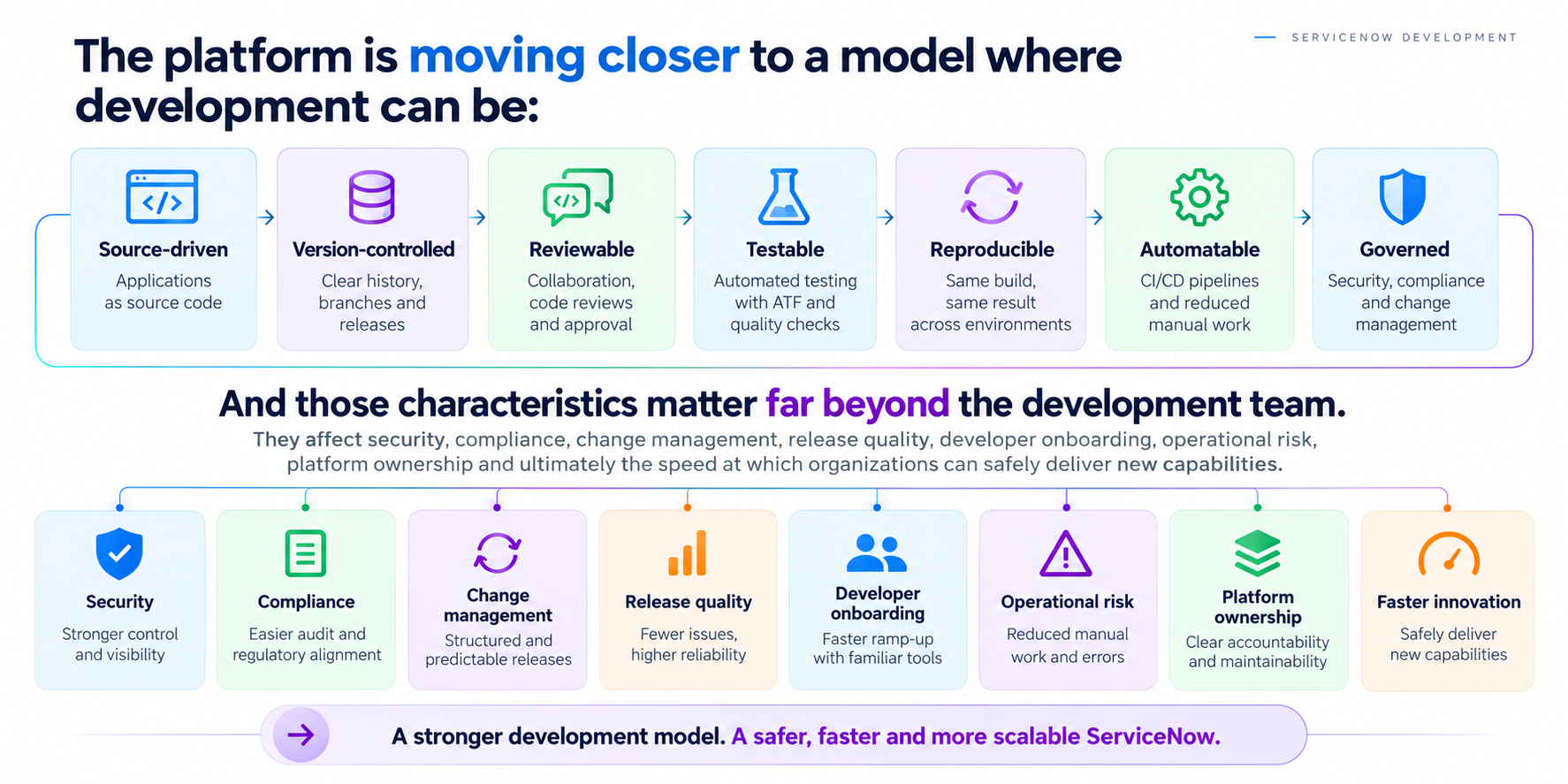
And ultimately the speed at which organizations can safely deliver new capabilities.
From “Platform Development” to Software Engineering on the Platform
The most interesting part of the Now SDK direction may ultimately be cultural rather than technical.
ServiceNow developers increasingly do not need to operate as a separate category of engineer using an isolated development lifecycle.
They can work inside an engineering model other developers already understand:
IDE.
Git.
Pull requests.
Builds.
Automated tests.
Release artifacts.
Deployment pipelines.
The target runtime remains ServiceNow.
The engineering model becomes increasingly familiar.
The future of ServiceNow development is not about making ServiceNow behave like a traditional coding platform. It is about bringing modern software engineering discipline to everything built on ServiceNow.
That distinction matters.
Because as ServiceNow becomes responsible for more critical workflows, AI agents, applications, integrations, employee experiences, and enterprise operations, the question is no longer simply:
Can we build this on ServiceNow?
The more important questions are:
Can we reproduce it?
Will automated tests validate it?
Is the code ready for review?
Does every change remain traceable?
Can it be released safely?
And:
Can we do all of that repeatedly at enterprise scale?
The emerging source-code development model provides a much stronger answer.
The Bottom Line
ServiceNow’s move toward source-driven development is not simply about allowing developers to write code in their preferred IDE.
This redefines where application truth lives.
That reshapes how releases are validated.
As a result, ServiceNow fits more naturally into the broader enterprise DevOps ecosystem.
And it creates the engineering foundation required for a future in which both humans and AI agents can build applications far faster than before.
The transition can be summarized in one line:
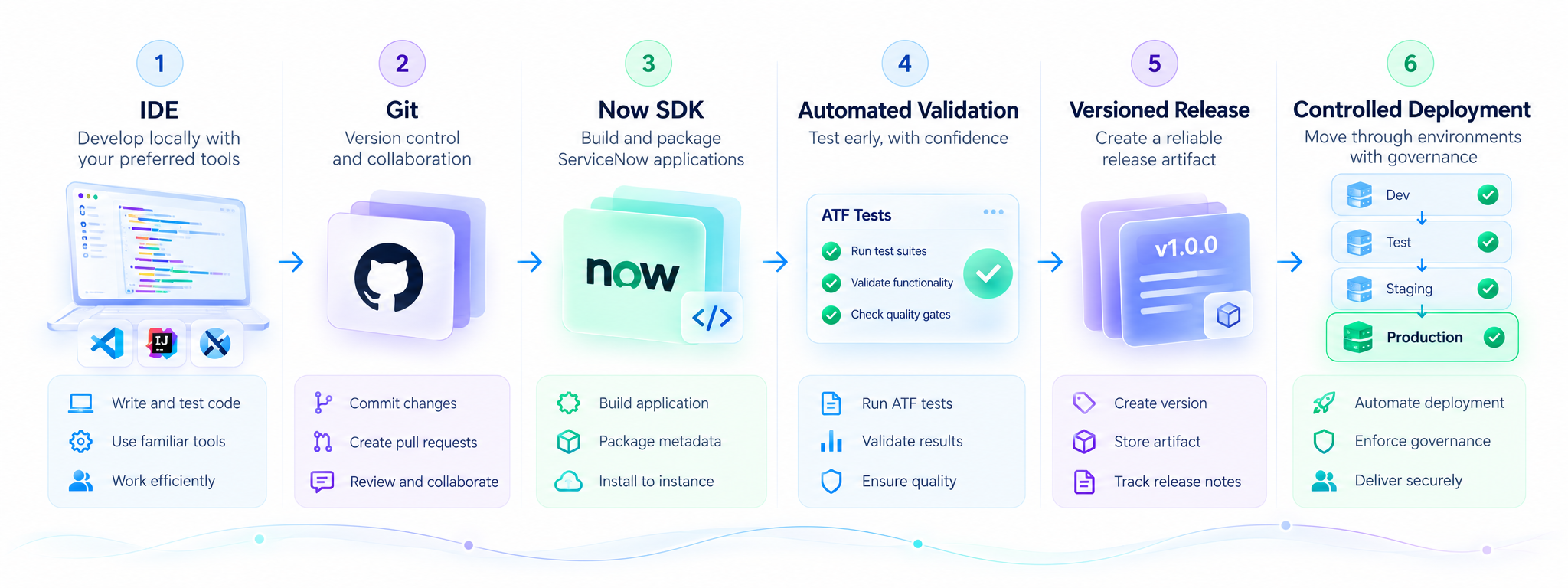
The tools are changing.
But the bigger shift is the development philosophy behind them.
ServiceNow is becoming less of a place where software is manually assembled—and more of a platform where software can be engineered.
Kostya Bazanov, Managing Director, Oct 07, 2026
Eager to take the next step? Contact us today!
Latest Articles
ServiceNow for the Public Sector: Five Requirements to Address Before Implementation
Public-sector organizations do not implement ServiceNow under the same conditions as a commercial enterprise. Getting the foundation right before development begins can determine whether the platform supports secure, measurable, and scalable public services for years to come.
read more
ServiceNow AI ROI: What Should You Measure After the Pilot?
Your AI pilot worked. That proves the technology can work. It does not yet prove ROI. Here are the six metrics that separate “the demo impressed leadership” from “we can prove measurable business value.”
read more
The First Five ServiceNow AI Agents an MSP Should Offer Its Customers
Managed service providers can now package ServiceNow AI agents as repeatable, recurring services — moving from ticket-response capacity to managed outcome delivery. Here is what the first five offerings look like, how each creates value, and what to get right before deploying them.
read more