
10 ServiceNow Predictions for 2027
ServiceNow is moving from managing work to actively executing work. By 2027, AI agents, autonomous workflows, and intelligent data will reshape what the platform does — and what it means to be a ServiceNow customer or partner. Here are our ten grounded predictions, with the evidence behind each one and what to do before they arrive.
“ServiceNow is moving from managing work to actively executing work.”
ServiceNow is entering a new phase. What started as a platform for IT service management is becoming an intelligent operating layer for enterprise work. By 2027, ServiceNow will be less about manual tickets and more about AI agents, autonomous workflows, predictive operations, and industry-specific digital products.
These ServiceNow predictions for 2027 show how the platform may evolve and what enterprises, ISVs, and implementation partners should prepare for now.
The main shift is simple: ServiceNow will move from managing work to actively executing work.
Routine tasks will be handled faster, ticket queues will shrink, and human teams will focus more on judgment, governance, and strategic improvement.
- AI agents will outnumber human operators
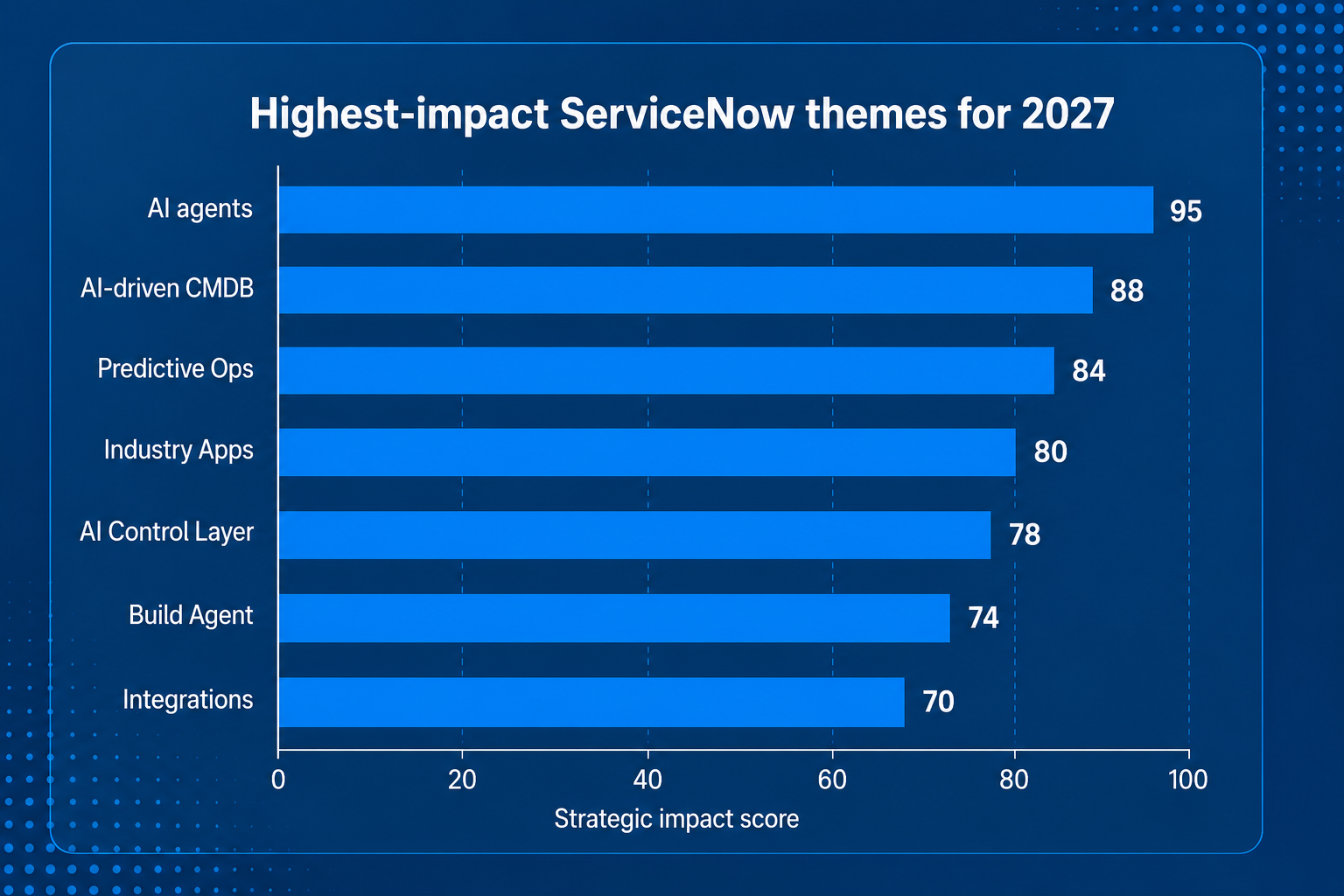
By 2027, AI agents will be the first line of action across many ServiceNow workflows — handling password resets, access requests, incident routing, case updates, knowledge suggestions, and basic remediation. Human operators will shift from manual processing to supervision, exception handling, and strategic decision-making.
Evidence: ServiceNow reports its own L1 AI Specialist handled over 80% of internal IT requests autonomously, with 99% faster case resolution. CVS Health reduced live agent chats by 50% after Now Assist deployment. The Autonomous Workforce now covers 20+ specialist roles across IT, HR, CRM, Security, Finance, and Legal.
2. CMDB will become AI-driven and self-healing
The CMDB has always been powerful but difficult to maintain. By 2027, AI will identify gaps, recommend corrections, detect relationship patterns, and predict the impact of changes. The CMDB will become a living intelligence layer — not just a technical database — that actively improves itself between human review cycles.
Evidence: A broken CMDB already breaks AI agents — we covered this in our CMDB AI Readiness post. AI Control Tower’s Discover dimension now ingests CMDB data from 30+ sources including AWS, Azure, and SAP, building a real-time asset graph that was previously maintained manually.
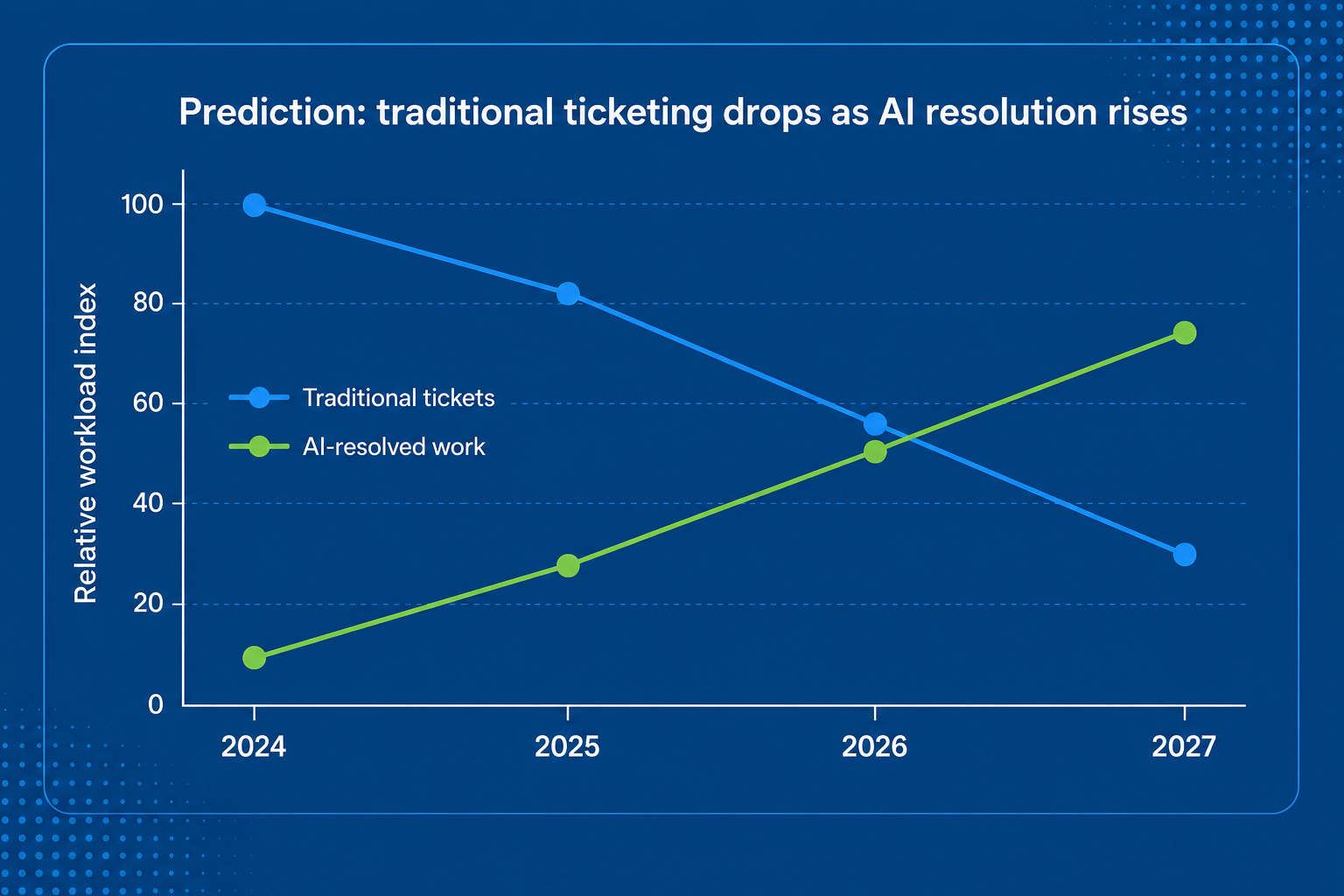
3. Traditional ticketing volume will drop 40% or more
Traditional ticketing will not disappear, but the volume of manually created tickets may fall sharply. Self-service, virtual agents, predictive monitoring, and automated remediation will resolve many issues before users need to submit a request. The ticket will become less important than the outcome: faster service, less waiting, and fewer manual handoffs.
Evidence: Automation Anywhere benchmark data shows AI agents auto-resolving over 80% of IT support requests in mature deployments, cutting ITSM costs by up to 50%. Average cost per L1 ticket manually: ~$25. Target with AI agents: below $15. That gap represents hundreds of thousands of dollars annually for mid-market enterprises.
4. Build Agent will go mainstream for ServiceNow development
Build Agent — already in limited preview — will become mainstream for ServiceNow development by 2027. Instead of manually configuring tables, forms, flows, and rules, developers will describe what they need in natural language. The platform generates application structures, workflows, catalog items, and integration logic automatically. Developers will focus on architecture, governance, and complex customization rather than repetitive configuration.
Evidence: ServiceNow Build Agent is already in limited preview (not a 2027 concept — a 2026 reality entering scale). GitHub Copilot reduced developer task completion time by 55% in controlled studies. ServiceNow development is structurally similar: high-repetition, rule-based configuration that AI is well-suited to accelerate..
5.ServiceNow will become the enterprise AI control layer
As organisations adopt more AI tools, they will need a platform that provides governance, visibility, and control across all of them — regardless of which vendor built them. ServiceNow is uniquely positioned to fill that role. By 2027, AI Control Tower will be the standard governance infrastructure for enterprise agent operations.
Evidence: 44% of enterprise AI leaders lack confidence in autonomous agent oversight, yet 67% have already deployed multi-agent systems. Gartner predicts 2,000+ AI governance incidents in 2026. The EU AI Act requires demonstrable governance over automated decision-making by 2027. The market need is not theoretical — it is regulatory.
“The future of ServiceNow will not be defined by the number of workflows a company has, but by how much work can be resolved before humans need to intervene.”
6. Employee experience will go fully conversational
Employees will increasingly interact with ServiceNow through natural language instead of forms and portals. A user may simply ask for access, report a slow laptop, request equipment, or check HR information. ServiceNow will understand the request, ask clarifying questions if needed, and trigger the right workflow. The best employee portals may become almost invisible — because the experience will be conversational.
Evidence: Moveworks — acquired by ServiceNow for $2.85B in 2025 — was processing millions of employee requests per month in natural language before the acquisition. ServiceNow is now integrating that capability as EmployeeWorks, available to its full customer base of nearly 200 million potential end-users.
7. Predictive IT operations will become the standard
IT operations will become more proactive. Instead of reacting after incidents occur, ServiceNow will help teams predict and prevent disruptions. AI will analyze signals from infrastructure, applications, monitoring tools, historical incidents, and business services. Mature organisations will expect ServiceNow to identify which service is at risk before it fails.
Evidence: ServiceNow’s ITOM AIOps is already in GA, with predictive scoring for incident risk and change impact. Early adopters report 30–50% reduction in major incident frequency after 12 months of AIOps operation. Körber Supply Chain reduced MTTR from 24 days to 14 days using ServiceNow’s AI-powered operations.
8. Industry-specific ServiceNow apps will grow faster
ServiceNow will continue expanding beyond generic IT workflows. By 2027, industry-specific applications will become a major growth area. Healthcare, telecom, banking, logistics, manufacturing, and public sector organisations all have unique processes that generic ITSM cannot address efficiently. ISVs and Build Partners that create reusable ServiceNow apps for specific industries will have a structural advantage.
Evidence: ServiceNow now has dedicated industry cloud solutions for telecom, financial services, healthcare, manufacturing, and public sector — and was named a Forrester Wave Leader in Industry Cloud Solutions for Public Sector Q1 2026. Industry-specific ACV is growing faster than core ITSM in consecutive quarters.
9. Integration will matter more than customization
In the past, many ServiceNow projects relied heavily on customization. By 2027, the strongest implementations will focus on clean architecture and smart integration. ServiceNow will need to connect smoothly with ERP systems, HR platforms, identity tools, cloud services, monitoring systems, and industry-specific platforms. The goal will be scalability, upgradeability, and connected enterprise work.
Evidence: Custom code is the single biggest cause of upgrade delays and technical debt in ServiceNow implementations we assess. The introduction of Action Fabric and MCP Server has made governed integration radically simpler — removing one of the main technical justifications for customisation that existed even 18 months ago.
10. ServiceNow partners will move from implementation to productization
ServiceNow partners will need to evolve. Implementation services will remain important, but customers will increasingly expect reusable accelerators, packaged solutions, spokes, templates, and AI-ready products. Partners that only deliver custom development will face more competition from lower-cost delivery models. Partners that productize their expertise — and build AI-native on top of that — will be better positioned for every growth stage ahead.
Evidence: The fastest-growing ServiceNow partners in 2025–2026 are those with repeatable, packaged IP — not those with the largest headcount. Customer RFPs are increasingly asking for ‘accelerators’, ‘templates’, and ‘proven patterns’ rather than custom development hours. The market is signalling the shift clearly.
The future of ServiceNow in 2027 will be shaped by AI agents, autonomous workflows, AI-driven CMDB, predictive operations, and stronger industry-specific products. Traditional ticketing and manual configuration will become less central, while intelligent execution and platform governance will become more important.
For enterprises, the implication is clear: the window to build the governance foundation before agents arrive in force is 2026. The organisations that activate AI Control Tower, clean their CMDB, audit their knowledge base, and define their governance tiers now will be the ones that activate agents confidently in 2027.
For partners and ISVs, the opportunity is equally clear: build scalable, AI-ready solutions that help customers move faster, automate more, and create better service experiences. The partners who productize their expertise in 2026 will be the ones customers call first in 2027.
“Ready-to-use excerpt: ServiceNow in 2027 will be less about managing tickets and more about intelligent execution. AI agents, predictive operations, AI-driven CMDB, and industry-specific apps will define the next stage of enterprise transformation.”
Oleksii Konakhovych, CTO, Jul 29, 2026
Eager to take the next step? Contact us today!
Latest Articles
How to Test a ServiceNow AI Agent Before Giving It Production Access
A successful demonstration proves that an agent can perform a task under specific conditions. It doesn’t prove the agent will behave correctly when faced with incomplete data, conflicting instructions, restricted records, broken integrations, or unexpected user requests.
read more
ServiceNow AI Readiness Assessment: 25 Questions to Answer Before Deploying AI Agents
Your AI agent is only as reliable as the environment it operates in. This assessment covers 25 essential questions across five areas to help IT leaders, architects, and platform owners prepare for production.
read more
ServiceNow AI ROI: What Should You Measure After the Pilot?
ServiceNow AI ROI: What Should You Measure After the Pilot? Your AI pilot worked. That proves the technology can work. It does not yet prove ROI. Here are the six metrics that separate “the demo impressed leadership” from “we can prove measurable business value.” Your ServiceNow AI pilot worked. Now what? The chatbot responded correctly. […]
read more