
AI Security in ServiceNow: Governance Is No Longer Optional
Artificial Intelligence is already operating inside enterprise ServiceNow environments.
It summarizes incidents.
It generates recommendations.
It automates workflows.
It influences operational decisions.
The question is no longer whether to adopt AI.
The question is:
How do you govern it securely and at scale?
At Teiva Systems, we believe AI without governance introduces exposure.
AI governed properly becomes a strategic advantage.
AI Is Expanding Across ServiceNow
ServiceNow continues to embed AI capabilities deeply into its platform ecosystem, including:
- Predictive Intelligence
- Virtual Agent
- Now Assist (Generative AI)
- Automated ticket summarization
- AI-powered knowledge generation
- Intelligent recommendations
These capabilities drive measurable improvements:
- Faster resolution times
- Reduced manual effort
- Improved service accuracy
- Enhanced employee experience
However, as AI adoption accelerates, so does risk.
Organizations must proactively address:
- Data exposure through AI-generated outputs
- Hallucinated or inaccurate AI recommendations
- Unauthorized automation triggering unintended system changes
- Prompt injection attacks
- Shadow AI usage outside governance frameworks
AI security is not an optional enhancement.
It is a foundational requirement.
What AI Security Means in a ServiceNow Environment
AI security is not limited to infrastructure protection.
It requires governance across four critical dimensions:
- Access Control – Who can use AI capabilities?
- Data Governance – What data can AI process?
- Operational Oversight – How are AI outputs monitored?
- Risk Integration – How are AI risks assessed and documented?
AI must be embedded into your enterprise risk model — not treated as a standalone innovation feature.
If AI influences operational decisions, it becomes part of your control framework.
Four Core Controls for Responsible AI Scaling
1. Role-Based Access & Least Privilege
Generative AI capabilities should never be universally enabled.
Organizations must clearly define:
- Who can access Now Assist
- Who can create or train AI models
- Who can modify prompts
- Who can deploy AI-driven automation
By applying Role-Based Access Control (RBAC) and scoped governance, AI usage aligns with least-privilege principles and minimizes exposure.
AI should be intentional — not default.
2. Data Classification & Regulatory Alignment
AI processes enterprise data. Therefore, AI governance must align with your information classification model.
Key controls include:
- Enforcing PII masking policies
- Restricting AI access based on confidentiality levels
- Applying regional data residency requirements (e.g., GDPR)
For organizations operating across multiple jurisdictions, structured data governance becomes critical.
Aligning AI controls with ISO 27001 classification standards ensures consistency between your ISMS and your ServiceNow configuration.
3. Logging, Transparency & Audit Readiness
If AI influences decisions, it must be auditable.
Organizations should:
- Store prompt history
- Track AI-generated outputs
- Log automation triggered by AI
- Maintain traceability for compliance reviews
Auditability protects both operational integrity and regulatory posture.
Without visibility, there is no accountability.
4. Change & Risk Management Integration
AI models must be treated as managed assets.
Best practice includes:
- Registering AI models as Configuration Items (CIs)
- Including AI in risk registers
- Subjecting AI updates to formal change management
AI should be integrated into:
- ITSM governance
- Integrated Risk Management (IRM)
- Change Advisory Board (CAB) reviews
This prevents shadow deployment and ensures full lifecycle control.
AI Governance + ISO 27001: A Strategic Opportunity
For ISO-aligned organizations, AI governance is not an additional burden — it is an opportunity to demonstrate maturity.
AI directly impacts:
- Access control requirements
- Data protection measures
- Supplier security oversight
- Risk assessment processes
Rather than creating separate AI policies, leading organizations embed AI controls directly into:
- Their Information Security Management System (ISMS)
- Their enterprise risk register
- Their operational governance workflows
This unified model strengthens audit outcomes and builds client trust.
The Competitive Advantage of Governed AI
AI in ServiceNow enables intelligent automation at scale.
But unmanaged AI creates compliance exposure, operational instability, and reputational risk.
Responsible scaling requires:
- Defined ownership
- Structured access control
- Integrated risk assessment
- Continuous monitoring
- Alignment with ISO 27001 and enterprise governance frameworks
At Teiva Systems, we support organizations in embedding AI securely into their ServiceNow ecosystem — ensuring innovation strengthens security rather than compromising it.
The future of ServiceNow is intelligent automation.
The future of resilient enterprises is intelligent governance.
Oleksii Konakhovych, CTO, Mar 10, 2026
Eager to take the next step? Contact us today!
Latest Articles
ServiceNow for the Public Sector: Five Requirements to Address Before Implementation
Public-sector organizations do not implement ServiceNow under the same conditions as a commercial enterprise. Getting the foundation right before development begins can determine whether the platform supports secure, measurable, and scalable public services for years to come.
read more
ServiceNow AI ROI: What Should You Measure After the Pilot?
Your AI pilot worked. That proves the technology can work. It does not yet prove ROI. Here are the six metrics that separate “the demo impressed leadership” from “we can prove measurable business value.”
read more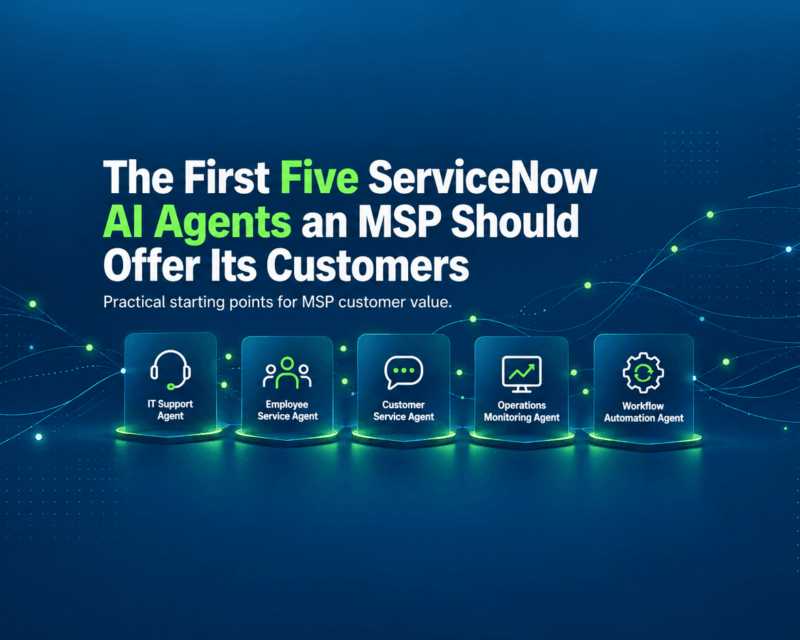
The First Five ServiceNow AI Agents an MSP Should Offer Its Customers
Managed service providers can now package ServiceNow AI agents as repeatable, recurring services — moving from ticket-response capacity to managed outcome delivery. Here is what the first five offerings look like, how each creates value, and what to get right before deploying them.
read more