

Pros and cons of ServiceNow Catalog Item Designer
There have been various discussions concerning the usage of Catalog Item Designer. Some companies have found it quite a useful tool for their operations whereas others are witnessing an inability by the public to embrace the concept which results in the development of Service Catalog still remaining very much part of the developers’ already heavy workload.
Let’s try to explain the essence of the issue and recognize what can be done to help those overcome certain obstacles with Catalog Item Designer adoption.
First, let’s consider Catalog Item Designer’s benefits, its main limitations, and understand where the main issues appear in its adoption.
Catalog Item Designer’s main benefit is how it can offload and speed up the development process by delegating duties to the Manager and Editor roles.
Catalog Managers and Catalog Editors can use the Catalog Item Designer to:
Create new items within a category they are assigned to;
Create questions, approvals, tasks, and sections for the item;
Publish items to their specific category after review. Most importantly, this frees up developers’ resources and saves valuable time.
It seems to be an easy and straightforward concept. However, on closer inspection, the following limitations were noted:
There is a need to create, educate and manage a group of Catalog Managers and Catalog Editors within an organization so that the concept of Item Designer is used successfully;
There is an option to request a category for a specific catalog item in order to apply Item Designer, however, without proper management and guidance, Service Catalog could become unmanageable and confusing due to the build-up of categories that support the Item Designer concept;
Questions type vs. variables type differs, the latter has more options and features to offer. For example Lookup Select Box – a variable type which allows an end-user to select several options from one drop-down;
Coding – UI policies and client scripts are not supported by the Item Designer. To implement these more advanced functions, the service catalog features need to be used. This means that you can only make a question mandatory or read-only, however, you cannot hide it nor make it appear on the form;
Approvals are a straightforward process in Item Designer. You can only do a limited amount of configuration to set an approver within your item. For instance, you can’t set an approval based on a specific selection on the form;
Backend limitations – since there are no client scripts, you can’t add additional variables to the backend of your form to benefit your fulfillers;
Update set and testing – Item Designer is used directly in Prod., so there are no update sets and only a limited amount of testing can be performed. This also means that the company needs to perform cloning regularly to keep instances in sync.
To conclude, Item Designer cannot be used to create sophisticated forms with complex approval processes, complicated UI performance, or forms that require additional actions on the back-end from fulfillers.
Nevertheless, it can be easily used for streamlined, repeatable, and simple processes, such as training management or hardware offering.
For example, let’s imagine Lisa is a course coordinator in company ABC. She is responsible for recruiting internal employees for language and software courses that will benefit the company financially by increasing revenue and operationally by growing employees’ productivity. In order to ascertain the number of employees that are interested, manage costs and prepare the overall courses, Lisa needs specific information about each participant as well as his/her manager’s approval in order to calculate the cost of the project. After organizational analysis, it appears that Lisa needs to have two forms within the Service Catalog to manage language and software courses intakes.
There are two approaches she can take:
- 1
Ask the developers to develop these forms within the next release, but this means it will take at least a month to implement and project manage.
- 2
Become familiar with the concept of Catalog Item Designer, sign up for Catalog Manager/Catalog Editor roles, and create items herself, with the help of Now YouTube Channel and Now Learning. This can be done in a couple of days and as Lisa will be the creator and manager of these two forms, she will have the freedom to do updates at any time and won’t need to wait for a new release to see them applied;
To sum up, the concept of Catalog Item Designer, regardless of its limitations, can be beneficial for medium and large size organizations where development cycles can take up to a month.
Nevertheless, it is crucial to appoint a responsible Service Catalog Process Owner who can effectively guide and supervise the growth of Service Catalog as well as have a separate guide for Service Catalog names and tiles, procedures, and policies. The growth of Service Catalog should be a carefully monitored and controlled process so that it doesn’t outgrow itself and loses its underlying purpose and functionality.
Natalia Kyzyurava, ServiceNow Solution Consultant, May 05, 2021
Eager to take the next step? Contact us today!
Latest Articles

Teiva Systems at ServiceNow World Forum 2026 — London
On October 20, 2026, Teiva Systems attended ServiceNow World Forum London at ExCeL London, where industry leaders, technology experts, and the ServiceNow community came together to explore how AI, intelligent automation, and digital workflows are transforming enterprise operations.
read more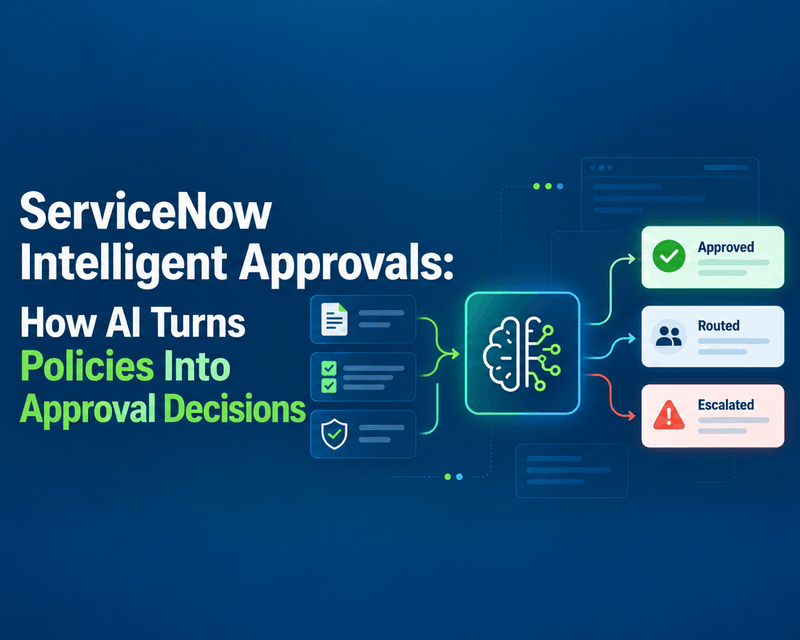
ServiceNow Intelligent Approvals: How AI Turns Policies Into Approval Decisions
What if your approval policies could make decisions, instead of sitting in documents waiting for someone to interpret them? For years, approval automation has followed the same pattern. Business teams write policies. Developers translate them into workflow conditions. Employees wait for someone to approve or reject their request, even when the outcome is obvious.
read more
ServiceNow Intelligent Approvals: How AI Clears Approval Bottlenecks Without Losing Control
Your automation is fast. Your approvals are not. Organizations invest heavily in automation, AI and digital transformation. Yet many business processes still stall at the same point: waiting for someone to click “Approve.”
read more