
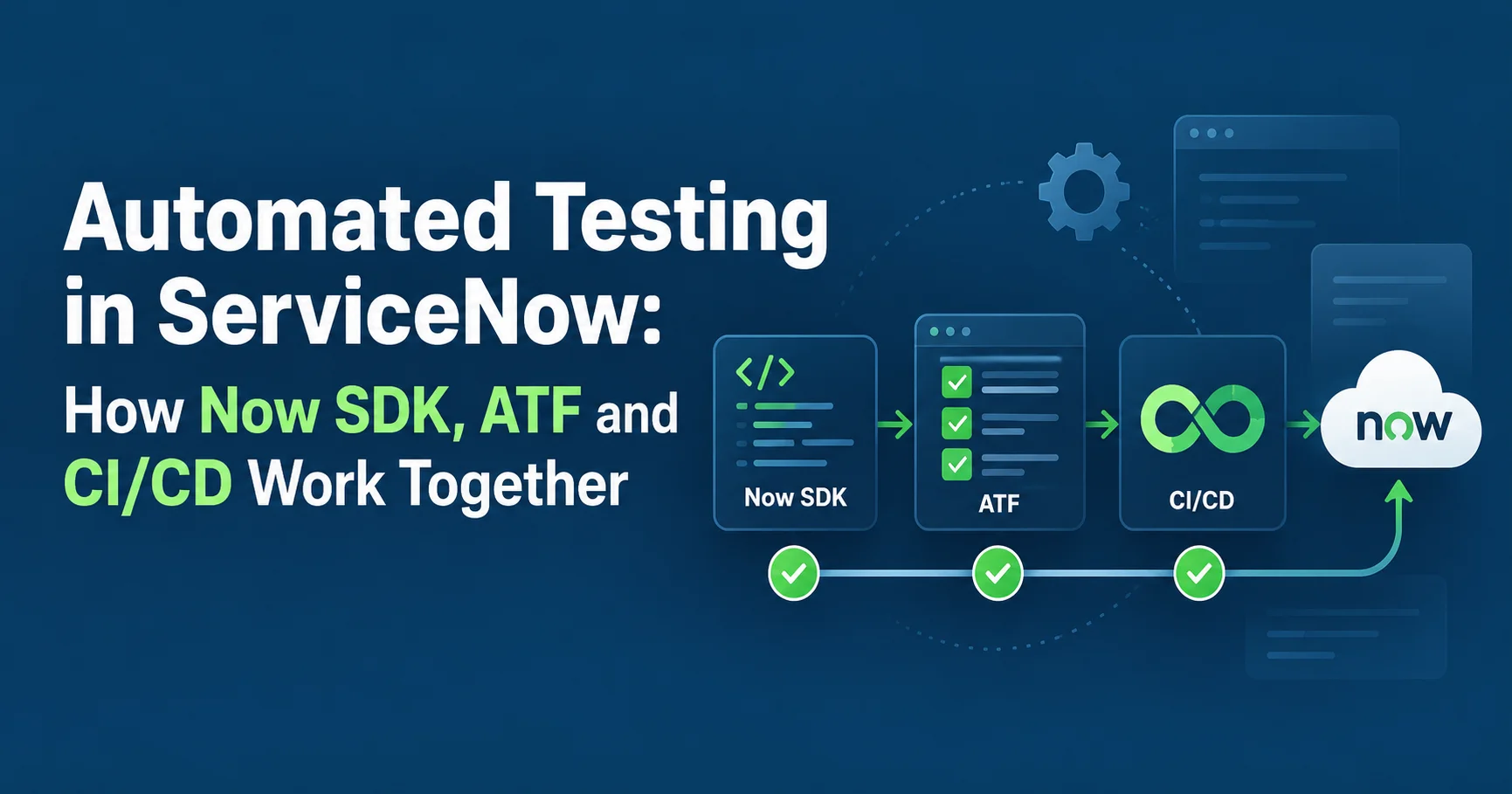
Automated Testing in ServiceNow: How Now SDK, ATF and CI/CD Work Together
Automated testing in ServiceNow is becoming more important, not because ATF or CI/CD are new concepts, but because the way they can work together is changing the development lifecycle itself.
As ServiceNow moves toward a more source-driven engineering model, testing is becoming less of a separate activity at the end of development and more of a built-in part of the delivery process.
That shift changes the question teams should be asking. Instead of simply asking whether an application was tested before release, the more useful question is whether every meaningful change can prove that it is ready before it moves closer to production.
This is where Now SDK, Automated Test Framework, and CI/CD become much more powerful as a connected system.
Testing Is Becoming Part of the Development Loop
In many ServiceNow projects, development and testing have traditionally been treated as separate stages. A developer implements a change, moves it into an instance, and only then does the testing process begin. If something fails, the team has to investigate the issue, return to development, apply a fix, and repeat the cycle.
The problem with this model is not that it cannot work. The problem is the distance between the moment a defect is introduced and the moment it is discovered. The longer that distance becomes, the more time teams spend investigating, reproducing, and fixing issues.
Modern software engineering tries to shorten that feedback loop as much as possible, and ServiceNow is moving in the same direction.
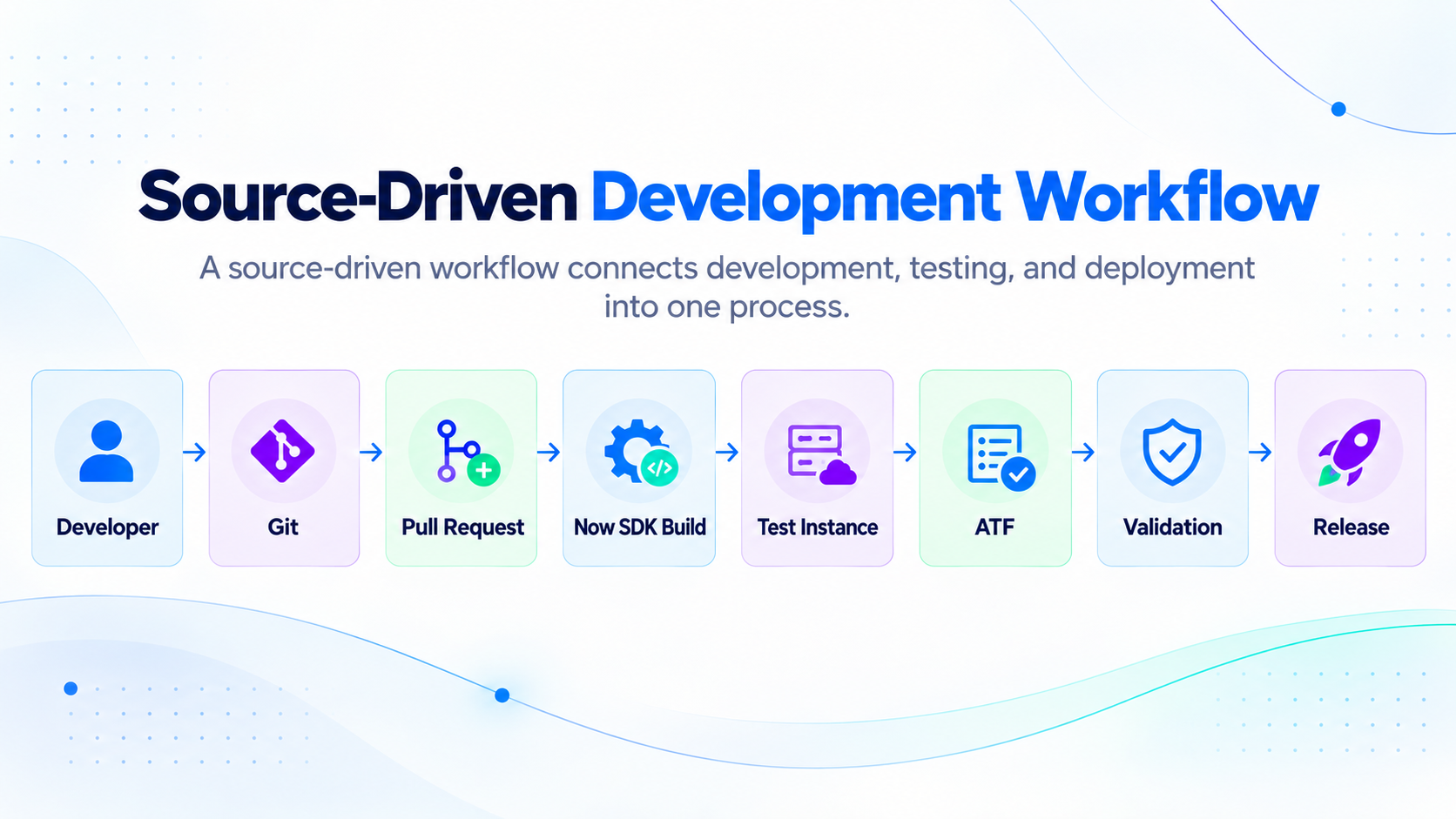
The most important change is that testing becomes a gate in the pipeline rather than a separate event. A release does not move forward simply because development is finished. It moves forward because there is evidence that the application behaves as expected.
Now SDK Creates the Foundation for Reproducible Testing
Now SDK is one of the key parts of this shift because it allows ServiceNow applications to participate in a more familiar software engineering workflow. Developers can work locally, manage application source in Git, build the application, and install it into a ServiceNow environment through a more controlled process.
That matters for testing because automated validation is much more reliable when teams know exactly what they are testing.
If the application is tied to a specific source state, teams can answer questions such as which commit produced the build, which version was installed into the test environment, which tests were executed against it, and whether the same application can be rebuilt later.
This is one of the reasons source-driven development matters beyond developer convenience. It creates a much stronger foundation for repeatable validation.
We explored this broader change in our article on ServiceNow source-code development, where Git increasingly becomes the system of record and ServiceNow instances become environments for building, testing, and deploying applications.
ATF Provides the Behavioral Verification Layer
ServiceNow Automated Test Framework adds the platform-native testing layer to this model. ATF allows teams to create repeatable tests that validate whether an application still behaves as expected after a change.
Depending on the solution, those tests can cover workflows, forms, business logic, user interactions, and other functional behavior. The real value, however, appears when ATF becomes part of the development and release workflow rather than something that is triggered manually after the fact.
A developer can commit a change, a pull request can start the pipeline, Now SDK can build the application, and the application can then be installed into a test instance. ATF suites can run automatically, and the pipeline can use the result to determine whether the release should continue.
If the tests pass, the change moves to the next stage. If they fail, the process stops and the team investigates.
That distinction is important. Automatically running tests is useful, but if failed tests do not affect the release process, the organization has automated reporting rather than automated quality control.
Regression Testing Becomes More Valuable as the Platform Grows
Most enterprise ServiceNow environments are constantly changing. New workflows are introduced, integrations are updated, business rules evolve, applications are extended, and platform releases add new functionality.
A new feature may work perfectly on its own and still break something that worked yesterday. This is where regression testing becomes essential.
The goal is not only to prove that a new feature works. Teams also need confidence that the new feature did not introduce problems elsewhere.
That becomes especially important as ServiceNow expands across ITSM, CSM, HRSD, security, asset management, employee workflows, and other business-critical areas. The larger the platform footprint becomes, the larger the potential impact of a change.
Automated regression suites provide a way to validate that expected behavior remains intact each time the application moves through the pipeline.
A Failed Test Is Only the Beginning of the Investigation
One of the biggest practical challenges in automated testing is that a failed test does not automatically tell developers what is wrong.
The application may contain a defect, but that is only one possibility. The test itself may be configured incorrectly, the expected behavior may have changed, test data may no longer be valid, an environment dependency may be missing, or an external service may be temporarily unavailable.
This is why one of the most time-consuming parts of automated testing is often not writing tests but understanding why they failed.
A good testing workflow therefore needs to provide more than a simple pass-or-fail result. Developers need enough information to understand where the failure occurred, what the application actually did, what the test expected, and whether the problem belongs to the application, the test, or the environment.
Debugging Is the Next Important Layer
The Developer Passport session discussed a direction in which developers could do more with ATF directly from their development workflow, including authoring tests, executing them against an instance, running regression suites, and investigating failed tests more efficiently.
This is particularly interesting because failed tests often require developers to move between several tools and contexts: the IDE, the ServiceNow instance, ATF results, logs, application code, and test configuration.
A stronger debugging workflow could reduce that friction.
Instead of seeing only that a test failed, developers could potentially get closer to answering the questions that actually matter: where the failure occurred, whether the application produced the wrong result, whether the test expectation is outdated, and whether a recent change caused the problem.
There is, however, an important editorial distinction here. Some of the deeper debugging capabilities discussed in the session were presented as upcoming or future-looking functionality. Because the session included Safe Harbor language, these features should not be described as generally available unless they are separately confirmed in official ServiceNow documentation.
The strategic direction is still important, but there is a major difference between saying that ServiceNow is moving toward deeper development-integrated testing and saying that every customer can use all of those capabilities today.
CI/CD Is What Connects the Entire Model
Now SDK, ATF, and Git are each useful individually, but CI/CD is what turns them into a connected delivery system.
Git tells the team what changed. Now SDK provides a repeatable way to build and install the application. ATF validates expected behavior. CI/CD then determines what happens next.
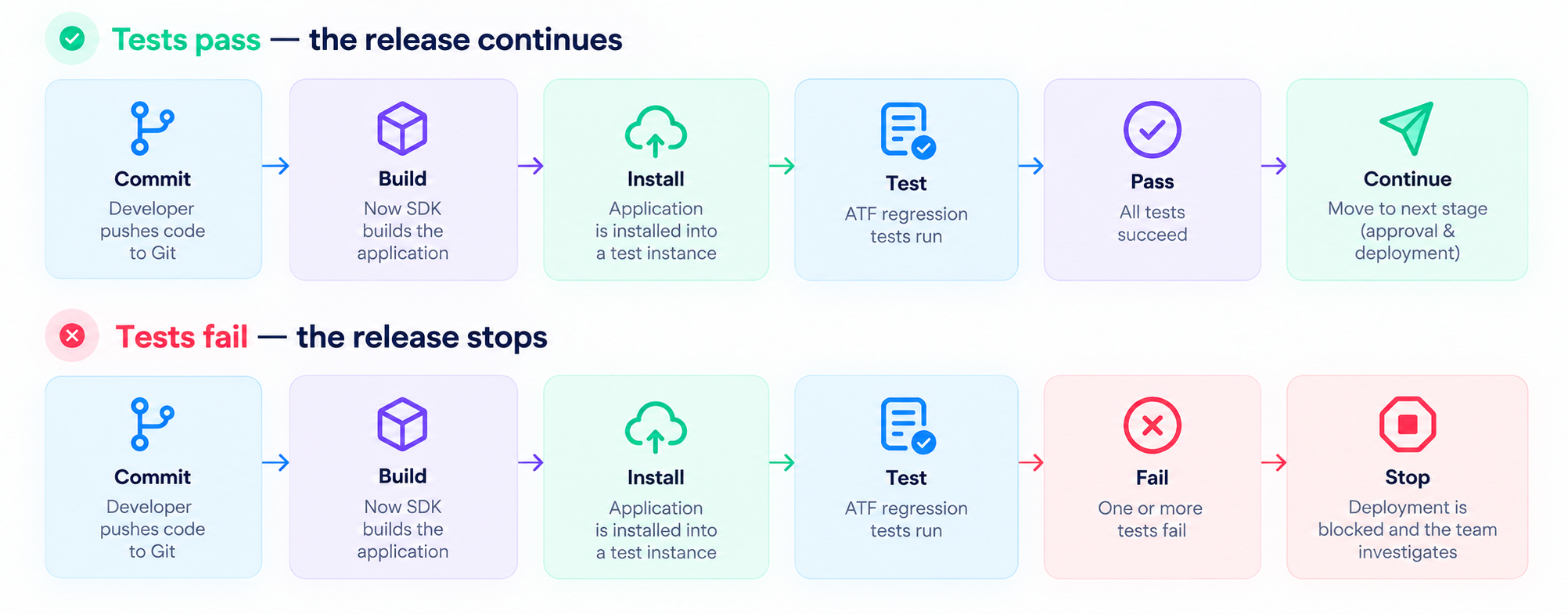
A mature pipeline can create evidence around every release: which source version was used, which build was produced, which test environment received it, which ATF suites were executed, which tests passed or failed, and whether the release received the required approval.
For developers, this improves feedback. For platform owners, security teams, auditors, and regulated organizations, it creates traceability.
Automated Testing Is Also Release Governance
In enterprise ServiceNow environments, testing is not only about finding defects. It also supports release governance.
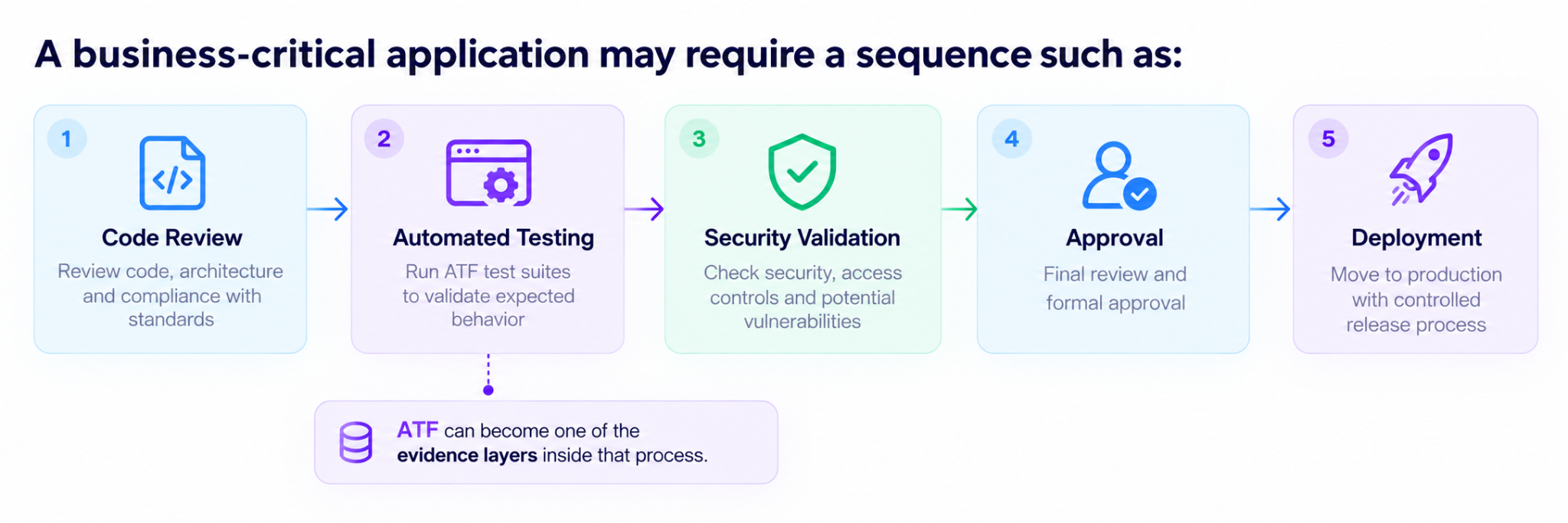
This connects directly to a broader principle we discussed in our article on AI SDLC governance for ServiceNow: speed is useful only when validation and accountability scale with it.
A faster development process without stronger controls simply allows teams to introduce problems faster. A faster process with automated quality gates can improve both delivery speed and confidence.
AI Makes This Even More Important
AI-assisted development raises the importance of automated testing even further.
AI tools can generate code, logic, and application components much faster than traditional development methods. That creates significant productivity potential, but faster generation does not automatically create confidence.
The more quickly software can be created, the more important it becomes to verify that the resulting application behaves correctly.
The question therefore changes from:
Did AI generate working code?
to:
Can the delivery pipeline prove that the resulting application is safe to release?
That is a much stronger engineering standard, and it is one of the reasons the combination of Now SDK + Git + ATF + CI/CD matters so much.
The Bottom Line
The future of automated testing in ServiceNow is not simply about running more tests.
It is about making testing part of the software delivery lifecycle itself.
Now SDK creates a source-driven development foundation. ATF provides automated behavioral verification. CI/CD connects those checks directly to the release process.
Together, they create a model where a release does not move forward because development is finished. It moves forward because the organization has evidence that the application is ready.
That means every important release should be able to answer a few basic questions:
What exactly did we build?
Which version did we test?
What passed?
What failed?
Why did it fail?
Can we release it safely?
That is the real value of automated testing in ServiceNow.
Not simply more automation, but continuous and reproducible validation built directly into the development lifecycle.
Oleksii Konakhovych, CTO, Oct 12, 2026
Eager to take the next step? Contact us today!
Latest Articles
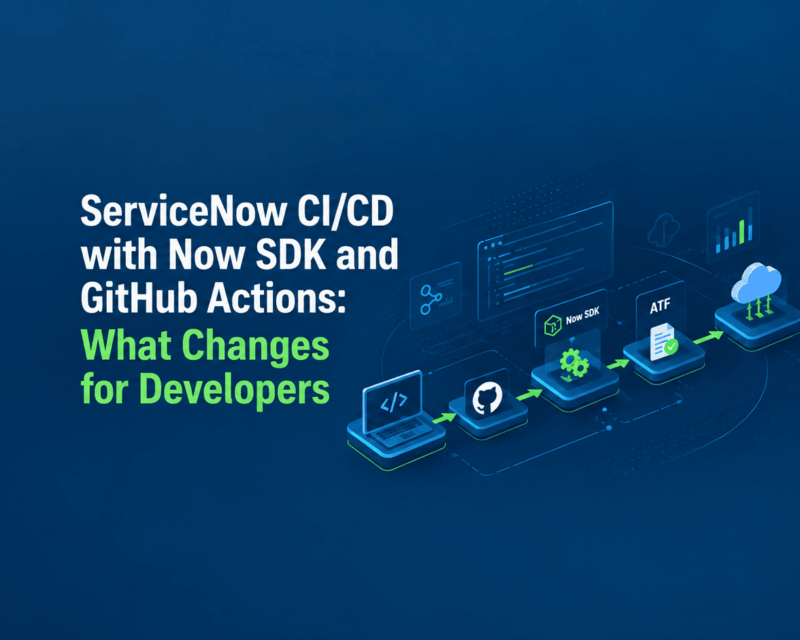
ServiceNow CI/CD with Now SDK and GitHub Actions: What Changes for Developers
The Now SDK connects ServiceNow application development to GitHub Actions CI/CD pipelines — bringing pull-request quality gates, automated ATF testing, and controlled release governance to a platform that has historically required its own isolated delivery process.
read more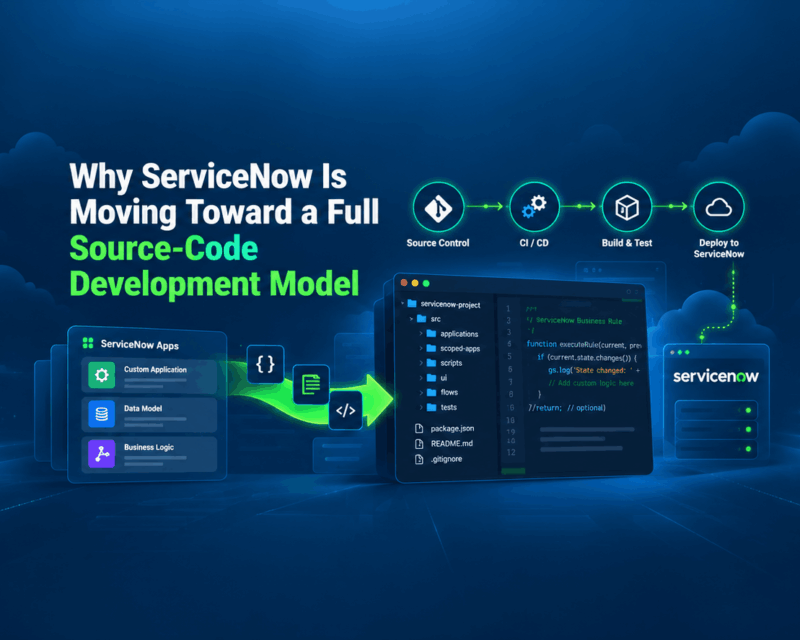
Why ServiceNow Is Moving Toward a Full Source-Code Development Model
ServiceNow development is converging on the engineering model enterprise teams already use for cloud, integration, and backend services: IDE, Git, CI/CD, and automated release governance. This post explains what that means for CTOs, architects, and delivery leaders.
read more
ServiceNow for the Public Sector: Five Requirements to Address Before Implementation
Public-sector organizations do not implement ServiceNow under the same conditions as a commercial enterprise. Getting the foundation right before development begins can determine whether the platform supports secure, measurable, and scalable public services for years to come.
read more