
The First Five ServiceNow AI Agents an MSP Should Offer Its Customers
Managed service providers can now package ServiceNow AI agents as repeatable, recurring services — moving from ticket-response capacity to managed outcome delivery. Here is what the first five offerings look like, how each creates value, and what to get right before deploying them.
Managed service providers have spent years building their businesses around a familiar promise: keep customers’ technology running, resolve issues quickly, and deliver reliable support at a predictable cost.
AI agents are changing how that promise can be delivered.
Instead of simply responding to tickets, MSPs can deploy AI agents that investigate incidents, execute approved workflows, identify recurring problems, and handle routine service requests. But there’s a strategic question: Which ServiceNow AI agents should an MSP offer first?
The answer isn’t to launch dozens of agents simultaneously. It’s to start with five practical service offerings tied to measurable customer problems.
| ⚠️ Important note: The five service packages below are proposed MSP offerings, not official ServiceNow product names. Each package can draw on existing agentic workflows, ServiceNow capabilities, integrations, and custom development where necessary. Commercial pricing, licensing, and permitted multi-customer operation must be assessed separately for each deployment. |
Here are the five service offerings, the customer problem each solves, and when to deploy each one:
| # | Service offering | Customer problem it solves | KPIs to track | Recommended wave |
| 1 | Incident Triage & Resolution | Too many tickets; too much manual investigation | MTTR, automated resolution rate, cost per ticket | Wave 1 — Start here |
| 2 | Service Request Fulfillment | Engineers spending time on repetitive, predictable requests | Automated fulfillment rate, request completion time, user ESAT | Wave 1 — Start here |
| 3 | Proactive IT Operations | Thousands of alerts; no automatic context or prioritisation | MTTD, MTTR, alert-to-incident ratio, availability | Wave 2 |
| 4 | Change Risk & Impact Assessment | Change assessment is time-consuming and inconsistent | Change failure rate, assessment time, rollback rate | Wave 2 |
| 5 | Security Triage & Remediation | Security teams overwhelmed by alerts with delayed response | MTTT, MTTR, backlog age, critical findings addressed | Wave 3 |
Why AI Agents Are Becoming a New Revenue Opportunity for MSPs
Traditional managed services often depend on a simple relationship: more customers generate more tickets, and more tickets require more support capacity.
AI agents offer a different operating model.
Rather than adding another engineer every time ticket volume increases, MSPs can automate selected workflows while keeping human specialists responsible for exceptions, complex investigations, and high-risk decisions.
ServiceNow provides several capabilities that support this model, including prebuilt AI agents, AI Agent Studio for custom development, and orchestration across multiple agents and workflows.
For MSPs, this creates opportunities to package AI into recurring managed services rather than selling isolated implementations.
Consider five possible offerings.
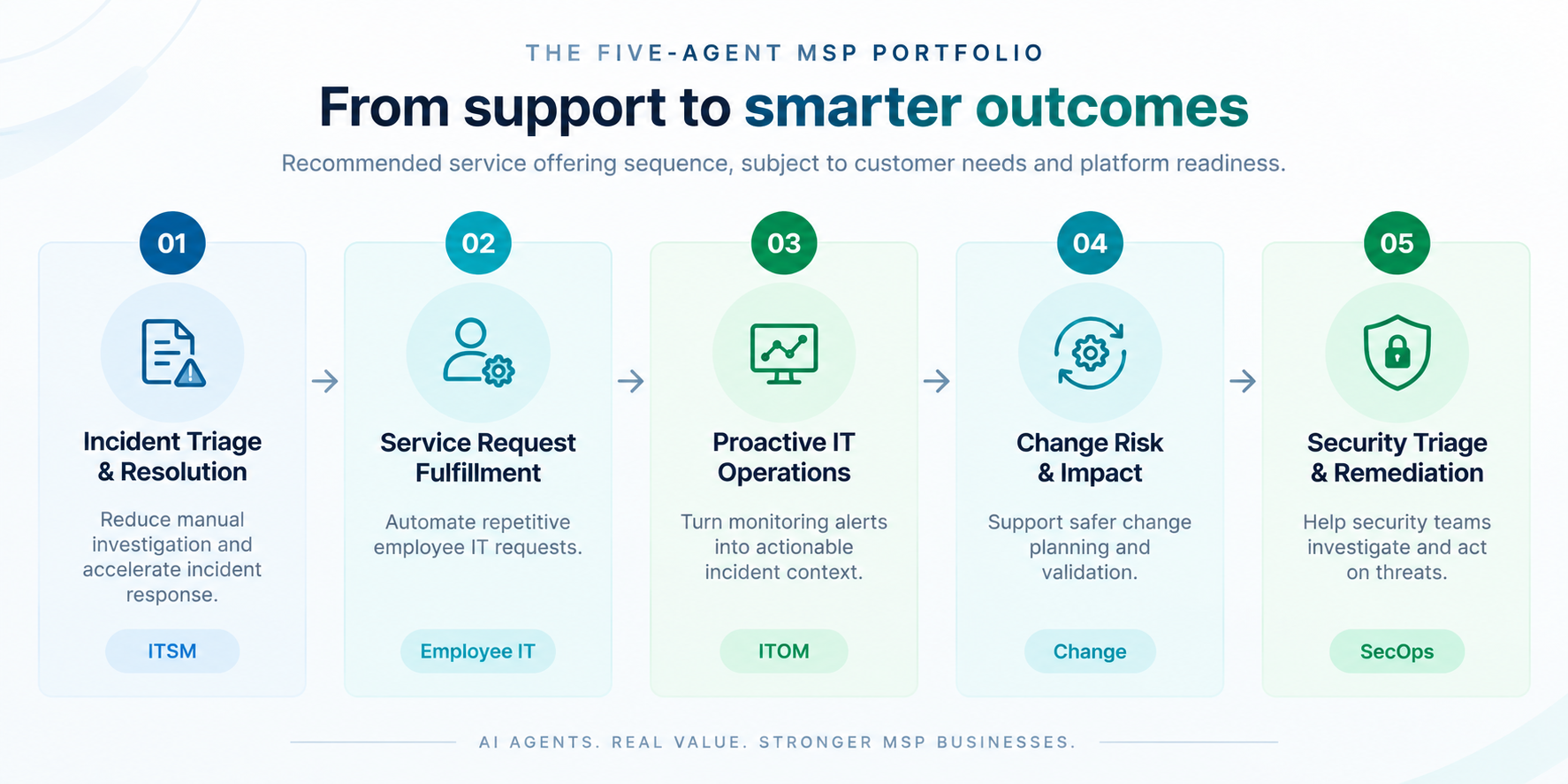
These are proposed MSP service packages, not five official ServiceNow product names. Each package can draw on existing agentic workflows, other ServiceNow capabilities, integrations, and custom development where necessary.
1. The Incident Triage & Resolution Agent
The customer problem: Too many tickets. Too much manual investigation. Too much time spent identifying the right team.
Every MSP knows the routine. An incident arrives. An engineer reads the description, checks the affected system, searches for similar incidents, identifies the correct assignment group, and starts troubleshooting. Sometimes, the actual resolution takes less time than the investigation.
| What the Incident Triage & Resolution Agent does: → Analyzes incoming incidents and identifies the affected service → Categorizes incidents and recommends appropriate priorities → Retrieves relevant knowledge articles and previous resolutions → Suggests troubleshooting steps and identifies the appropriate resolver group → Executes approved, low-risk resolution workflows where supported → Summarizes the investigation and updates incident records |
ServiceNow documents agentic workflows for incident triage, categorization, investigation, resolution, and post-incident reviews within Now Assist for ITSM. These provide a foundation for an MSP offering, subject to the customer’s licensed capabilities and configuration.
Example: A customer’s VPN stops working. Instead of immediately assigning the issue to an engineer, the agent checks the incident details, identifies the affected user and service, and retrieves relevant troubleshooting guidance. It may guide the user through an approved diagnostic procedure or initiate a permitted remediation workflow. If the issue remains unresolved, the agent escalates it with the investigation already documented. The engineer receives context instead of starting from zero.
How an MSP can monetize it: Offer an AI-assisted service desk package with incident triage, approved remediation workflows, performance monitoring, and continuous optimization. KPIs to track: MTTR, correct assignment rate, automated resolution rate, cost per ticket, and SLA compliance.
For a deeper technical perspective, explore TEIVA’s article on AI agents in production incident management , which examines incident coordination, ownership, and automated escalation.
2. The Service Request Fulfillment Agent
The customer problem: Skilled IT engineers are spending their time on repetitive requests that follow predictable procedures.
Password-related assistance. Software access. Group membership changes. Standard equipment requests. These activities are essential, but many don’t require a specialist to manually coordinate every step.
| What the Service Request Fulfillment Agent does: → Interprets an employee’s request in natural language → Identifies the appropriate service catalog item → Checks applicable policies and authorization requirements → Collects missing information → Initiates approval workflows when required → Executes permitted fulfillment actions through approved integrations → Confirms completion and records the result |
ServiceNow’s documented ITSM agentic workflows include managing Microsoft 365 group members. Its broader AI agent offering also supports request fulfillment workflows.
Example: An employee submits “I need access to the marketing team’s Microsoft 365 group.” The agent identifies the requested group, checks the relevant policy, and initiates approval where necessary. After approval, it can execute the configured membership workflow, verify the result, and update the request. If the requested access conflicts with policy, the agent routes it to the appropriate human decision-maker.
How an MSP can monetize it: Create an AI Service Desk subscription that includes a defined catalog of supported requests, integration maintenance, workflow improvements, and monthly performance reporting. KPIs to track: automated fulfillment rate, average request completion time, human handling time, cost per request, and user satisfaction.
3. The Proactive IT Operations Agent
The customer problem: MSPs receive thousands of monitoring signals, but signals don’t automatically explain what is wrong or what should happen next.
A server generates an alert. A database reports elevated latency. An application becomes unavailable. Are these three separate problems or symptoms of the same underlying failure? An engineer needs to investigate dependencies, establish business impact, and determine which alert matters most.
| What the Proactive IT Operations Agent does: → Consumes alerts and correlated events from connected monitoring systems → Retrieves affected configuration items and service relationships → Identifies potentially related incidents and recent changes → Recommends prioritization based on available business impact information → Creates or enriches incident records → Initiates approved diagnostic or remediation workflows → Escalates unresolved issues according to operational policies |
This offering combines ServiceNow IT Operations Management capabilities with AI agents and governed workflow automation. AI agents should not be presented as replacing monitoring, event correlation, or observability tools.
Example: Monitoring detects increased response times on an e-commerce application. Event correlation identifies related infrastructure signals. The AI agent retrieves service relationships from the CMDB, checks recent changes, and prepares an incident summary identifying the affected business service and possible contributing factors. If a preapproved diagnostic workflow exists, the agent may execute it. Otherwise, the engineer receives a consolidated investigation instead of a collection of disconnected alerts.
Critical dependency: trustworthy configuration data. If service relationships, ownership, and configuration information are inaccurate, the agent may draw incorrect conclusions about incident impact. See our CMDB AI Readiness post for what to validate before deploying this agent.
How an MSP can monetize it: Package this as an AI-enhanced managed operations service covering monitoring integrations, incident enrichment, approved remediation, CMDB maintenance, and continuous optimization. KPIs to track: MTTD, MTTR, alert-to-incident ratio, false-positive rate, and successful automated remediation rate.
Teiva explores this challenge in Your ServiceNow CMDB Is Not AI-Ready: Here’s How to Fix It in 6 Months .
If service relationships, ownership, and configuration information are inaccurate, the agent may draw incorrect conclusions about incident impact.
4. The Change Risk & Impact Assessment Agent
The customer problem: Changes are necessary, but understanding their operational impact takes time.
A routine software update may affect one application. A configuration change may affect an entire business service. For MSPs managing multiple customer environments, change assessment involves checking technical dependencies, evaluating conflicts, reviewing implementation plans, and verifying that rollback procedures exist.
| What the Change Risk & Impact Assessment Agent does: → Reviews change requests for completeness and missing information → Retrieves affected configuration items and available service dependencies → Identifies potential scheduling conflicts → Examines relevant incident and change history → Drafts implementation, testing, and rollback plans → Flags incomplete documentation and policy conflicts → Prepares evidence for human review and approval |
ServiceNow’s documented ITSM agentic workflows include change conflict assessment, change quality assessment, scheduling, CI suggestions, and change-plan generation.
Important: An agent can support risk assessment, but it should not independently approve high-impact changes or bypass established change controls.
How an MSP can monetize it: Offer AI-Assisted Change Management covering automated assessment, documentation, scheduling support, and ongoing workflow governance. This is particularly relevant to customers with frequent releases, complex integrations, or demanding change-control requirements. KPIs to track: change failure rate, assessment time, rollback rate, change-related incidents, and documentation rework rate.
5. The Security Triage & Remediation Agent
The customer problem: Security teams are overwhelmed by alerts, while delayed investigation can increase exposure.
A vulnerability scanner identifies a critical finding. A monitoring system detects suspicious activity. An employee reports a potentially malicious email. Each event requires investigation, prioritization, and an appropriate response — and the information is scattered across security tools, asset records, and service management systems.
| What the Security Triage & Remediation Agent does: → Collects and summarizes relevant security alert information → Enriches findings with asset and business-service context → Identifies duplicate or related security records → Retrieves approved investigation procedures → Recommends remediation actions → Creates and assigns remediation tasks → Tracks remediation status and escalates overdue work |
ServiceNow includes Security Operations within its portfolio, while its broader AI platform supports agentic workflows and security-related automation. The exact capabilities will depend on the product, release, integrations, and configuration.
Autonomy should be proportional to risk. Collecting evidence and preparing remediation tasks can be automated more broadly than isolating production servers or modifying security controls.
How an MSP can monetize it: Offer AI-Enhanced Security Operations as a premium service combining alert enrichment, remediation coordination, workflow maintenance, and performance reporting. Customers retain visibility into approvals and decisions, while the MSP operates and improves the automation. KPIs: mean time to triage, mean time to remediate, backlog age, false-positive rate.
Which AI Agent Should an MSP Launch First?
The five agents address different operational problems. An MSP should select its initial offering based on customer demand, workflow volume, data quality, integration readiness, and acceptable operational risk.
For MSPs with an established ITSM practice, incident triage and request fulfillment are practical starting points because they address familiar workflows with measurable outcomes. However, an MSP specializing in security or infrastructure may have a different starting point.
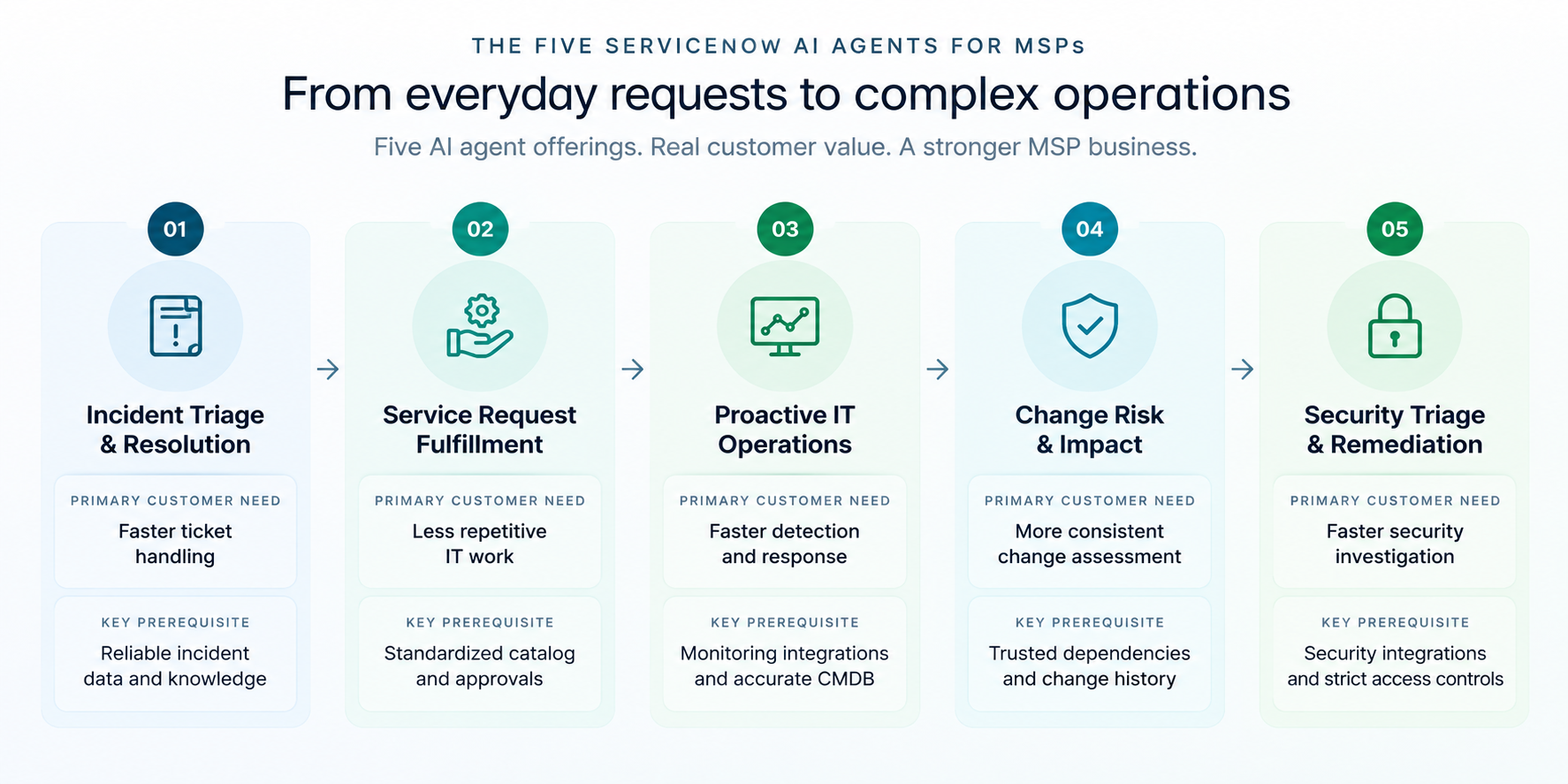
| Service offering | Best for MSPs that… | Prerequisites | Deploy first? |
| Incident Triage & Resolution | MSPs with ITSM as core practice | Stable CMDB, knowledge articles, ITSM licenses | Yes — highest volume, fastest proof point |
| Service Request Fulfillment | MSPs with strong portal/catalog baseline | ServiceNow catalog, integration access (e.g. M365) | Yes — measurable automation in weeks |
| Proactive IT Operations | MSPs with ITOM or monitoring practice | CMDB service relationships, monitoring integrations | No — CMDB quality must be validated first |
| Change Risk & Impact | MSPs managing complex/regulated customers | CAB processes, CMDB dependency data | No — needs mature change baseline |
| Security Triage & Remediation | MSPs with Security Operations practice | SecOps/SIEM integrations, CMDB asset data | No — premium offering after Wave 1–2 |
The goal isn’t to deploy all five immediately. It’s to establish one repeatable offering, validate the results, and expand when the evidence supports it. For a more detailed approach to prioritization, see our guide: Which ServiceNow AI Agent Should You Deploy First?
For a more detailed approach to prioritization, read Teiva’s Which ServiceNow AI Agent Should You Deploy First? .
How MSPs Can Turn Five Agents Into Recurring Revenue
Building the agent is only the beginning. A customer doesn’t simply need an AI agent installed. They need it to remain accurate, secure, measurable, and useful as their IT environment changes. That is where the managed services model becomes particularly relevant.
An MSP can structure its offering around three commercial phases:
| Phase | Service name | What it includes |
| Phase 1One-time project | AI Readiness & Implementation | Assess customer workflows, validate data and CMDB quality, configure agents, integrate systems, test security and permissions, establish deployment controls, and define baseline KPIs |
| Phase 2Recurring subscription | Managed AI Operations | Monitor agent performance, maintain integrations, review failures and exceptions, manage changes, optimize workflows and prompts, report business outcomes monthly |
| Phase 3Expansion | Additional Agents & Workflows | Introduce new service packages from the five-agent portfolio, integrate additional systems, expand approved automation scope as evidence supports it |
Commercial pricing, licensing, and permitted multi-customer operation must be assessed separately for each deployment. MSPs should not assume that AI software costs disappear when manual work decreases. License entitlements, AI consumption, integration costs, implementation effort, monitoring, and human oversight must all be reflected in the financial model.
The central principle: measure business outcomes, not merely how many times an AI agent runs.
Teiva examines the measurement side in How to Calculate ROI for ServiceNow AI Agents: A CIO’s Operational Framework for 2026 .
Before You Sell the Agent, Make Sure You Can Operate It
A successful demonstration is not proof of production readiness. For MSPs, AI deployment introduces additional responsibilities because an automation error can affect customer systems, sensitive information, or business-critical workflows.
| Five operational requirements every MSP must address before selling AI agent services: → Tenant and data isolation — clear boundaries between customers; agents must never retrieve information from unauthorized customer environments → Least-privilege access — agents receive only the permissions required for their defined responsibilities; administrator access is never the default → Human approval for high-risk actions — changes involving production infrastructure, privileged access, or disruptive security responses require explicit authorization → Testing and rollback — test normal workflows, exceptions, incorrect inputs, integration failures, and unauthorized-action attempts; define how to disable and reverse → Continuous monitoring and accountability — assign an owner, maintain audit records, review unexpected behavior, establish clear escalation procedures |
ServiceNow’s AI Control Tower provides capabilities for AI visibility, governance, security, monitoring, and value measurement. It can support an MSP’s governance model, although deployment architecture and licensing need to be validated for each customer.
For managed service providers, governance is not an optional feature added after deployment. It is part of the service they are selling.
A Practical 90-Day Roadmap for MSPs
An MSP doesn’t need to build five sophisticated agents before entering the market. A controlled rollout can establish a reusable foundation and produce evidence for future expansion.
| From first agent to repeatable service — 90 days: → Days 1–30: Select and prepare — identify one high-volume customer workflow, establish baseline KPIs, verify licensing and data access, map the process, and define agent permissions and success criteria → Days 31–60: Build and validate — configure existing ServiceNow agentic capabilities or develop a custom agent, test integrations, exceptions, access restrictions, approval paths, and failure scenarios → Days 61–90: Launch and measure — release to a controlled customer group, monitor outcomes, compare with baseline, review incidents, and optimize before expanding scope |
By the end of the pilot, the MSP should be able to answer four questions:
| Four questions that prove the pilot is ready to scale: → Did the agent improve an agreed operational KPI? → Did it reduce total handling cost after accounting for AI operating expenses? → Can the workflow operate safely under the customer’s governance requirements? → Can the implementation approach be reused for another customer without compromising isolation or security? |
The MSP Opportunity Is Not Selling AI Agents. It’s Managing Outcomes.
AI agents give managed service providers an opportunity to rethink their service portfolios. Incident triage can reduce manual investigation. Request fulfillment can automate repetitive tasks. AI-powered operations can connect monitoring signals with business context. Change agents can improve assessment consistency. Security agents can help accelerate investigation and remediation coordination.
But deploying an agent is not the same as delivering a managed service. Customers need reliable workflows, appropriate controls, measurable performance, and a partner who will continuously improve the solution.
The MSPs that build repeatable services around those responsibilities can create recurring revenue opportunities while helping customers move from reactive support toward more automated operations.
The starting point isn’t fifty agents. It’s five services. One validated use case. And a measurable business outcome.
Slava Trotsenko, CEO, Sep 25, 2026
Eager to take the next step? Contact us today!
Latest Articles
How to Test a ServiceNow AI Agent Before Giving It Production Access
A successful demonstration proves that an agent can perform a task under specific conditions. It doesn’t prove the agent will behave correctly when faced with incomplete data, conflicting instructions, restricted records, broken integrations, or unexpected user requests.
read more
ServiceNow AI Readiness Assessment: 25 Questions to Answer Before Deploying AI Agents
Your AI agent is only as reliable as the environment it operates in. This assessment covers 25 essential questions across five areas to help IT leaders, architects, and platform owners prepare for production.
read more
ServiceNow AI ROI: What Should You Measure After the Pilot?
ServiceNow AI ROI: What Should You Measure After the Pilot? Your AI pilot worked. That proves the technology can work. It does not yet prove ROI. Here are the six metrics that separate “the demo impressed leadership” from “we can prove measurable business value.” Your ServiceNow AI pilot worked. Now what? The chatbot responded correctly. […]
read more