
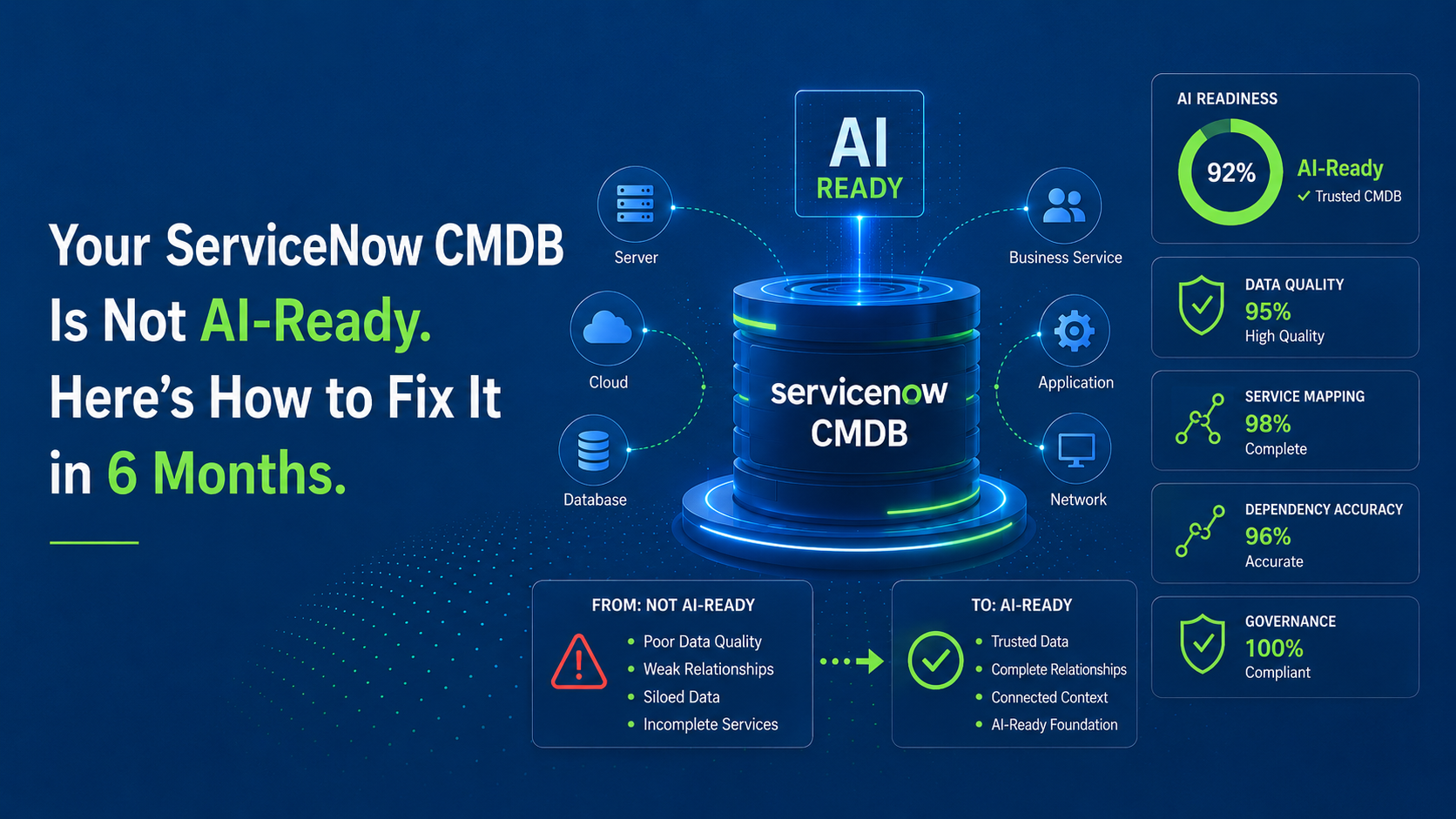
Your ServiceNow CMDB Is Not AI-Ready. Here’s How to Fix It in 6 Months.
The uncomfortable truth: AI will expose your CMDB problems
In 2026, every enterprise wants AI agents, automated change risk analysis, predictive incident management, and smarter IT operations. However, there is one problem many teams still prefer not to discuss: their ServiceNow CMDB is not ready.
For years, a weak CMDB could hide behind manual workarounds. For example, service desk agents knew which servers mattered. Change managers could ask application owners directly. Operations teams could also use spreadsheets when ServiceNow data was incomplete.
AI will not work that way. Instead, AI depends on structured, trusted, and connected data. This is why ServiceNow positions the Common Service Data Model, or CSDM, as the CMDB data model standard for products that use CMDB data. In addition, CSDM provides guidance for unified data access across ServiceNow AI Platform products.
As a result, CMDB quality is no longer just an IT operations issue. It has become a core AI-readiness requirement.
Why most ServiceNow CMDBs are broken
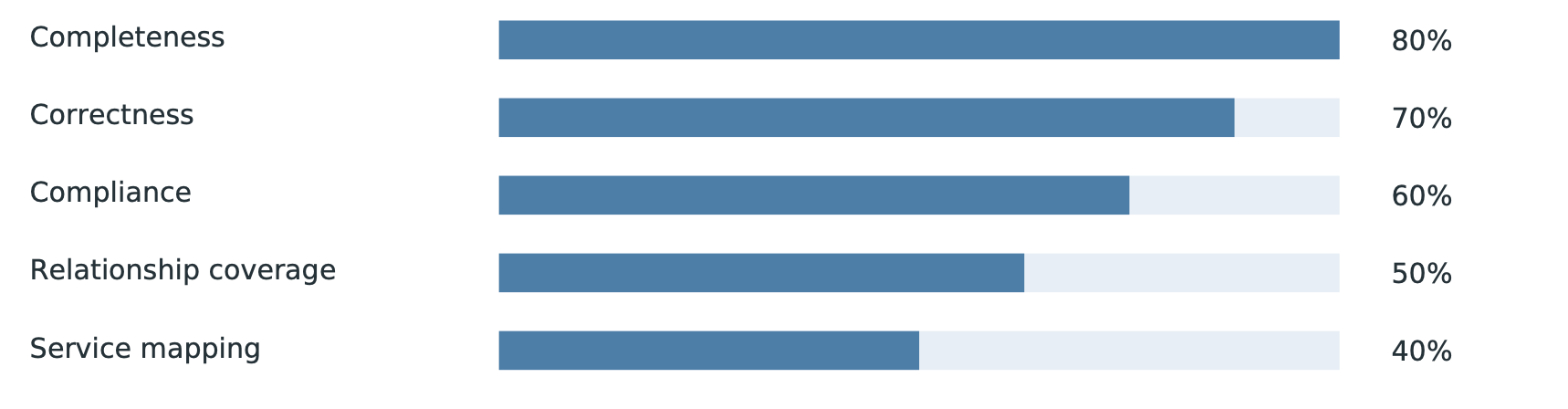
Most CMDBs do not fail because the platform is weak. Instead, they fail because ownership, governance, and operating discipline are missing. As a result, the same symptoms appear again and again: duplicate configuration items, stale records, missing relationships, unclear ownership, inconsistent lifecycle statuses, and manual updates that cannot keep pace with cloud, SaaS, endpoints, networks, and changing business services.
At the CI level, the data may still look acceptable. However, at the service level, the model often starts to collapse. This is exactly where AI becomes unforgiving. Before it can make useful recommendations or take safe action, it needs service context, dependency context, support-group context, and lifecycle context.
“AI does not fix a broken CMDB. It scale the consequences of one.”
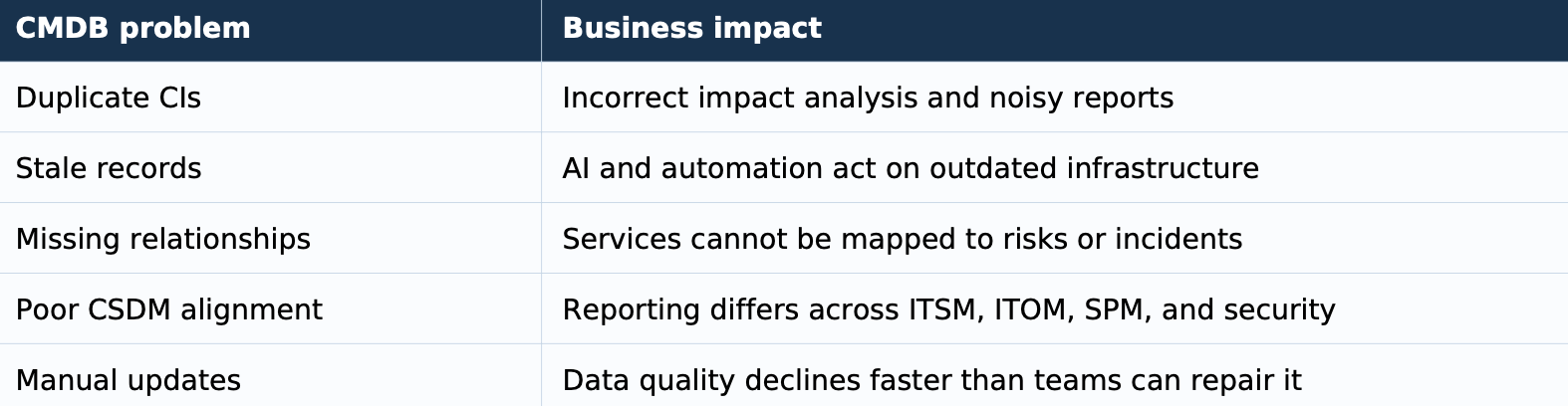
Graph 1: Typical CMDB health gap before AI adoption
The AI problem: context is everything
AI agents need more than asset names. They also need reliable operational context. For example, they must understand which application depends on which database, which server supports which business service, who owns the service, what change window applies, which incidents are related, and whether a CI is production-critical. In addition, ServiceNow’s 2026 AI direction points toward AI agents acting through enterprise workflows, playbooks, approval chains, and business rules. However, this approach works only when the data beneath those workflows is trustworthy. Without that foundation, bad CMDB data is no longer a simple reporting issue. Instead, it becomes an automation risk.
“Bad CMDB data is no longer a reporting inconvenience. It becomes an automation risk — bad decisions at machine speed, executed with confidence.”
Here is what AI needs at each layer of the CSDM model — and what breaks when it is missing:
| CSDM layer | Example | What AI needs here | AI priority |
| Business Service | Payroll, Order Management, CRM | Owner, SLA, criticality, support group | Critical for AI |
| Application Service | SAP ERP app service, CRM app service | App owner, upstream/downstream dependencies | Critical for AI |
| Technical Service | Database cluster, API gateway | Support group, environment, ops runbook reference | Required |
| Infrastructure CI | Server, container, network device | Lifecycle status, owner, discovery source, location | Foundational |
How to fix your CMDB before AI uses it
First, start with business-critical services, not every CI. In other words, do not try to clean the whole CMDB at once. Instead, select 10 to 20 critical business services and validate the most important data around them. This should include business applications, application services, technical services, owners, support groups, lifecycle status, and CI relationships. As a result, CMDB improvement becomes a measurable business program rather than an endless data cleanup project.
Align to CSDM
Second, align your CMDB to CSDM. CSDM gives ServiceNow products a common language for interpreting CMDB data consistently. Therefore, it helps different platform capabilities work from the same service and dependency structure. However, the objective is not to model everything perfectly on day one. Instead, the goal is to stop creating local structures that may break cross-platform reporting later. As a practical first milestone, focus on your critical business applications and application services. Make sure they are modeled consistently and connected to the right support teams, technology dependencies, and service context.
Use connectors, IntegrationHub ETL, and reconciliation rules
Third, reduce manual maintenance. To do this, use trusted data sources and automation instead of relying on manual updates. For example, Service Graph Connectors can import and integrate third-party data into CMDB and non-CMDB tables. In addition, IntegrationHub ETL provides a guided way to create and manage transform maps for third-party data without compromising data integrity. However, importing more data is not enough. You also need reconciliation rules, identification rules, and regular data-owner reviews to prevent duplicate records and control which sources can update specific attributes. Ultimately, the goal is not simply to collect more data. The goal is to build governed, reliable, and AI-ready data.
Make CMDB health a recurring KPI
Finally, make CMDB health an operating KPI. To keep the data reliable over time, CMDB quality should be measured regularly, not reviewed only during major projects. ServiceNow CMDB Health dashboards can help by providing health reporting, failed test visibility, relationship health insights, and remediation functions.
For this reason, teams should track duplicate CI rate, stale CI rate, required-field completeness, relationship coverage, and ownership coverage. In particular, ownership should be non-negotiable for production services. If nobody owns the record, AI should not act on it. Otherwise, automation may move faster than accountability.
Final thought: fix the foundation first
The companies that win with ServiceNow AI in 2026 will not necessarily be the ones with the most ambitious AI roadmap. Instead, they will be the ones with the cleanest and most reliable operational data. After all, a broken CMDB does more than create reporting problems. It slows incident response, weakens change management, damages service visibility, and blocks automation. Moreover, in an AI-powered enterprise, the risk becomes even greater because bad data can drive bad decisions at machine speed. Your CMDB does not need to be perfect. However, it must be governed, service-aware, CSDM-aligned, and continuously monitored. Ultimately, that is the real foundation for an AI-ready ServiceNow environment.
Suggested CMDB KPIs for AI readiness
Track these six KPIs monthly (relationship coverage quarterly) to maintain a governance baseline that AI agents can reliably act on. All are available natively in ServiceNow’s CMDB Health dashboard — no external tooling required.
| KPI | AI-ready target | How to measure | Why AI needs it | Cadence |
| Duplicate CI rate | < 5% | CMDB Health dashboard | Prevents double-execution by agents | Monthly |
| Stale CI rate | < 10% | Discovery freshness report | Agents act on live data only | Monthly |
| Required-field completeness | > 90% | CMDB Health score | Agent context accuracy | Monthly |
| Relationship coverage | > 80% | CSDM validation dashboard | Reliable impact analysis | Quarterly |
| CI ownership coverage | 100% critical | Ownership governance report | Accountability chain for AI-triggered work | Monthly |
| Discovery coverage | > 85% | Discovery status dashboard | No shadow infrastructure for agents to miss | Monthly |
Slava Trotsenko, CEO, Jun 11, 2026
Eager to take the next step? Contact us today!
Latest Articles
ServiceNow Intelligent Approvals: How AI Clears Approval Bottlenecks Without Losing Control
Your automation is fast. Your approvals are not. Organizations invest heavily in automation, AI and digital transformation. Yet many business processes still stall at the same point: waiting for someone to click “Approve.”
read more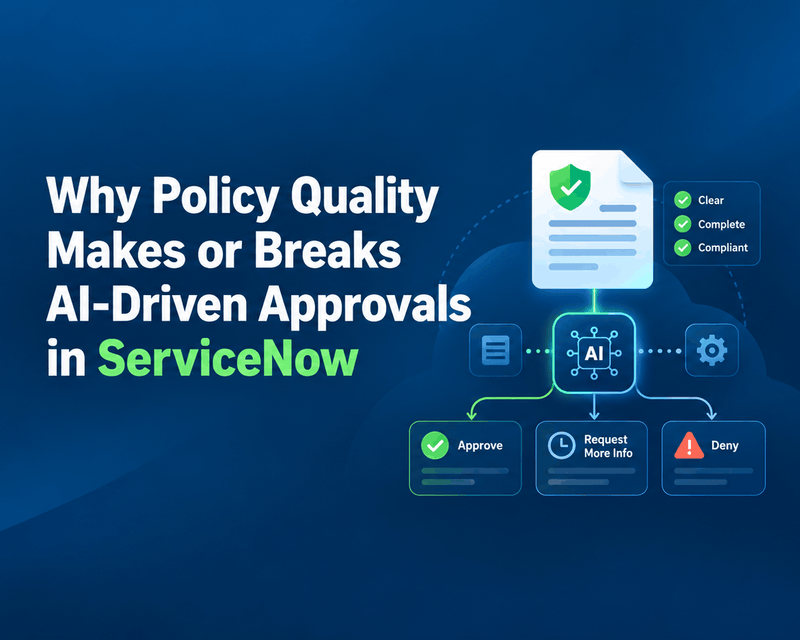
Why Policy Quality Makes or Breaks AI-Driven Approvals in ServiceNow
As enterprises bring AI-driven approvals into ServiceNow, attention goes straight to automation: faster decisions, fewer manual tasks, shorter approval queues. One factor gets far less attention: the quality of the policies behind those decisions.
read more
Teiva Systems at ServiceNow AI Summit 2026 — Munich
On October 7, 2026, Teiva Systems joined the ServiceNow AI Summit in Munich, where industry leaders, innovators, and the ServiceNow community came together to explore the next chapter of enterprise AI and intelligent automation.
read more