
ServiceNow AI ROI: What Should You Measure After the Pilot?
Your AI pilot worked. That proves the technology can work. It does not yet prove ROI. Here are the six metrics that separate “the demo impressed leadership” from “we can prove measurable business value.”
Your ServiceNow AI pilot worked.
Now what?
The chatbot responded correctly. Agents tried summarization. Developers generated code. Employees experimented with AI Search. Leadership saw the demo.
That proves the technology can work.
It does not yet prove ROI.
The real question after a ServiceNow AI pilot is: Did AI make the workflow measurably better?
ServiceNow’s own approach to AI value measurement focuses on quantifiable outcomes such as time saved, self-service effectiveness, productivity gains, and adoption. Its AI value framework translates AI usage into operational and financial impact rather than treating feature activation as success.
AI adoption is a usage metric. AI ROI is a business outcome. You need both.
Here are the metrics platform owners should measure once the pilot ends and the pressure to prove value begins:
Teiva insight — What we hear most often after a ServiceNow AI pilot:
The question is almost always the same: “the pilot went well, but how do we prove the value?” The underlying problem is that most organisations capture no baseline before the pilot starts. Without a Day 0 measurement of resolution time, deflection rate, and cost per case, every post-pilot improvement is an estimate rather than evidence. The six metrics in this post need to be captured before the pilot, not after it ends.
6 metrics to measure — with the ServiceNow tool that captures each one and the benchmark signal to watch for:
| # | Metric | Question it answers | Where to measure it | Benchmark signal |
| 1 | Resolution time | Is AI making work faster? | Now Assist Analytics, Performance Analytics | 14% – 50%+ faster (varies by workflow) |
| 2 | Deflection rate | How much work never reaches an agent? | Self-Solve Performance analytics | ServiceNow internal: +14% |
| 3 | Developer productivity | Is AI increasing delivery capacity? | Now Assist for Creator analytics | ServiceNow internal: 10% gain, 48% acceptance |
| 4 | Cost per case | Is AI lowering service delivery economics? | Custom report: cost ÷ resolved cases | $1.50–$2 reduction = $750K–$1M/year at 500K cases |
| 5 | User adoption | Are people actually using what you deployed? | Now Assist Analytics, Assistant Analytics | Track sustained use, not launch-week spike |
| 6 | Acceptance rate | Does the AI produce something people trust? | Now Assist Analytics — acceptance indicators | Below 50%: diagnose before scaling |
1. Resolution Time: Is AI Actually Making Work Faster?
One of the easiest ways to demonstrate ServiceNow AI ROI is to compare how long work takes before and after AI.
For ITSM, CSM, HRSD, or similar workflows, look at metrics such as:
- average resolution time;
- mean time to resolution;
- average handling time;
- time to first meaningful response;
- time spent summarizing records;
- time spent writing resolution notes.
For example, if an agent previously needed 15 minutes to understand a complex case and prepare a response, but Now Assist reduces that process to nine minutes, you have a measurable six-minute productivity gain.
ServiceNow’s Now Assist Analytics provides visibility into AI usage and performance, including indicators that can help organizations understand whether AI is contributing to faster task completion.
ServiceNow also measures estimated reading and writing time savings for certain generative AI use cases. Its methodology calculates time saved from activities such as summarization and AI-generated content, then combines usage and acceptance rates to estimate productivity improvements.
The important part is establishing a baseline before scaling.
Otherwise, “agents are faster” remains an opinion.
Instead, measure:
Average resolution time before AI → Average resolution time after AI
Then segment it by case type, priority, team, and AI-assisted versus non-AI-assisted work.
If AI is saving time, you should be able to point to where those minutes disappeared.
2. Deflection Rate: How Much Work Never Reaches an Agent?
For self-service use cases, deflection is one of the most valuable metrics.
If employees or customers can solve a problem through AI Search, Virtual Agent, or an AI assistant without creating a ticket, the organization avoids agent work entirely.
That is often where the strongest AI economics appear.
ServiceNow’s Self-Solve Performance analytics tracks metrics including total deflection events, successful deflections, live-agent transfers, deflection rates, and outcomes over time.
A simple calculation is:
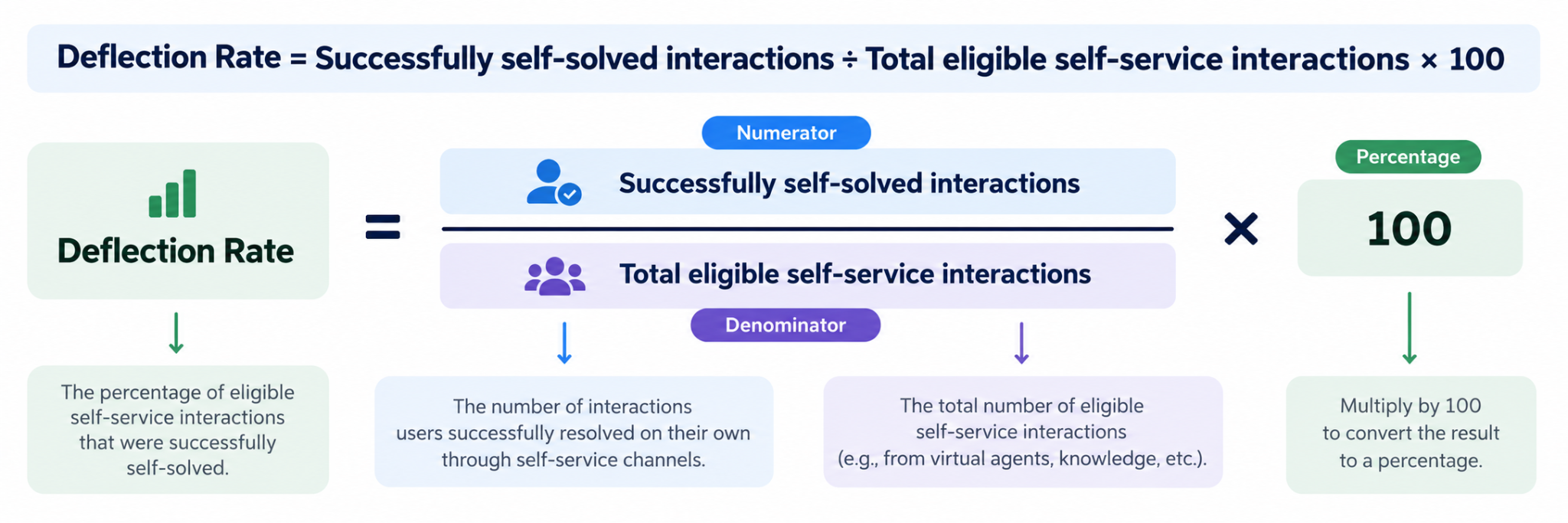
But don’t stop at the percentage.
Translate deflection into business value.
If AI prevents 8,000 low-complexity cases per year and the average cost to handle each case is $12, that represents:
8,000 × $12 = $96,000 in avoided handling cost
ServiceNow has reported similar results internally. In its Now on Now implementation of Now Assist, ServiceNow reported a 14% increase in employee deflection rate alongside broader productivity improvements.
Deflection turns AI from an interesting interface into an operational capacity lever.
3. Developer Productivity: Is AI Increasing Delivery Capacity?
AI ROI is not limited to service agents.
For development teams using capabilities such as Now Assist for Creator, one of the most important metrics is developer capacity created.
Measure:
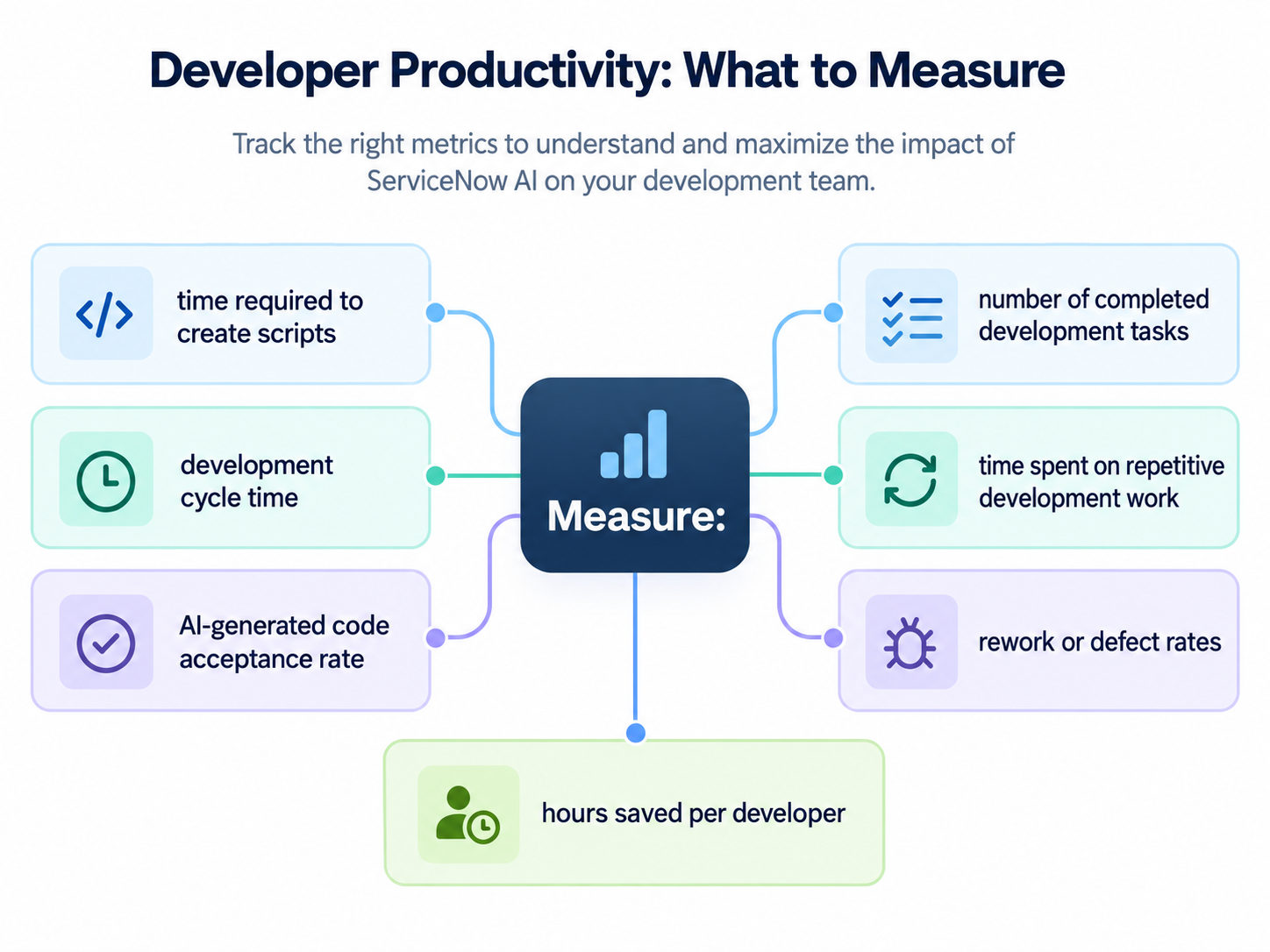
AI value framework uses a straightforward model for developer productivity:
AI uses × Acceptance rate × Time saved per use = Productivity value
For example, generating code is not valuable simply because developers clicked the AI button 5,000 times.
What matters is:
How often was the generated code accepted, and how much developer time did it actually save?
ServiceNow reported that its own use of Now Assist for Creator delivered approximately a 10% developer productivity gain, with a reported code-generation acceptance rate of 48%. (ServiceNow Now on Now)
That is a much stronger ROI conversation than:
“We generated 20,000 AI responses last quarter.”
4. Cost per Case: Is AI Lowering the Economics of Service Delivery?
Time savings become much more meaningful when converted into financial impact.
Suppose your service desk handles 500,000 cases per year.
If the average cost per case is $15, your annual handling cost is:
$7.5 million.
Now imagine AI-driven deflection, summarization, knowledge retrieval, and automated resolution reduce the effective cost per case to $13.50.
That $1.50 difference becomes:
$750,000 of potential annual operational value.
This is why cost per case should be measured alongside productivity.
Track:
Total service delivery cost ÷ Number of resolved cases
Then compare:
Before AI vs. after AI
You can also calculate cost separately for:
- AI-deflected cases;
- AI-assisted cases;
- fully human-handled cases.
This creates a much clearer picture of where AI actually changes the economics of your ServiceNow operating model.
The best AI metric is not how much AI you use. It is how much expensive work AI removes.
5. User Adoption: Are People Actually Using What You Deployed?
You can build an excellent AI capability and still generate almost no ROI if employees ignore it.
That makes adoption a critical leading indicator.
ServiceNow’s Now Assist Analytics provides usage and adoption data for AI capabilities and agents.
Useful metrics include:
- daily unique AI users;
- monthly active AI users;
- AI interactions per user;
- adoption by department;
- adoption by workflow;
- skill usage;
- repeat usage;
- AI response acceptance rate.
You should also distinguish between trial usage and sustained adoption.
A large spike during launch week means very little if usage collapses a month later.
Look instead for increasing habitual usage.
ServiceNow’s Assistant Analytics is designed to help organizations monitor AI assistant adoption, engagement, user sentiment, and usage trends across workflows.
The question is not simply:
“Did people try the AI?”
It is:
“Did they keep using it because it made their work easier?”
6. Acceptance Rate: Does the AI Produce Something People Trust?
Usage alone can be misleading.
Imagine an agent generates 1,000 AI responses but rewrites 800 of them manually.
Technically, adoption looks high.
Operational value does not.
That is why acceptance rate matters.
Track how frequently users accept:
- generated summaries;
- resolution notes;
- suggested responses;
- generated code;
- AI-generated knowledge;
- recommended actions.
ServiceNow’s analytics includes indicators related to AI skill usage and acceptance, helping organizations understand whether generated outputs are actually useful rather than simply produced. (Now Assist Analytics indicators)
A high usage rate combined with a low acceptance rate may indicate:
poor prompts, weak grounding data, incorrect configuration, or the wrong use case.
That insight is extremely valuable before expanding AI across the enterprise.
7. Translate Every AI Metric Into Business Value
Translate Every AI Metric Into Business Value
Eventually, leadership will ask one question: “What did we get for the money?”
Your AI ROI model should therefore connect operational metrics with financial outcomes. Here is the translation framework — and exactly how to build it for your most common AI activities:
| Instead of reporting this activity metric | Report this outcome translation | And this business value calculation |
| 42,000 Now Assist interactions | 42,000 interactions → 6,300 hours saved | ~$X in productivity capacity (apply your average hourly cost) |
| 12,000 self-service conversations | 12,000 conversations → 4,200 cases deflected | 4,200 × $12 avg case cost = $50,400 handling cost avoided |
| 1,500 code generation uses | 1,500 × 51% acceptance = 765 accepted → 190 developer hours saved | 190 hours × developer day rate = measurable delivery capacity |
This is broadly aligned with the methodology described in ServiceNow’s Now Assist implementation lessons learned, which connects AI activity with estimated hours saved and then converts those gains into measurable business value.
ServiceNow reported $10 million in annualized tangible benefit within 120 days of its internal Now Assist deployment, including both cost reduction and productivity value. That later increased to $14.4 million. (ServiceNow Now on Now)
The important lesson is not the number. It is the measurement discipline behind it.
Your Pilot Should End With a Baseline, Not a Celebration
Before declaring the pilot a success and scaling, answer these six questions:
1. Did resolution time improve?
2. Did more users solve problems themselves?
3. Did developers save meaningful time?
4. Did cost per case decrease?
5. Are employees continuing to use the AI?
6. Are they accepting its output?
If you cannot answer all six yet, your AI initiative may be technically successful — but its ROI is still unproven.
The goal of enterprise AI is not to generate more AI activity. It is to remove work, accelerate outcomes, and create measurable capacity.
The organizations that get the most value from ServiceNow AI will not necessarily be the ones that deploy the most features. They will be the ones that measure the right things, improve the right workflows, and scale only where the numbers prove the value.
Slava Trotsenko, CEO, Sep 17, 2026
Eager to take the next step? Contact us today!
Latest Articles

Teiva Systems at ServiceNow World Forum 2026 — New York
Teiva Systems was excited to join the ServiceNow World Forum 2026 in New York, where AI, Agentic AI, and the future of enterprise technology took center stage.
read more
7 Signs Your ServiceNow Instance Needs a Health Check
Your ServiceNow instance rarely becomes unhealthy overnight. The warning signs usually appear gradually: pages take longer to load, integrations fail more often, upgrades become increasingly painful, and every new requirement seems to need another customization.
read more
What Should a ServiceNow Partner Actually Deliver in the First 90 Days?
Signing a ServiceNow implementation partner is easy. Knowing whether that partner is actually delivering value is harder. “The first 90 days should reduce uncertainty. You should understand what you have, what you are building, why it matters, and how success will be measured.”
read more