
AI Agents Are Breaking the Per-User Software Model
What This Means for ServiceNow Customers
AI agents are changing more than enterprise workflows. They are challenging one of the assumptions SaaS economics has relied on for decades: that software value broadly scales with the number of humans using it.
“AI architecture is becoming a financial architecture decision.”
For most of the SaaS era, enterprise software economics have been relatively easy to understand.
A company has 5,000 employees. Perhaps 800 of them are fulfillers, service agents, developers, or other users who need access to a platform. More users generally mean more licenses, and software costs can therefore be modeled around the number and type of people using the system.
AI agents complicate that equation.
A digital worker does not need to log in at 9 a.m., work through a queue, take a lunch break, and log out at 6 p.m. It can investigate incidents, retrieve data, invoke tools, update records, communicate with users, and trigger downstream actions continuously.
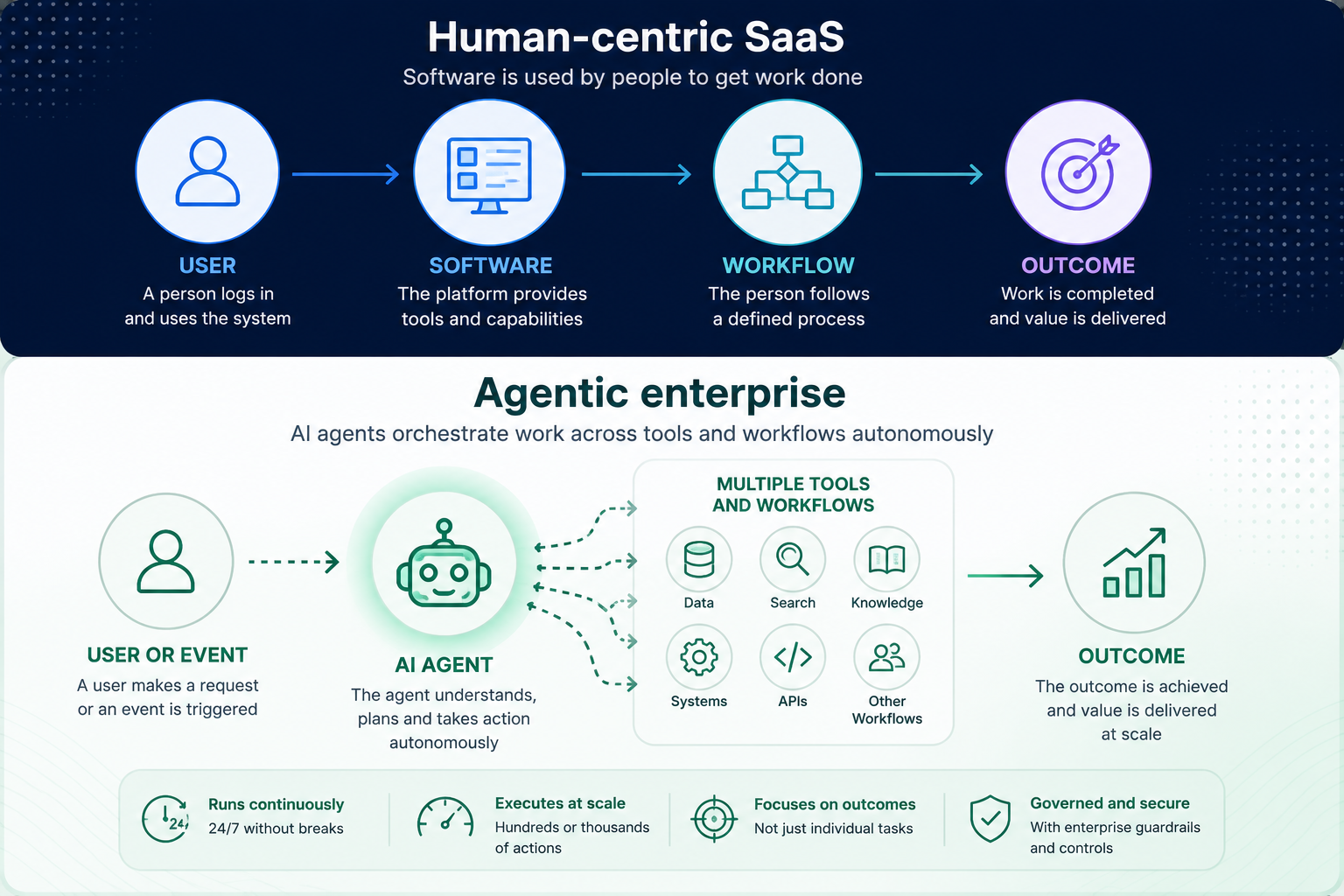
ServiceNow itself describes AI agents as autonomous systems capable of interacting with their environment, gathering information, making decisions, and completing tasks that would otherwise require human work. See the ServiceNow AI Agents FAQ.
The second model creates an important question for CIOs and ServiceNow platform owners:
If humans are no longer performing every unit of work, is the number of human users still the best way to understand the value and cost of enterprise software?
The answer is increasingly complicated.
Per-user licensing is not disappearing overnight. But as AI agents take on a larger share of enterprise work, organizations need to understand another economic unit alongside seats:
Autonomous work performed by the platform.
Why AI Agents Challenge Per-User Software Economics
Consider a ServiceNow environment supporting an enterprise service desk with 100 employees.
Traditionally, those people investigate incidents, search knowledge, review configuration data, check monitoring information, communicate with employees, document their findings, resolve issues, and close records.
The commercial logic naturally revolves, at least partly, around the humans performing that work.
Now introduce AI agents.
An AI agent can potentially:
- investigate an incident;
- query the CMDB;
- retrieve relevant knowledge;
- analyze monitoring information;
- identify a likely resolution;
- execute or initiate remediation;
- update the incident;
- communicate progress to the requester;
- verify the result;
- close or route the case.
The technology is also moving beyond isolated agents. ServiceNow’s agentic platform increasingly allows AI agents to use tools and workflows to pursue broader objectives rather than simply generating a response for a human.
That changes the economics.
One hundred service-desk employees may remain in the organization. But those same 100 people could supervise a dramatically larger amount of work performed autonomously by software.
The meaningful question is therefore no longer only:
How many people need access to the platform?
It also becomes:
How much work will the platform perform on their behalf?
And that raises a broader question for enterprise software:
Should AI-era software economics be measured by seats, agents, interactions, actions, consumption, or business outcomes?
There probably will not be one universal answer.
But ServiceNow already gives customers a practical example of what this transition can look like.
ServiceNow Already Shows What the Transition Looks Like
ServiceNow has not simply abandoned user-based licensing.
Instead, AI introduces another layer of economics through Assists, ServiceNow’s unit for measuring consumption across Now Assist capabilities.
AI Agents themselves also sit within ServiceNow’s existing commercial framework. According to the official ServiceNow installation requirements for Now Assist AI Agents, customers need a Pro Plus or Enterprise Plus license, as well as a Now Assist license.
The important difference is what happens when agents start working.
Different AI activities can consume different amounts of capacity. For agentic workflows, consumption can depend directly on how many tools the workflow executes.
Current ServiceNow guidance on managing AI Agents, skills, and Assists describes the following tiers:
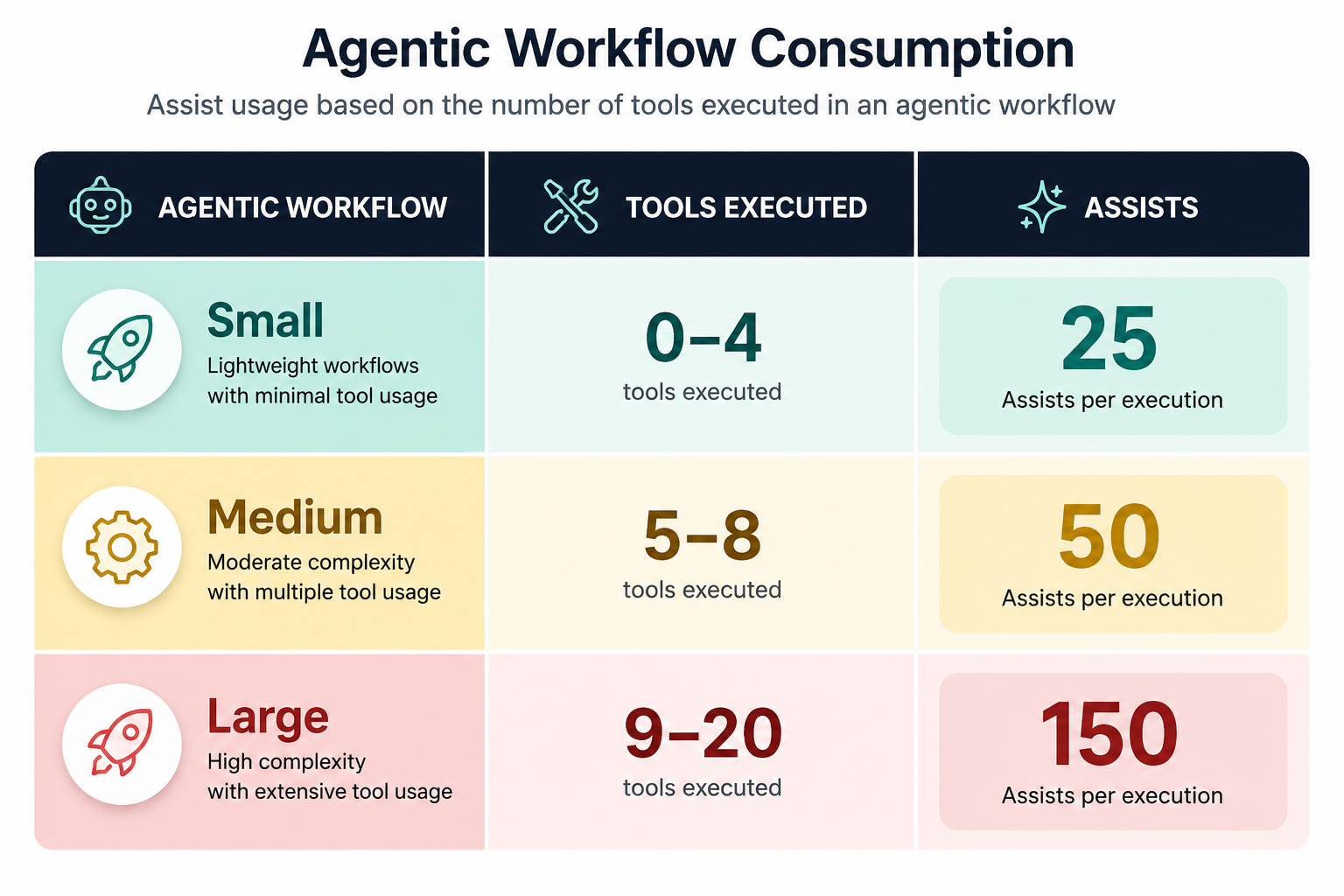
That is an excellent illustration of the broader economic shift.
Old question:
“How many people need access?”
New question:
“How much autonomous work will the platform perform?”
Two organizations could have almost identical employee counts, identical numbers of ServiceNow users, and completely different AI consumption profiles.
The Hidden Economics of Autonomous Work
This is where things become particularly interesting for ServiceNow customers.
Imagine an AI agent that executes 10,000 times per month.
If each execution falls into the Small tier:
10,000 × 25 = 250,000 Assists
Now imagine architectural complexity pushes those executions into the Large tier:
10,000 × 150 = 1,500,000 Assists
Same number of employees.
Same 10,000 executions.
Potentially the same business outcome.
But:
6× the Assist consumption.
That means AI architecture is no longer simply a technical architecture decision.
AI architecture is becoming a financial architecture decision.
And ServiceNow itself provides a particularly revealing example.
Its AI Agent management best practices recommend reviewing agents for “over-tooling.”
ServiceNow notes that reducing an agentic execution from nine tools to eight can move it from the Large tier to the Medium tier.
The result?
150 Assists → 50 Assists per execution.
That is a 67% reduction in consumption per execution.
Now apply that difference at scale.
At 100 executions:
15,000 vs. 5,000 Assists
At 10,000 executions:
1.5 million vs. 500,000 Assists
At 100,000 executions:
15 million vs. 5 million Assists
A seemingly small architecture decision can therefore have a significant impact on enterprise AI economics.
This changes the optimization question.
Instead of asking:
“How sophisticated can we make this agent?”
ServiceNow architects should increasingly ask:
“What is the minimum agentic complexity required to reliably produce the business outcome?”
The goal is not the most complex agent.
It is the most efficient reliable agent for the outcome required.
AI Consumption Has to Be Forecast Before Production
Consumption also needs to be modeled before an AI agent reaches enterprise scale.
ServiceNow now explicitly recommends this.
In its guide on estimating and forecasting agentic Assist usage, ServiceNow shows how historical incident volumes can be used to estimate future Assist consumption for AI Agents designed to triage and resolve incidents.
That represents an important change in ServiceNow architecture planning.
Before deployment, teams should estimate:
Expected executions × Assist consumption per execution = expected consumption
But the calculation should not stop there.
A useful model should include:
- expected execution volume;
- peak execution volume;
- tool count;
- failed executions;
- retries;
- escalations;
- testing and sub-production activity;
- expected growth;
- percentage of executions producing a valuable outcome.
Why?
Because an agent that looks inexpensive at 1,000 executions can become a very different financial proposition at 100,000.
The Runaway-Agent Problem
Human-driven software has a natural speed limit.
A person can only open so many records, make so many decisions, and execute so many actions in an hour.
Autonomous software does not have the same constraint.
Imagine a poorly configured pattern:
Agent → Action → Event → Agent → Action → Event → Agent…
What looks like a small trigger problem can become a machine-speed consumption loop.
This risk is significant enough that ServiceNow has introduced platform controls specifically designed to address it.
In Australia Patch 3, ServiceNow added functionality to detect and disable runaway AI agent triggers to prevent unintended Now Assist consumption, according to the official Now Assist AI Agents Australia release notes.
ServiceNow describes a Kill Switch that can automatically disable an AI agent when the same record repeatedly triggers the same agent objective beyond a configured threshold.
That tells us something important.
AI cost governance cannot happen only at procurement time.
It has to happen at runtime.
ServiceNow also recommends that customers actively manage agentic Assist consumption by monitoring Assist usage, reviewing trigger configurations, avoiding potential loops, checking over-scheduled triggers, and reviewing agents for over-tooling.
This points toward an emerging discipline:
AgentOps + FinOps + ServiceNow Governance
Organizations scaling agentic AI will need to govern not only what agents are allowed to do, but also:
- how frequently they run;
- what triggers them;
- how many tools they invoke;
- how much they consume;
- whether executions produce valuable outcomes;
- whether abnormal consumption is occurring;
- and what each autonomous outcome ultimately costs.
AI governance and AI economics are becoming increasingly difficult to separate.
Stop Measuring AI by “Number of Users”
Many enterprise AI programs still highlight adoption metrics such as:
“3,200 employees now have access to AI.”
That is useful.
But it is not a business outcome.
Imagine Company A gives 5,000 employees access to AI, but agents resolve only 1,000 meaningful tasks each month.
Company B gives 1,000 employees access, but its carefully designed agents autonomously resolve 30,000 repetitive service requests.
Which organization has the more successful AI strategy?
The number of users cannot answer that question.
For ServiceNow AI, CIOs should increasingly track several layers of performance.
Consumption
How many Assists are we consuming?
ServiceNow recommends monitoring this through capabilities such as AI Agent Studio > Analytics > Assist Consumption and Now Assist subscription management. See ServiceNow’s Assist consumption management guidance.
Automation
How many tasks are AI agents completing without manual intervention?
Outcome
How many incidents, requests, cases, or alerts are being successfully resolved?
Efficiency
How much AI consumption is required to achieve each successful result?
Business Value
How many employee hours, service-desk costs, downtime hours, or operational delays are being avoided?
Together, those metrics provide a much more meaningful picture of AI performance than user adoption alone.
A Better Metric: Cost per Autonomous Outcome
This leads to a simple metric CIOs should consider:
Cost per autonomous outcome
At an operational level, organizations could begin with:
Assists consumed ÷ successful autonomous outcomes
Imagine an AI agent consumes 500,000 Assists in one month and autonomously produces 20,000 successful resolutions.
That equals:
25 Assists per successful autonomous outcome.
Now imagine an architectural change causes consumption to increase to 1.2 million Assists while successful resolutions remain at 20,000.
The organization is now consuming:
60 Assists per successful autonomous outcome.
Employee adoption might look exactly the same.
The economics are completely different.
That is why technical telemetry needs to be connected to business outcomes.
What CIOs Should Model Before Scaling ServiceNow AI Agents
Before deploying an agent across thousands or millions of potential executions, ServiceNow customers should be able to answer five questions.
1. How Often Will This Agent Run?
An agent that executes 500 times per month has a very different economic profile from one executing 500,000 times.
Historical ServiceNow data can help here. ServiceNow itself recommends using existing incident volumes when forecasting potential agentic Assist usage.
2. How Many Tools Does Each Execution Require?
Tool architecture can directly influence consumption.
Model the typical path, complex cases, and failure scenarios — not just the ideal execution.
3. What Assist Tier Does That Create?
Calculate expected monthly consumption at realistic execution volumes.
Then model:
2× volume.
5× volume.
10× volume.
The economics of a successful AI deployment can change precisely because adoption succeeds.
4. What Percentage of Executions Produce a Valuable Outcome?
More agent activity does not automatically mean more value.
If an agent repeatedly escalates cases, fails to complete workflows, or invokes tools without producing a useful result, consumption can grow faster than ROI.
5. What Does One Successful Autonomous Outcome Cost?
Do not stop at:
“Our AI Agent resolved 50,000 requests.”
Ask:
“What did it consume to resolve those requests?”
Then compare that number with the cost, speed, and quality of the previous process.
Agent Design Is Becoming Cost Design
This introduces another responsibility for ServiceNow architects.
Historically, enterprise architecture focused heavily on:
- performance;
- reliability;
- security;
- maintainability;
- upgradeability;
- user experience.
Agentic AI introduces another dimension:
unit economics.
Should the agent invoke nine tools, or can eight produce the same reliable outcome?
Should every record update trigger an agent?
Could multiple actions be consolidated?
Could a Virtual Agent topic or conversational catalog item handle a simpler use case instead of a full agentic workflow?
ServiceNow itself recommends asking these questions when reviewing agents for over-tooling in its AI Agent optimization guidance.
This means:
The architecture of an AI agent can become part of the architecture of your ServiceNow spend.
Organizations should therefore involve ServiceNow architects, AI governance teams, platform owners, and financial stakeholders before autonomous workflows reach enterprise scale — not after consumption unexpectedly spikes.
What Enterprise Software Pricing Could Become
Does all of this mean per-user licensing is dead?
No.
Humans will continue using enterprise platforms directly, and per-user models remain logical for many applications.
But autonomous AI introduces units of work that seats alone cannot describe.
Several models could therefore coexist.
Per-user — still appropriate where humans remain the primary software operators.
Per-agent — organizations pay for deployed digital workers.
Consumption-based — pricing scales with executions, actions, AI usage, or compute consumption.
Outcome-based — pricing connects more directly with resolved incidents, completed requests, processed cases, or other business outcomes.
There is already evidence of this strategic direction in ServiceNow’s own messaging. In its Q4 2024 financial results, ServiceNow said it planned to include AI Agents in Pro Plus and Enterprise Plus rather than requiring incremental subscriptions upfront, with the goal of driving adoption and “monetize increasing usage over time.”
The likely future therefore may not be one pricing model replacing another.
It may be hybrid enterprise software economics.
Human access can remain licensed through users or roles while autonomous work is increasingly measured through consumption, agents, or outcomes.
From Software Access to Software Labor
For decades, enterprise software was primarily a tool used by employees.
Agentic AI turns software into something closer to a participant in the workforce.
That is a profound economic change.
When software waits for a human to click a button, the human is the natural unit around which usage can be modeled.
When software can reason, invoke tools, modify records, coordinate workflows, communicate, and pursue outcomes autonomously, that relationship changes.
The platform is no longer simply enabling work.
It is performing work.
And once software performs work, enterprises need to understand its productivity and economics much more like any other operational resource.
How much work did it perform?
How much did that work consume?
How reliable was the result?
How much human effort did it replace or augment?
What was the cost per successful outcome?
Those questions are becoming more meaningful than simply counting how many employees clicked an AI button.
The Takeaway
AI agents are not making user licenses irrelevant.
They are making user count insufficient as the primary lens for understanding enterprise AI economics.
ServiceNow customers entering the agentic era should therefore think beyond adoption.
The next generation of ServiceNow optimization will involve designing agents that are not only capable, secure, and reliable but also economically efficient at scale.
Because when an autonomous workflow can execute thousands of times without another employee opening the platform, the question changes.
It is no longer only:
“How many people use our ServiceNow platform?”
It becomes:
“How much valuable work does our ServiceNow platform perform — and what does each outcome cost?”
AI agents aren’t just changing how enterprises use ServiceNow. They’re changing the unit by which enterprises need to understand the value — and cost — of the platform.
Slava Trotsenko, CEO, Sep 07, 2026
Eager to take the next step? Contact us today!
Latest Articles
Teiva Systems at ServiceNow World Forum 2026 — London
On October 20, 2026, Teiva Systems attended ServiceNow World Forum London at ExCeL London, where industry leaders, technology experts, and the ServiceNow community came together to explore how AI, intelligent automation, and digital workflows are transforming enterprise operations.
read more
ServiceNow Intelligent Approvals: How AI Turns Policies Into Approval Decisions
What if your approval policies could make decisions, instead of sitting in documents waiting for someone to interpret them? For years, approval automation has followed the same pattern. Business teams write policies. Developers translate them into workflow conditions. Employees wait for someone to approve or reject their request, even when the outcome is obvious.
read more
ServiceNow Intelligent Approvals: How AI Clears Approval Bottlenecks Without Losing Control
Your automation is fast. Your approvals are not. Organizations invest heavily in automation, AI and digital transformation. Yet many business processes still stall at the same point: waiting for someone to click “Approve.”
read more