
Shadow AI Is the New Shadow IT: How ServiceNow Customers Are Taking Back Control in 2026
AI adoption has outrun enterprise control models. For most ServiceNow customers, that gap is no longer theoretical — it is live, growing, and showing up in board-level risk conversations. Here is what practical AI governance actually looks like, and how to close the gap before it becomes an incident.
We see the same pattern across almost every ServiceNow environment we assess.
Three to five AI tools running without central visibility. A CMDB that does not know they exist. An IT team that did not approve them. A compliance team that cannot audit them. A leadership team that has no dashboard showing what AI is doing across the enterprise.
It is not recklessness. It is the natural result of AI adoption moving faster than governance frameworks were built to handle. Business teams found tools that worked. They used them. Nobody built the control model fast enough to catch up.
The problem is that ServiceNow is not a generic SaaS tool. It is where enterprise work happens — incidents, vulnerabilities, employee records, approvals, contracts, audit trails. When AI operates inside that environment without governance, the consequences are not limited to a bad recommendation. They extend to compliance exposure, data risk, and autonomous actions that nobody explicitly authorised.

Why AI Governance Has Moved to the Board Agenda
For most of the last decade, enterprise AI governance was a document. A policy. A set of principles written by a committee that met twice a year.
That model no longer works. AI is not a feature you deploy and review annually. It is a live participant in your business operations — making recommendations, summarising cases, triggering approvals, executing workflows, interacting with sensitive data. In some environments, it is doing all of this autonomously, without a human reviewing every step.
The shift from annual review to continuous governance is not optional. It is the consequence of deploying AI in real operations.
ServiceNow’s AI Control Tower expansion at Knowledge 2026 reflects this directly. The platform now governs AI across five dimensions: Discover, Govern, Secure, Observe, and Measure. That is not a product roadmap. It is a governance operating model made concrete in software.
| “AI governance is no longer a policy document. It is becoming an operating model for every workflow, agent, model, and decision that touches the enterprise.” |
For ServiceNow customers specifically, this matters more than for most platforms. ServiceNow connects IT, HR, customer service, security, procurement, and operations in a single workflow layer. When AI operates in that environment, it is not touching one system. It is touching all of them.
Shadow AI: The Problem Most ServiceNow Customers Have and Don’t Know It
Shadow AI is the new shadow IT. And it is already inside your ServiceNow environment.
Employees are experimenting with public AI tools. Business teams are purchasing niche AI products without IT review. Technical teams are connecting models to workflows before centralised governance catches up. In the organisations we assess, we typically find three to five AI tools in active use that are invisible to the platform team.
The issue is not that experimentation is bad. Experimentation is how organisations find value. The issue is that invisible AI creates unmanaged risk.
For ServiceNow environments, that risk is amplified by what lives in the platform. Incidents. Vulnerabilities. Employee records. Customer cases. Contracts. Approvals. Audit trails. If AI agents operate across that data without role-based controls, supervised execution, and clear ownership, they expand the attack surface in ways that neither IT nor compliance can see.
| The shadow AI problem in ServiceNow is rarely intentional. It is the gap between how fast AI tools become available and how slowly governance frameworks catch up. When we do an AI inventory for a new client, the number of undocumented AI assets is almost always higher than the platform team expected. The first step is always the same: you cannot govern what you cannot see. |
Security discussions around enterprise AI have also surfaced three specific risks that ServiceNow environments must address: prompt injection (an agent being manipulated into taking actions its policy does not permit), privilege misuse (an agent using access rights beyond what the task requires), and agent-to-agent risk (one agent triggering behaviour in another without human visibility). Each of these requires observability — not just policy documentation.
| “You cannot secure, measure, or improve AI that you cannot see.” |
What Good AI Governance Actually Looks Like in ServiceNow
Good AI governance is not more documentation. It is a shift in how the platform operates every day.
In our experience, the organisations that govern AI well share one characteristic: they treat governance as an operational function, not a compliance event. It runs continuously, it is owned by a named individual, and it is built into the same workflows the business uses for everything else.
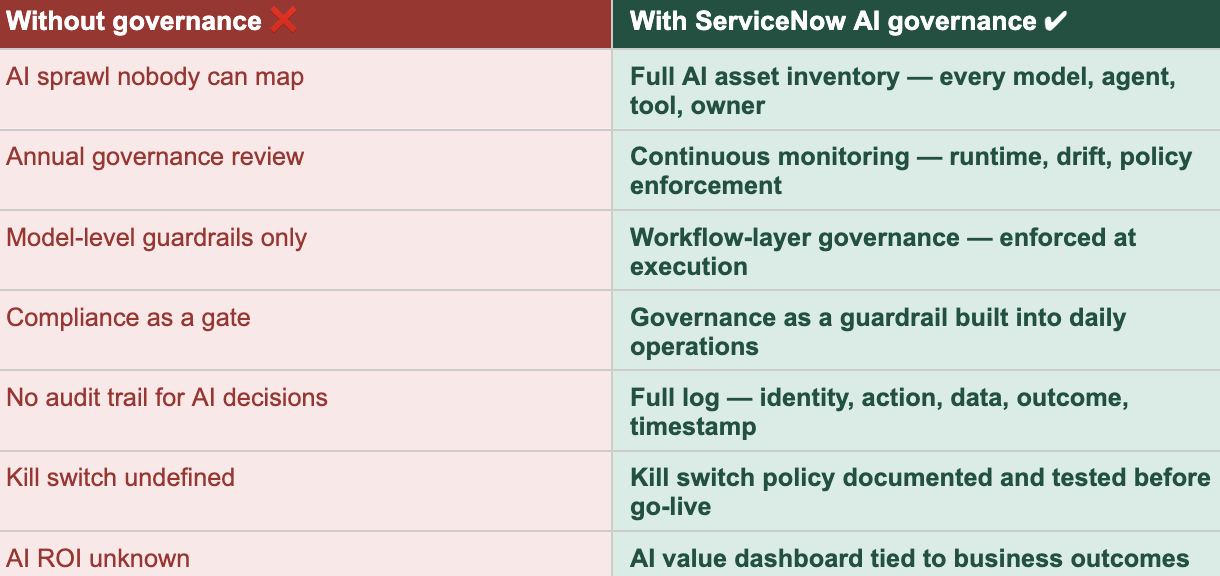
ServiceNow provides the infrastructure for all of this natively: AI Control Tower for discovery and governance, role-based access controls for permission scoping, audit logs for every agent action, risk scoring workflows, vendor management for third-party AI tools, and Performance Analytics for tracking AI value against business outcomes.
The gap we see most often is not missing capability. It is missing activation. The tools are available. The governance framework is not yet in place to use them.
The AI Governance Maturity Model: Where Are You?
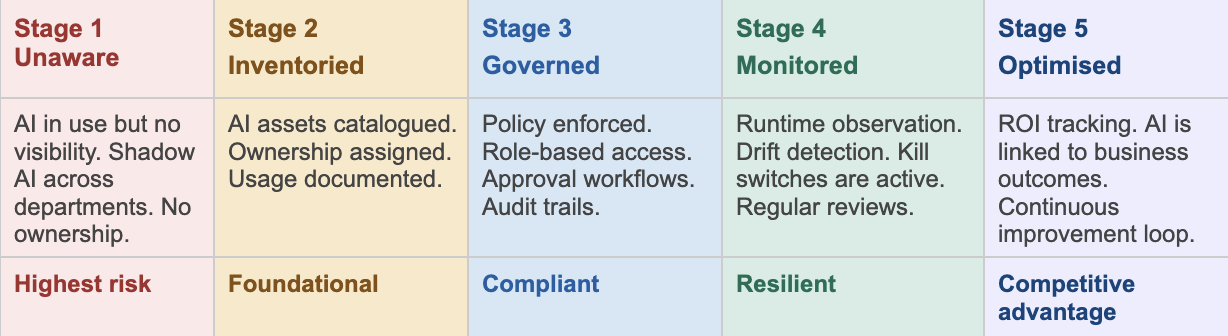
In the assessments we run, we use a five-stage maturity model to help organisations understand where they are and what to prioritise next. Most ServiceNow customers are at Stage 1 or 2. Very few are at Stage 4 or 5.
Six Questions Every ServiceNow Customer Needs to Answer Today
In every AI governance conversation we have with clients, the same six questions come up. If you cannot answer them today, you have a governance gap.
1. Where is AI being used?
Can you produce a complete inventory of every AI agent, model, tool, and integration running in your ServiceNow environment right now? Most organisations cannot.
2. Who owns each AI asset?
Not the vendor. Not the platform team. Who in your organisation is accountable for each AI use case — its data access, its actions, and its outcomes?
3. What data can each AI agent access?
Role-based tool packages in AI Control Tower define this. Are they configured? Are they current? Have they been reviewed since the agents were activated?
4. What happens when an agent behaves incorrectly?
Do you have a kill switch policy? Is it documented? Has it been tested? Who has the authority to invoke it?
5. Can you produce an audit trail for any AI action?
Not in theory. Right now. Can you pull the log for the last ten actions a specific agent took, including the records it touched?
6. Is AI governance owned by a named individual?
Not a committee. Not a shared responsibility. One person who is accountable for the AI governance operating model and has the authority to enforce it.
The Business Case: Why Governance Is a Competitive Advantage, Not a Cost
We hear the same objection regularly: “governance slows us down.” However, in our experience, the opposite is true. Ungoverned AI slows organisations down because every incident, every compliance question, and every audit request costs more time and money to resolve reactively than it would have cost to prevent.
As a result, the organisations winning with AI in 2026 are not the ones moving fastest without controls. Instead, they are the ones moving confidently because their controls are already in place. They can say yes to new use cases faster because they have a governance framework that can evaluate and approve them quickly. At the same time, they can prove AI value to the board because they have measurement built in. Moreover, they can respond to compliance requests in hours, not weeks.
This is why AI governance is such a strong positioning topic for ServiceNow partners. CIOs, CISOs, risk leaders, and transformation teams are not asking only for AI features. They are also asking for trust, control, transparency, and a scalable operating model. In practice, that is the conversation Teiva is having with every client.
| Teiva insight — What we tell every client considering skipping the governance step: You will not skip governance. You will either build it proactively, or you will build it reactively after something goes wrong. Building it proactively is faster, cheaper, and less disruptive. The only question is timing. |
AI governance is not the end of AI ambition. It is what makes AI ambition sustainable.
The organisations that build governance into their ServiceNow AI operating model today are the ones that will activate new agents faster, prove value to the board sooner, and scale confidently in the second half of 2026. Every AI Specialist in the Autonomous Workforce, every Action Fabric integration, every Otto workflow — all of it runs better on a governed foundation.
The question is not whether to govern AI. It is how far behind you can afford to be when governance becomes mandatory — from regulators, from auditors, or from a board that has just read about someone else’s AI incident in the morning news.
Slava Trotsenko, CEO, May 28, 2026
Eager to take the next step? Contact us today!
Latest Articles
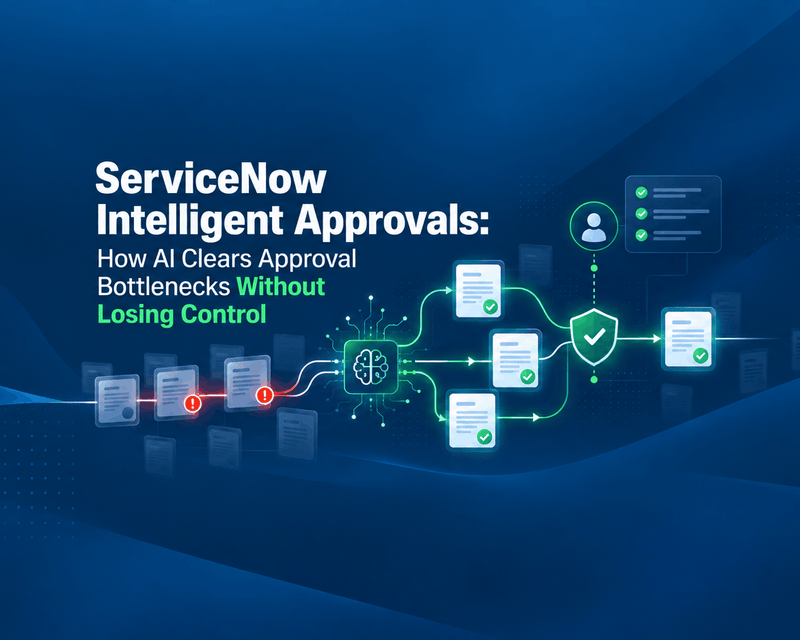
ServiceNow Intelligent Approvals: How AI Clears Approval Bottlenecks Without Losing Control
Your automation is fast. Your approvals are not. Organizations invest heavily in automation, AI and digital transformation. Yet many business processes still stall at the same point: waiting for someone to click “Approve.”
read more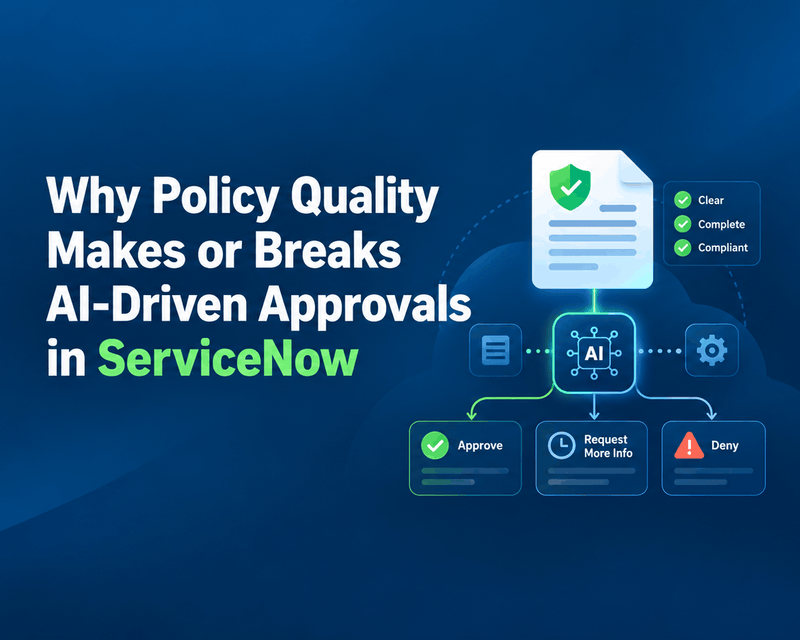
Why Policy Quality Makes or Breaks AI-Driven Approvals in ServiceNow
As enterprises bring AI-driven approvals into ServiceNow, attention goes straight to automation: faster decisions, fewer manual tasks, shorter approval queues. One factor gets far less attention: the quality of the policies behind those decisions.
read more
Teiva Systems at ServiceNow AI Summit 2026 — Munich
On October 7, 2026, Teiva Systems joined the ServiceNow AI Summit in Munich, where industry leaders, innovators, and the ServiceNow community came together to explore the next chapter of enterprise AI and intelligent automation.
read more