
ServiceNow Australia Release: What to Deploy First, What to Wait On, and What Most Teams Get Wrong
Australia went GA on May 5, 2026 — the same week as Knowledge 2026 in Las Vegas. The release is significant: RaptorDB, the L1 AI Specialist, AI Control Tower v2, Action Fabric, and a preview of Autonomous CRM. The question is not whether to upgrade. It is what to activate first, and what to leave alone until your foundation is ready.
Every major ServiceNow release brings the same temptation.
The release notes arrive. At first, they look like a standard upgrade checklist. However, they are long, and there is something interesting in almost every section. Someone in leadership asks about the AI Specialist they heard about at Knowledge 2026. Meanwhile, someone in IT wants to know about the performance improvements. At the same time, someone in HR wants to talk about employee service automation. As a result, the upgrade project suddenly becomes a feature activation project — and that is where most organizations get into trouble.
The Australia release is the most significant ServiceNow upgrade since the platform shifted to agentic AI. However, that significance cuts both ways. On the one hand, there is more genuine value available in this release than in several previous ones combined. On the other hand, there is also more that can go wrong if you activate before your foundation is ready.
What follows is our honest guide to Australia — what actually changed, what to deploy in which order, and the one mistake we see most often that costs organizations six months of rework.

“Australia is the release where AI stops being a feature you test – and starts becoming a capability you govern, scale, and deploy.”
What Is Actually New in Australia — and How Significant Is Each Change
Australia is not an incremental release. It is the first version of ServiceNow designed from the ground up for agentic AI execution — not AI retrofitted onto an existing workflow engine, but AI built into how the platform operates. Here is every major capability, what it does, and which wave it belongs in:
| Feature | What it does | Impact | Deploy wave |
| L1 IT Service Desk AI Specialist | GA — resolves password resets, access provisioning, network triage autonomously. ServiceNow reports 99% faster case resolution internally. | Deploy now | Wave 1 |
| RaptorDB Performance | Database engine upgrade. PayPal: standard tasks 2x faster, longest operations 5x faster. All customers benefit. | Automatic | Wave 1 |
| AI Control Tower v2 | 5 dimensions: Discover, Govern, Secure, Observe, Measure. 30 new integrations. Kill switch. GA August. | Activate early | Wave 1 |
| Otto (Now Assist + Moveworks) | Unified conversational AI + enterprise search. Routes intent to the right specialist. Executes end-to-end. | Pilot first | Wave 2 |
| Intelligent Approvals | Context-aware approval routing. Surfaces relevant data to approvers. Measurable cycle time reduction. | Pilot first | Wave 2 |
| Action Fabric + MCP Server | External agents (Claude, Copilot) execute governed ServiceNow workflows. Included in Now Assist SKU. | Architecture decision | Wave 2 |
| Knowledge Management upgrades | Better search relevance, article quality scoring, lifecycle management. Prerequisite for AI accuracy. | Start now | Wave 1 |
| Autonomous CRM (preview) | Sales, CPQ, order management, case resolution. Preview in Australia. Target: replace legacy CRM workflows. | Watch & plan | Wave 3 |
The Statistics Decision-Makers Should Remember
Three numbers summarize the release story. March 12, 2026 was the Early Availability date. May 5, 2026 is the current official GA date shown by ServiceNow. And May 5-7, 2026 placed the release conversation directly around Knowledge 2026, where ServiceNow emphasized putting AI to work across the enterprise.
Another important signal is the scale of the release notes. The Australia documentation spans a wide range of products, from core platform updates to IT workflows, customer workflows, industry solutions, and AI capabilities. Because of that, the release can create pressure to activate too much too quickly. However, that scale is exactly why companies should not deploy everything at once.
“The smartest upgrade strategy is not to activate the most features. It is to activate the features that remove the most friction first.”
What Should You Deploy First?
The smartest Australia upgrade strategy is not to activate the most features. It is to activate the right features in the right order, measure impact at each stage, and scale only what is working.
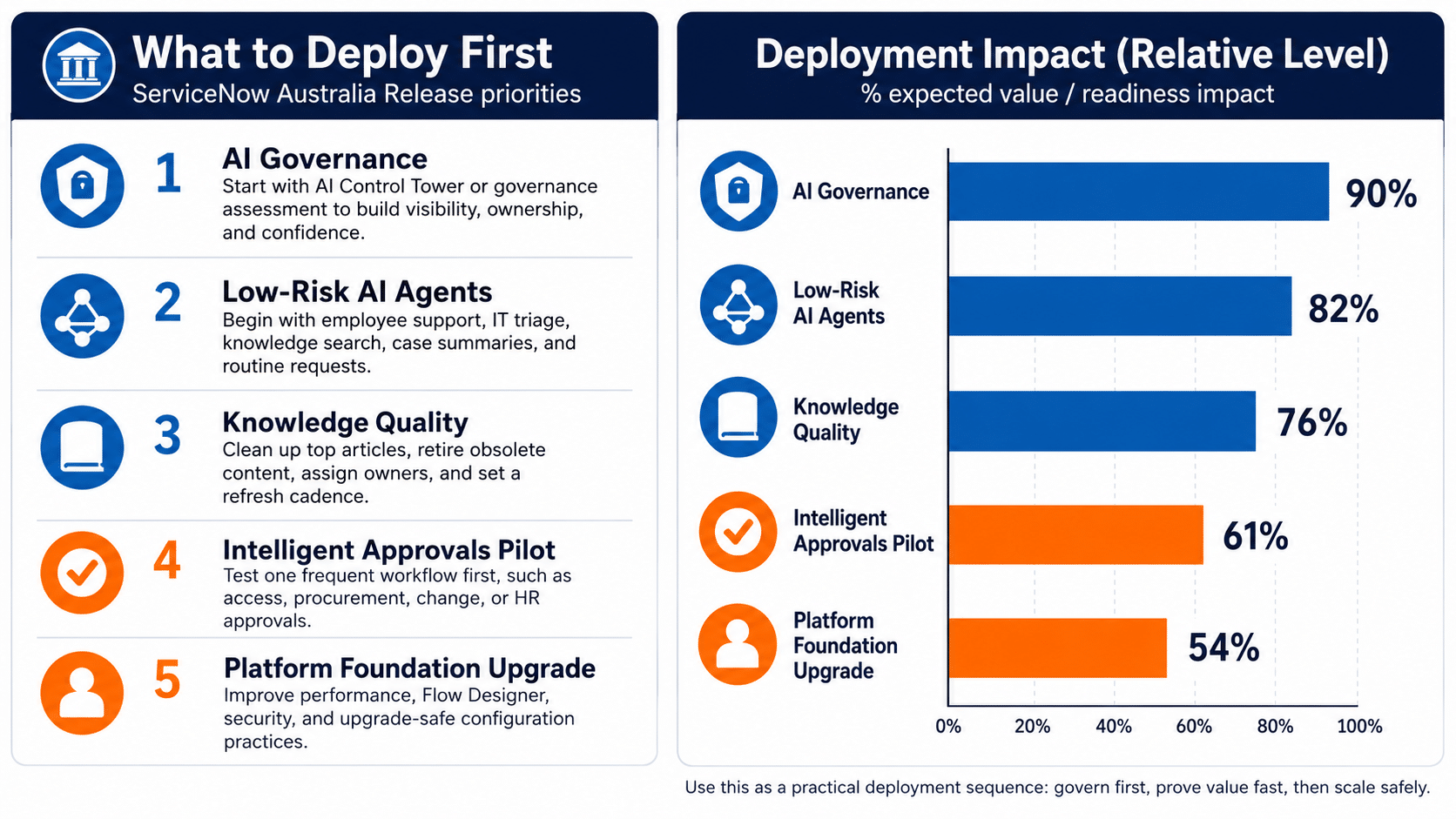
- Start with AI governance.
Before expanding AI agents, deploy or assess AI governance capabilities such as AI Control Tower. This step is important because it creates visibility, ownership, and confidence. Without governance, AI adoption can quickly become fragmented. As a result, it becomes harder to measure, harder to control, and harder to defend to leadership. - Prioritize high-volume, low-risk AI agent use cases.
Start with areas such as employee support, IT service desk triage, knowledge search, case summarization, and routine request handling. These are strong first candidates because they usually have measurable volume, clear outcomes, and lower risk. By contrast, complex financial, legal, or clinical decisions should usually wait until governance and data quality are stronger. - Improve knowledge quality before scaling AI.
If your knowledge base is outdated, duplicated, or inconsistent, AI will amplify the problem. Therefore, before deploying AI broadly, review your most-used knowledge articles. Then retire obsolete content, define article owners, and create a refresh cadence. - Test Intelligent Approvals in one workflow first.
Choose a process where approvals are frequent and delays are visible. For example, start with access requests, procurement approvals, change approvals, or HR requests. Then, measure cycle time before and after deployment. This way, the business value is easier to prove. - Upgrade the platform foundation.
Finally, do not ignore core admin and platform improvements. Performance, Flow Designer changes, security updates, and upgrade-safe configuration practices are not just technical details. Instead, they are the foundation that makes advanced AI features sustainable.
“AI does not fix broken processes. It exposes them faster.”
The Features Worth Your Closest Attention
1. L1 IT Service Desk AI Specialist — the headline feature
The L1 AI Specialist is generally available with Australia. ServiceNow uses it internally and reports 99% faster case resolution and 91% of IT service requests now handled with AI involvement. In a live enterprise deployment, CVS Health reduced live agent chats by 50%.
The prerequisite that most teams underestimate: the specialist’s quality is directly proportional to the quality of your knowledge articles and CMDB accuracy. A knowledge base at 60% quality produces a specialist at 60% quality — confidently. Before activating, run a knowledge audit. Retire outdated articles. Assign ownership. Create a refresh cadence. This is not optional preparation. It is the deployment itself.
2. RaptorDB — the most underrated improvement in Australia
RaptorDB is ServiceNow’s new database engine, and it ships as an automatic improvement with Australia. PayPal’s deployment data shows standard database operations running 2x faster and the longest-running operations running 5x faster. For large enterprises with complex reporting, heavy integrations, or performance-sensitive workflows, this alone justifies the upgrade timeline.
No activation work required. Every customer gets this. It is one of the most straightforward wins in the Australia release.
3. AI Control Tower v2 — the governance foundation everything else depends on
AI Control Tower expanded from a visibility dashboard to a five-dimension governance platform: Discover, Govern, Secure, Observe, Measure. Thirty new integrations cover AWS, Azure, Google Cloud, SAP, Oracle, and Workday. The kill switch — demonstrated catching a live prompt injection attack at Knowledge 2026 — is active from the moment you configure it.
Our recommendation: activate Discover mode on day one of your Australia upgrade, before you enable a single AI agent. See what is already running. You will almost certainly find assets you did not know existed. That inventory is the governance baseline for everything that follows.
4. Intelligent Approvals — the quickest ROI proof point
Approval processes are where digital workflows most visibly slow down. Intelligent Approvals surfaces relevant context to approvers, routes based on availability and authority, and reduces the information gap that causes approvals to stall. The ROI is fast and measurable: cycle time before activation versus after. Access requests, procurement approvals, change approvals, and HR requests are the strongest starting points.
This is the feature we most often recommend for Wave 2 pilot because the business value is easy to demonstrate to leadership in the first 30 days.
What Not to Do
Three patterns that reliably cause Australia upgrades to stall:
→ Treat the release notes as a feature shopping list. Activating everything at once creates noise, increases regression risk, and makes it impossible to isolate what is delivering value. Activate in waves. Measure between each one.
→ Deploy AI agents before knowledge quality and CMDB accuracy are assessed. The agent will execute confidently against whatever data it can find. If that data is wrong, the confidence makes the problem worse, not better.
→ Run the upgrade without a named AI governance owner. AI Control Tower is available. A kill switch policy is possible. But neither does anything without a person who owns agent governance, has the authority to enforce it, and reviews it regularly.
The Australia release is the most consequential ServiceNow upgrade in several years — not because of the feature count, but because of the architecture shift it represents.
Unlike previous releases, every earlier ServiceNow release mainly added new capabilities to a workflow platform. With Australia, however, that platform becomes the execution layer for agentic AI — where agents govern, route, approve, and complete work, not just assist with it. As a result, RaptorDB, the L1 AI Specialist, AI Control Tower v2, Action Fabric, and Otto together represent a different kind of platform than the one most organizations upgraded from.
For that reason, the organizations that will get the most from Australia in 2026 are not the ones that activate everything on day one. Instead, they are the ones that upgrade with a plan, activate with governance in place, measure from the first deployment, and scale only what is proven.
Oleksii Konakhovych, CTO, May 25, 2026
Eager to take the next step? Contact us today!
Latest Articles
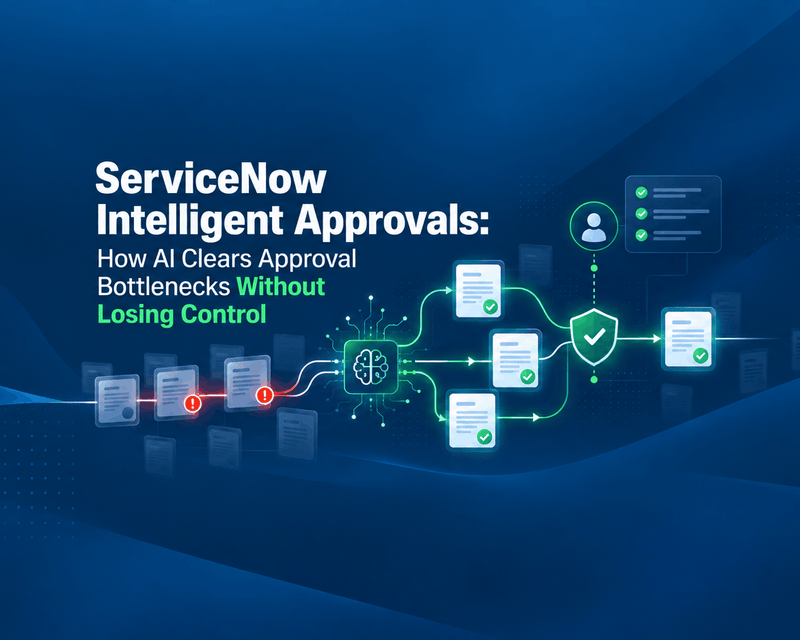
ServiceNow Intelligent Approvals: How AI Clears Approval Bottlenecks Without Losing Control
Your automation is fast. Your approvals are not. Organizations invest heavily in automation, AI and digital transformation. Yet many business processes still stall at the same point: waiting for someone to click “Approve.”
read more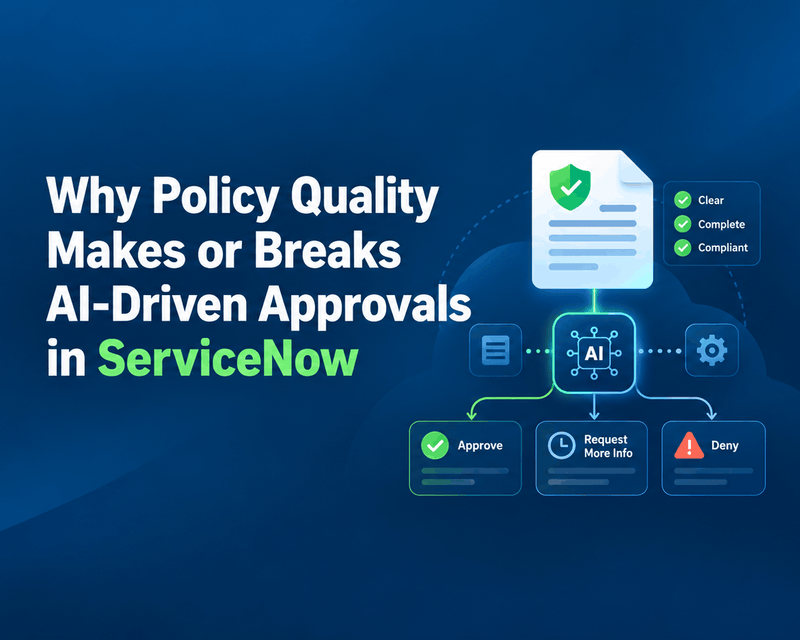
Why Policy Quality Makes or Breaks AI-Driven Approvals in ServiceNow
As enterprises bring AI-driven approvals into ServiceNow, attention goes straight to automation: faster decisions, fewer manual tasks, shorter approval queues. One factor gets far less attention: the quality of the policies behind those decisions.
read more
Teiva Systems at ServiceNow AI Summit 2026 — Munich
On October 7, 2026, Teiva Systems joined the ServiceNow AI Summit in Munich, where industry leaders, innovators, and the ServiceNow community came together to explore the next chapter of enterprise AI and intelligent automation.
read more