
ServiceNow AI Skills, AI Agents & AI Workflows: The Complete Guide (2025–2026)
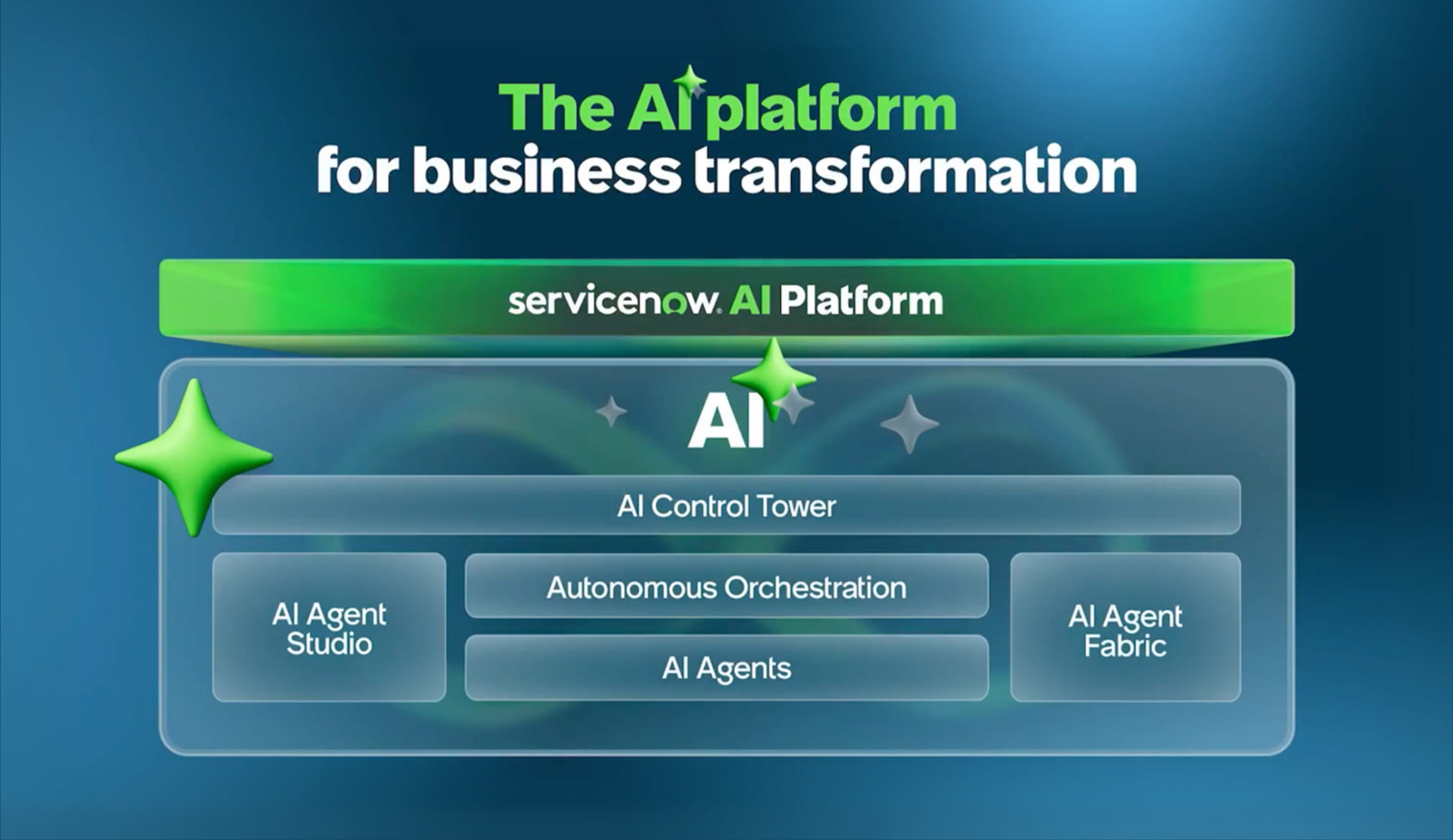
ServiceNow offers over 300 AI Skills across 30+ product modules, organized under the Now Assist ecosystem. AI Skills are discrete, reusable GenAI capabilities (e.g., incident summarization, resolution notes generation). AI Agents are autonomous entities that orchestrate multiple skills to investigate and act. AI Workflows chain skills and agents into end-to-end business outcomes. This guide catalogs every available skill by module as of Q1 2026.
By the numbers (Q1 2026):
- 300+ individual AI Skills
- 30+ product modules covered
- 5+ autonomous AI Agent frameworks
- 6 code-assist workflows for developers
- 6 knowledge management automation skills
Table of Contents
- Why ServiceNow AI Skills Matter
- ServiceNow AI Skills by Module — Full Catalog
- ServiceNow AI Agents — Autonomous Process Execution
- ServiceNow AI Workflows — End-to-End Automation
- Now Assist Platform Skills — Cross-Cutting Capabilities
- How to Adopt ServiceNow AI Skills — A Phased Approach
- Frequently Asked Questions
What Are ServiceNow AI Skills, AI Agents, and AI Workflows?
ServiceNow has fundamentally shifted how enterprises automate work by embedding artificial intelligence directly into its platform through three interconnected concepts: AI Skills, AI Agents, and AI Workflows.
- AI Skills are discrete, reusable AI capabilities — such as summarizing an incident, extracting data from an invoice, or recommending a resolution — that can be invoked individually or composed together.
- AI Agents are autonomous, goal-oriented entities that orchestrate multiple AI Skills to investigate, decide, and act across complex processes without human intervention.
- AI Workflows are the end-to-end automated processes that chain AI Skills and Agents into business outcomes — from alert triage through to resolution, from employee request through to fulfilment.
Together, they form the Now Assist ecosystem: ServiceNow’s GenAI-powered layer that spans every major product line on the platform. Refer to the official AI Agent resource for more details and updates.
Why ServiceNow AI Skills Matter
Organizations adopting ServiceNow AI Skills gain measurable advantages:
- Faster resolution times — AI-generated resolution notes and incident summaries reduce mean time to resolve (MTTR) by eliminating manual documentation overhead.
- Consistent quality — Sentiment analysis, quality assessments, and AI-driven triage remove variability from human-dependent classification.
- Scalable expertise — Knowledge gap detection and KB generation skills ensure institutional knowledge grows automatically, not just when someone remembers to write an article.
- Reduced agent effort — Chat reply recommendations, email drafts, and sidebar summarizations let agents focus on judgement, not typing.
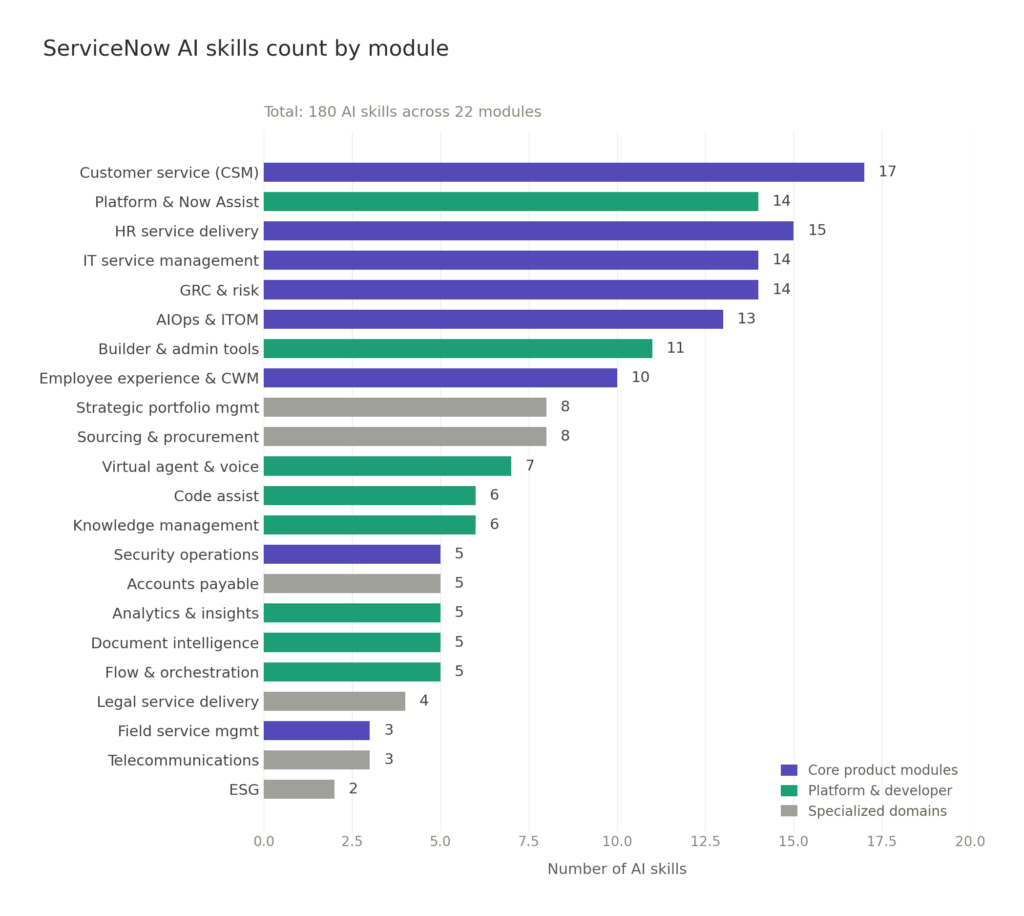
The current ServiceNow AI Skills catalog spans over 300 individual skills across more than 30 product modules — far beyond what most organizations realize is available out of the box.
Read our blog article about AI Skills and how to build your first AI Agent.
ServiceNow AI Skills by Module — Full Catalog
ServiceNow IT Service Management (ITSM)
ITSM is where ServiceNow’s AI investment is deepest. These skills address the full incident and change lifecycle.
| Skill | What It Does |
|---|---|
| Incident Summarization | Generates a concise summary of incident records including work notes, comments, and resolution context |
| Incident Assist | Provides real-time guidance to agents working incidents, surfacing relevant knowledge and similar records |
| Incident Activity Response | Drafts contextual responses to incident activities such as comments and work notes |
| Incident Sentiment Analysis | Detects caller sentiment to flag escalation risk and prioritize agent attention |
| Resolution Notes Generation | Auto-generates structured resolution notes from the incident work history |
| Chat Reply Recommendation | Suggests next-best replies during live chat support sessions |
| Chat Summarization | Produces a summary of chat transcripts for record documentation |
| Email Recommendation | Drafts email responses based on incident context and communication history |
| Sidebar Discussion Summarization | Summarizes threaded sidebar conversations attached to records |
| KB Generation | Automatically drafts knowledge articles from resolved incident patterns |
| Change Request Risk Explanation | Provides AI-generated risk narratives for change requests to support CAB review |
| Change Request Summarization | Condenses change request details into executive-readable summaries |
| Major Incident Email Content | Generates communication drafts for major incident notifications |
| Suggested Steps Generation | Recommends procedural next steps based on incident category and history |
ServiceNow IT Operations Management (ITOM) & AIOps
ServiceNow AI Agents for ITOM are among the most autonomous on the platform — designed to triage, correlate, and act on operational alerts with minimal human input.
| Skill / Agent | What It Does |
|---|---|
| Alert Analysis | Investigates alert context, related CIs, and historical patterns |
| Alert Impact Analysis | Determines the business impact of an alert by mapping affected services |
| Alert Investigation | Autonomously triages alerts using AI-driven correlation |
| Triage and Investigate Alerts | End-to-end alert triage agent combining multiple investigation skills |
| Related Changes Analysis | Identifies recent changes that may have caused an alert or incident |
| KB Summarization Skill | Surfaces and summarizes relevant knowledge for alert context |
| Alert Assist | Combines alert triage with recommended remediation actions |
| LEAP (AIOps) | A full agent framework — action mapping, grouping, topic detection, hierarchical point-of-view analysis, and outcome enhancement for operational events |
Observability Skills extend AI Agents into third-party monitoring tools:
- Datadog Observability Skill
- Dynatrace Observability Skill
- Gemini Cloud Assistant Observability Skill
- Kentik Observability Skill
- New Relic Observability Skill
These skills allow ServiceNow AI Agents to pull context directly from observability platforms during investigation — eliminating the need for agents to context-switch between tools.
If you are not sure about the actual value and outcomes of using AI in your organisation, you can check our GenAI Assessment tool. We are happy to assist with your AI discovery.
ServiceNow Customer Service Management (CSM/CRM)
CSM AI Skills focus on reducing agent handle time, improving response quality, and automating case documentation.
| Skill | What It Does |
|---|---|
| Case Summarization | Generates concise case summaries for handoffs and escalations |
| Chat Recommendation | Suggests contextual responses during customer chat interactions |
| Chat Summarization | Documents chat sessions automatically on the case record |
| Email Recommendation | Drafts customer-facing email responses |
| Sentiment Analysis (Case) | Detects customer sentiment to flag at-risk cases |
| Sentiment by Channel Insight | Analyzes sentiment trends across support channels |
| Sentiment Escalation Insight | Identifies sentiment-driven escalation patterns |
| Sentiment Progression Insight | Tracks how sentiment changes throughout a case lifecycle |
| Service Recommendation | Suggests relevant services based on customer interaction history |
| Resolution Notes Generation | Auto-generates case resolution documentation |
| KB Generation | Creates knowledge articles from resolved case patterns |
| Sidebar Summarization | Summarizes agent-to-agent sidebar discussions |
| Suggested Steps Generation | Recommends next-best actions for case resolution |
| Top Drivers (Positive/Negative) Insights | Identifies the primary factors driving customer satisfaction or dissatisfaction |
| Trending Topics by Field | Surfaces emerging case themes for proactive management |
| Activity Response Generation | Drafts responses to case activities and updates |
| Negative Assignment Group Insight | Flags assignment patterns correlated with poor outcomes |
CSM also includes a dedicated AI Agent collection — the ServiceNow CSM Agent — that composes these skills into autonomous customer service workflows.
Check further ITSM, ITOM, and CSM use cases as well as the 2026 outlook.
ServiceNow HR Service Delivery (HRSD)
HR AI Skills reduce the administrative burden on HR agents and improve the employee experience.
| Skill | What It Does |
|---|---|
| Case Summarization | Summarizes HR cases for review and escalation |
| Chat Reply Recommendation | Suggests responses during employee chat interactions |
| Chat Summarization | Auto-documents HR chat sessions |
| Email Recommendation | Drafts HR-appropriate email responses |
| ER Case Summarization | Summarizes Employee Relations cases with sensitivity-aware language |
| Interview Note Skill Relevance | Assesses relevance and completeness of interview documentation |
| Job Description Skill Relevance | Evaluates job descriptions for completeness and bias indicators |
| KB Generation | Generates HR knowledge articles from resolved case patterns |
| Persona Assistant | Provides role-aware guidance to HR agents based on case context |
| Resolution Notes Generation | Auto-generates HR case resolution documentation |
| Resume Skill Extraction | Extracts structured data from candidate resumes |
| Sentiment Analysis (HR Case) | Detects employee sentiment in HR interactions |
| Sentiment Analysis (HR Task) | Analyzes sentiment in HR task-related communications |
| Sidebar Discussion Summarization | Summarizes internal HR discussions |
| Skill Keyword Extractor | Identifies key skills and competencies from text |
ServiceNow Governance, Risk & Compliance (GRC)
GRC AI Skills address the documentation-heavy, analysis-intensive nature of risk and compliance work.
| Skill | What It Does |
|---|---|
| Issue Summarization | Generates executive summaries of GRC issues |
| Issue Action Plan Generation | Recommends remediation action plans for identified issues |
| Issue Validator | Assesses the validity and completeness of reported issues |
| Control Objective Creation | Drafts common control objectives from regulatory requirements |
| Control Objective Details Updater | Enriches existing control objectives with additional context |
| Control Objective Impact Analyzer | Assesses the downstream impact of control objective changes |
| Risk Assessment Summarization | Summarizes risk assessment findings for review |
| Risk Event Summarization | Generates narratives for risk events |
| Suggest Risks (LLM-based) | Recommends potential risks based on contextual analysis |
| Similar Regulatory Alerts | Identifies related regulatory alerts for cross-reference |
| Regulatory Alert Summarization | Summarizes regulatory alerts and their implications |
| Regulatory Alert — Impacted Citations/Controls/Policies | Maps regulatory changes to affected organizational artifacts |
| Create Regulatory Change Task Plan | Generates task plans for responding to regulatory changes |
| GRC Category Enrichment | Enhances GRC categorization with AI-driven classification |
ServiceNow Security Operations (SecOps)
| Skill | What It Does |
|---|---|
| Security Incident Summarization | Summarizes security incidents for SOC review |
| Security Incident Recommended Actions | Suggests response actions for security events |
| Security Operations Metrics Analysis | Analyzes SecOps performance metrics and trends |
| Common Security Incident Quality Assessment | Evaluates the quality and completeness of security incident records |
| Vulnerable Item Deduplication | Identifies and consolidates duplicate vulnerability records |
ServiceNow Field Service Management (FSM)
| Skill | What It Does |
|---|---|
| KB Generation | Creates field service knowledge from resolved work orders |
| Sidebar Summarization | Summarizes dispatcher-to-technician communications |
| Work Order Task Summarization | Generates concise task summaries for field technicians |
ServiceNow Accounts Payable Operations (APO)
| Skill | What It Does |
|---|---|
| Invoice Case Summarization | Summarizes invoice dispute and inquiry cases |
| Invoice Data Extraction | Extracts structured data from invoice documents |
| Invoice Inquiry Solution Generator | Recommends resolutions for invoice inquiries |
| Purchase Order Line Mapping | Maps invoice line items to purchase order records |
| Relevant Invoice Finder | Identifies related invoices for cross-reference |
ServiceNow Sourcing & Procurement Operations (SPO)
| Skill | What It Does |
|---|---|
| Negotiation Summarization | Summarizes procurement negotiation sessions |
| Procurement Case Summarization | Generates case summaries for procurement issues |
| Purchase Order Summarization | Condenses purchase order details |
| Purchase Requisition Summarization | Summarizes purchase requisition context |
| Sourcing Event Summarization | Documents sourcing event outcomes |
| Sourcing Request Summarization | Summarizes sourcing requests for review |
| Supplier Recommendation | Recommends suppliers based on criteria and history |
| Supplier Summarization | Generates supplier profile summaries |
ServiceNow Strategic Portfolio Management (SPM)
| Skill | What It Does |
|---|---|
| Acceptance Criteria Generation | Drafts acceptance criteria for agile stories and features |
| Agile Story Generation | Generates user stories from requirements or descriptions |
| EAP Document Summarization | Summarizes Enterprise Architecture Planning documents |
| Feedback Summarization | Condenses stakeholder feedback for planning review |
| Multi Feedback Summarization | Aggregates and synthesizes feedback from multiple sources |
| Planning Item Document Summarization | Summarizes planning artifacts |
| Project Document Summarization | Generates project document summaries |
| Project Insights Generation | Produces AI-driven project health insights |
ServiceNow Employee Experience & Collaborative Work Management
| Skill | What It Does |
|---|---|
| Case Summarization for Approvals | Summarizes approval context for employee experience requests |
| Request Summarization for Approvals | Condenses request details for approver review |
| Requested Item Summarization | Summarizes catalog request items |
| Acceptance Criteria Generation (CWM) | Drafts acceptance criteria for collaborative work items |
| CWM Document Generation & Insights | Generates documents and extracts insights for work management |
| CWM Tasks Generation | Creates task breakdowns from work management objectives |
| Journey Designer | Designs employee experience journeys |
| Journey Generation for Managers | Creates manager-specific journey content |
| Journey Summarization for Managers | Summarizes journey progress and outcomes |
| Knowledge Transfer Document Grouper | Organizes knowledge transfer materials |
ServiceNow Legal Service Delivery
| Skill | What It Does |
|---|---|
| Legal Request Categorization | Classifies incoming legal requests by type |
| Legal Matter Summarization | Summarizes legal matter records |
| Legal Request Summarization | Generates concise legal request summaries |
| Triage Legal Request | Routes and prioritizes legal requests using AI classification |
ServiceNow Environmental, Social & Governance (ESG)
| Skill | What It Does |
|---|---|
| Consumption Report Summarization | Summarizes ESG consumption and sustainability reports |
| Outcome Summarization | Generates narratives for ESG outcome tracking |
ServiceNow Telecommunications (Sales & Order Management)
| Skill | What It Does |
|---|---|
| Order Action Strategy | Recommends actions for telecommunications order processing |
| Order Line Item Topics/Strategy | Analyzes and groups order line items for efficient processing |
| Order Grouping | Clusters related orders for batch processing |
ServiceNow AI Agents — Autonomous Process Execution
While individual AI Skills handle discrete tasks, ServiceNow AI Agents combine multiple skills into autonomous workflows that investigate, decide, and act. Here are the key agent frameworks available on the platform:
Platform-Level AI Agents
| Agent | Domain | What It Does |
|---|---|---|
| Problem Investigator | ITSM | Investigates problem records by analyzing related incidents, changes, and CI data to identify root cause patterns |
| Build Agent | App Engine | Assists in application creation by generating table structures, forms, and logic from natural-language descriptions |
| ATF Troubleshooting Agent | Platform | Diagnoses and resolves Automated Test Framework failures |
| Survey Filler Answer Suggestion | Platform | Recommends survey responses based on contextual analysis |
| Survey Intelligence | Platform | Analyzes survey data to surface actionable insights |
AIOps AI Agents
| Agent | What It Does |
|---|---|
| LEAP Agent Framework | Full autonomous operational event management — maps actions, groups alerts, identifies topics, generates points of view, and enhances outcomes |
| Alert Assist | Combines alert correlation, impact analysis, and KB retrieval into an automated triage workflow |
| Observability Agents (Datadog, Dynatrace, New Relic, Kentik, Gemini) | Pull monitoring context into ServiceNow for AI-driven analysis |
Domain-Specific AI Agents
| Agent | Domain |
|---|---|
| CSM AI Agent Collection | Customer Service — autonomous case handling, answer generation, field discovery |
| HRSD AI Agent Collection | HR Service Delivery — case routing, sentiment-aware responses, knowledge generation |
| Workplace Insights Agent | Workplace Service Delivery — facility and workplace intelligence |
| TMT AI Agent Collection | Telecommunications — order management and service workflows |
Group-Action Framework (GAF)
The Group-Action Framework is ServiceNow’s composable agent architecture that powers multi-step reasoning across domains. It provides a consistent pattern — action mapping, action reduction, action strategy, and grouping — applied to:
- ITSM (incident triage and resolution)
- CSM (case investigation and response)
- HRSD (HR case routing and resolution)
- Trending Topics detection across all three domains
GAF is the engine behind many of the “suggested steps” and “recommended actions” experiences in the platform.
ServiceNow AI Workflows — End-to-End Automation
AI Workflows are where Skills and Agents combine into business outcomes. Key workflow categories include:
Flow Generation & Orchestration
- Flow Generation — Now Assist generates Flow Designer flows from natural-language descriptions, including image-based flow generation where users can sketch a process and have AI convert it to a working flow.
- Flow Summarization — Produces human-readable summaries of complex flows for documentation and review.
- Spoke Generation — AI-assisted creation of IntegrationHub spokes, reducing custom integration development time.
- Playbook Generation — Generates process automation playbooks from descriptions or existing patterns.
- Playbook Recommendation — Suggests relevant playbooks based on record context.
Creator / Code-Assist Workflows
- Code Assist AutoComplete — AI-powered code completion in the ServiceNow IDE.
- Code Assist Edit — Suggests edits to existing scripts based on intent.
- Code Assist Generation — Generates new scripts from natural-language prompts.
- Code Assist Summarization — Documents existing code with AI-generated summaries.
- Intelligent Code Recommendations — Context-aware suggestions during development.
- Code Fix — Identifies and suggests fixes for code issues.
Knowledge Management Workflows
- Knowledge Gap Identification — Detects topics where knowledge articles are missing or insufficient.
- Knowledge Gap Grouping — Clusters related knowledge gaps for prioritized authoring.
- Knowledge Gap Action — Recommends specific actions to close knowledge gaps.
- Knowledge Gap Topic Detection — Surfaces trending topics that lack KB coverage.
- Knowledge Duplicates Detection — Identifies redundant knowledge articles for consolidation.
- KB Generation — End-to-end creation of knowledge articles from resolved records.
Document Intelligence Workflows
- Document Extraction — Extracts structured data from uploaded documents using AI.
- Extract Information from Documents — Processes documents to populate ServiceNow records.
- Multimodal Chat — Enables document-aware conversations where AI can reference uploaded files.
- Smart Documents — AI-enhanced document management within Document Management.
- Document Intelligence for Utility Invoices — Specialized extraction for utility billing documents.
Analytics & Insights Workflows
- Data Visualization Generation — Creates charts and dashboards from natural-language requests.
- Analytics Follow-Up Generation — Suggests next analytical questions based on current insights.
- Analytics Insight Generation — Surfaces hidden patterns in data.
- Analytics Query Generation — Converts natural-language questions into platform queries.
- AI Filter Assist — Helps users build list filters using conversational input.
Now Assist Platform Skills — Cross-Cutting Capabilities
Several AI Skills operate across all modules as platform-level capabilities:
| Skill | What It Does |
|---|---|
| Now Assist Context Menu | Provides AI actions directly from record context menus |
| Now Assist Q&A | Conversational question-answering powered by RAG (Retrieval-Augmented Generation) |
| Now Assist Multi-Turn Catalog Ordering | Guides users through catalog requests via multi-turn conversation |
| Now Assist Topics | Manages and generates Virtual Agent conversation topics |
| AI Search RAG | Powers AI-augmented search with retrieval and generation |
| RAG Query Rewrite | Reformulates search queries for better retrieval accuracy |
| Navigation | AI-assisted platform navigation |
| Now Assist Recommendations | Context-aware recommendations across modules |
| Now Assist Data Kit | Data preparation and enrichment tools for AI model training |
| Custom App Record Summarization | Summarizes records from any custom scoped application |
| Column Description Generator | Auto-generates column descriptions for data governance |
| Complete Record Generation | Generates complete record drafts from partial input |
| New Column Data Generation | Populates new columns with AI-generated data |
Virtual Agent AI Skills
| Skill | What It Does |
|---|---|
| Chat Summarization for Virtual Agent | Summarizes VA conversations for agent handoff |
| Now Assist Multi-Turn Conversations | Enables complex, multi-step VA interactions |
| Voice Assist for Documents | Voice-enabled document interaction |
| AI Voice Agents | Voice-based autonomous agent interactions |
| Voice Input (VTT) | Voice-to-text transcription for ServiceNow inputs |
| Chat Topic Classifier | Classifies incoming chat topics for routing |
| Conversation Evaluator (Coherence, Conciseness, Context Retention, Intent Accuracy, Truthfulness) | Quality assessment framework for VA conversations |
Builder & Admin AI Skills
| Skill | What It Does |
|---|---|
| App Generation | Generates scoped applications from descriptions |
| App Summary Generation | Documents applications with AI-generated summaries |
| Table Summary Generation | Creates documentation for table structures |
| Catalog Item Generation | Builds catalog items from natural-language input |
| UI Generation | Generates UI components and layouts |
| Client Script Summarization | Documents client scripts with AI summaries |
| Data Binding Generation | Creates data bindings for UI components |
| Event Handler Generation | Generates event handlers from descriptions |
| Experience Generation | Creates portal and workspace experiences |
| Test Generation (Text2Test) | Generates ATF tests from natural-language descriptions |
| Mobile Card Generation | Creates mobile interface cards |
How to Adopt ServiceNow AI Skills — A Phased Approach
Phase 1: Foundation (Weeks 1–4)
Start with high-volume, low-risk summarization skills — incident summarization, case summarization, and chat summarization. These require minimal configuration, deliver immediate agent productivity gains, and build organizational confidence in AI-generated content.
Our AI expert team will help you better understand LLMs and AI technology, if needed.
Phase 2: Augmentation (Weeks 5–12)
Expand to recommendation and generation skills — resolution notes generation, KB generation, chat reply recommendations, and suggested steps. These skills augment agent decision-making while keeping humans in the loop.
Phase 3: Automation (Weeks 13–24)
Deploy AI Agents and autonomous workflows — alert triage agents, problem investigation, and flow generation. These skills operate with reduced human oversight and require robust governance, feedback loops, and quality monitoring.
Phase 4: Transformation (Ongoing)
Leverage predictive and proactive skills — knowledge gap detection, trending topics analysis, sentiment progression insights, and AI-driven analytics. These capabilities shift the organization from reactive operations to predictive service management.
Frequently Asked Questions
What licensing is required for ServiceNow AI Skills?
Most Now Assist AI Skills require Now Assist add-on licensing, which is available as a per-user or per-interaction SKU depending on the module. Some foundational Predictive Intelligence features are included with ITSM Pro and CSM Pro. Contact your ServiceNow account team or partner for current packaging.
Which ServiceNow release introduced AI Skills?
Now Assist was introduced in the Vancouver release (2023) with a foundational set of skills. The Washington DC and Xanadu releases significantly expanded the catalog. The skill list continues to grow with each release — Zurich and beyond are expected to add further agent autonomy.
Can I build custom AI Skills?
Yes. The Now Assist Skill Kit allows organizations to create custom AI Skills using ServiceNow’s GenAI framework. This enables domain-specific or organization-specific AI capabilities beyond the out-of-box catalog.
How do ServiceNow AI Agents differ from Virtual Agent?
Virtual Agent is a conversational chatbot framework for employee and customer self-service. AI Agents are autonomous backend entities that investigate, decide, and execute across processes — they don’t require a conversation to operate. AI Agents may use Virtual Agent as a delivery channel, but they also operate independently through flows, playbooks, and direct record manipulation.
Are ServiceNow AI Skills safe to use with sensitive data?
ServiceNow AI Skills operate within the platform’s existing security model — ACLs, data classification, and encryption apply to AI-processed data. Now Assist uses the AI Gateway for secure model orchestration, and organizations can configure data residency and model selection policies. Review ServiceNow’s AI trust and governance documentation for your compliance requirements.
Where can I learn more about Now Assist and ServiceNow AI platform?
Visit ServiceNow University for reliable and up-to-date courses, including Now Assist applications, Skill Kit, Admin Console, and GenAI Controller.
How many AI Skills does ServiceNow have?
As of Q1 2026, ServiceNow offers over 300 individual AI Skills across more than 30 product modules. This catalog spans every major product line — from ITSM and CSM to GRC, SecOps, HRSD, FSM, and specialized domains like Telecommunications and ESG. The number continues to grow with each platform release.
How much does ServiceNow Now Assist cost?
Now Assist is not included in standard ServiceNow licenses. It requires a Pro Plus or Enterprise Plus SKU, which adds per-user or per-consumption pricing on top of your existing license. Each AI action (summarization, generation, etc.) consumes licensed capacity. Contact your ServiceNow account team or a ServiceNow partner like Teiva Systems for current packaging and pricing guidance. See also our Now Assist Consumption Guide for detailed breakdown.
What is the ServiceNow Group-Action Framework (GAF)?
The Group-Action Framework is ServiceNow’s composable agent architecture that powers multi-step reasoning across ITSM, CSM, and HRSD. It follows a consistent pattern — action mapping, action reduction, action strategy, and grouping — to enable AI Agents to break complex problems into structured, step-by-step resolution paths.
ServiceNow AI Agents vs Salesforce Agentforce — what’s the difference?
ServiceNow AI Agents operate natively within the Now Platform, orchestrating skills across ITSM, ITOM, CSM, HRSD, and other modules using the platform’s data model, ACLs, and workflow engine. Salesforce Agentforce is similarly embedded within the Salesforce ecosystem, focused on CRM-centric use cases. The key differentiator is scope: ServiceNow Agents span IT operations, security, HR, and enterprise workflows beyond CRM, while Salesforce Agents are strongest in sales, marketing, and customer service scenarios.
Conclusion
The ServiceNow AI Skills catalog is no longer a handful of experimental features — it’s a comprehensive, production-grade capability layer spanning every major module on the platform. From individual summarization skills that save agents minutes per interaction, to autonomous AI Agents that resolve alerts without human involvement, the opportunity to transform service delivery is available today.
The organizations that will benefit most are those that treat AI Skills adoption as a deliberate program — phased, measured, and governed — rather than a feature toggle.
About Teiva Systems: We are a ServiceNow Premier Partner specializing in platform architecture, AI-enabled service delivery, and enterprise automation. Contact us for any assistance or requests.
About Author: Kostya Bazanov | Managing Director, Teiva Systems ServiceNow Certified Technical Architect (CTA) | 15+ years in enterprise platform architecture (LinkedIn)
Last updated: March 2026. Skills availability varies by ServiceNow release and licensing. Refer to the ServiceNow Store and Now Assist documentation for current availability.
Kostya Bazanov, Managing Director, Mar 25, 2026
Eager to take the next step? Contact us today!
Latest Articles
From Ticket Chaos to Autonomous IT: How Enterprises Are Turning ServiceNow Into a Self-Driving Platform
Why scaling tickets is not the same as scaling IT - and what leading organizations are doing instead.There was a time when IT success seemed simple:close more tickets.
read more
Teiva Systems at ServiceNow Partners Day Munich: In the Age of AI, Execution Wins
Teiva Systems recently joined ServiceNow Partners Day in Munich, where more than 70 partner organizations and 120+ attendees came together to discuss the future of the ServiceNow ecosystem.
read more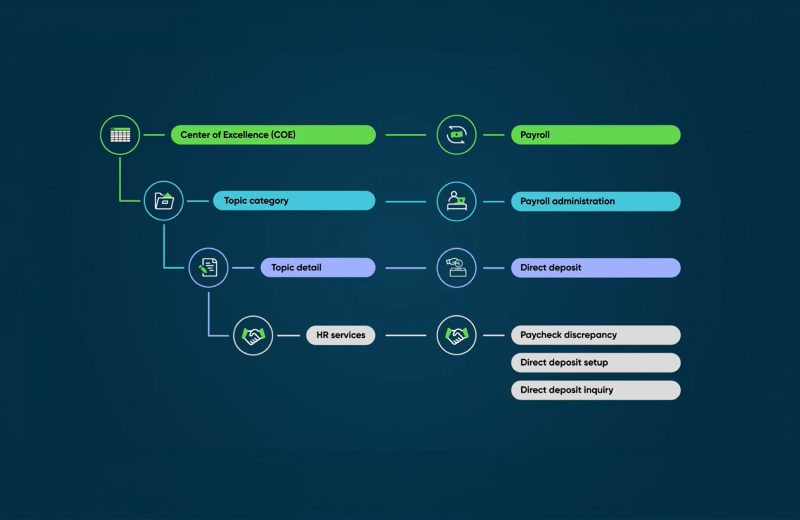
Operating a ServiceNow Center of Excellence (CoE): Governance in Practice
ServiceNow Center of Excellence is a perfect framework for businesses that want to turn their governance tactics from theory to reality. It can serve as an optimizable operational backbone that aligns your strategy and delivery.
read more