
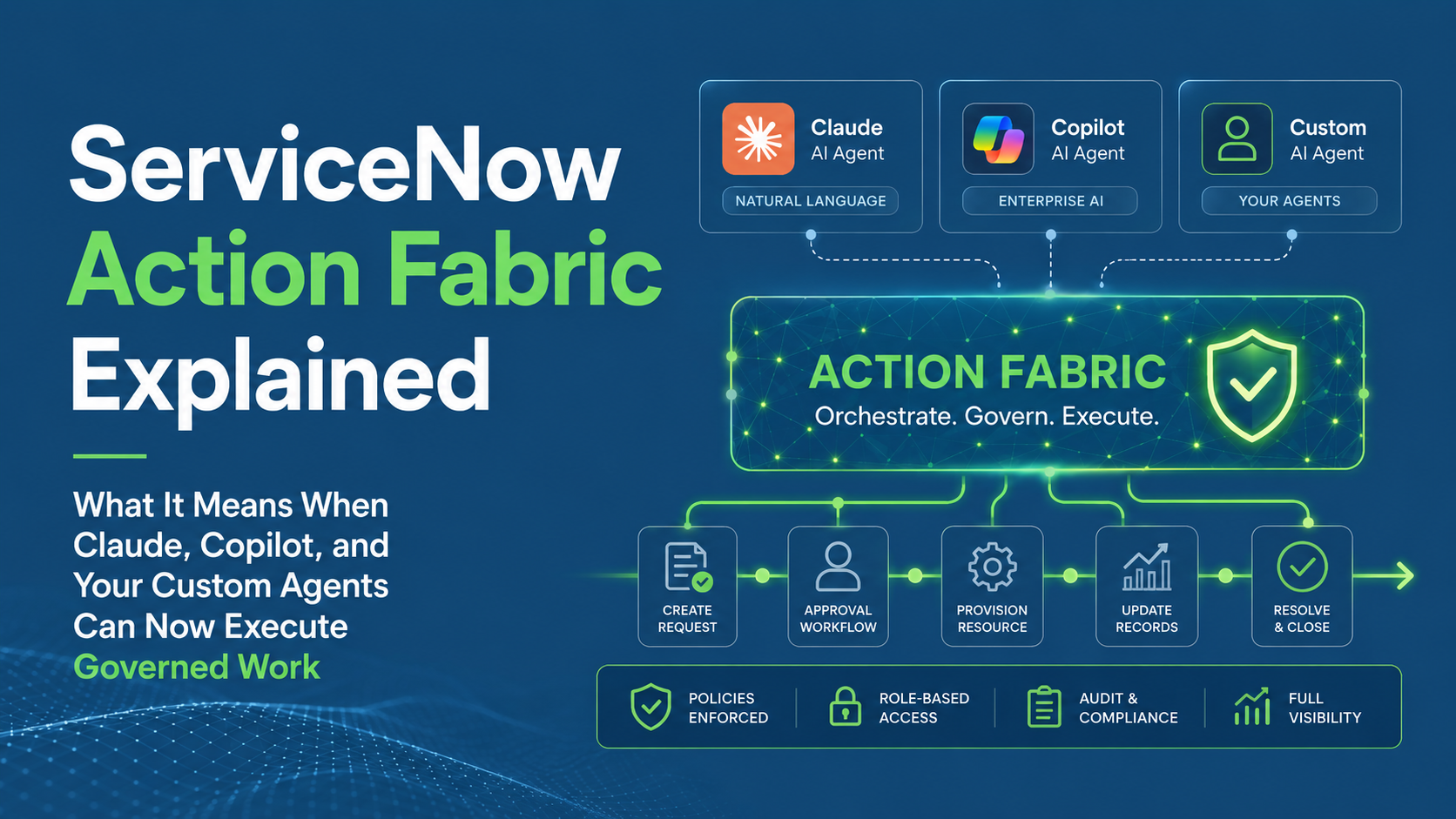
ServiceNow Action Fabric Explained: What It Means When Claude, Copilot, and Your Custom Agents Can Now Execute Governed Work
There is a moment in almost every AI agent project we work on where the same question surfaces.
The agent is smart. It understands what needs to happen. For example, it can identify the access gap, draft the approval request, and describe the exact workflow that should run.
However, intelligence alone is not enough. After that, someone still has to open ServiceNow, find the right form, trigger the process manually, and make sure it completes.
That gap — between knowing what to do and actually doing it — is where enterprise AI productivity dies.
ServiceNow Action Fabric, announced at Knowledge 2026, is the architectural answer to that problem. It is the most significant platform shift we have seen from ServiceNow since the introduction of Flow Designer — and the one with the most immediate implications for how enterprise AI gets built.

What Is ServiceNow Action Fabric?
Action Fabric is an open execution layer that allows any AI agent — built on ServiceNow, Claude, Microsoft Copilot, or your own internal stack — to trigger governed ServiceNow workflows headlessly, without going through a traditional user interface.
The key word is “governed.” In other words, this is not an API that simply lets agents read or write fields. Instead, it is a controlled connection to ServiceNow’s full system of action, including flows, playbooks, approval chains, service catalogue actions, and business rules.
Most importantly, every action runs through AI Control Tower. As a result, each execution is identity-verified, permission-scoped, and fully auditable.
“Others let agents read and write data. We let agents execute governed work.” — Nenshad Bardoliwalla, Group VP AI Products, ServiceNow — Knowledge 2026 keynote
That is not a marketing line. It is an architectural distinction with real consequences for every enterprise running AI agents today. Most platforms give agents a window to look through. Action Fabric gives them a door to walk through — with a security desk, a visitor log, and a policy framework on the other side.
How It Works: The 5-Step Architecture
Here is exactly what happens when Claude, Copilot, or a custom agent triggers a workflow through Action Fabric:
1 — Intent detection
An employee asks Claude or Copilot to resolve an access issue, trigger an onboarding workflow, or create a service request. The agent understands the intent and maps it to the ServiceNow workflow that needs to run.
2 — MCP Server connection
The agent connects to ServiceNow’s MCP Server via Streamable HTTP. Authentication runs through managed OAuth, built into the MCP Server Console. This is included in every Now Assist and AI Native SKU today — no additional purchase required.
3 — AI Control Tower verification
Every request is routed through AI Control Tower before anything executes. Two questions are answered: who or what is making this request (identity), and is this agent authorised to perform this action on this record in this context (permission scope). Role-based tool packages define exactly what each agent can and cannot do.
4 — Governed workflow execution
The flow, playbook, approval, or catalogue action runs inside ServiceNow’s existing workflow engine. The same business rules, SLA timers, assignment logic, and compliance controls that apply to human-triggered work apply to agent-triggered work. There is no shortcut around governance.
5 — Full audit trail
Every action is logged: session ID, agent identity, action type, records touched, outcome, and Assist credits consumed. The MCP Server Console surfaces consumption metering, enterprise audit trails, and session management in one place. Nothing executes without a trace.
Teiva insight — What we tell every client before they connect their first agent:
Action Fabric will execute exactly what your ServiceNow workflows say. If your approval chains are outdated, your SLA policies have not been reviewed in 18 months, or your business rules were built for a process that no longer exists — Action Fabric will execute all of that, at agent speed and at scale. Clean the foundation before you open the door. This is not optional.
API Access vs. Action Fabric: What’s Actually Different
Most organisations already connect AI tools to enterprise systems via API. The two approaches are frequently confused in vendor conversations. Here is a precise comparison:
| Dimension | API access only | Action Fabric |
| What the agent can do | Read / write data fields | Execute flows, playbooks, approvals, catalogue actions |
| Governance layer | None built in | AI Control Tower — identity-verified, permission-scoped |
| Audit trail | No | Full — OAuth, session ID, records touched, outcome |
| Business rules enforced | No | Yes — same rules as human-triggered work |
| SLA timers | No | Yes — triggered on execution |
| Kill switch | No | Yes — via AI Control Tower |
| Regulated industry fit | Low | High |
This distinction matters most in regulated industries, including financial services, healthcare, the public sector, telecommunications, and insurance.
In these sectors, AI adoption is often blocked for a specific reason. It is not because the technology is weak. Instead, it is because compliance teams cannot answer six basic questions:
→ Who approved this action?
→ Which agent performed it?
→ What data did it access?
→ Was the action within policy?
→ Can we produce an audit log?
→ Can we stop it if it behaves incorrectly?
Action Fabric, together with AI Control Tower, answers all six simultaneously — by design, not by policy overlay.
The Anthropic Partnership: What Claude Cowork Actually Does
Anthropic is Action Fabric’s first named design partner. Claude Cowork connects directly to ServiceNow’s system of action. That means Claude can initiate approval workflows, trigger playbooks, provision access, and update catalogue records — all from within an employee’s normal workspace, with a full audit trail inside ServiceNow.
The example ServiceNow uses is precise. For example, a new employee may start on day one without access to the tools they need.
In the old process, the employee would open a ticket, wait for triage, wait for approval, and then wait for provisioning.
With Claude Cowork and Action Fabric, however, the process changes. First, Claude identifies the access gaps. Then, it routes each request through the correct approval workflow. Next, it provisions access and logs every action.
As a result, the issue can be resolved without a single ticket being opened manually.
“The gap between knowing what needs to happen and making it happen is where productivity dies. Connecting Claude Cowork to ServiceNow’s system of action closes that gap with enterprise execution, directly in the flow of work.”— Boris Cherny, Head of Claude Code, Anthropic
The choice of Anthropic as a launch partner is not coincidental. In fact, Claude has become a preferred enterprise AI model for many of the world’s largest organisations. At the same time, a significant number of those organisations are also ServiceNow customers.
Therefore, this overlap gives Action Fabric an immediate addressable market. More importantly, it signals where the enterprise AI integration ecosystem is heading.
It also sets a precedent. In the future, Microsoft Copilot, custom-built agents, and models from other vendors will be able to do the same. This is because Action Fabric is open by design.
The Governance Architecture Decision Every Team Needs to Make
Action Fabric creates a question we are already hearing in client conversations: if any MCP-compatible agent can now trigger governed ServiceNow workflows, where should governance live in your architecture?
There are three options. Only one is right for enterprise environments.
| Option AModel governance | Option BBolt-on compliance | Option CWorkflow-layer governance ✔ |
| Guardrails inside the model Probabilistic — can be prompted aroundNo audit trail in enterprise systems | Separate monitoring tool Reactive — flags after the factNo visibility into workflow layer | Governance at execution — by design Every action identity-verified & permission-scopedFull audit trail, kill switch included |
| Verdict: fine for low-stakes tasks | Verdict: inadequate for regulated workflows | Verdict: the right architecture for enterprise AI |
What This Means for the Projects You’re Running Right Now
Four scenarios we are already working through with clients following Knowledge 2026:
You’re building AI agents outside ServiceNow and connecting via custom API
The architecture conversation has changed. Therefore, you are not necessarily replacing existing integrations. Instead, you should now evaluate whether governed workflow execution through Action Fabric is a better execution layer for any process where auditability matters. After all, API integrations give agents data access. In contrast, Action Fabric gives agents governed execution. For compliance-sensitive workflows, this distinction matters. These two approaches are not the same thing.
You’re running Now Assist today
The MCP Server is already included in your SKU. You have access today. The immediate question is not “can we activate this?” — it is “which workflows are ready to be safely exposed?” Review your flow governance before you connect anything. Your agents will execute exactly what your workflows say.
You’re evaluating AI platforms and haven’t committed
The combination of Action Fabric and AI Control Tower changes the evaluation framework. The question is no longer which platform has the most capable model. It is which platform provides the most trustworthy governed execution layer for multi-agent, multi-system workflows. ServiceNow’s position is now architecturally distinct from any point-solution agent platform.
You’re in a regulated industry
In regulated environments, the audit trail built into every Action Fabric execution is critical. Each action is identity-verified, permission-scoped, session-logged, and OAuth-authenticated. As a result, compliance and legal teams receive the evidence they have been asking for since AI agents became a board-level topic. However, this review should not happen after deployment. Instead, bring compliance and legal teams into the room before deployment, so they can validate the governance model early.
Before you activate Action Fabric — five things to do first:
→ Check your SKU. Now Assist or AI Native = MCP Server included today. Confirm activation with your ServiceNow account team before scoping any agent project.
→ Audit your workflows. Approval chains, business rules, SLA policies. Outdated logic exposed to agents will execute at scale. This is the step most organisations skip.
→ Map every AI agent running in your environment. For each one: does it need to execute governed work in ServiceNow? If yes, Action Fabric is the right connection architecture.
→ Brief security and compliance now. The AI Control Tower audit trail is the evidence they need. Their sign-off before deployment is faster and cheaper than their review after an incident.
→ Define your kill switch policy. Who has the authority to pause or revoke an agent? Under what conditions? AI Control Tower makes this technically possible — but only if you define it before go-live.
ServiceNow spent 22 years building a system of action for enterprise work. Over time, that system became the foundation for workflows, approvals, SLA logic, and business rules. This infrastructure exists for a reason: enterprise work is complex, regulated, and consequential.
However, Action Fabric does not replace that infrastructure. Instead, it opens it to AI agents in a governed way.
As a result, every AI agent you build — regardless of which model powers it or which platform it lives on — can now execute work inside that infrastructure. More importantly, it can do so with governance, auditability, and the controls your compliance, security, and audit teams require.
Therefore, this is not just a feature update. It is a platform architecture shift.
The question is no longer whether to build AI agents. It is whether the execution layer underneath them is ready for what you are about to ask them to do.
Is your ServiceNow platform ready for Action Fabric?
At Teiva Systems we run an Action Fabric Readiness Review — covering workflow governance, CMDB quality, AI Control Tower configuration, and agent architecture — so you know exactly what to fix before connecting your first external agent.
Oleksii Konakhovych, CTO, Jun 09, 2026
Eager to take the next step? Contact us today!
Latest Articles
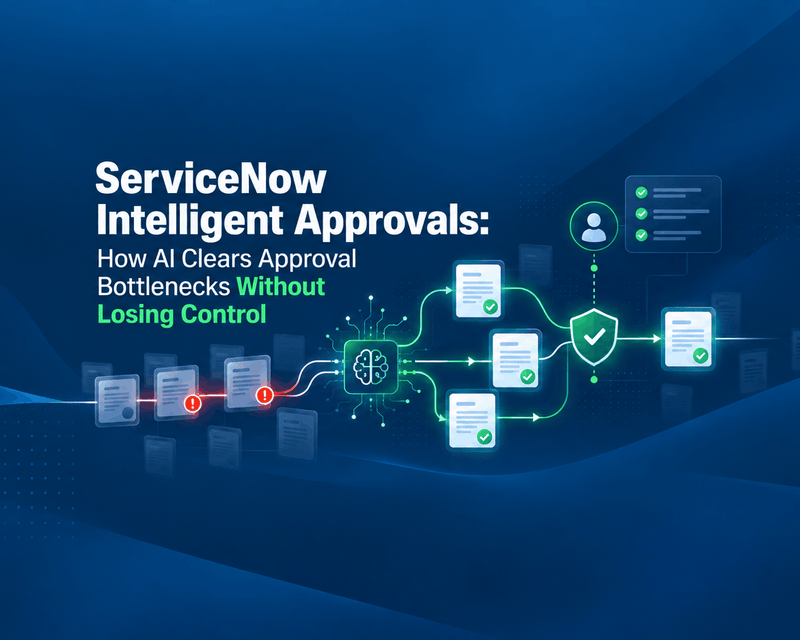
ServiceNow Intelligent Approvals: How AI Clears Approval Bottlenecks Without Losing Control
Your automation is fast. Your approvals are not. Organizations invest heavily in automation, AI and digital transformation. Yet many business processes still stall at the same point: waiting for someone to click “Approve.”
read more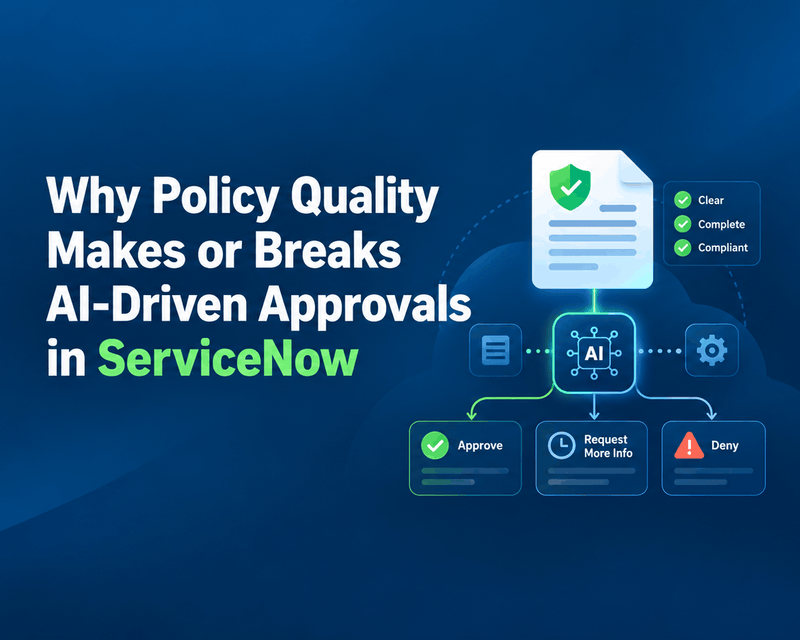
Why Policy Quality Makes or Breaks AI-Driven Approvals in ServiceNow
As enterprises bring AI-driven approvals into ServiceNow, attention goes straight to automation: faster decisions, fewer manual tasks, shorter approval queues. One factor gets far less attention: the quality of the policies behind those decisions.
read more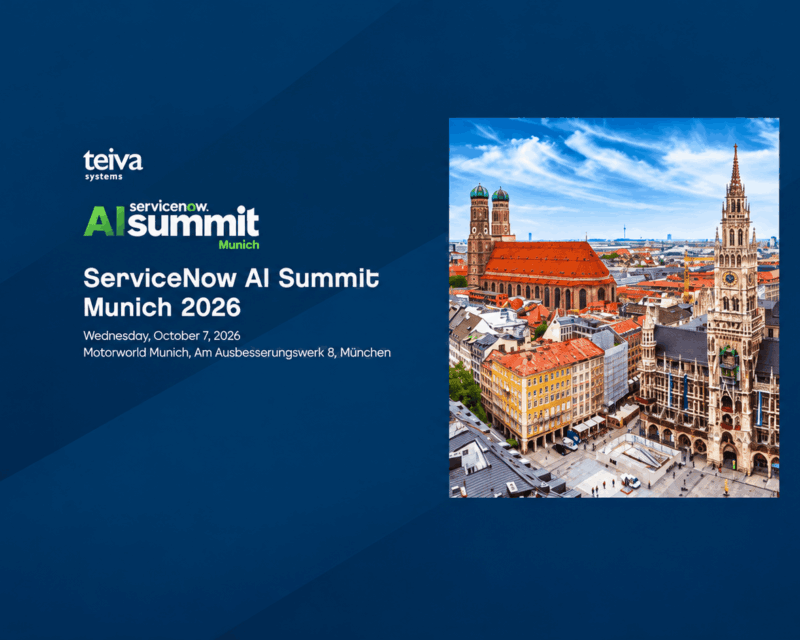
Teiva Systems at ServiceNow AI Summit 2026 — Munich
On October 7, 2026, Teiva Systems joined the ServiceNow AI Summit in Munich, where industry leaders, innovators, and the ServiceNow community came together to explore the next chapter of enterprise AI and intelligent automation.
read more