
Your CMDB Design Decides Whether AIOps Pays Off
ServiceNow is betting big on autonomous IT operations. But without proper CMDB design, none of it works.
In January 2026, ServiceNow launched the ITOM AIOps Configuration Center. It’s a centralized hub that shifts IT operations from reactive to proactive. On top of that, the new AI Agents for AIOps can now triage alerts, assess impact, and fix problems on their own.
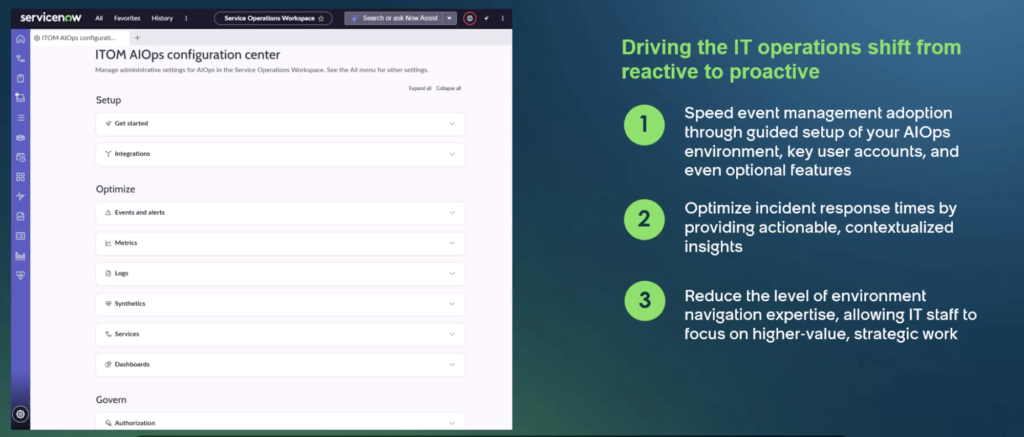
The early results speak for themselves. In fact, organizations using ServiceNow AIOps report 45% faster incident resolution. One enterprise cut 12,000 monthly alerts down to just 2,500 actionable ones. That alone saved them roughly $600,000 per year.
ServiceNow is clearly doubling down. They’ve launched a global workshop series for 2026 called “Achieve Zero Outages.” Autonomous IT operations are no longer a roadmap item. They’re here.
But there’s a quiet dependency that nobody talks about.
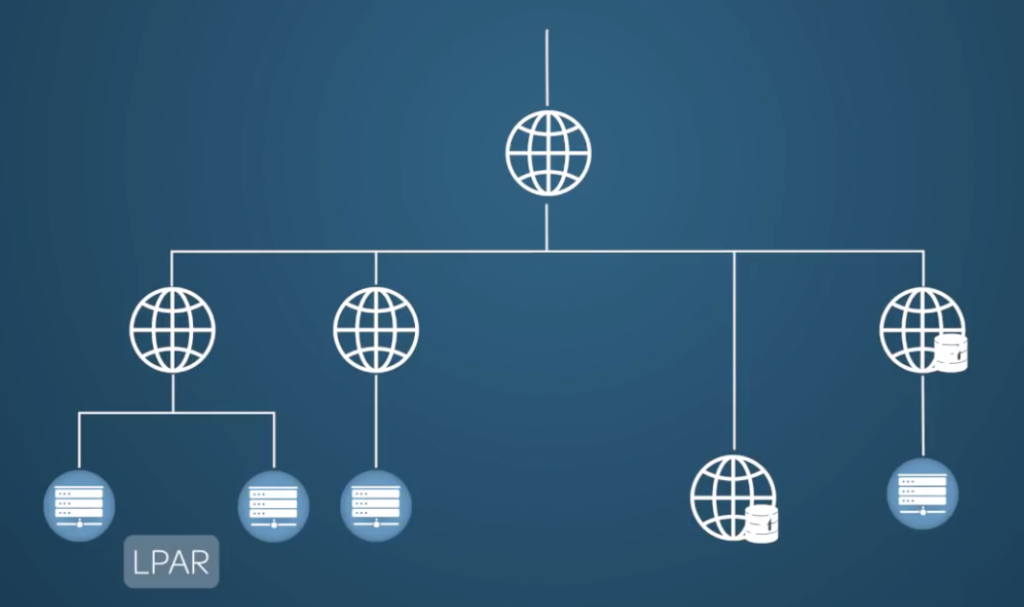
- All of these AI capabilities — alert enrichment, impact assessment, root cause analysis — rely on one thing: accurate CMDB data.
- In short, without solid CMDB design upfront, the smartest AI agent is flying blind.
Why CMDB Design Is the True Foundation for AIOps
ServiceNow’s own architecture makes this dependency obvious. The platform enriches events with business context and CMDB data. Now Assist for ITOM pulls CI relationships and service maps from the CMDB to generate alert summaries. So if your CMDB is empty or outdated, the AI has nothing useful to work with.
Think of it this way. An AI triaging alerts without good CMDB data is like a doctor without a patient’s history. They might get lucky. But you wouldn’t bet your operations on luck.
Sadly, this is where most organizations stand today. They invest in AIOps and Now Assist. Yet their CMDB was never properly designed. In many cases, Discovery got turned on at some point. CI records piled up. But there’s no data model, no governance, and no clear ownership. Good CMDB design would have prevented all of that.
This brings us to the most underrated success factor in the ServiceNow ecosystem.
We have now demonstrated that generative AI for ServiceNow is huge. If you think about the power of our CMDB and taking that data and applying generative AI to it, there are literally endless opportunities with use cases to help people actually experience a better life.

Why 70–80% of CMDB Projects Fail — and How CMDB Design Prevents It
Most CMDB projects don’t fail during implementation. They fail before it. The reason? Nobody designed what “done” looks like.
Industry analysts say 70–80% of organizations struggle with their CMDB. The cause isn’t technical complexity. Nor is it missing features. Teams simply jump into configuration without asking the right questions first.
Questions like: What business outcomes should this CMDB support? Who owns the data? How does it fit the operating model? Without answers, every technical decision becomes a guess. As a result, guesses always compound into technical debt.
ServiceNow’s own NowCreate methodology confirms this. Their playbook is clear: put your desired CMDB model in place before you implement. Good CMDB design upfront prevents months of costly rework later.
At Teiva Systems, we’ve seen this play out across industries. The winners treat their CMDB design phase as a first-class deliverable. Not as a checkbox on the way to implementation. This is especially true now, when CMDB data quality directly shapes whether AIOps delivers value — or just noise.
What a Proper CMDB Design Document Contains
So what does a solid CMDB design look like in practice? At its core, it’s a business-driven blueprint. It answers five questions that determine success or failure.
1. Which business outcomes should the CMDB enable?
Start with use cases. NowCreate recommends this as step one. Common examples include incident impact analysis, change risk assessment, compliance reporting, and outsourcing governance. Increasingly, AIOps readiness belongs on that list too.
Each use case then determines which CI classes and relationships you actually need. As a consequence, everything else is noise. You don’t need every CI class on day one. You need the ones behind your most critical processes — plus a roadmap for the rest.
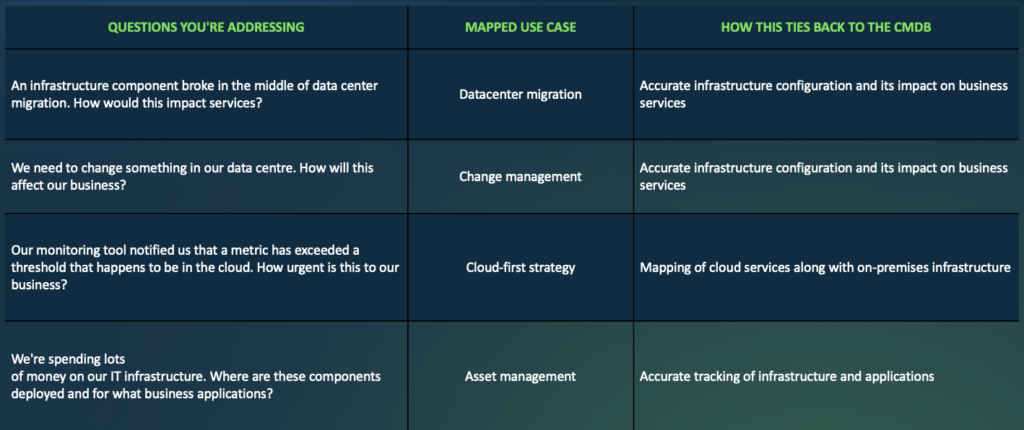
For AIOps adoption, the CMDB design must account for data that Event Management and Now Assist will consume. That means service-to-infrastructure mappings, business criticality tags, and relationship data for automated impact analysis.
2. What does the target data model look like?
Next comes the data model. This is where the Common Service Data Model (CSDM) becomes essential. CSDM provides a standard way to organize services, applications, and infrastructure. It maps how Business Services connect to Application Services, Technical Services, and infrastructure CIs.
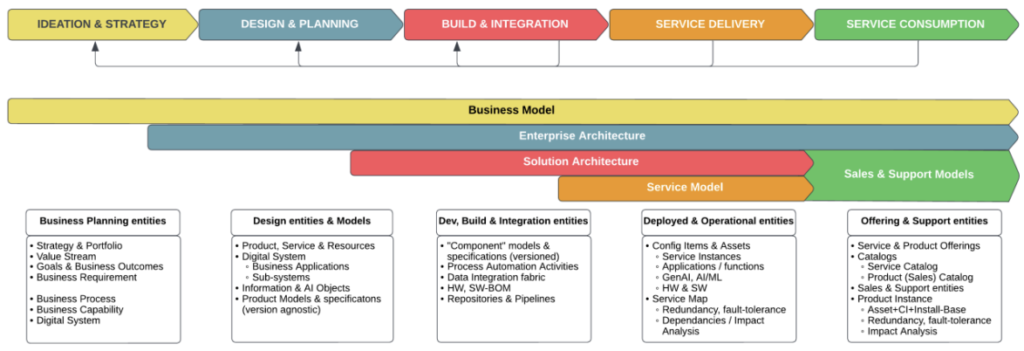
Skipping CSDM alignment during CMDB design always leads to rework. For example, we’ve seen teams build custom CI classes from scratch. Then they discover ServiceNow’s out-of-the-box model already covered their needs. Often better, because it connects natively with Discovery, Service Mapping, and the AIOps engine.
The design phase is where you make these choices on purpose — not by accident.
3. Who owns and maintains the data?
A CMDB without governance is just a database that decays. Your CMDB design must define who creates CI records, who validates them, and who retires them. On top of that, it needs a RACI matrix across IT operations, app owners, and external providers.
This last point is critical for outsourced environments. You need to define contractually what each partner must maintain. Without this, gaps appear at provider boundaries. And that’s exactly where AIOps alert routing breaks down.
4. How do you measure and maintain data quality?
You also need a data quality strategy from day one. ServiceNow offers native CMDB Health tools: completeness checks, correctness validation, compliance scoring. However, they need to be configured against clear standards. Therefore, your CMDB design must set KPIs, thresholds, and remediation triggers.
Start with a “crawl, walk, run” approach. Begin with basic completeness metrics. Then add correctness checks and relationship validation over time. Define the target now, even if you implement it step by step. This matters especially for AIOps: alert enrichment only works when CI data meets minimum quality bars.
5. How does the CMDB integrate with existing systems?
Finally, you need an integration plan. Discovery, Service Graph Connectors, manual imports — your CMDB design maps out all data sources. In addition, it defines reconciliation priorities and identification rules. This prevents data sources from overwriting each other without clear precedence.
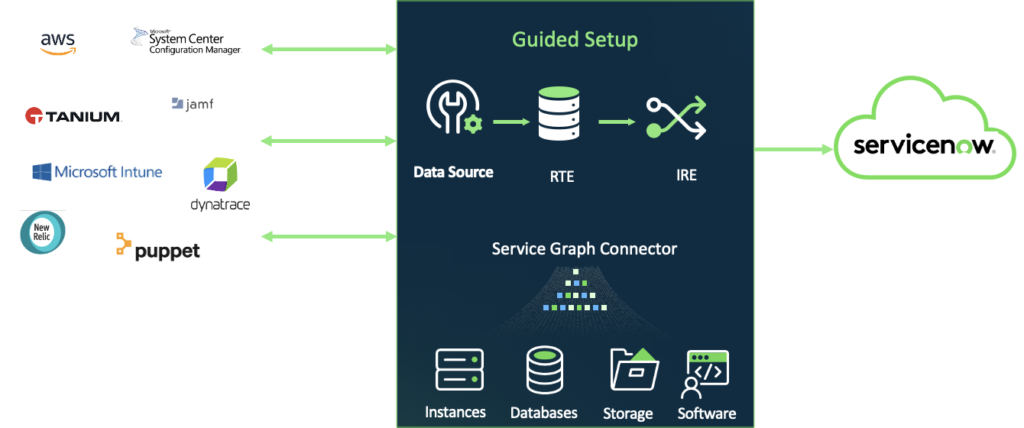
NowCreate recommends using the Identification and Reconciliation Engine (IRE) from the start. Design your IRE rules during the concept phase. This ensures data integrity from the first day of implementation.
Co-Creation Beats Ivory-Tower CMDB Design
The process matters just as much as the content. In our experience, CMDB designs fail when written in isolation. A consultant interviews some stakeholders, disappears for four weeks, and returns with 120 pages. Nobody reads it. Nobody feels ownership.
We take a different approach. Our CMDB design emerges from structured workshops with the people who will live with the results.
Phase 1: Discovery and current-state analysis
Before we design anything, we look at what exists. That means read-only access to the ServiceNow instance. We review the current data model, CI classes, discovery sources, and data quality. Then we benchmark against CMDB Health best practices.
We also map all stakeholders. Who uses CMDB data today? What decisions do they make with it? What’s missing? These interviews produce a prioritized use-case list — the foundation for everything that follows.
Phase 1 ends with a quality gate. We present our findings to the steering committee. Together, we decide if the scope is right. This protects both sides from building a CMDB design that misses the mark.
Phase 2: Workshop-based concept development
The CMDB design then takes shape across five focused workshops. Each starts with a short expert impulse on NowCreate and CSDM best practices. Then we move into collaborative work:
- Workshop 1 — Target vision and scope: We define what “good” looks like. This includes AIOps readiness targets.
- Workshop 2 — Data model design: We map CI classes, attributes, and relationships within CSDM. No custom classes without good reason.
- Workshop 3 — Governance and processes: We build the operating model. Roles, RACI, lifecycle management.
- Workshop 4 — Integration and data quality: We map data sources, set IRE rules, and define DQ-KPIs.
- Workshop 5 — Review and rollout planning: We validate the full concept and build the roadmap.
Between workshops, we share consolidated results for review. Nothing in the final document is a surprise.
We also deliver a compact CMDB Playbook (5–10 pages) alongside the full CMDB design. It covers principles, decision logic, and governance essentials. Your team can use it independently after the project ends.
Why Outsourced IT Needs CMDB Design Even More
The design-first approach becomes even more important when you rely on external IT providers. In that case, the CMDB design serves two purposes: it’s a blueprint and a governance tool.
The concept defines what data each provider must deliver. It also sets quality standards for SLAs. Above all, it gives you an independent view of your IT landscape. One that doesn’t depend on any single provider’s perspective.
Without this, you’re asking your outsourcing partners to define the standard by which their own performance gets measured. That’s a conflict of interest. And it’s one of the top reasons CMDB projects stall in outsourced setups.
AIOps raises the stakes even further. After all, AI-driven alert routing needs accurate service maps. If the CMDB reflects only one provider’s view, the AI will misjudge impact and misroute alerts. Good CMDB design prevents this from the start.
We’ve seen this across industries. In manufacturing asset lifecycle management, getting the data right first prevented an expensive restart. When extending ITSM and ITOM for backup and restore, proper CMDB design proved essential.
Our data retention and CMDB migration work confirmed the pattern. Starting from CMDB actualization created a common base for smooth process transitions. Concept-phase documentation cut timelines and saved budget.
The Business Case: CMDB Design Is an Investment, Not a Cost
“Why pay for design when we could just start building?” Fair question. Here’s the short answer.
A typical CMDB implementation costs €150,000 to €500,000. Industry data shows 60–70% fail to deliver value. A CMDB design phase costs a fraction of that. It’s essentially insurance against a failed project.
But the value goes beyond risk reduction. Here’s what you gain:
Faster implementation. A solid CMDB design gives implementation teams a clear blueprint. No more weeks lost to alignment. NowCreate says it plainly: define your target state before you start.
Platform alignment. A concept grounded in CSDM works with the platform. Less customization means lower maintenance and smoother upgrades.
AIOps readiness. Without proper CMDB design, your AIOps investment delivers only a fraction of its potential.
Built-in buy-in. A co-created CMDB design has champions from day one. When implementation starts, the “why” conversation is already done.
Outsourcing leverage. Your CMDB design becomes a contractual reference. It defines exactly what each provider must deliver and maintain.
Conclusion: CMDB Design First, Then Automate
The direction is clear. ServiceNow is moving toward autonomous IT operations. AI Agents will soon detect, analyze, and fix issues on their own. The winners will be those who built the foundation first.
Here’s the irony. The most advanced capability on the platform depends on the most basic one: a clean, well-designed CMDB.
So if you’re starting a CMDB project — or fixing a broken one, or preparing for AIOps — begin with the CMDB design. Ask yourself: do we have a clear vision for what our CMDB should contain and how it gets governed?
If the answer isn’t a confident “yes,” the design phase is where you start.
ServiceNow offers great starting points through NowCreate and the CMDB Design Guidance. But turning frameworks into a CMDB design that fits your organization is where external expertise helps most.
I shared my personal view on that topic in my recent Linkedin Article.
We’re happy to share more. Get in touch or explore our case studies to see how we build solid ServiceNow foundations.
Teiva Systems is a ServiceNow Build Partner specializing in platform architecture, custom application development, and ITSM/ITOM implementations.
Kostya Bazanov, Managing Director, Jan 30, 2026
Eager to take the next step? Contact us today!
Latest Articles
From Ticket Chaos to Autonomous IT: How Enterprises Are Turning ServiceNow Into a Self-Driving Platform
Why scaling tickets is not the same as scaling IT - and what leading organizations are doing instead.There was a time when IT success seemed simple:close more tickets.
read more
ServiceNow AI Skills, AI Agents & AI Workflows: The Complete Guide (2025–2026)
ServiceNow offers over 300 AI Skills across 30+ product modules, organized under the Now Assist ecosystem. AI Skills are discrete, reusable GenAI capabilities (e.g., incident summarization, resolution notes generation).
read more
Teiva Systems at ServiceNow Partners Day Munich: In the Age of AI, Execution Wins
Teiva Systems recently joined ServiceNow Partners Day in Munich, where more than 70 partner organizations and 120+ attendees came together to discuss the future of the ServiceNow ecosystem.
read more