
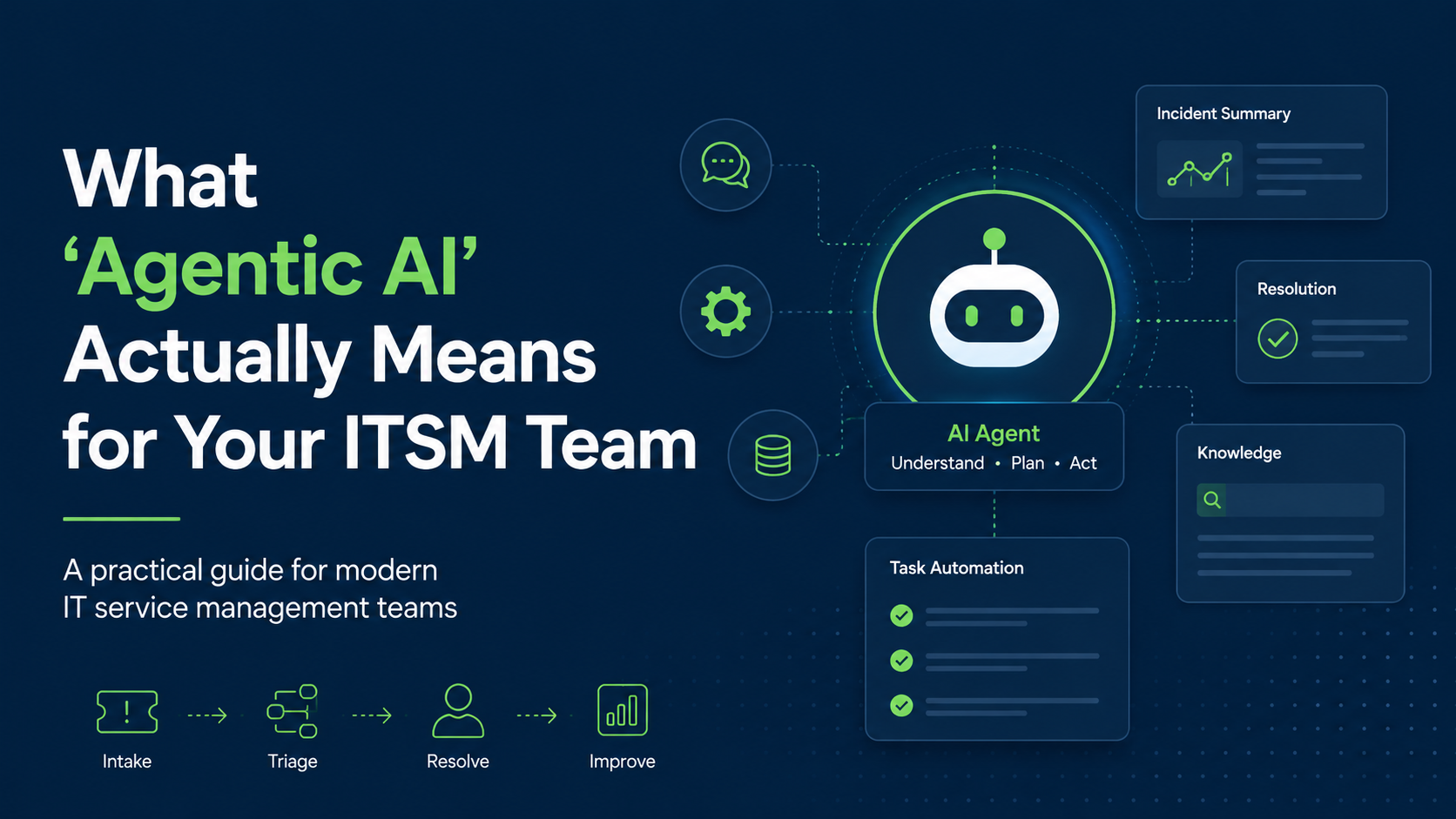
Agentic AI in ITSM: Which Work Should Your ServiceNow Agents Actually Own?
The question for ITSM teams in 2026 is not ‘can AI answer this ticket?’ It is ‘which work should AI be trusted to move forward?’ The distinction matters — and it changes everything about how you deploy, govern, and measure AI in ServiceNow.
Every ITSM team we work with has a version of the same conversation.
Leadership has heard about AI agents. They want to know when ServiceNow will start handling tickets automatically.
The service desk team has a different concern: will AI replace their roles, or help them?
Meanwhile, the platform team is asking the most practical question of all: what exactly does “agentic AI” mean for the workflows they have spent years building?
The honest answer is that agentic AI changes something specific and significant: it moves AI from advisor to executor.
However, this does not mean automating all work at once. It does not mean removing governance. And it does not mean giving AI unrestricted control over critical processes.
Instead, for the right use cases — high-volume, well-defined, low-risk, and measurable — agentic AI can own the work from request to resolution without requiring a human in the loop at every step.
In ServiceNow terms, this is the direction of the L1 AI Specialist, Now Assist, Otto, and the broader Autonomous Workforce. The question is no longer whether this shift is coming. The real question is whether your ITSM environment is ready for it.
Which ITSM Work Should AI Own? A Deployment Sequencing Guide
Not all ITSM work suits AI deployment equally. Teams should start where volume is high, the process is clear, risk remains controlled, and outcomes are easy to measure. The wrong starting point is the use case that looks most impressive. In practice, the best first use case is usually the one that teams can repeat, measure, and control well enough to prove value quickly.
| Use case | Volume | AI risk | Data readiness | Deploy wave |
| Password reset & unlock | Very High | Low | Clean | Wave 1 — Start here |
| Software access requests | High | Low | Clean | Wave 1 — Start here |
| Incident triage & routing | Very High | Medium | Needs KB | Wave 1 — Start here |
| Case summarization | High | Low | Needs KB | Wave 1 — Start here |
| Approval routing | Medium | Medium | Clean | Wave 2 — After pilot |
| Change risk assessment | Medium | High | Needs CMDB | Wave 2 — After pilot |
| Problem management | Low | High | Complex | Wave 3 — Scale stage |
| Major incident coordination | Low | Very High | Complex | Wave 3 — Scale stage |
What we tell every ITSM team about Wave 1:
Password resets and software access requests may not be glamorous. However, they are the right first use cases for a reason: they are high-volume, rule-based, low-risk, and easy to measure.
ServiceNow’s own L1 AI Specialist was designed around exactly this scope. Before it was offered to customers, it handled more than 80% of ServiceNow’s internal IT requests.
That is the practical starting point. Start with use cases where the rules are clear, the risk is limited, and the impact can be measured quickly. Prove the value there first. Then expand.
Governance: The Operating Layer AI Agents Cannot Function Without
As AI moves from assistance to action, governance becomes the operating model, not an afterthought.
Someone must decide which agents can act, which systems they can access, which workflows they can trigger, and when they must escalate to a human.
In ServiceNow, much of this infrastructure already exists. AI Control Tower can govern agent actions, role-based tool packages can define exactly what each agent can and cannot do, and audit trails can record every action the agent takes.
However, most organisations do not lack the technical capability. They lack ownership. The governance framework does not run itself. It needs a named individual — not a committee — to own the AI operating model and hold the authority to pause, adjust, or revoke agent permissions when needed.
Four governance decisions to make before any agent goes live:
→ Assign an AI governance owner. This should be one named individual with clear authority over what agents can do, how risk is controlled, and how escalations are handled.
→ Define the human-in-the-loop threshold. For each use case, decide which actions require human review before execution and which actions the agent can complete autonomously.
→ Configure AI Control Tower before activation. Discover, Govern, and Observe modes should be active before the first agent is enabled — not after.
→ Document and test the kill switch. If an agent behaves unexpectedly, who stops it, how quickly can they act, and what does recovery look like? This process should be documented and tested in a non-production environment before any live deployment.
What to Measure: The Baseline Every ITSM Team Needs Before Day One
One of the most consistent mistakes we see in ITSM AI deployments is starting without a documented baseline. Without one, you cannot prove value to leadership, identify what is working, or justify expanding the programme.
| Metric | Baseline to capture | AI agent target | Why it matters |
| Mean time to resolve (MTTR) | Current avg by priority | 30–50% reduction | Core AI agent ROI proof point |
| Ticket deflection rate | Self-service % of volume | 25–40% of L1 volume | Direct cost reduction signal |
| First-contact resolution (FCR) | Current FCR % | +10–15 points | Quality of AI routing accuracy |
| Reassignment rate | Tickets rerouted per week | 50% reduction | Signals AI categorisation quality |
| Approval cycle time | Avg hours per request type | 40–60% faster | Intelligent Approvals ROI |
| User satisfaction (CSAT/ESAT) | Current survey score | +5–10 points | Human experience outcome |
The metric most teams forget to capture:
Reassignment rate — the percentage of tickets rerouted after the initial assignment. This metric gives one of the clearest signals of AI categorisation quality.
At first glance, when an AI agent assigns a ticket incorrectly, the issue may look like a routing problem. However, the root cause usually sits deeper: the categorisation model may have classified the request inaccurately, the service mapping may be incomplete, or the knowledge article may not reflect the real issue.
For this reason, teams should track reassignment rate from day one. Over time, this metric creates a practical feedback loop that helps improve AI accuracy, refine categories, and strengthen the knowledge base continuously.
Agentic AI will not fix broken ITSM processes.
However, when teams deploy Agentic AI on top of strong governance, clean knowledge, reliable data, and a clear activation sequence, it can make good processes faster, more consistent, and more scalable than any previous generation of ITSM technology.
For this reason, every ITSM team considering this step should use that framing. Agentic AI is not a shortcut around ITSM maturity. Rather, it multiplies the maturity already present in your team.
Ultimately, the teams that benefit most will prepare the foundation, choose the right first use cases, measure from day one, and scale only what proves its value. This is not a conservative approach. On the contrary, it is the fastest route to sustainable results.
“Agentic AI is not a shortcut around ITSM maturity. It is a multiplier for the maturity already present in your team.”
Oleksii Konakhovych, CTO, Jun 17, 2026
Eager to take the next step? Contact us today!
Latest Articles
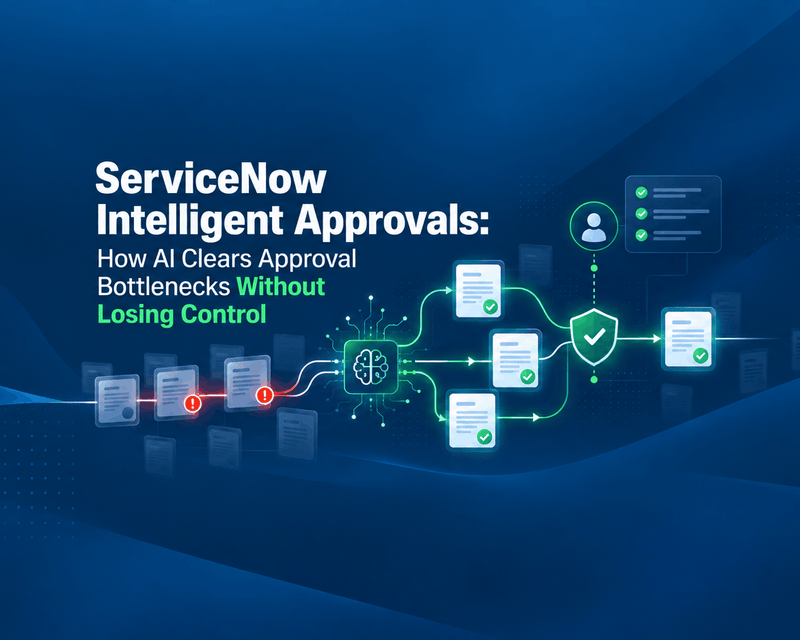
ServiceNow Intelligent Approvals: How AI Clears Approval Bottlenecks Without Losing Control
Your automation is fast. Your approvals are not. Organizations invest heavily in automation, AI and digital transformation. Yet many business processes still stall at the same point: waiting for someone to click “Approve.”
read more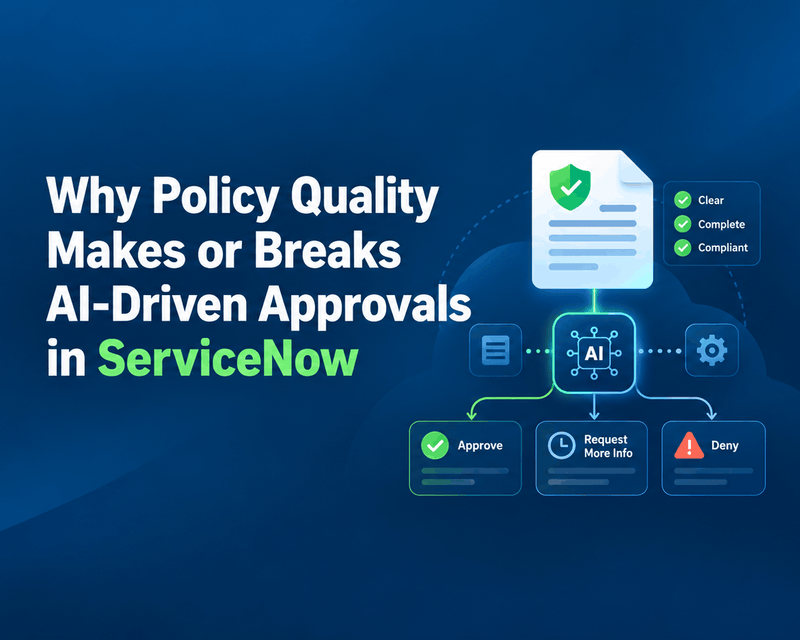
Why Policy Quality Makes or Breaks AI-Driven Approvals in ServiceNow
As enterprises bring AI-driven approvals into ServiceNow, attention goes straight to automation: faster decisions, fewer manual tasks, shorter approval queues. One factor gets far less attention: the quality of the policies behind those decisions.
read more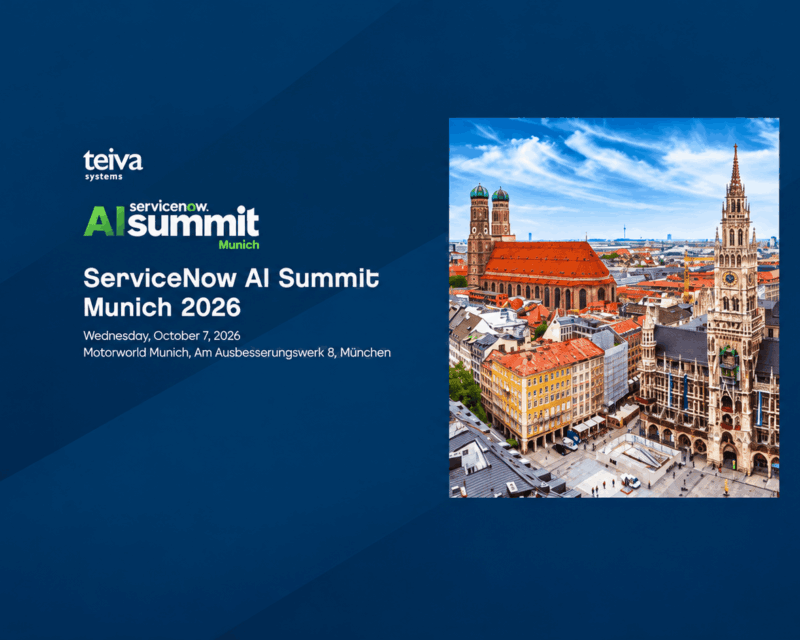
Teiva Systems at ServiceNow AI Summit 2026 — Munich
On October 7, 2026, Teiva Systems joined the ServiceNow AI Summit in Munich, where industry leaders, innovators, and the ServiceNow community came together to explore the next chapter of enterprise AI and intelligent automation.
read more