
ServiceNow for the Public Sector: Five Requirements to Address Before Implementation
Public-sector organizations do not implement ServiceNow under the same conditions as a commercial enterprise. Getting the foundation right before development begins can determine whether the platform supports secure, measurable, and scalable public services for years to come.
Public-sector organizations face different conditions when they implement ServiceNow than commercial enterprises do.
Government agencies, municipalities, healthcare authorities, public utilities, education institutions, and other public bodies must meet stricter requirements for security, accountability, procurement, accessibility, data governance, and long-term platform ownership.
That changes the implementation question. It is not simply: “Which ServiceNow modules should we deploy?”
The more important question is: “Is the organization ready to operate ServiceNow under public-sector constraints for the next five or ten years?”
A technically successful go-live can still create operational problems when organizations fail to define governance, data ownership, integrations, security, or scalability before development begins.
“Public-sector ServiceNow programmes rarely struggle because the platform cannot do enough. They struggle because organizations postpone critical operating decisions until after the build starts.”
Before implementation begins, five requirements deserve particular attention:
| # | Requirement | Public sector constraint | Primary question to answer |
| 1 | Define governance before you configure | Multi-department, multi-vendor ownership creates conflicting standards | Who owns each workflow, application, and AI capability? |
| 2 | Establish data ownership and CMDB quality | AI, AIOps, and automation depend on trusted operational context | Who owns the data, validates it, and resolves conflicts? |
| 3 | Design security and auditability into workflows | Sensitive citizen, employee, and financial data in every workflow | Who can see, modify, and approve each record? What must be logged? |
| 4 | Assess existing applications before building on them | Legacy apps, inherited workflows, and partner handovers hide real risk | Do we understand what was actually built — not just what was planned? |
| 5 | Define outcomes and measurement before starting | Public accountability requires evidence, not just activity metrics | What baselines exist today, and how will improvement be proven? |
1. Define Governance Before You Configure the Platform
ServiceNow makes it easy to create workflows, applications, integrations, automations, and custom business logic.
That flexibility is valuable. But it can also create risk when multiple departments, vendors, agencies, or external contractors share responsibility for the same platform.
Before development begins, the organization should answer a set of core governance questions.
Eight governance questions to answer before development begins:
→ Who owns the ServiceNow platform?
→ Who can approve architectural changes?
→ Who owns each workflow and service?
→ Which teams can create applications or integrations?
→ What requires security or compliance review?
→ Who decides when customization is justified?
→ How will technical debt be identified and remediated?
→ What happens when an implementation partner changes?
Without clear answers, different teams can gradually create their own workflows, naming conventions, access models, and technical standards.
The platform may still work, but it becomes harder to audit, upgrade, secure, and scale.
This becomes even more important as AI enters the platform.
AI agents that can take actions need clear ownership, permissions, audit trails, approval boundaries, and governance before they are given operational autonomy.
For more on AI governance architecture within ServiceNow, see our Enterprise AI Governance Blueprint and AI Control Tower Implementation Guide.
Teiva explores this issue further in its article on governance for enterprise AI agents in ServiceNow and the importance of putting control mechanisms around autonomous workflows. Explore Teiva Systems’ ServiceNow articles
“Governance should not be the documentation produced after implementation. It should be part of the architecture implemented from day one.”
2. Establish Data Ownership and CMDB Quality
For many public-sector ServiceNow programmes, the CMDB becomes one of the most important parts of the platform.
It connects applications, infrastructure, services, users, locations, suppliers, incidents, changes, and the dependencies between them.
But installing Discovery or importing configuration items does not automatically create a trustworthy CMDB. The bigger challenge is ownership.
CMDB ownership questions to answer before implementation:
→ Who owns the data?
→ Who validates it?
→ Which source is authoritative when systems conflict?
→ Who resolves conflicting information?
→ How are relationships maintained?
→ What happens when a system is retired?
These questions become even more important as ServiceNow expands its use of AI.
AI-generated incident summaries, root-cause recommendations, service impact analysis, AIOps, and automated workflows all depend on reliable platform context.
A wrong CI relationship can lead to a wrong impact assessment. An outdated owner can cause incorrect routing. Missing service dependencies can result in incomplete operational recommendations.
For more on preparing the CMDB for AI, see our CMDB AI Readiness Assessment post.
As Teiva explains in Your CMDB Design Decides Whether AIOps Pays Off, AI and AIOps outcomes depend heavily on the quality of the underlying CMDB. Read the CMDB and AIOps article
A public-sector CMDB should not be treated as an IT inventory. It is operational infrastructure for every process that depends on trusted context.
For this reason, CMDB architecture, ownership and governance should be addressed before implementation—not several phases later when data problems have already spread across the platform.
3. Design Security, Access, and Auditability Into Every Workflow
Public-sector workflows often involve sensitive or restricted information, including employee and citizen data, financial records, legal cases, infrastructure information, supplier data, internal investigations, and identity and access requests.
For this reason, security cannot be treated as a final implementation step. It needs to be designed into each major workflow from the beginning.
Security design questions for every public-sector workflow:
→ Who can see this record?
→ Who can modify it?
→ Who can approve it?
→ What information can integrations access?
→ Which actions must be logged?
→ What evidence would an auditor need six months later?
These questions apply to traditional workflows, custom ServiceNow applications, and especially AI-driven automation.
An AI agent is different from a chatbot that only generates text. Once it can retrieve data, update records, trigger flows, or execute actions, identity, permissions, and auditability become architectural requirements.
If an action matters enough to automate, it matters enough to audit.
Public-sector organizations should therefore define access-control standards, segregation-of-duties principles, integration security, logging requirements, and approval boundaries before high-value workflows move into production.
4. Assess Existing Applications and Integrations Before Building Around Them
Many ServiceNow public-sector programmes are not greenfield implementations.
In many cases, the platform already includes:
- legacy applications,
- custom tables,
- outdated integrations,
- inherited workflows,
- scripts created by previous suppliers,
- undocumented business rules,
- portal customizations,
- external systems that depend on ServiceNow data.
A common mistake is to assume that if something works today, it is safe to build on.
That is not always the case.
A functioning application may still contain hidden dependencies, weak ACLs, outdated APIs, upgrade-sensitive customizations, or technical debt. These issues often become visible only when a new transformation programme begins.
“It works” is an operational observation — not an architectural assessment.
Before extending inherited applications or connecting them to a new public-sector architecture, organizations should first understand what actually exists in the ServiceNow instance.
That is the purpose of a structured ServiceNow App Assessment: examining the data model, access controls, scripts, dependencies, integration surfaces and application structure before additional investment is committed. Read ServiceNow App Assessment: What Is Really in Your App
This is especially valuable when responsibility is moving between implementation partners.
The outgoing partner’s documentation describes what the system was intended to become.
The instance shows what was actually built.
Those two versions are not always identical.
5. Define Outcomes and Measurement Before Implementation Starts
Public-sector transformation programmes often start with functionality: “We need ITSM.” “We need CSM.” “We need a new employee portal.” “We need AI.”
But these statements describe technology needs, not success.
A stronger ServiceNow implementation starts with clear, measurable operational outcomes. Organizations should establish baseline metrics before implementation begins. Without them, it becomes difficult to prove whether the programme actually improved service delivery.
Here are eight measurable outcomes public-sector ServiceNow programmes should define and baseline before implementation:
| Outcome to measure | How to measure it | Where to find baseline in ServiceNow |
| Reduce incident resolution time | Average MTTR before/after | ServiceNow Performance Analytics |
| Shorten citizen request processing | Average request cycle time | Performance Analytics — CSM dashboards |
| Reduce manual handoffs | Handoff count per request type | Flow Designer analytics, task routing data |
| Increase self-service adoption | Self-service vs agent-assisted rate | Service Portal analytics, Now Assist deflection |
| Improve SLA compliance | SLA met % before/after | SLA dashboards, Performance Analytics |
| Reduce cost per request | Staff hours ÷ request volume | Custom report: hours per ticket type |
| Increase CMDB completeness | CMDB accuracy score % over time | CMDB Health dashboard, Scan Engine |
| Improve employee satisfaction | ESAT score per service category | ServiceNow Surveys, Now Assist ESAT data |
The same principle is becoming critical for ServiceNow AI programmes. Establishing baseline metrics before deployment and connecting activity to measurable operational outcomes is the difference between an AI programme that survives its next budget review and one that gets quietly shelved. See our CIO ROI Framework for the approach.
Teiva’s framework for calculating ServiceNow AI Agent ROI emphasizes establishing baseline metrics before deployment and connecting activity to measurable operational outcomes rather than simply counting how many requests an AI system processed. Read the ServiceNow AI Agent ROI framework
If success cannot be measured before implementation, it will be much harder to prove after implementation.
This matters especially in the public sector. Technology investments often need to demonstrate value not only to IT leadership, but also to finance teams, procurement, auditors, regulators, and ultimately the public.
Public-Sector ServiceNow Readiness Is an Architecture Question
ServiceNow can become much more than an IT ticketing platform. It can serve as a common workflow layer that connects IT, employees, citizens, operations, assets, security, suppliers, and increasingly AI-driven processes.
But that value depends on the foundation underneath it.
| Before implementation begins, public-sector organizations should be able to answer these five questions confidently: 1. Who governs the platform? 2. Can we trust the data and CMDB behind our workflows? 3. Are security, permissions, and auditability designed into the architecture? 4. Do we understand the applications and integrations we are inheriting? 5. Do we know exactly how success will be measured? If the answer to one or more of these is unclear, that is not a reason to stop. It is where the implementation should start. |
The strongest ServiceNow implementations do not begin with configuration. They begin by deciding what the platform must protect, who must own it, and what business outcome it is expected to improve.
For public-sector organizations, getting those decisions right before development begins can determine whether ServiceNow becomes another system that must be maintained — or a platform capable of supporting secure, measurable, and scalable public services for years to come.
Kostya Bazanov, Managing Director, Oct 02, 2026
Eager to take the next step? Contact us today!
Latest Articles
ServiceNow AI ROI: What Should You Measure After the Pilot?
Your AI pilot worked. That proves the technology can work. It does not yet prove ROI. Here are the six metrics that separate “the demo impressed leadership” from “we can prove measurable business value.”
read more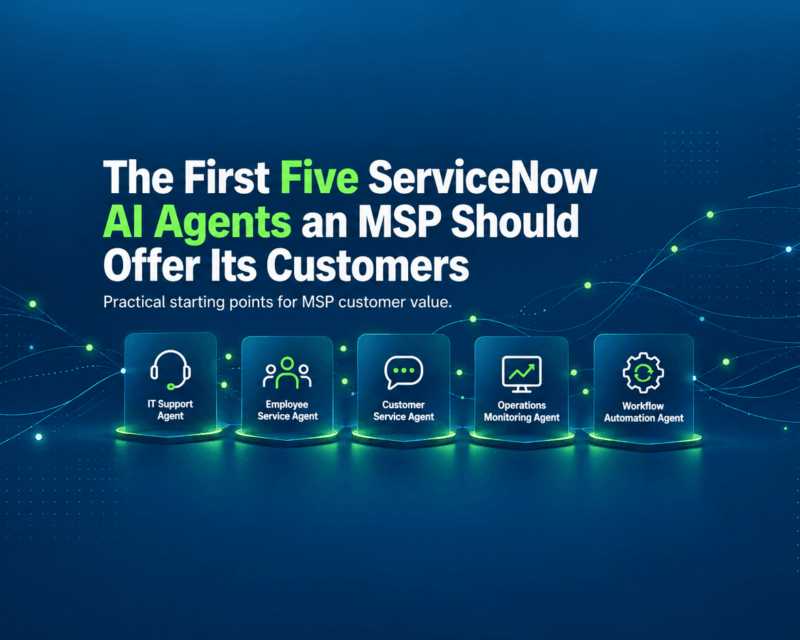
The First Five ServiceNow AI Agents an MSP Should Offer Its Customers
Managed service providers can now package ServiceNow AI agents as repeatable, recurring services — moving from ticket-response capacity to managed outcome delivery. Here is what the first five offerings look like, how each creates value, and what to get right before deploying them.
read more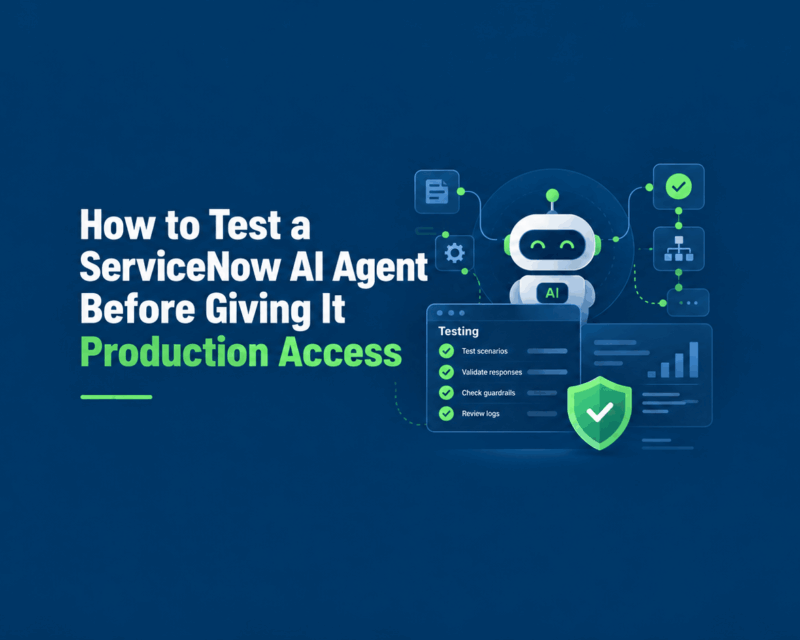
How to Test a ServiceNow AI Agent Before Giving It Production Access
A successful demonstration proves that an agent can perform a task under specific conditions. It doesn’t prove the agent will behave correctly when faced with incomplete data, conflicting instructions, restricted records, broken integrations, or unexpected user requests.
read more