
ServiceNow Autonomous Security:What Should You Actually Automate?
ServiceNow Autonomous Security can now move security operations from detection to investigation, decision, and action. But how much authority should AI actually have? Here is a practical framework for deciding what to automate — and where human approval should remain.
It is 2:13 a.m.
ServiceNow detects suspicious activity associated with an employee account.
An AI security specialist correlates the alert with identity data, asset context, previous incidents, and threat intelligence. The evidence suggests that the account may be compromised.
The next action is obvious: disable the account.
But should the AI do it?
But should the AI do it?
What if the account belongs to a regular employee? What if it belongs to the CFO? What if it is a privileged production account supporting a business-critical system? And what happens if the AI makes the wrong decision?
These are the questions enterprises need to answer as ServiceNow Autonomous Security moves security operations beyond traditional workflow automation.
The challenge is no longer simply:
Can we automate this security task?
The more important question is:
How much autonomy should we give AI before a human needs to approve the decision?
The answer should depend on risk — not on how technically impressive the automation is.
ServiceNow Autonomous Security Changes the Automation Model
Security automation itself is not new. SOC teams have spent years building rules, playbooks, integrations, and workflows to reduce repetitive manual work.
Traditional model:
Detect → Recommend → Human decides → Human acts
Emerging autonomous model:
Detect → Investigate → Decide → Act → Document
Traditional automation generally follows predefined logic: if X happens, execute Y.
Agentic security goes further. It can analyze what happened, investigate the surrounding context, determine the appropriate response, execute actions, and document the outcome.
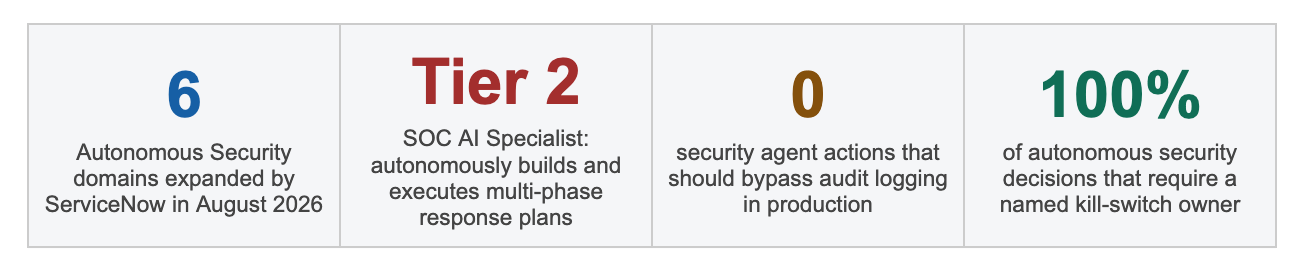
In August 2026, ServiceNow announced an expansion of its Autonomous Security strategy across six areas: unified exposure management, continuous vulnerability detection, cyber-physical security, identity and access security, agentic incident response, and cyber risk and compliance.
One of the most important additions is the Tier 2 SOC AI Specialist, designed to autonomously build and execute multi-phase response plans for complex incidents. This can include enrichment, correlation, containment, and blocking, while higher-risk decisions are escalated to human analysts.
The Vulnerability Resolution AI Specialist follows the same direction, orchestrating vulnerability triage and remediation workflows, including approved low-risk patches.
AI is no longer only helping analysts understand a security event. It is beginning to participate directly in the response.
That changes the governance question completely.
Enterprises now need a clear operating model that defines what AI can do autonomously, what requires human approval, and where autonomous action must stop.
The ServiceNow Security Autonomy Ladder
The wrong debate is:
Should we trust AI with cybersecurity?
That question is too broad to be useful.
A better approach is to define different levels of autonomy based on the consequences of the action.
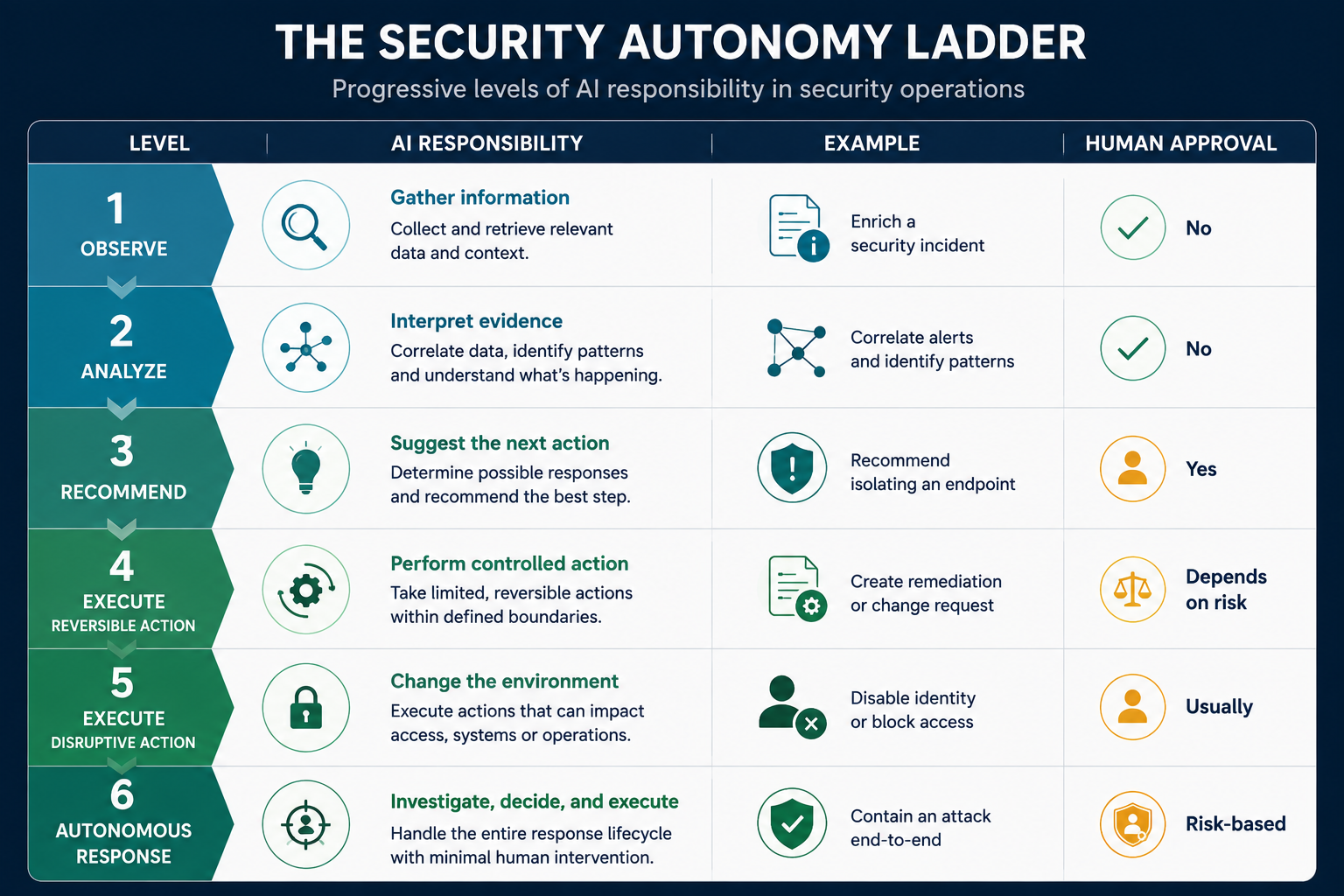
This creates a much more practical principle for ServiceNow customers:
The goal isn’t maximum autonomy. It’s the right level of autonomy for the risk involved.
There is little value in requiring an analyst to manually approve every enrichment query.
There may be enormous value in requiring approval before an AI agent disables a privileged identity connected to production infrastructure.
Both workflows use AI.
They should not have the same governance model.
What Should You Automate in ServiceNow Autonomous Security?
The strongest candidates for high autonomy generally share three characteristics:
High volume. Low individual impact. High reversibility.
Examples include:
- Alert enrichment
- Duplicate and noise reduction
- Vulnerability categorization
- Asset and configuration context gathering
- Threat-intelligence correlation
- Incident creation
- Work assignment and routing
- Historical incident searches
- Remediation recommendations
- SLA monitoring
- Incident-summary generation
- Evidence gathering
- Vulnerability prioritization
- Compliance evidence collection
These activities consume enormous amounts of analyst time but usually do not create a significant blast radius when automated correctly.
Take incident enrichment.
An AI specialist can gather identity information, affected assets, related alerts, previous incidents, vulnerability data, and relevant threat intelligence before an analyst even opens the case.
There is usually little reason to require a human to approve each retrieval step.
The AI is reducing investigation time rather than making a high-impact business decision.
Vulnerability management offers another strong example.
ServiceNow’s Vulnerability Resolution AI Specialist is designed to triage findings, retrieve remediation information, initiate workflows, and support remediation at enterprise scale.
Instead of security teams manually moving thousands of findings through disconnected queues, AI can help turn exposure data into actionable remediation workflows.
This is where autonomous security has enormous potential:
not replacing security judgment, but removing the repetitive work surrounding that judgment.
What Should Keep a Human in the Loop?
Now consider a different category of actions:
- Disabling privileged accounts
- Revoking high-level administrative access
- Isolating production infrastructure
- Blocking business-critical applications
- Rotating critical credentials
- Pushing potentially disruptive patches
- Closing major security incidents
- Making decisions with regulatory consequences
- Executing actions based on incomplete or conflicting evidence
These actions have something in common.
Being wrong is expensive.
That does not mean they should never be automated.
It means the approval model should reflect their potential impact.
Consider endpoint isolation.
Automatically isolating a suspicious employee laptop may be acceptable when several independent signals indicate compromise.
Automatically isolating 2,000 production endpoints because an AI agent identified an unusual behavioral pattern is a very different decision.
The technical action may be similar.
The business risk is not.
That leads to one of the most important rules for autonomous security:
The blast radius should determine the approval model.
The greater the potential operational, financial, regulatory, or customer impact, the stronger the case for human authorization.
A Five-Question Autonomy Decision Framework
Before giving a ServiceNow AI specialist authority to execute a security action autonomously, ask five questions.
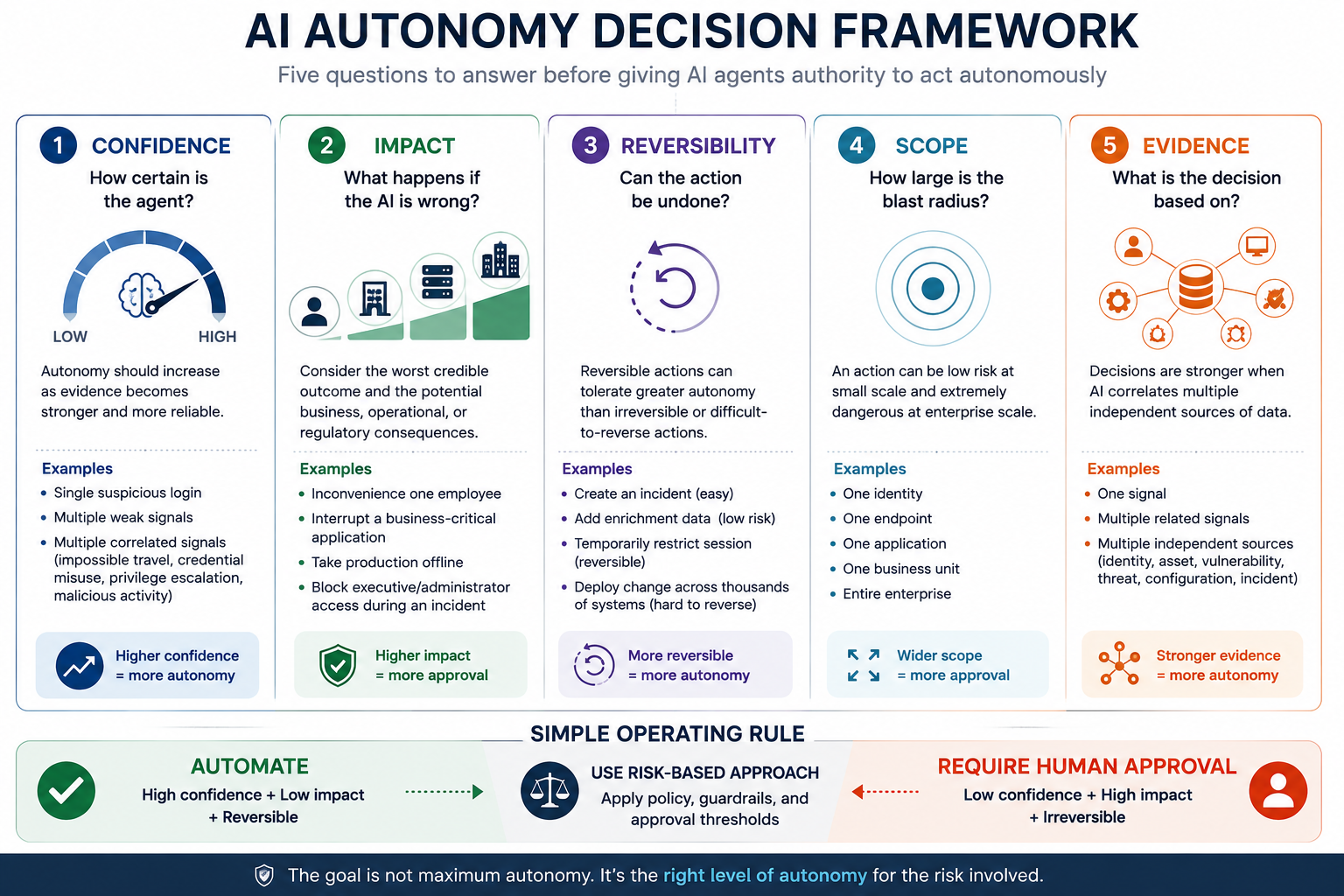
Everything between those extremes should follow a defined risk policy.
The Identity Question: What Permissions Should an AI Security Agent Have?
Autonomous security creates another challenge that enterprises cannot treat as an afterthought.
AI agents themselves become identities.
If an AI specialist can investigate incidents, retrieve sensitive data, revoke access, trigger remediation, or execute workflows, then that agent has operational power inside the enterprise.
That makes identity governance fundamental to autonomous security.
ServiceNow’s broader Autonomous Security & Risk strategy increasingly combines ServiceNow capabilities with technologies from Veza and Armis.
Veza brings permission visibility and governance across human and non-human identities, including AI agents. Armis contributes continuous asset intelligence across connected environments including IT, OT, IoT, code, and other infrastructure.
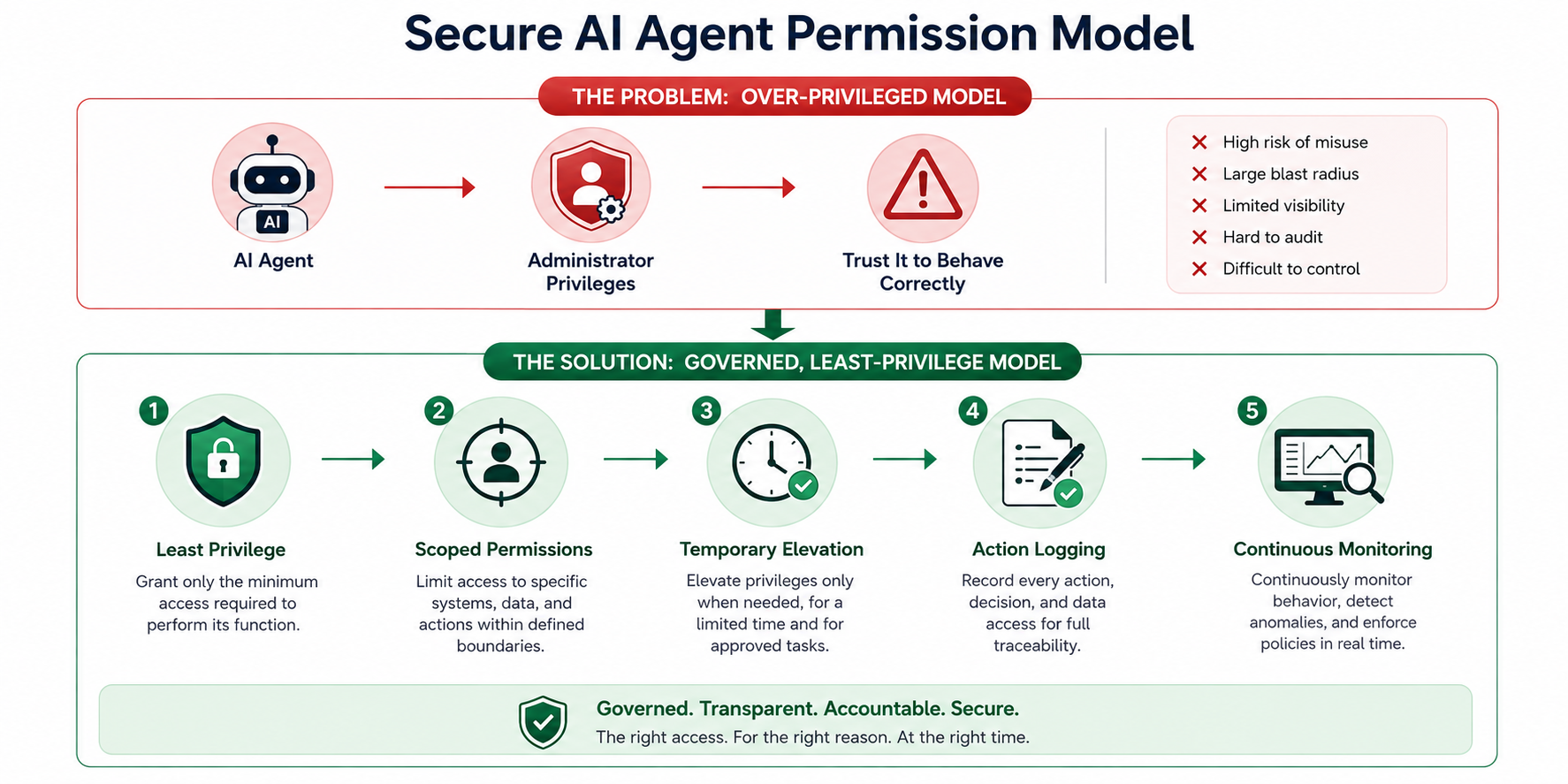
An AI security specialist should receive only the permissions required for the specific workflow it is executing.
If it needs read access to investigate an incident, give it read access.
If containment requires temporary elevated authority, that elevation should be controlled.
If it needs to revoke a permission, the action should be logged.
And if its behavior moves outside the expected policy, the enterprise needs the ability to stop it.
We explore this problem in more detail in our guide to Securing Enterprise AI Agents: Identity, Permissions, Guardrails, and Auditability.
The question is no longer only:
What can this AI agent do?
It is also:
What should this AI identity be allowed to do?
Who Watches the Security Agent?
This may ultimately become the most important governance question in autonomous security.
Imagine an AI security specialist automatically contains an incident at 3:07 a.m.
At 9:00 a.m., the CISO asks what happened.
Your platform should be able to answer:
Who or what initiated the action?
What evidence did the agent use?
Which identities, assets, records, and systems did it access?
What decision did it make?
Which actions did it execute?
Which policy authorized those actions?
Was human approval required?
Could the action be reversed?
When did the agent escalate?
If the organization cannot reconstruct that chain, it does not have governed autonomy.
It has automated opacity.
This is why AI governance needs to exist at runtime — not only in architecture documents.
ServiceNow’s AI Control Tower is increasingly positioned as a governance layer for enterprise AI, providing visibility, policy enforcement, monitoring, and control across AI agents.
Teiva has explored this architecture in ServiceNow Action Fabric: Governed AI Agent Execution Explained, where the important architectural idea is that agent actions should execute through governed workflows rather than unrestricted system access.
We also cover the broader operating model in The Enterprise AI Governance Blueprint for ServiceNow.
For security teams, this becomes especially important.
A customer-service agent making the wrong recommendation can create a bad customer experience.
A security agent making the wrong privileged action can change the operating environment itself.
Auditability therefore cannot be optional.
Three Stages for Implementing Autonomous Security Safely
ServiceNow customers do not need to jump directly from manual security operations to fully autonomous response.
A more practical rollout has three stages.
Stage 1 — AI Observes
AI investigates → enriches → correlates → recommends
Human decides → human executes
Start by letting AI build context.
Allow specialists to collect evidence, correlate signals, investigate historical incidents, prioritize vulnerabilities, and recommend actions.
This stage lets teams measure AI quality without immediately exposing critical systems to autonomous execution.
The key metric is not only speed.
Measure how often analysts accept, modify, or reject the AI’s recommendations.
That tells you where greater autonomy may be justified.
Stage 2 — AI Acts Within Guardrails
AI investigates → decides → executes predefined low-risk actions
Human approves high-risk actions
Once confidence is established, expand autonomy to clearly defined, reversible actions.
For example:
AI can create remediation tasks automatically.
AI can route incidents.
AI can enrich cases.
AI can execute approved low-risk remediation.
But disabling privileged identities, isolating critical infrastructure, or executing high-impact changes still triggers an approval workflow.
At this stage, governance becomes as important as the AI itself.
Organizations should define:
- Permission scopes
- Confidence thresholds
- Approval rules
- Escalation paths
- Maximum action scope
- Logging requirements
- Rollback procedures
- Kill-switch ownership
ServiceNow customers scaling AI agents should also consider the wider governance model described in our AI Control Tower Implementation Guide.
Stage 3 — Risk-Based Autonomy
The final stage is not:
AI does everything.
It is:
AI acts autonomously when predefined risk conditions are satisfied.
The workflow becomes:
Detect → Investigate → Assess risk → Decide → Act → Verify → Document
Humans focus on exceptions, ambiguous evidence, high-impact actions, novel threats, and decisions requiring business judgment.
This is where autonomous security becomes genuinely powerful.
The SOC does not disappear.
Its operating model changes.
Analysts spend less time gathering context, moving tickets, deduplicating alerts, and executing repetitive remediation.
They spend more time on the cases where judgment actually matters.
Don’t Start With the Agent. Start With the Autonomy Model.
The temptation with every new AI capability is to start with the technology.
Which AI Specialist should we activate?
Which workflows can it execute?
Which security tools can we connect?
Those are important questions.
But they should come later.
Start with:
Which decisions are we willing to delegate?
Then define:
What evidence is required?
What level of confidence is acceptable?
What permissions does the agent need?
What is the maximum acceptable blast radius?
Which actions require approval?
How do we reverse an incorrect action?
How do we audit every decision afterward?
Only then should you configure the agent.
ServiceNow’s move toward autonomous security makes faster security operations possible. Its emerging AI Specialists can investigate, correlate, prioritize, remediate, and increasingly execute parts of the security-response lifecycle.
But autonomy should not become the objective itself.
The objective is faster security response without losing control.
For most enterprises, that means automating aggressively where actions are repetitive, evidence is strong, impact is limited, and mistakes are reversible.
As risk increases, human oversight should increase with it.
The most mature autonomous security architecture will therefore not be the one with the fewest humans.
It will be the one that knows exactly when humans are needed.
Automate the work. Govern the authority.
That is the foundation ServiceNow customers should build before autonomous security moves from an interesting capability to an operational reality.
Ready to Define Your ServiceNow Autonomy Model?
Autonomous security is not simply another feature to switch on.
Before deploying autonomous security workflows, organizations need to define permissions, approval boundaries, risk thresholds, escalation paths, auditability, and rollback controls around the agents that will execute them.
Teiva Systems can help you assess your ServiceNow environment, identify the right security workflows for automation, and design a governed autonomy model before AI agents receive operational authority.
Explore more ServiceNow AI insights from Teiva Systems
Slava Trotsenko, CEO, Aug 31, 2026
Eager to take the next step? Contact us today!
Latest Articles
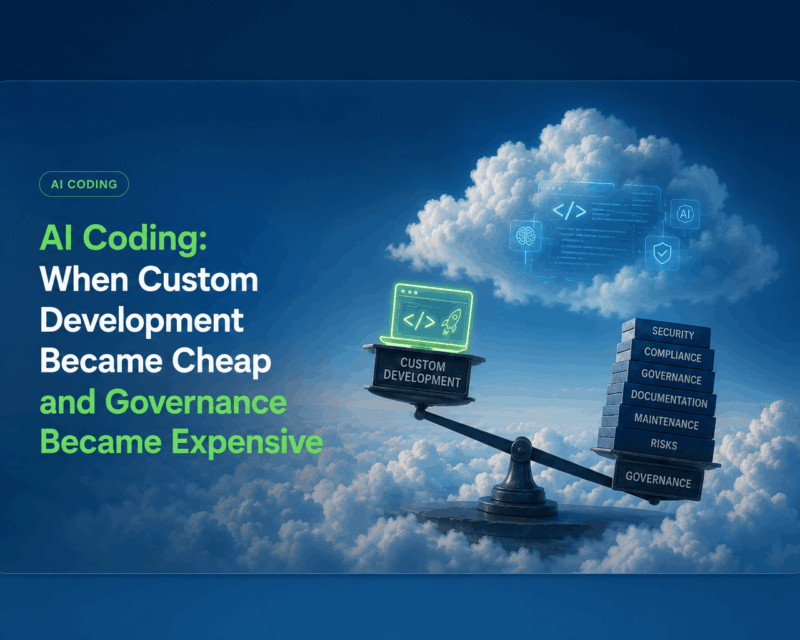
AI Coding: When Custom Development Became Cheap and Governance Became Expensive
We at Teiva Systems also see this when assessing typical enterprise platforms, like service desk, HR workflows, and similar. A task force produces a serious capability map, hands it upward, and the whole map comes back resolved into one decision. License a platform, or build it internally. Forty or fifty distinct capabilities, one answer.
read more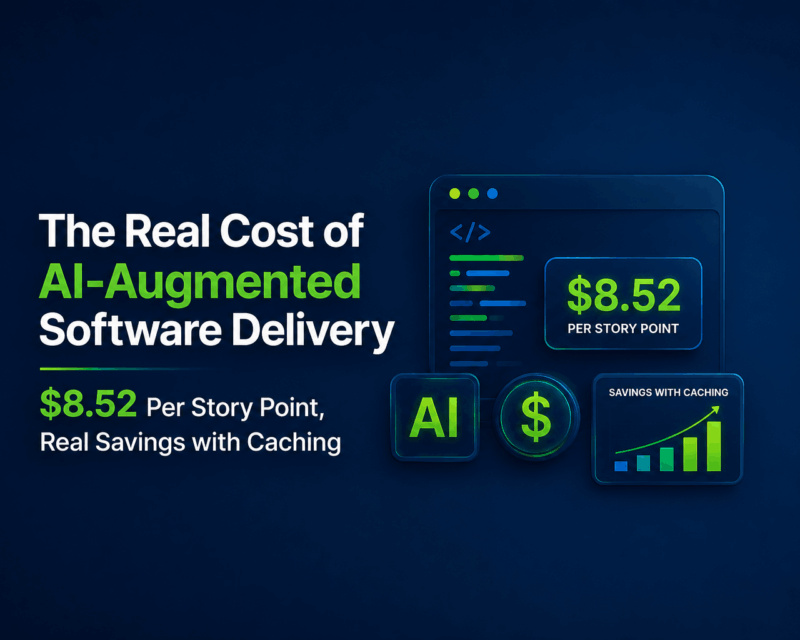
The Real Cost of AI-Augmented Software Delivery: $8.52 Per Story Point, Real Savings with Caching
We delivered multiple apps and solutions with our AI-augmented delivery factory. Here are our measured costs across multiple engagements, at public list prices. Cost per agent, sprint, and story point.
read more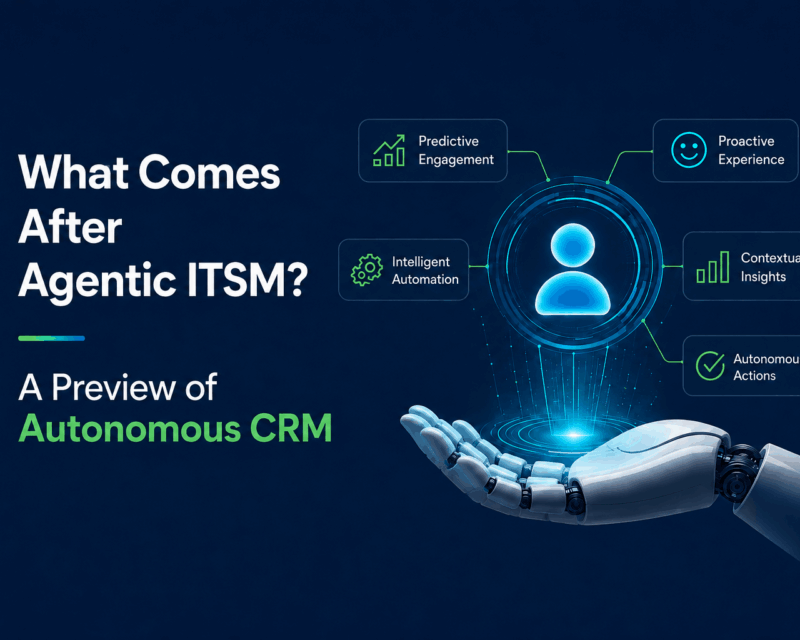
What Comes After Agentic ITSM? A Preview of Autonomous CRM
How ServiceNow's next AI evolution could transform customer operations — and why organizations should prepare before Autonomous CRM arrives. Over the past year, enterprise AI conversations have revolved around Agentic ITSM.
read more