
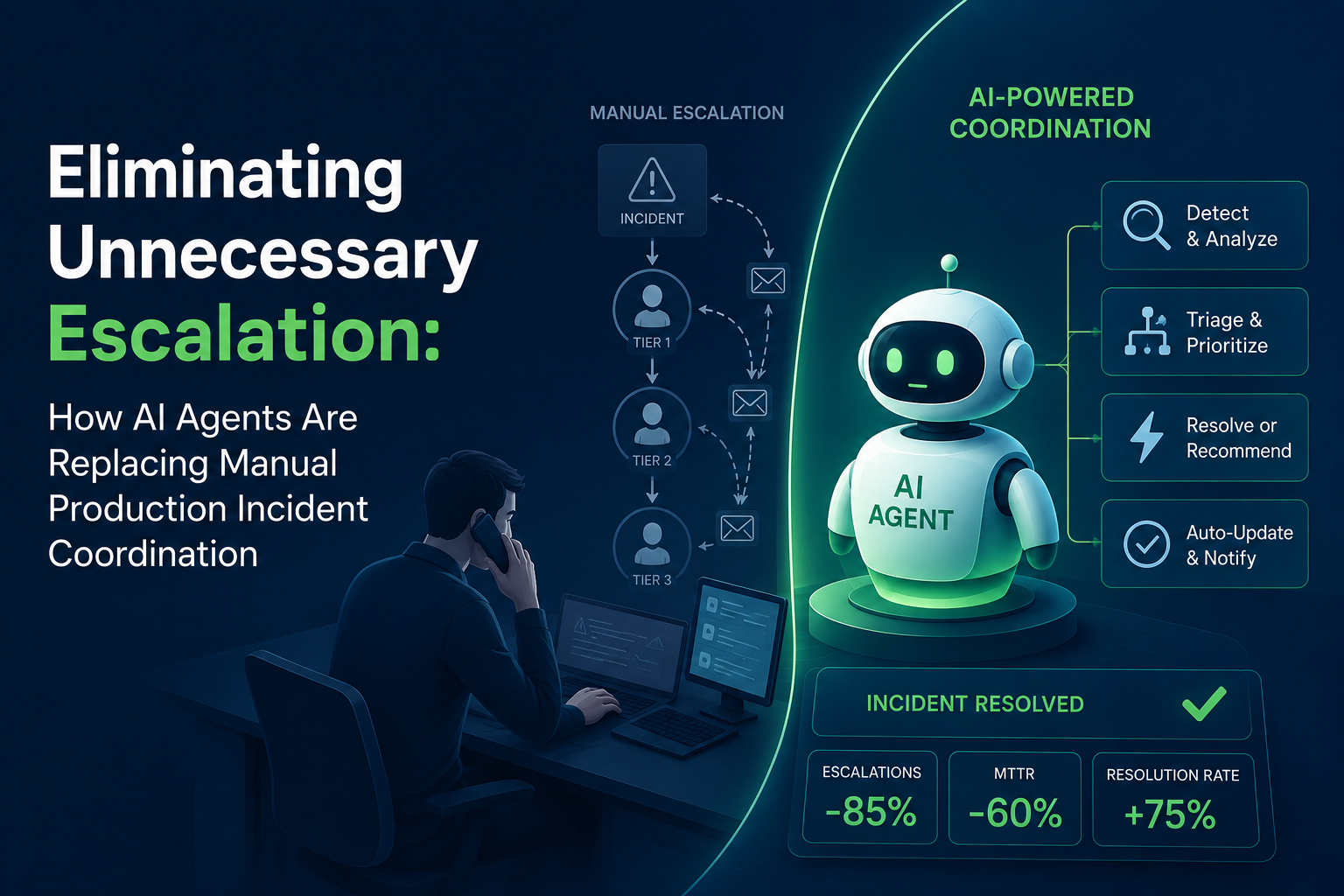
Eliminating Unnecessary Escalation: How AI Agents Are Replacing Manual Production Incident Coordination
The future of incident management is not faster escalation. It is eliminating unnecessary escalation altogether. Here is how ServiceNow AI agents detect, classify, route, and resolve production incidents — before a human ever has to ask “who owns this?”
Ask any incident manager what actually slows down a production outage, and the answer is rarely the technical fix.
It is figuring out who owns the problem. A single incident in a modern cloud-native environment can touch a dozen microservices, three infrastructure layers, and two customer-facing channels at once. By the time the right resolver group is identified, paged, and briefed, the technical root cause is often already half-solved — by someone who was never supposed to be the first responder.
That coordination tax is the real cost of manual escalation. Not the outage. The delay in getting the right people, with the right context, looking at the right problem.
“The most expensive production incident is often not the outage itself. It is the delay in response.”

Why Manual Escalation Breaks Down at Scale
The traditional escalation model was built for a simpler world: a monitoring tool fires an alert, an engineer reviews it, an incident manager identifies the right resolver group, and someone coordinates the response by phone, chat, or email. That model worked when applications were monolithic and infrastructure was predictable.
It does not work at modern scale. A mid-size enterprise can generate thousands of monitoring alerts daily. A single incident frequently spans multiple applications, business services, and infrastructure components simultaneously. Determining ownership often takes longer than identifying the technical root cause — because ownership is a people problem, and people problems do not scale the way infrastructure does.
The operational symptoms are familiar to every IT leader: different teams follow different escalation procedures. Critical knowledge sits trapped in individual engineers’ heads rather than in a shared system. The quality of the response depends heavily on who happens to be on call that night. And the time lost to figuring out “who should respond” is time the incident keeps running.
“The most expensive production incident is often not the outage itself—it is the delay in response.”
How AI Agents Actually Transform Escalation — Step by Step
AI agents change the escalation model fundamentally: instead of waiting for a human to notice, interpret, and route an alert, the agent does all three continuously and automatically. In a ServiceNow environment, this runs on Predictive AIOps and the Event Management workspace — correlating signals across monitoring tools, infrastructure, and CMDB relationships in real time.
Here is exactly what happens, end to end, when application performance degrades:
| # | Step | What the agent does | Outcome |
| 1 | Detect | Predictive AIOps correlates signals across monitoring platforms, infrastructure, and business services in real time | Anomaly detected |
| 2 | Classify | Agent determines business impact using CMDB service relationships — not just technical symptoms | Severity assigned |
| 3 | Route | Resolver group assigned automatically based on service ownership data — no guessing, no phone calls | Owner identified |
| 4 | Notify | All affected teams notified simultaneously through their preferred channel — Slack, Teams, SMS, email | Stakeholders alerted |
| 5 | Escalate | If unresolved within policy threshold, agent escalates automatically to the next tier — before breach, not after | SLA protected |
Every step in that sequence draws on historical incident data and knowledge articles to provide context-aware recommendations — not generic alerts. The agent does not just say “something is wrong.” It says which service is affected, who owns it, what changed recently, and what resolved similar incidents before. That context is what lets support teams focus on resolution instead of administration.
“AI agents do not just escalate faster. They escalate correctly — the first time.”
Manual vs. AI-Driven Escalation: A Direct Comparison
The difference is not incremental. It is structural — across every dimension that matters during a production incident:
| Dimension | Manual escalation | AI-driven escalation (ServiceNow) |
| Who determines ownership | On-call engineer guesses, calls around | AI agent maps incident to service owner via CMDB instantly |
| Time to first response | Minutes to hours depending on time of day | Seconds — agent triggers regardless of staffing |
| Process consistency | Varies by who is on call, what they know | Identical governed workflow every time |
| Cross-team coordination | Phone calls, Slack threads, email chains | Automatic notification to all affected resolver groups |
| Root cause context | Manually pieced together from multiple tools | Correlated automatically across monitoring + CMDB |
| Audit trail | Scattered across chat logs and memory | Full record: who, what, when, why — in ServiceNow |
| SLA breach prevention | Reactive — noticed after the fact | Proactive — escalates before SLA threshold is hit |
The Business Case for AI-Driven Escalation
Organisations do not adopt AI agents for incident management because the technology is novel. They adopt it because three measurable outcomes are difficult to achieve through manual coordination alone.
Speed
Automated detection and routing collapse response time from minutes or hours down to seconds. Körber Supply Chain reduced MTTR from 24 days to 14 days using ServiceNow’s AI-powered operations — a result driven primarily by eliminating the manual coordination delay, not by faster technical fixes.
Consistency
AI agents apply the same governed escalation policy to every incident, regardless of who is on call or what time zone they are in. This directly reduces variability and strengthens compliance posture — a material benefit for regulated industries where escalation procedures are subject to audit.
Visibility
Leaders gain real-time insight into incident status, ownership, service impact, and operational trends — in a single ServiceNow dashboard rather than reconstructed after the fact from chat logs and memory. This is the data that makes a credible MTTR improvement case to the board.
Where ServiceNow Fits: The Platform Behind the Agent
AI agents are only as good as the context they can access. In a ServiceNow environment, that context comes from a combination most other platforms cannot replicate natively: CMDB service relationships, full incident history, governed workflow automation, native monitoring integrations, and predictive intelligence — all in one connected system.
Operating within this environment, AI agents can classify incidents by business impact rather than technical severity alone, recommend solutions based on what resolved similar incidents previously, identify likely root causes by correlating change history with the CMDB, assign resolver groups automatically based on service ownership data, and escalate proactively — before an SLA is breached, not after.
This is the mechanism behind the shift from reactive support to genuinely autonomous operations: not a single feature, but the combination of governed data, governed workflow, and governed AI execution operating together.
What to Do Before You Automate Escalation
AI agents will struggle to deliver reliable outcomes without trusted underlying data — regardless of how advanced the model is. Before activating AI-driven escalation, four things need to be true:
The 4 prerequisites for reliable AI-driven escalation:
→ Map your current escalation workflows and identify the repetitive manual activities. You cannot automate what you have not documented — start with your three highest-volume incident types.
→ Establish clear governance and standardised escalation policies. Different teams following different procedures is the root cause of most coordination delay. Standardise before you automate.
→ Validate your CMDB and service data accuracy. AI agents that route based on incorrect service ownership data will misroute incidents confidently — making the coordination problem worse, not better.
→ Define your escalation SLA thresholds explicitly. The agent can only escalate proactively before a breach if the breach threshold is defined precisely, in ServiceNow, ahead of time.
AI agents are becoming a core component of enterprise operations — not a future possibility, but a capability already running in production at the organisations moving fastest on incident management maturity.
Companies investing in AI-driven incident management today will gain a competitive advantage by improving resilience, reducing operational costs, and delivering more reliable digital services.
The question is no longer whether AI agents will participate in escalation management. It is how quickly your organisation can adopt them — on a foundation clean enough for them to work reliably from day one.
Oleksii Konakhovych, CTO, Aug 07, 2026
Eager to take the next step? Contact us today!
Latest Articles
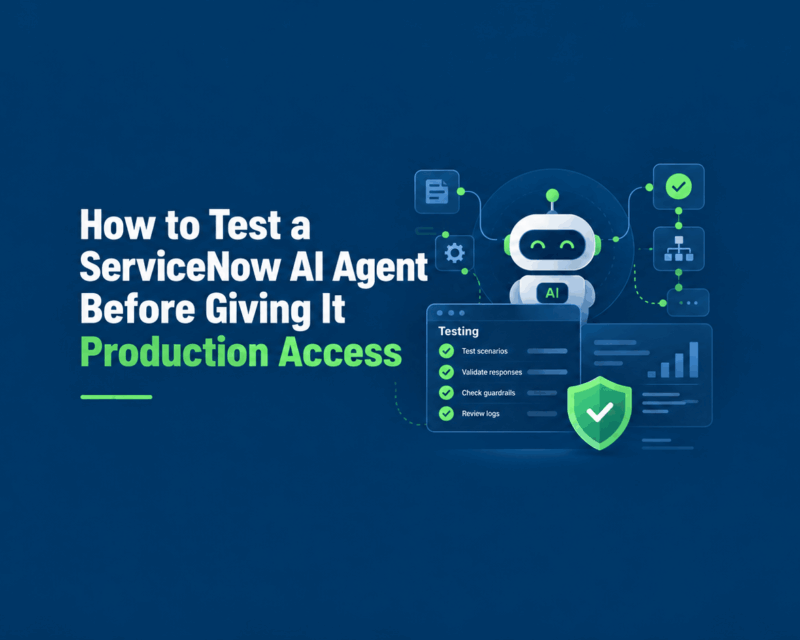
How to Test a ServiceNow AI Agent Before Giving It Production Access
A successful demonstration proves that an agent can perform a task under specific conditions. It doesn’t prove the agent will behave correctly when faced with incomplete data, conflicting instructions, restricted records, broken integrations, or unexpected user requests.
read more
ServiceNow AI Readiness Assessment: 25 Questions to Answer Before Deploying AI Agents
Your AI agent is only as reliable as the environment it operates in. This assessment covers 25 essential questions across five areas to help IT leaders, architects, and platform owners prepare for production.
read more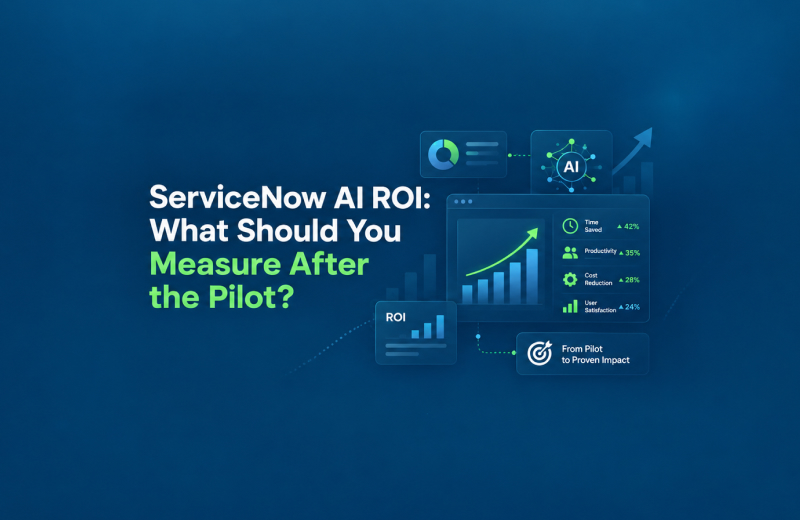
ServiceNow AI ROI: What Should You Measure After the Pilot?
ServiceNow AI ROI: What Should You Measure After the Pilot? Your AI pilot worked. That proves the technology can work. It does not yet prove ROI. Here are the six metrics that separate “the demo impressed leadership” from “we can prove measurable business value.” Your ServiceNow AI pilot worked. Now what? The chatbot responded correctly. […]
read more