
How to Build a Business Case for ServiceNow AI in 2026: The CFO-Ready Framework
Most AI business cases don’t stall because the technology is weak. They stall because they’re written in the language of possibility – not the language of finance. Here’s the CFO-ready framework for 2026.

Three months ago, someone in your organization likely built a polished, 40+ slide deck on ServiceNow AI. It covered Now Assist, agentic workflows, automation layers, and future-state architecture. It was technically sound, even impressive. Then finance asked a simple question:
“What happens to our P&L?”
Silence. That moment is where most AI investments stall – not because the value isn’t real, but because it hasn’t been translated into something a CFO can defend. In 2026, that gap is getting wider. AI is no longer a “strategic experiment.” It’s expected to perform like any other capital investment. If it can’t show measurable return within 12 months, it’s cut.
CFOs have seen enough inflated ROI models
Finance teams don’t trust AI business cases – they’ve seen too many projections built on optimistic assumptions and vague productivity gains. If your proposal starts with benefits instead of baseline reality, it’s already in trouble.
A CFO-ready business case starts with one thing: what does it cost today to run your operation? Not estimates. Not benchmarks. Your actual numbers.

Without this “Day 0 baseline,” every projected benefit becomes subjective. With it, your business case is anchored in fact – and that ~51% annual ROI becomes credible rather than theoretical.
The TCO trap: where most models collapse
Most teams include the license. Maybe implementation. Then stop there. Finance doesn’t. A realistic ServiceNow AI TCO is typically 3–5× the annual license fee once fully accounted for. For a mid-sized ITSM deployment of around 60 fulfillers, expect Year 1 costs of $800K–$1.5M and steady-state annual costs of $500K–$1.2M.
If your model doesn’t include upgrade cycles, training, change management, and integration maintenance – finance will. And your ROI will collapse in the room.
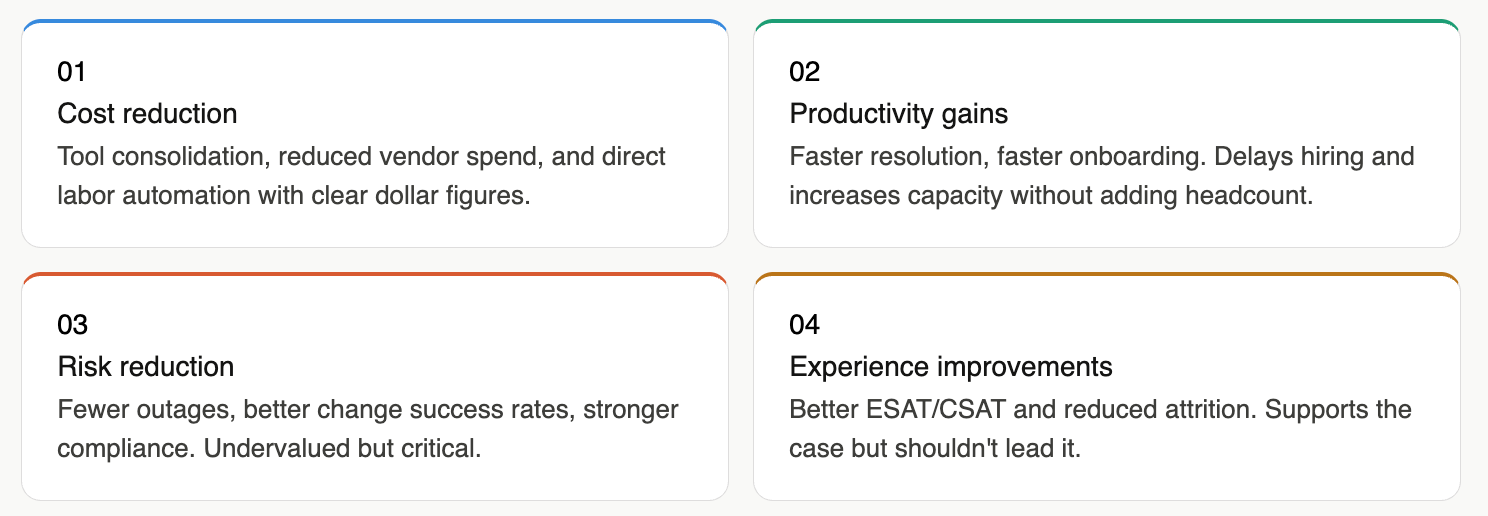
The four pillars of value – not just “tickets saved”
Most AI business cases rely on a single metric: ticket reduction. That’s not enough. A CFO-ready model distributes value across four pillars.
The shift that changes everything: monthly proof over annual promises
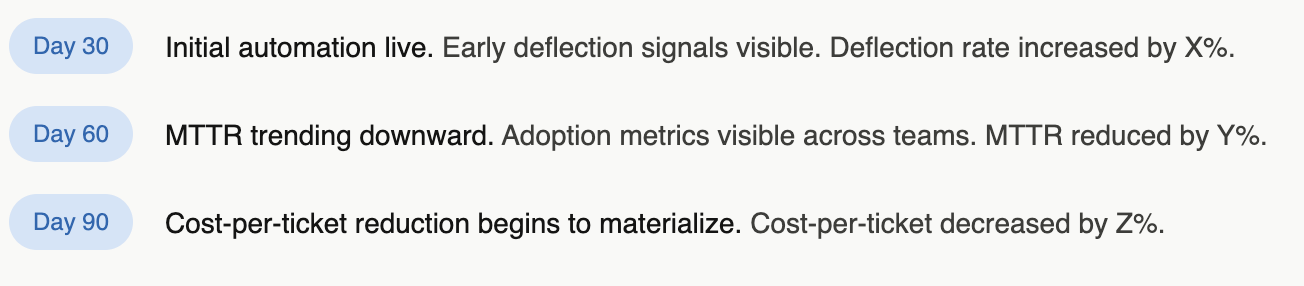
CFOs no longer approve investments based on year-end projections. They approve based on how quickly value can be proven and tracked. A strong business case includes measurable realization gates with clear pass/fail criteria – not “we’ll evaluate later.”
What a CFO-ready business case actually looks like
By the time your proposal reaches finance, it should clearly answer five questions:
- What does it cost us today? – Your actual baseline, not a benchmark from a vendor white paper.
- What will it truly cost to implement and run? – Full TCO including the costs most proposals quietly omit.
- Where exactly does the value come from? – Distributed across all four pillars, not just automation metrics.
- How quickly will we see results? – 30/60/90-day gates with specific, measurable targets.
- How will we track and prove it? – An ongoing measurement model, not a one-time slide deck.
If any of these are missing, your proposal is a concept – not an investment case.
The most important feature of any AI platform isn’t intelligence. It’s credibility.
The organizations winning in 2026 aren’t the ones with the most advanced AI. They’re the ones who can prove, month by month, how those capabilities impact cost, efficiency, and risk.
Slava Trotsenko, CEO, Apr 27, 2026
Eager to take the next step? Contact us today!
Latest Articles
ServiceNow AI ROI: What Should You Measure After the Pilot?
Your AI pilot worked. That proves the technology can work. It does not yet prove ROI. Here are the six metrics that separate “the demo impressed leadership” from “we can prove measurable business value.”
read more
The First Five ServiceNow AI Agents an MSP Should Offer Its Customers
Managed service providers can now package ServiceNow AI agents as repeatable, recurring services — moving from ticket-response capacity to managed outcome delivery. Here is what the first five offerings look like, how each creates value, and what to get right before deploying them.
read more
How to Test a ServiceNow AI Agent Before Giving It Production Access
A successful demonstration proves that an agent can perform a task under specific conditions. It doesn’t prove the agent will behave correctly when faced with incomplete data, conflicting instructions, restricted records, broken integrations, or unexpected user requests.
read more