
Which ServiceNow AI Agent Should You Deploy First?
A Practical Guide for Enterprise Leaders in 2026
“The first AI agent you deploy matters less than the first business outcome it delivers.”
Every executive asks the same question after seeing ServiceNow’s latest AI innovations:
“Which AI Agent should we deploy first?”
It is a reasonable question — but it is also the wrong one.
The most successful organisations do not start by choosing technology. They start by identifying high-friction workflows, measurable business outcomes, and the operational data required for AI to succeed.
That is exactly why ServiceNow has shifted from delivering isolated AI capabilities to building an entire AI Platform powered by AI Agents, AI Agent Fabric, Action Fabric, Context Engine, Workflow Data Fabric, and AI Control Tower. Together, these capabilities enable AI agents to reason, collaborate, and execute governed enterprise workflows rather than simply answering questions.
The real challenge is no longer whether you should adopt AI. It is deciding where AI creates value first — and in what order.
The AI Deployment Trap
Many organisations rush to deploy the newest AI capability. Excitement rarely translates into business value.
In the assessments we run at Teiva, the pattern is consistent: organisations that move fast without a prioritisation framework either pick low-volume use cases that produce no measurable ROI in 90 days, or pick high-visibility use cases on poor data foundations that produce confident wrong outputs. Both outcomes damage leadership trust in AI faster than a thoughtful deployment would have built it.
Common mistakes that stall AI agent programmes before they scale:
- Building custom agents before fixing poor data quality — AI inherits every CMDB gap and stale knowledge article
- Automating low-volume or low-value tasks — the ROI is invisible at board level
- Deploying multiple disconnected AI assistants with no shared governance layer
- Ignoring governance and security until after go-live
- Measuring AI usage (requests handled) instead of business outcomes (cost per ticket, MTTR, deflection rate)
“AI doesn’t fail because models are weak. AI fails because organisations automate the wrong work.”
Start With Business Value, Not Technology
The best first AI agent solves three problems simultaneously. If a workflow satisfies all three conditions, AI usually delivers measurable value within the first 90 days of production deployment:
The three conditions that determine your best first AI agent:
✔ High volume The workflow processes enough transactions that even a 30% automation rate produces a measurable result within 90 days. Password resets handle thousands per month. Strategy approvals handle tens.
✔ Repetitive decisions The decisions the workflow requires follow clear patterns with defined inputs and outputs. If the answer to “what information does someone need to resolve this?” is the same 80% of the time, AI will handle it well.
✔ Measurable outcomes You can define success before deployment: cost per ticket, MTTR, deflection rate, cycle time. Without a pre-agreed baseline, there is no proof of value to show the board.
Workflows that score strongly on all three conditions consistently produce the fastest ROI and the strongest evidence base for executive approval to scale. Workflows that score weakly on even one — particularly measurable outcomes — are where AI programmes stall.
Enterprise AI Readiness Matrix
The organisations seeing the fastest ROI generally prioritise AI deployments using business impact rather than technical complexity. Here is the full prioritisation matrix across the eight most common ServiceNow AI agent use cases, with typical payback periods and ROI ranges from industry benchmarks and client deployments:
| Use case / AI Agent | Volume | Typical payback | Typical ROI | Recommended wave |
| IT Service Desk (L1) | Very High | 3–6 mo | 100–180% | Wave 1 — Start here |
| Employee Center / HR Self-Service | High | 4–8 mo | 80–150% | Wave 1 — Start here |
| Customer Service Management | High | 6–10 mo | 70–130% | Wave 2 |
| IT Operations / AIOps | Medium | 6–12 mo | 90–160% | Wave 2 |
| Security Operations | Medium | 9–15 mo | 50–100% | Wave 3 |
| HR Case Management | Medium | 6–10 mo | 70–130% | Wave 2 |
| Finance / Procurement | Medium | 8–14 mo | 60–110% | Wave 3 |
| Autonomous CRM (Sales/CPQ) | Varies | 10–18 mo | 50–90% | Wave 3 |
We use this matrix as a starting point, not a prescription. The right first use case depends on your specific data readiness, CMDB quality, and which workflows currently create the most pain for employees or customers. An organisation with a clean CMDB and poor knowledge base should start with ITSM over Employee Center. An organisation with strong HR data and weak ITSM infrastructure may find the reverse is true. The matrix sets the sequence; the readiness assessment confirms it.
AI Agent #1: IT Service Management
For most enterprises, ITSM remains the strongest starting point.
Because every organisation already manages incidents, requests, knowledge articles, change requests, configuration items, and SLAs — the data already exists. The workflows already exist. AI simply accelerates execution.
In production deployments, ServiceNow’s L1 AI Specialist handles password resets, software access requests, basic hardware issues, and common employee queries autonomously. ServiceNow reports that its own internal deployment now resolves over 80% of IT service requests with AI involvement, achieving 99% faster case resolution. CVS Health reduced live agent chat volume by 50% following Now Assist deployment.
The reason ITSM consistently delivers the fastest ROI is structural: it is the highest-volume, most-structured, most-measured workflow in most enterprises. Every improvement in deflection rate or MTTR produces a number you can put in a board presentation on day 30.
Typical ITSM AI agent outcomes in production:
- L1 ticket deflection rate: 25–40% of volume automated within 90 days
- MTTR reduction: 30–50% faster for incidents handled by AI Specialist
- Cost per ticket: from ~$25 (manual L1) toward $15 or below
- Fewer manual reassignments: AI routing accuracy improves with each CMDB quality sprint
- ESAT improvement: employees get answers faster without waiting for a human to be available
AI Agent #2: Employee Service Delivery
After IT, employee service delivery usually offers the quickest return.
Employee questions rarely require deep reasoning. Instead, they involve onboarding, policy guidance, leave requests, payroll questions, document retrieval, and equipment requests. These interactions are high-volume, pattern-driven, and resolved with information that already exists in ServiceNow or connected HR systems.
AI agents can resolve a significant portion of these interactions automatically while routing complex requests to HR specialists. As a result, HR teams spend less time answering repetitive questions and more time supporting employees through situations that require genuine human judgment.
The Moveworks acquisition — now deployed as ServiceNow EmployeeWorks — is specifically designed for this use case. The technology processed millions of employee service requests monthly before the acquisition. Now it is available to ServiceNow’s entire customer base as part of the Australia release.
The prerequisite most organisations miss before deploying Employee Service agents:
Knowledge article quality. If your HR policy articles are outdated, incomplete, or inconsistently structured, the agent will surface that confidently and visibly. Before activating any employee service agent, run a knowledge audit against your top 30 most-asked HR questions. Update, consolidate, or retire articles until the answers are accurate and structured for AI readability. This step takes two to three weeks and has an outsized impact on first-30-day agent quality.
AI Agent #3: Customer Service
“The goal isn’t replacing employees. The goal is removing unnecessary work from every employee.”
Customer service introduces more complexity — but also enormous opportunity.
Modern ServiceNow AI Agents in the customer service space can summarise cases, recommend resolutions, retrieve relevant knowledge, coordinate multiple systems, assist human agents, and automate follow-up actions. Meanwhile, customers receive faster responses without sacrificing quality.
Customer service typically lands in Wave 2 rather than Wave 1 because it requires higher data maturity across CMDB service relationships, case history, and product/service catalogues. Organisations that have successfully deployed ITSM and Employee Service agents first carry the data readiness and governance frameworks that make Customer Service deployment significantly smoother.
Autonomous CRM — launched at Knowledge 2026 — extends this into the full customer lifecycle: lead qualification, configure-price-quote, order fulfilment, invoice disputes, and renewals. This is Wave 3 territory for most organisations, but the architecture should be planned from Wave 1.
Where AI Agent Fabric Changes Everything
One of the biggest announcements at Knowledge 2026 was not another AI agent. It was AI Agent Fabric together with Action Fabric.
Instead of creating isolated assistants, ServiceNow now allows AI agents to collaborate across platforms using open standards such as Model Context Protocol (MCP) and Agent2Agent (A2A) communication. AI agents — whether built on ServiceNow or third-party platforms — can securely invoke governed enterprise workflows through the ServiceNow platform.
Think of AI Agent Fabric as the communication layer. Think of Action Fabric as the execution layer. Together they allow AI to move from answering questions to completing real work.
In practical terms: a Wave 3 organisation running a mature ITSM AI Specialist and an HR AI Specialist can use AI Agent Fabric to coordinate between them — so when an incident involves a contractor whose access needs to be revoked, the IT agent and the HR agent can collaborate on the resolution without a human having to bridge the two workflows manually.
This is why Wave 1 governance decisions matter for Wave 3 capability. The agents you deploy today become the nodes in the network you build later. Getting identity, permissions, and governance right from the first deployment makes every subsequent deployment faster.
Enterprise AI Maturity Journey
Organisations rarely deploy dozens of AI agents immediately. Instead, maturity grows over time. Here is the five-stage model we use to help clients understand where they are and what to prioritise next:
| Stage | Active AI | What this looks like | Next step |
| 1Pilots | Ad-hoc copilots, Now Assist summarisation | Isolated AI tools, no shared data model, no governance framework. Value limited to individual productivity gains. | Inventory AI assets. Establish AI Control Tower baseline. Define first governed use case. |
| 2Assistants | Now Assist + basic workflow integration | AI assists humans in specific workflows. Some governance in place. Data quality being remediated. | Activate first AI Specialist (ITSM L1). Define deployment metrics before go-live. |
| 3Specialists | L1 AI Specialist, Employee Center, AIOps | AI Specialists handling specific function areas autonomously. AI Control Tower governing all agents. ROI being measured. | Scale to Wave 2 use cases. Activate AI Agent Fabric for cross-specialist coordination. |
| 4Orchestrated | Multi-specialist coordination via AI Agent Fabric | Agents collaborate across ITSM, HR, Security, Finance. Context Engine providing unified operational picture. Action Fabric enabling governed execution. | Measure compound ROI. Extend to Autonomous CRM and cross-platform agents. |
| 5Autonomous | Full Autonomous Workforce across business functions | AI Specialists run entire business function workflows end-to-end. Human oversight focused on exceptions, governance, and continuous improvement. | Continuous optimisation. AI ROI dashboard live. Governance as operating model. |
The CIO Checklist Before Deploying Any AI Agent
Before building another AI solution, ask five questions. If the answer to any is no, pause before scaling.
Five questions to answer before any AI agent goes live:
→ Does the workflow generate measurable business value? If you cannot state the success metric before deployment, you cannot prove ROI after it.
→ Is the underlying data trustworthy? CMDB accuracy, knowledge article quality, and service ownership completeness determine AI output quality.
→ Does the AI have clear ownership? One named individual who approves changes, monitors performance, and can pause the agent if needed.
→ Can every decision be audited? AI Control Tower must be active and logging before the first agent action in production.
→ Does governance exist before autonomy? Approval workflows, permission scoping, and kill switch policy must be documented before the agent goes live.
“The organisations that lead the AI era won’t deploy the most AI agents. They’ll deploy the right AI agents, on the right platform, with the right governance.”
Choosing your first ServiceNow AI Agent is not about chasing industry trends or simply adopting the newest release.
Instead, organisations should select a workflow where AI can deliver measurable outcomes within weeks rather than years.
For most enterprises, the journey starts with IT Service Management. From there, organisations can expand into Employee Service Delivery and Customer Service. Ultimately, these capabilities create a connected AI ecosystem in which AI Agent Fabric, Action Fabric, and centralised governance work together to orchestrate enterprise workflows.
Moreover, enterprise AI in 2026 goes far beyond individual copilots. Today, organisations orchestrate intelligent agents that understand context, collaborate securely, and execute business processes from end to end.
The question is no longer “Which AI agent should we deploy?”
The better question is: “Which business outcome should our first AI agent transform?”
Kostya Bazanov, Managing Director, Jul 13, 2026
Eager to take the next step? Contact us today!
Latest Articles
Teiva Systems at ServiceNow World Forum 2026 — London
On October 20, 2026, Teiva Systems attended ServiceNow World Forum London at ExCeL London, where industry leaders, technology experts, and the ServiceNow community came together to explore how AI, intelligent automation, and digital workflows are transforming enterprise operations.
read more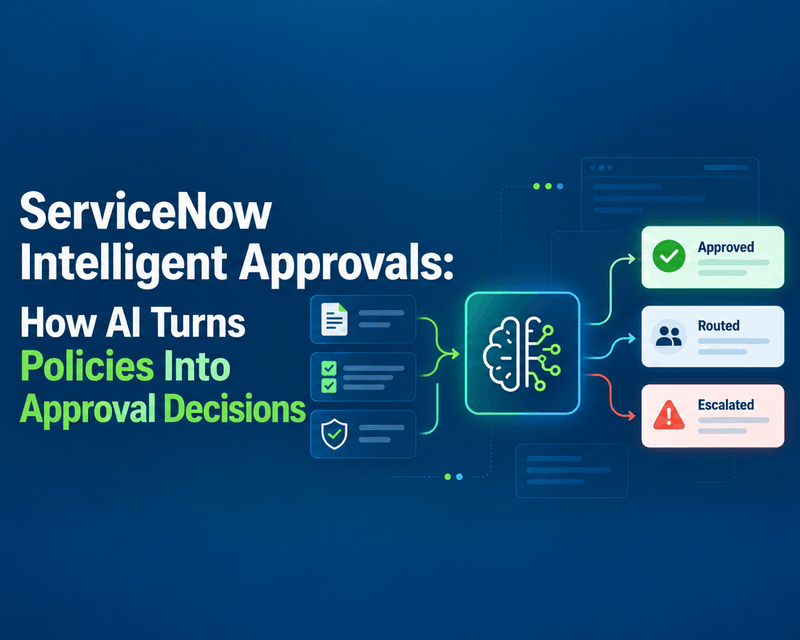
ServiceNow Intelligent Approvals: How AI Turns Policies Into Approval Decisions
What if your approval policies could make decisions, instead of sitting in documents waiting for someone to interpret them? For years, approval automation has followed the same pattern. Business teams write policies. Developers translate them into workflow conditions. Employees wait for someone to approve or reject their request, even when the outcome is obvious.
read more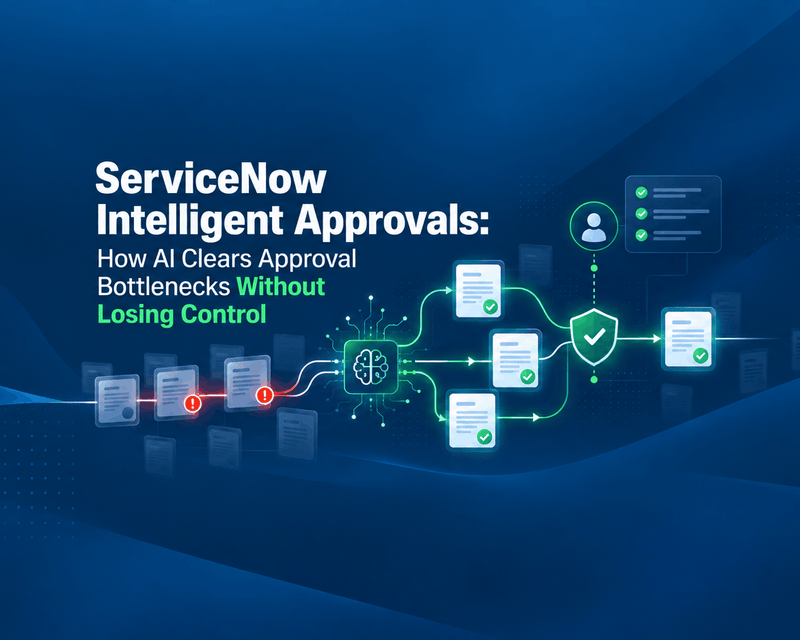
ServiceNow Intelligent Approvals: How AI Clears Approval Bottlenecks Without Losing Control
Your automation is fast. Your approvals are not. Organizations invest heavily in automation, AI and digital transformation. Yet many business processes still stall at the same point: waiting for someone to click “Approve.”
read more