
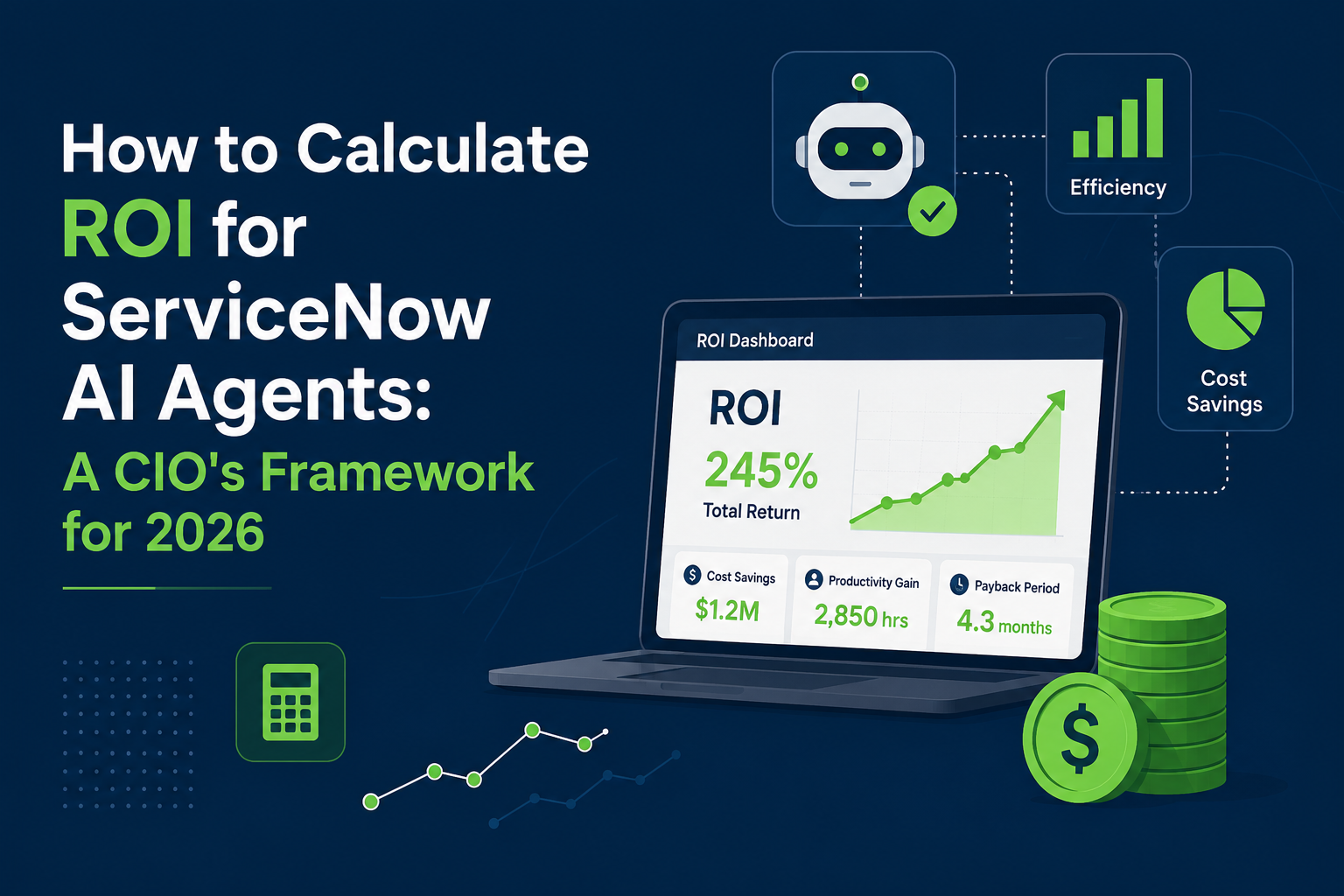
How to Calculate ROI for ServiceNow AI Agents: A CIO’s Operational Framework for 2026
Your CFO wants to know what it costs and when it pays back. Your job as CIO is different: which agent to deploy first, how to sequence the rollout, and which technical metrics prove the value before the next budget review. This is that framework.
Every CIO we talk to is facing the same boardroom dynamic.
Two years of AI pilots produced impressive demos and genuine technical wins — but boards are no longer satisfied with proof of concept. The question has shifted from “can AI do this?” to “what did it return, and how fast?” That shift is not a financial detail. It is the difference between an AI programme that survives its next budget review and one that gets quietly shelved.
ServiceNow AI Agents are in a stronger position than most enterprise AI investments to answer that question, because they operate directly inside enterprise workflows — not as standalone tools sitting beside them. They automate requests, resolve incidents, generate knowledge, and orchestrate actions across systems that already produce measurable operational data. That means agent ROI is not an estimate. It is something you can instrument and track from day one.
This framework focuses on the CIO’s side of that conversation: which use case to deploy first, how to sequence the rollout across the organisation, and which technical KPIs build the evidence base your CFO will need. If you are building the financial business case itself — the TCO model, the board-ready ROI narrative — that is covered in our companion post, the CFO-Ready Framework.
“The biggest obstacle to AI adoption in 2026 is no longer technology. It is proving business value.”
Why AI Agent ROI Became the Board’s #1 Question
Over the past two years, most organisations invested heavily in AI pilots. Many delivered promising technical results that never translated into a board-credible business case. Boards are now asking sharper questions: how much value will this create, how quickly will it pay for itself, and what risk does it reduce?
ServiceNow AI Agents are uniquely positioned to answer those questions because they are not isolated AI tools sitting beside enterprise workflows — they operate inside them. That means agent activity can be tied directly to operational metrics your organisation already tracks: ticket volume, resolution time, approval cycle time, cost per transaction. The data foundation for ROI already exists. The job is connecting it.
The Four Layers of AI Agent ROI
Most ROI conversations stop at direct cost savings. That is the easiest layer to measure — and the smallest part of the picture. A complete agent ROI model captures value across four layers:
| Layer | What it captures | How to measure it | Visible in |
| Layer 1Direct Cost | Reduced manual effort, ticket handling cost, repetitive admin work | Cost per ticket, FTE hours reclaimed | 3–6 months |
| Layer 2Productivity | Less time waiting for approvals, searching, manually updating records | Cycle time, approval turnaround, MTTR | 3–9 months |
| Layer 3Risk Reduction | Standardised execution improves governance, compliance, audit trail | Audit prep time, compliance incidents | 6–12 months |
| Layer 4Strategic Growth | Scale operations without proportional headcount increase | Volume handled per FTE, revenue per employee | 12+ months |
The ROI Formula — and Why You Need Two Scenarios, Not One
The core formula is straightforward:
ROI = (Annual Benefits − Total Costs) ÷ Total Costs × 100
A single optimistic example will not survive board scrutiny. The framework needs two scenarios — a realistic baseline case and a conservative downside case — so leadership sees the full range of outcomes, not a best-case number that looks like marketing.
Scenario A — Realistic baseline
| IT Service Desk + Employee Center, mid-market enterprise | |
| Investment (Year 1, fully loaded) | $300,000 |
| Automation savings | $420,000 |
| Productivity gains | $180,000 |
| Cost avoidance (risk reduction) | $120,000 |
| Total Value | $720,000 |
| ROI / Payback | 140% ROI · ~9 month payback |
Scenario B — Conservative downside
| Same scope, 50% adoption shortfall in Year 1 | |
| Investment (Year 1, fully loaded) | $300,000 |
| Automation savings (60% of target) | $252,000 |
| Productivity gains (50% of target) | $90,000 |
| Cost avoidance (50% of target) | $60,000 |
| Total Value | $402,000 |
| ROI / Payback | 34% ROI · ~16 month payback |
Why Agentic AI ROI Is Structurally Different from Automation ROI
Traditional automation ROI focuses on individual tasks: this step now takes less time. Agentic AI ROI is different because it focuses on outcomes: an agent can identify an issue, gather information, execute actions, communicate status, and document results — a full sequence that previously required multiple handoffs between people and systems.
“AI agents do not create value because they exist. They create value when they remove cost, increase productivity, or accelerate business outcomes.”
The most consistent finding from organisations adopting agentic AI: the greatest value rarely comes from labour reduction. It comes from cycle-time reduction and improved customer or employee experience — outcomes that are harder to model up front but show up clearly once an agent is live and measured properly.
This is the structural reason a pure labour-cost ROI model understates agentic AI value. Track cycle time — the full time from request to resolution, not just handling time — as a primary metric from day one, alongside cost savings.
Where CIOs See the Fastest Returns
Not all ServiceNow use cases return value at the same speed. The highest-return areas share three characteristics: high volume, repetitive activity, and measurable operational cost. Here is how the six most common entry points compare — with typical payback period, ROI range, and recommended deployment wave:
| Use case | Typical payback | Typical ROI range | Deploy wave | Confidence |
| IT Service Desk | 3–6 mo | 100–180% | Wave 1 | Highest |
| Employee Center | 4–8 mo | 80–150% | Wave 1 | High |
| HR Case Management | 6–10 mo | 70–130% | Wave 2 | High |
| IT Operations Management | 6–12 mo | 90–160% | Wave 2 | Medium |
| Customer Service Mgmt | 8–14 mo | 60–120% | Wave 2 | Medium |
| Security Operations | 9–15 mo | 50–100% | Wave 3 | Medium |
Five Mistakes That Kill AI Agent ROI
Successful organisations establish KPIs before deployment and measure value continuously afterward. The organisations that struggle almost always make one or more of these five mistakes — and most make several at once.
| 1 | No baseline metrics |
| Without documented Day 0 numbers — cost per ticket, MTTR, approval cycle time — every benefit claim after deployment is an opinion, not a measurement. This is the single most common reason a board rejects an otherwise solid AI business case.Fix: Capture your baseline before a single workflow is configured. It takes one week and it is the foundation every other metric depends on. |
| 2 | Measuring activity instead of outcomes |
| Tracking how many requests an agent handled tells you the agent is busy. It does not tell you whether resolution time improved, costs dropped, or employees are happier. Activity metrics feel productive and prove nothing to a board.Fix: For every activity metric you track, pair it with an outcome metric: not just “requests handled” but “cost per request” and “time to resolution.” |
| 3 | Choosing low-volume use cases first |
| An impressive but rare use case — say, a complex multi-system security investigation workflow — will never generate enough transaction volume to produce a credible ROI number in 90 days, no matter how well it is built.Fix: Start with your highest-volume, most repetitive workflow, even if it feels unglamorous. Password resets and access requests prove ROI faster than anything else in your environment. |
| 4 | Ignoring adoption and change management |
| A technically excellent agent that employees route around delivers zero ROI. Adoption is not automatic just because the technology works — people need a reason to trust it and a clear path to use it.Fix: Budget for change management as part of the AI agent project, not as an afterthought. Track adoption rate as a leading indicator — it predicts ROI weeks before the financial numbers catch up. |
| 5 | Underestimating governance requirements |
| Teams that skip AI Control Tower configuration and clear ownership assignment in the rush to show early wins almost always pay for it later — in a stalled rollout after a governance gap surfaces during a security or compliance review.Fix: Build governance in parallel with your first use case, not after it. Projects that do this pass enterprise security review roughly four times more reliably, without losing deployment momentum. |
Executive Recommendations for 2026
Start with measurable use cases. Establish baseline metrics before deployment. Report outcomes in financial language your board already understands. Track automation savings separately from productivity gains — they are different layers of value and conflating them weakens your case. Include risk reduction and strategic value in every board presentation, not just cost savings.
The organisations that succeed with ServiceNow AI Agents will not be the ones deploying the most agents. They will be the ones creating the greatest business value from every automated decision — and the ones who can prove it, in numbers their board trusts, at every review.
Oleksii Konakhovych, CTO, Jun 30, 2026
Eager to take the next step? Contact us today!
Latest Articles
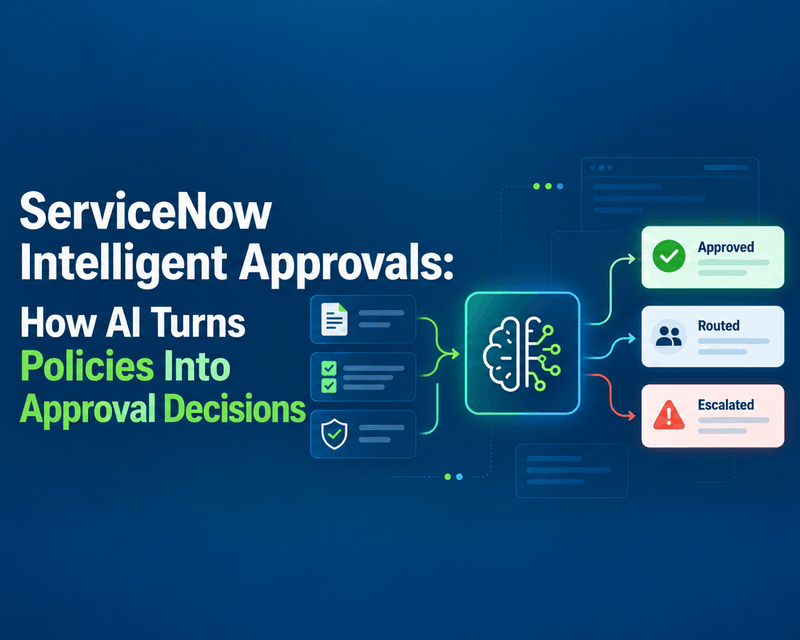
ServiceNow Intelligent Approvals: How AI Turns Policies Into Approval Decisions
What if your approval policies could make decisions, instead of sitting in documents waiting for someone to interpret them? For years, approval automation has followed the same pattern. Business teams write policies. Developers translate them into workflow conditions. Employees wait for someone to approve or reject their request, even when the outcome is obvious.
read more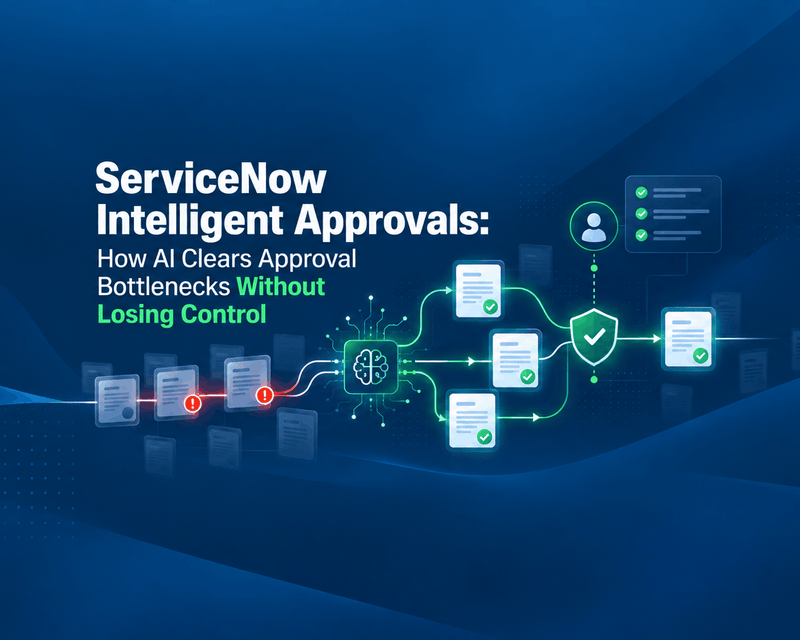
ServiceNow Intelligent Approvals: How AI Clears Approval Bottlenecks Without Losing Control
Your automation is fast. Your approvals are not. Organizations invest heavily in automation, AI and digital transformation. Yet many business processes still stall at the same point: waiting for someone to click “Approve.”
read more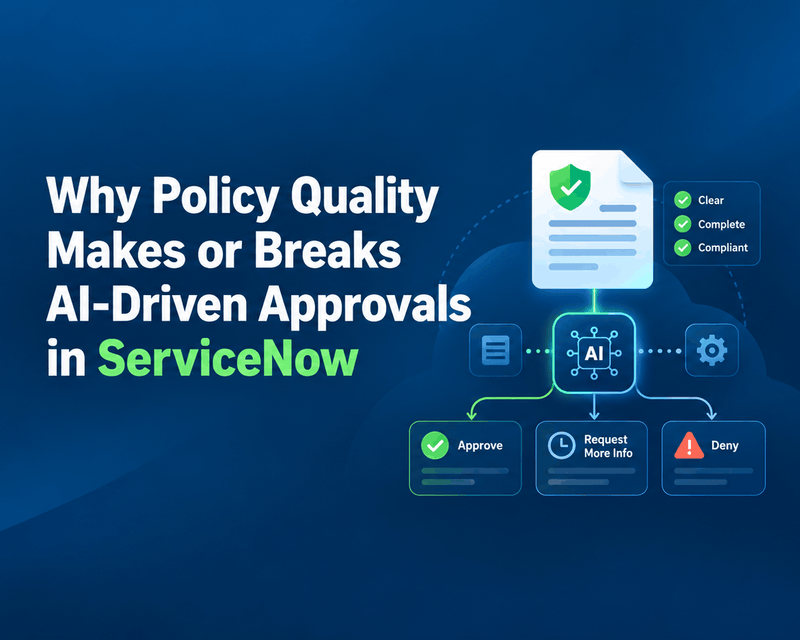
Why Policy Quality Makes or Breaks AI-Driven Approvals in ServiceNow
As enterprises bring AI-driven approvals into ServiceNow, attention goes straight to automation: faster decisions, fewer manual tasks, shorter approval queues. One factor gets far less attention: the quality of the policies behind those decisions.
read more