
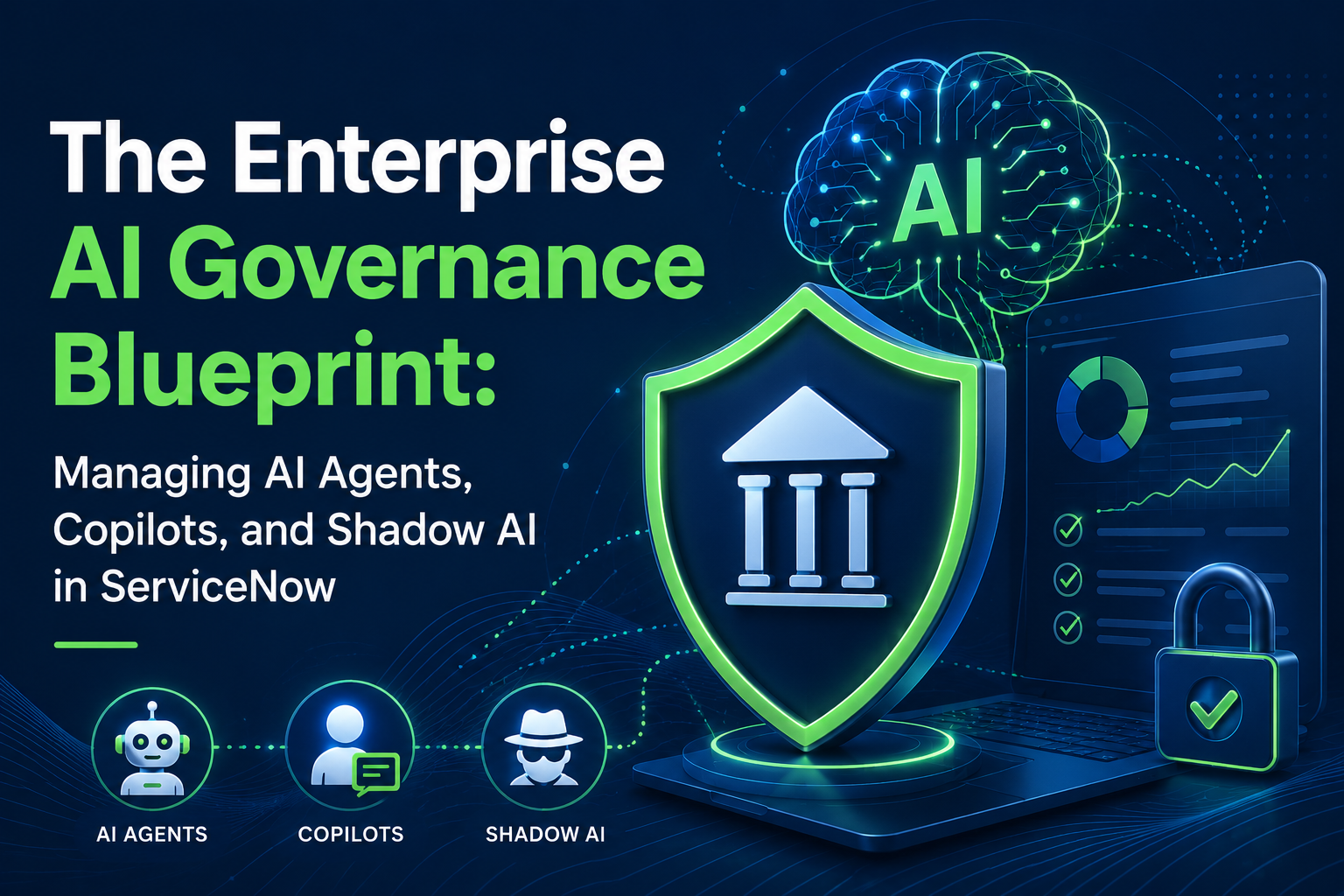
The Enterprise AI Governance Blueprint: Managing AI Agents, Copilots, and Shadow AI in ServiceNow
The why-now argument for AI governance is covered in our companion post. This is the how: a practical four-step blueprint — Discover, Classify, Control, Monitor — with the ServiceNow workflows, tables, and operating loops that make governance an operational capability rather than a policy document.
“AI governance works best when it is embedded in the platform where work, approvals, ownership, and remediation already happen.”
Artificial intelligence is moving quickly from experimentation into core enterprise operations. Across many organizations, copilots already help employees draft, summarise, search, and respond faster. At the same time, AI agents are starting to take action inside workflows, from triaging requests to triggering tasks and updating records. Meanwhile, shadow AI continues to spread across departments as teams adopt unsanctioned tools faster than IT, security, and governance functions can evaluate, govern, and control them.
For enterprises running ServiceNow, this shift creates a very specific challenge. AI is no longer just a technology initiative or a stand-alone innovation project. Instead, it is becoming part of day-to-day service delivery, employee support, IT operations, and business workflow automation. As a result, the governance question changes completely. Once AI starts touching enterprise data, influencing decisions, or taking action inside operational processes, governance stops being optional and becomes a core operational requirement.
The real question is no longer whether to adopt AI. It is how to scale AI responsibly without slowing innovation down
Why AI Governance Has Become an Operational Priority
Most enterprises are now managing three overlapping categories of AI.
The first category is copilots: AI assistants that help employees summarise tickets, generate responses, search internal knowledge, draft documentation, and speed up repetitive work. In many organizations, these tools are the easiest to deploy and the fastest to deliver visible productivity gains. At the same time, however, they also raise important governance questions. Teams still need to decide what data a copilot can access, how much they can trust its outputs, how to protect confidentiality, and where employees may begin relying on AI inside processes that were never designed for it in the first place.
The second category is AI agents. Unlike copilots, agents do not stop at suggestions. Instead, they take action directly inside enterprise workflows. For example, an AI agent might classify incidents, trigger approvals, update records, route requests, or coordinate actions across multiple systems. As soon as AI moves from assistance to execution, however, governance requirements increase dramatically. At that point, enterprises need much clearer visibility into what an agent is allowed to do, which data it can access, when a human must remain in the loop, and how every action is logged, reviewed, and controlled.
The third category is shadow AI: unsanctioned AI tools, prompt workflows, bots, or external services introduced without formal review. In many cases, shadow AI grows out of good intentions and a desire to move quickly. A team finds a tool that saves time, plugs it into a workflow, and starts using it immediately. On the surface, that may look harmless or even productive. In reality, though, the issue is not experimentation itself. The real issue is invisible risk. Teams may share sensitive data with unapproved systems, AI-generated outputs may influence regulated or business-critical decisions without oversight, and the organization may have no reliable record of which AI tools are actually being used across the business.
This is why AI governance is no longer a policy document or a quarterly review topic. It is an operating model problem.
Copilots, AI agents, and shadow AI create different governance pressures and require different controls:
| Dimension | Copilot — AI assistant | AI Agent — autonomous | Shadow AI — unsanctioned |
| What it does | Advises, summarises, drafts | Takes action autonomously | Varies — unknown until assessed |
| Governance pressure | Low–Medium | High–Critical | Unknown — automatically High |
| Data exposure risk | Knowledge base, ticket context | CMDB, approvals, records, actions | Uncontrolled — may include PII |
| Audit trail needed | Basic — query and output logged | Full — every action, identity, outcome | Required — start at discovery |
| Human oversight | Low — user reviews suggestion | High — approval for key actions | Required until risk assessed |
| Controls required | Data access policy, output review | Full Tier 3–4 framework | Intake, classify, restrict or approve |
| First step now | Inventory and classify | Activate AI Control Tower + owner | Discover and intake workflow |
Why ServiceNow Is a Strong Foundation for AI Governance
ServiceNow already sits at the center of how many enterprises manage approvals, workflows, service ownership, exceptions, remediation, and operational accountability. For that reason, it makes sense to extend AI governance into the same platform rather than treat it as a separate process running outside day-to-day operations.
Instead of relying on disconnected spreadsheets, email approvals, and scattered documentation, organizations can manage AI governance in the same environment where work already happens. As a result, governance becomes more structured, more scalable, and far easier to operationalize. Teams can register AI use cases, classify them by risk, and assign clear business and platform owners from the start. From there, high-risk scenarios can trigger approval workflows before deployment or use, while policy exceptions can automatically create tasks for platform, security, risk, or compliance owners. In the same way, teams can escalate runtime incidents through structured processes, track them to resolution, and connect them back to the affected AI use case instead of handling them ad hoc.
This matters because enterprise AI governance is not only about documenting what should happen. It is about controlling what actually happens when AI is used inside real workflows.
A Practical AI Governance Blueprint for ServiceNow
A strong governance model in ServiceNow covers four core layers. Each builds on the one before it — you cannot monitor what you have not classified, and you cannot classify what you have not discovered.
The four-step governance blueprint: from discovery to continuous monitoring
| Step | What it covers | How it works in ServiceNow | Outcome | Maturity |
| 1. Discover | Build a living inventory of every AI asset — copilots, agents, shadow tools, data connectors | AI Control Tower Discover mode + manual intake for undetected assets | Complete AI asset register with owners, data access, and approval status | Foundation |
| 2. Classify | Score each asset across five dimensions: data sensitivity, autonomy, criticality, regulation, system reach | Risk classification workflow — low/medium/high per dimension, overall tier assigned | Every AI asset has a risk tier — Tier 1 (read-only) to Tier 4 (autonomous execution) | Governed |
| 3. Control | Enforce ownership, approval workflows, access restrictions, and human-in-the-loop checkpoints | ServiceNow approval flows, role-based tool packages in AI Control Tower, governance registry | High-risk agents require named owner, security review, testing evidence, and rollback plan | Resilient |
| 4. Monitor | Observe runtime behaviour, detect anomalies, log every action, respond to shadow AI discoveries | AI Control Tower Observe mode + structured shadow AI intake and remediation workflow | Every AI action is auditable. Shadow AI is brought into a governed intake process | Optimised |
1. Discover and inventory AI assets
The first step is visibility, because you cannot govern what you cannot see. Before an enterprise can approve, monitor, or control AI effectively, it needs a living inventory of AI assets across the organisation. That inventory should include sanctioned copilots, internal assistants, autonomous agents, external AI services, prompt-driven workflows, data connectors, and the business processes they influence.
From there, the inventory needs to answer six basic questions for every AI capability. In other words, teams should treat this register as an operational asset record rather than a static spreadsheet. It should connect directly to owners, services, workflows, and controls so the organization can make governance decisions quickly, consistently, and with the right level of context.
| Inventory question | What to capture | Where in ServiceNow | Status |
| What is it? | Asset name, type (copilot/agent/shadow), version, vendor | AI Control Tower registry | Required |
| Who owns it? | Named business owner + named platform/technical owner | AI Control Tower + CMDB | Required |
| What data can it access? | Tables, APIs, PII scope, confidentiality classification | AI Control Tower — Secure | Required |
| What actions can it take? | Read-only / advisory / workflow-triggering / autonomous execution | Governance tier assignment | Required |
| Which systems does it affect? | Connected integrations, workflows, downstream services | CMDB service mapping | Required |
| Is it approved? | Approved / Under review / Unsanctioned — remediation open | Governance registry status | Required |
Before teams start any manual inventory work, they should first activate AI Control Tower’s Discover dimension. This gives them an immediate baseline by automatically surfacing AI assets across AWS, Azure, Google Cloud, SAP, Oracle, Workday, and Microsoft Agent 365. In many cases, that first discovery step reveals AI assets the platform team did not even know existed, which is exactly why discovery should come first rather than later in the governance process.
From there, teams can use manual intake to capture everything automated discovery does not find. That includes shadow AI tools uncovered through department interviews, internal IT reviews, architecture reviews, procurement checks, or incident investigations. In other words, automated discovery creates the initial map, while manual intake fills in the blind spots. Together, these two steps give the organization a much more complete and realistic view of its AI landscape before it starts making governance decisions.
2. Classify risk, autonomy, and business impact
Not every AI use case needs the same level of control. For example, a low-risk summarisation assistant for internal notes should not follow the same governance path as an AI agent that updates employee records, supports customer decisions, or triggers financial workflows. If an organization applies the same control model to every AI capability, it creates unnecessary friction in areas where speed and experimentation matter most, while still leaving too much ambiguity in the areas where stronger oversight is actually required.
As a result, organizations need a more flexible, risk-based approach. Instead of forcing every AI capability through the same governance path, they should align the level of control to the actual risk, impact, and autonomy of the use case. That way, teams can move quickly where the risk is low, while leadership, security, and compliance teams can apply stronger oversight where the business stakes are significantly higher.
Instead, teams should score each AI asset across five core dimensions and use that classification to shape the governance model around it. Once the organization classifies an AI use case, governance becomes much easier to operationalise. Higher-risk capabilities can go through stronger approvals, require more implementation evidence, undergo more frequent review, and operate under stricter runtime monitoring. At the same time, lower-risk use cases can move faster with lighter controls. As a result, the organization can protect the business where the stakes are highest without slowing down every experiment or low-risk productivity use case in the same way.
| Dimension | Low → Tier 1 | Medium → Tier 2–3 | High → Tier 4 |
| Data sensitivity | Internal notes, general KB | Employee or customer data | PII, financial, regulated data |
| Autonomy level | Advises only — human acts | Recommends + limited actions | Executes autonomously |
| Business criticality | Non-critical workflow | Operational disruption possible | Customer or compliance impact |
| Regulatory exposure | No compliance implications | Audit trail recommended | Regulated process — mandatory trail |
| System reach | Single tool, few users | Department-wide access | Cross-system, enterprise-wide |
Teams apply the same controls to everything — either everything is Tier 4 (slowing down all deployments) or everything is Tier 1 (no meaningful governance). Proportional governance means the risk tier drives the controls, not the other way around. A summarisation agent and an access provisioning agent carry fundamentally different risk profiles. Treating them the same is both inefficient and unsafe.
3. Apply controls, approvals, and human oversight
Not every AI use case needs the same level of control. For example, a low-risk summarisation assistant for internal notes should not follow the same governance path as an AI agent that updates employee records, supports customer decisions, or triggers financial workflows. If an organization applies the same control model to every AI capability, it creates unnecessary friction where speed and experimentation matter most, while still leaving too much ambiguity in the areas where stronger oversight is actually required.
A better approach is to classify each AI asset first and then shape governance around its actual risk profile. In practice, that means scoring every AI use case across five core dimensions and using that classification to determine the right level of control. Once teams complete that classification, governance becomes much easier to operationalise. Higher-risk capabilities can move through stronger approval paths, require more implementation evidence, undergo more frequent review, and operate under stricter runtime monitoring. By contrast, lower-risk use cases can move faster with lighter controls and fewer checkpoints. As a result, the organization can focus governance effort where the stakes are highest while still preserving speed, experimentation, and productivity for lower-risk AI use cases.
The goal is not to create bureaucracy. It is to make governance repeatable. If AI is allowed to influence important processes, the controls around it should be visible, structured, and easy to audit.
The minimum control set every AI agent needs before going live:
→ Named business owner — one person accountable for the agent’s actions and outcomes
→ Platform owner — person responsible for configuration, monitoring, and updates
→ Approved data access profile — which tables, APIs, and systems the agent can reach
→ Kill switch policy — who can pause the agent, under what conditions, and how fast
→ Audit trail active in AI Control Tower — before the first action, not after the first incident
4. Monitor runtime behaviour and respond to shadow AI
Governance does not stop at deployment. In many cases, deployment is exactly where the real risk begins. AI behaviour changes based on prompts, user inputs, model updates, data context, and the systems it interacts with. For that reason, runtime observability is not optional. It is what turns governance from a theoretical policy exercise into a real operating capability.
A mature governance model therefore needs to capture what actually happens once AI is in use. That includes who invoked the AI, what data or context it used, which model or agent responded, what tools, APIs, or systems it called, whether a human approved the action, and whether any policy exceptions or anomalies occurred. In other words, governance has to extend beyond design-time controls and into runtime behaviour. AI Control Tower’s Observe mode supports that directly, with anomaly detection and a kill switch available as a first line of response.
The same runtime layer should support shadow AI response. When an unsanctioned tool or workflow is discovered, a clear five-step operating loop brings it under governance — turning shadow AI from an unmanaged blind spot into a governed process:
Shadow AI response operating loop — five steps from discovery to closure:
1. Identify: Owner name, department, tool name, how long in use, which data accessed
2. Assess risk: Classify using the five-dimension matrix above — assign governance tier immediately
3. Decide: Approve (with controls documented), restrict (limit data access), or block (decommission)
4. Document: Register in AI Control Tower with owner, tier, approval status, and required controls
5. Track: Open remediation task to closure — no shadow AI case stays unresolved more than 30 days
What Good AI Governance Looks Like in Practice
A well-designed ServiceNow governance model does not try to stop every experiment. Instead, it creates a framework that helps the business move faster with more confidence, because speed without structure eventually creates more risk, more rework, and less trust in AI outcomes.
In practice, that means the organization makes AI use cases visible and assigns clear ownership from the start. It classifies high-risk capabilities early and consistently, rather than waiting until problems appear later in deployment or operations. It embeds approval paths directly into workflow instead of relying on manual reviews, side conversations, or disconnected documentation. It also makes runtime behaviour observable, so teams can see how AI behaves in production rather than assuming controls continue to work after go-live. Finally, it brings shadow AI into a structured intake, review, and remediation process instead of allowing it to remain hidden across teams and business units.
In other words, strong governance does not slow the business down. On the contrary, it gives the organization a repeatable way to experiment, scale, and control AI at the same time.
“The more autonomy an AI system has, the stronger the evidence trail and human accountability around it must be.”
Oleksii Konakhovych, CTO, Jun 24, 2026
Eager to take the next step? Contact us today!
Latest Articles
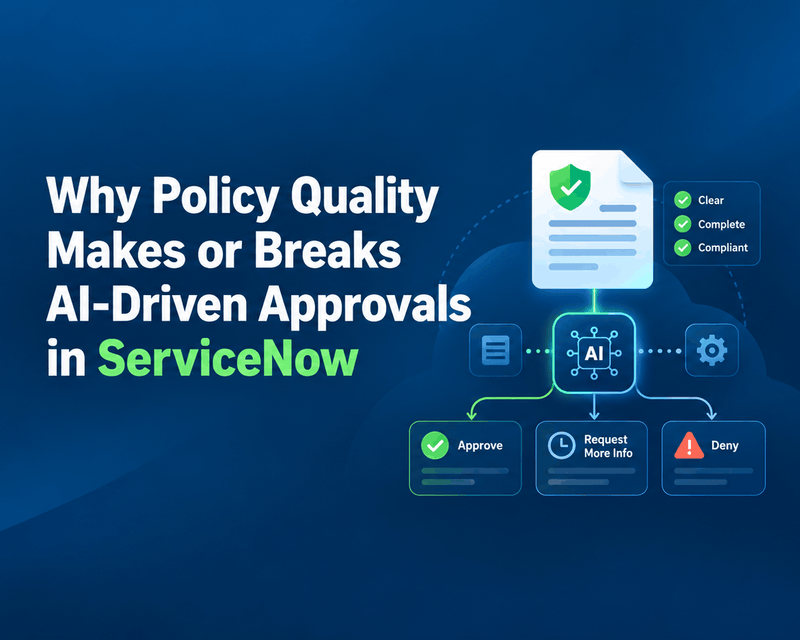
Why Policy Quality Makes or Breaks AI-Driven Approvals in ServiceNow
Why Policy Quality Makes or Breaks AI-Driven Approvals in ServiceNow AI can make approval decisions in seconds. It can also make the wrong ones, consistently, if the policy behind them is vague. As enterprises bring AI-driven approvals into ServiceNow, attention goes straight to automation: faster decisions, fewer manual tasks, shorter approval queues. One factor gets […]
read more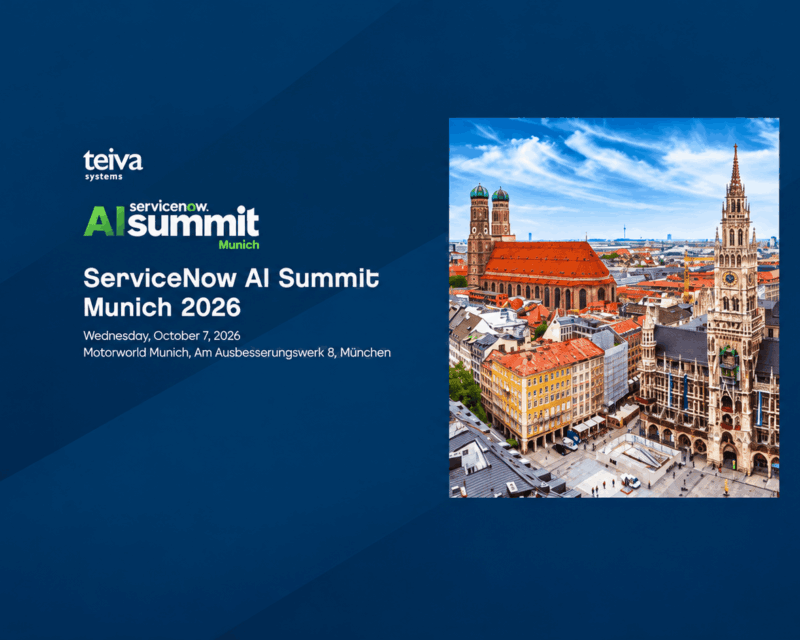
Teiva Systems at ServiceNow AI Summit 2026 — Munich
On October 7, 2026, Teiva Systems joined the ServiceNow AI Summit in Munich, where industry leaders, innovators, and the ServiceNow community came together to explore the next chapter of enterprise AI and intelligent automation.
read more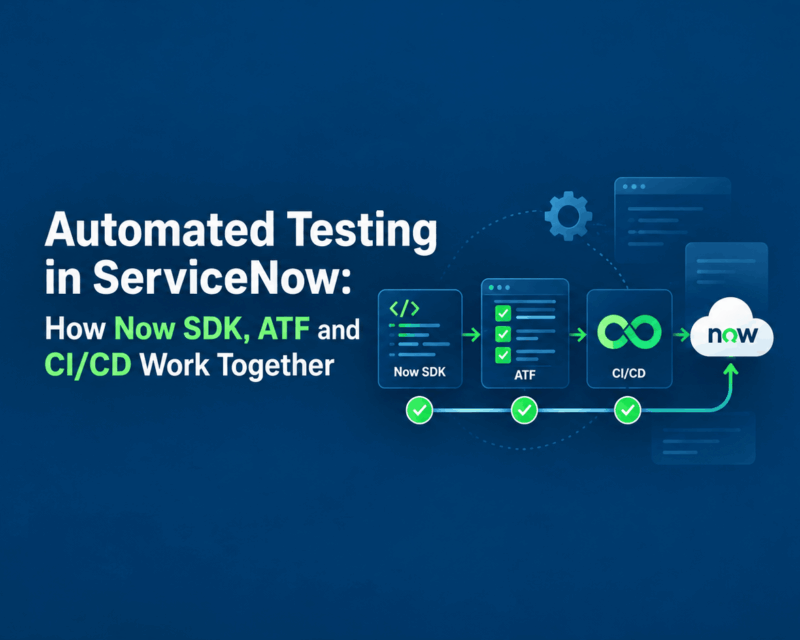
Automated Testing in ServiceNow: How Now SDK, ATF and CI/CD Work Together
Automated Testing in ServiceNow: How Now SDK, ATF and CI/CD Work Together Automated testing in ServiceNow is becoming more important, not because ATF or CI/CD are new concepts, but because the way they can work together is changing the development lifecycle itself. As ServiceNow moves toward a more source-driven engineering model, testing is becoming less […]
read more