
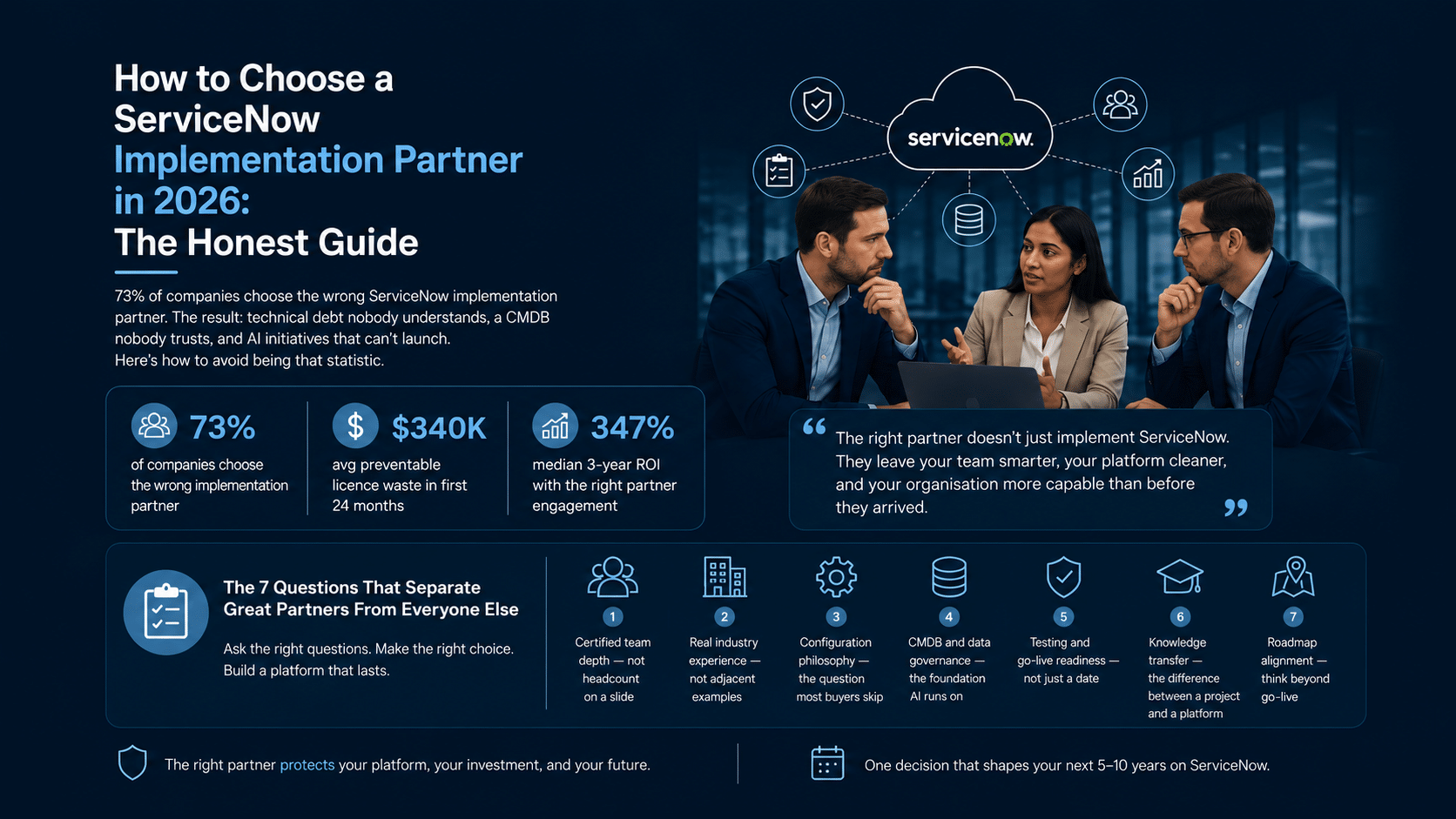
How to Choose a ServiceNow Implementation Partner in 2026
The Honest Guide
73% of companies choose the wrong ServiceNow implementation partner. The result: technical debt nobody understands, a CMDB nobody trusts, and AI initiatives that can’t launch. Here’s how to avoid being that statistic.
There are nearly 2,000 certified ServiceNow partners today. A handful will transform your platform. Many will configure exactly what you ask for — no more. And a few will leave you with customisations nobody understands, upgrade cycles that break annually, and an AI roadmap that stalls before it starts.
The problem is that every partner looks impressive before the contract is signed. Slide decks are polished. References are curated. Certifications are proudly listed. The real difference emerges later — when requirements become architecture, architecture becomes configuration, and configuration becomes long-term maintainability.

| “The right partner doesn’t just implement ServiceNow. They leave your team smarter, your platform cleaner, and your organisation more capable than before they arrived.” |
Here are the seven questions that separate partners who build platforms from partners who build dependencies.
The 7 Questions That Separate Great Partners From Everyone Else
| 1. Certified team depth — not headcount on a slide A proposal saying “we have 40 certified consultants” means little if your project gets two of them at limited capacity. The senior architect who presents the proposal is often not the person who builds your platform. Ask for named roles before you sign: solution architect, technical lead, integration specialist, CMDB expert, and project manager. Ask what percentage of their time is committed — and what happens if a key consultant leaves mid-implementation. → Who is assigned to our project by name, and what is their time commitment? → Are the resources employees or subcontractors? → What is your consultant retention rate over the last 12 months? 🚩Red flag: “We’ll confirm the team after contract signing.” |
| 2. Real industry experience — not adjacent examples A bank, hospital, manufacturer, and public sector body may all use ITSM — but their approval chains, risk controls, service structures, and data governance requirements are fundamentally different. A partner with real industry experience brings proven patterns, avoids expensive regulatory mistakes, and shortens decision cycles because they’ve already solved the same problems in your sector. → Show us a case study in our exact industry — not an adjacent one. → What were the specific compliance or regulatory challenges you solved? → How many projects of this scope have you delivered in our sector? 🚩Red flag: Every case study sounds generic: “improved efficiency and streamlined workflows” — with no specifics. |
| 3. Configuration philosophy — the question most buyers skip This may be the single most important question in your partner evaluation. Custom code is not always wrong — but unnecessary customisation creates upgrade risk, technical debt, and dependency on people who may not be there in two years. A strong partner should be able to articulate exactly where they draw the line, and they should push back on requirements that create long-term problems. → Where do you draw the line between configuration and customisation? → What is your process for documenting every customisation exception? → How do you handle a client requirement that would create significant upgrade risk? 🚩Red flag: A partner who says “we’ll customise whatever you need” without pushback is not protecting your platform — they’re protecting the contract value. ✅Green flag: They challenge your requirements and explain the long-term consequences of each customisation choice before building it. |
| 4. CMDB and data governance — the foundation everything AI runs on Your CMDB is the foundation for impact analysis, change risk, automation, and — critically in 2026 — AI readiness. A CMDB at 60% accuracy means AI agents trained on it will make incorrect autonomous decisions. Agents with bad data are not just ineffective. They are a liability. If the CMDB is weak, everything built on top of it becomes unreliable — and your AI programme will fail before it starts, regardless of which models you deploy. → Who owns CMDB health after go-live, and what are the data quality KPIs? → What CSDM phase do you target, and what’s the roadmap to get there? → How do you handle CI duplicates and stale discovery data at scale? → What CMDB accuracy threshold do you require before activating AI agents? 🚩Red flag: Nobody has a clear answer on who owns CMDB health after go-live. If nobody owns it, it decays — and so does every workflow and AI capability built on top of it. |
| 5. Testing and go-live readiness — not just a date A successful go-live is not a date on a calendar. It is a controlled business event with documented entry criteria, exit criteria, a rollback trigger, and a named person accountable after hypercare ends. A partner without documented answers to these questions is improvising — and you will live with the consequences long after they have moved to their next engagement. → What are the UAT pass criteria — what specific defect level prevents go-live? → What is the rollback trigger, and who has the authority to invoke it? → Who stays accountable after go-live and for how long — by name? → Is there a written cutover runbook we can review before we sign? 🚩Red flag: “We’ll work out hypercare details closer to the go-live date.” |
| 6. Knowledge transfer — the difference between a project and a platform The most common failure mode is not a bad go-live. It is an excellent go-live followed by a platform that nobody inside the company can maintain or evolve. Knowledge transfer is not a handover meeting at the end of the project — it is a discipline that must happen throughout delivery, in every sprint, every architecture decision, every configuration choice. A weak partner builds dependency. A strong partner builds capability. → How is knowledge transfer structured — per sprint, not just at project close? → Will your team work alongside ours on real tasks, or deliver documentation at the end? → What internal skills will our team have that they don’t have today? 🚩Red flag: Knowledge transfer appears only as a final project phase, not woven throughout the delivery methodology. |
| 7. AI readiness — the 2026 differentiator In 2026, AI readiness is not a bonus — it is table stakes. But it doesn’t start with agents. It starts with clean processes, trusted data, CSDM alignment, governance, and specific use cases with measurable outcomes. Any partner selling AI capability without first auditing your data foundation is selling future potential, not proven delivery. Ask for live references — not roadmap demos. → Have you delivered live Now Assist or AI Agent use cases — not demos? → How do you run an AI readiness assessment before recommending agent deployment? → What data quality thresholds must be met before you activate agentic AI? 🚩Red flag: Vague AI answers: “we’re fully prepared for the AI era” with no live references, no data readiness methodology, no governance framework. |
| 🤖 AI-specific questions no one else is asking: → What CMDB accuracy score do you require before enabling agentic workflows? → Have you configured AI Control Tower governance policies in a production environment? → How do you define and enforce human-in-the-loop checkpoints for autonomous agents? |
The 5 Red Flags That Should End the Conversation
Walk away if a prospective partner does any of these:
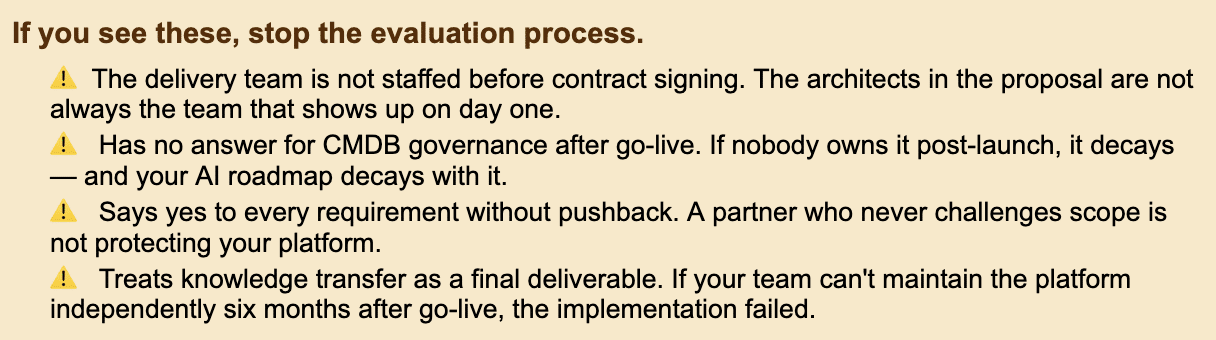
Partner Evaluation Weighting: 2026 Edition
AI readiness has been elevated from 5% to 16% versus previous weightings. In 2026, a partner without live AI delivery experience is structurally behind — regardless of their other credentials.
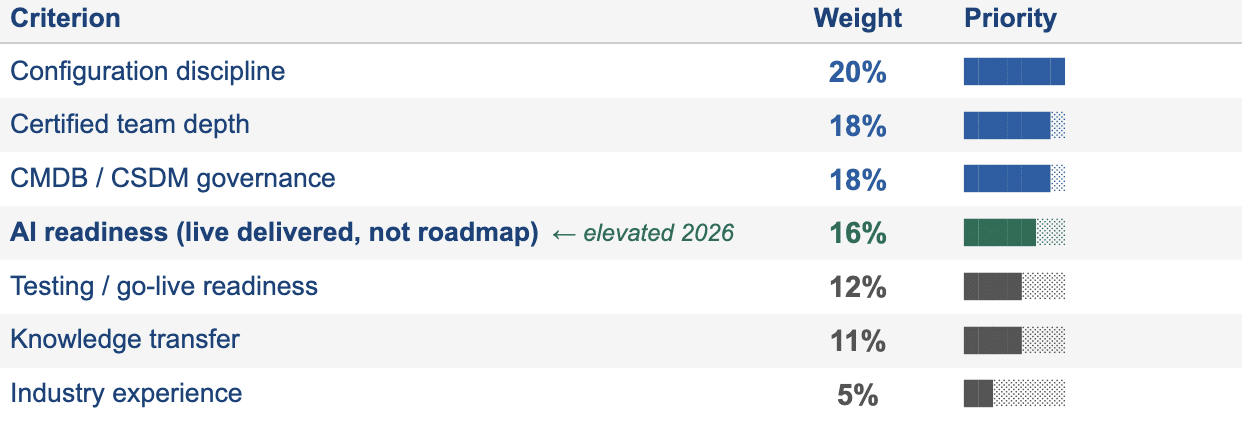
| “Do not choose the partner who promises the most. Choose the partner who explains the consequences.” |
The right ServiceNow implementation partner challenges weak requirements, protects your platform from unnecessary customisation, designs for upgrades, governs data seriously, tests honestly, and enables your internal team to be self-sufficient. That is the difference between a project and a platform. And it is the difference between a ServiceNow instance your organisation depends on — and one your organisation eventually works around.
Oleksii Konakhovych, CTO, May 21, 2026
Eager to take the next step? Contact us today!
Latest Articles
ServiceNow AI Readiness Assessment: 25 Questions to Answer Before Deploying AI Agents
Your AI agent is only as reliable as the environment it operates in. This assessment covers 25 essential questions across five areas to help IT leaders, architects, and platform owners prepare for production.
read more
ServiceNow AI ROI: What Should You Measure After the Pilot?
ServiceNow AI ROI: What Should You Measure After the Pilot? Your AI pilot worked. That proves the technology can work. It does not yet prove ROI. Here are the six metrics that separate “the demo impressed leadership” from “we can prove measurable business value.” Your ServiceNow AI pilot worked. Now what? The chatbot responded correctly. […]
read more
Teiva Systems at ServiceNow World Forum 2026 — New York
Teiva Systems was excited to join the ServiceNow World Forum 2026 in New York, where AI, Agentic AI, and the future of enterprise technology took center stage.
read more