
Top 5 Mistakes Companies Make When They Are Not Ready for a ServiceNow Release
A fresh ServiceNow drop might bring gains – if it doesn’t overwhelm you first. Still, some companies push through chaos without realizing half their pain comes from gearing up too late.
Blunders tied to rollouts keep turning up, across each update cycle, leaving tech groups and stakeholders alike scratching their heads. A hasty setup might shake a solid system, no matter how careful the build.
One thing tends to slip through cracks – readiness isn’t only about tools. It lives in how people talk to each other, work together, and show up at the right moment. When groups leap ahead without checking effects, test early, or brush aside learning efforts, chaos follows later. When details are missing, nobody quite knows what they are supposed to do.
Rushing through changes brings extra stress while making small mistakes more likely. What should reveal fresh tools instead feels like chaos taking over. What helps is knowing who does what, having time to prepare, and staying open with updates. This turns a change into opportunity instead of pressure.
Why lack of release readiness causes issues
Most mistakes happen because people aren’t ready. Problems show up late – solutions then take long to apply, costs rise fast. In such situations, organizations experience avoidable ServiceNow upgrade issues that could have been prevented with structured planning.
Ready for launch means more than patching code. Who holds responsibility matters just as much as how teams talk across stages. Trying things early helps spot gaps before deadlines tighten. When updates hit work flows, that shift needs attention too.
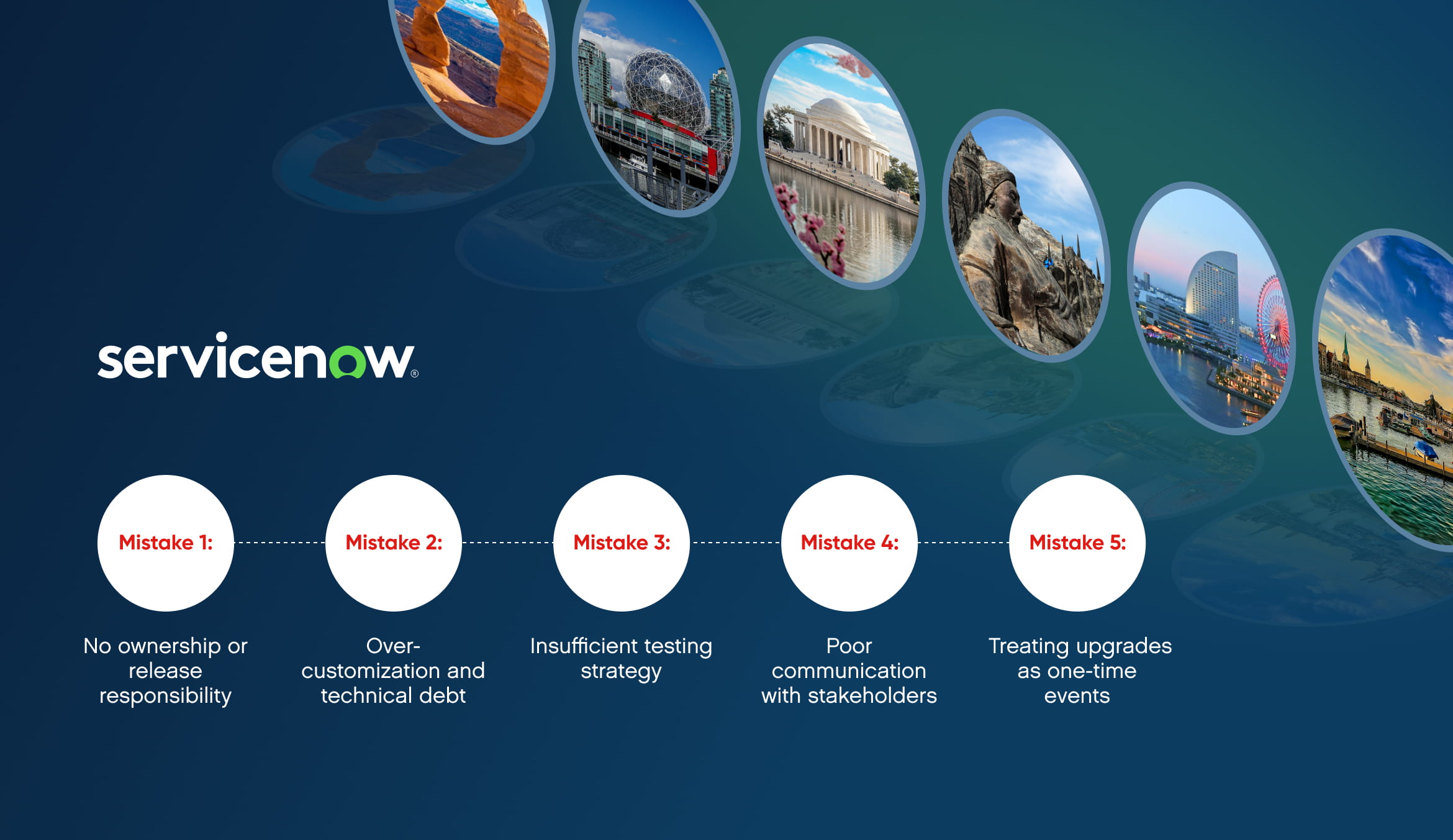
Mistake 1: No ownership or release responsibility
A single issue stands out – there’s often no defined owner. Without someone accountable for moving things forward, efforts fragment among groups. Efforts overlap in places, yet gaps remain just as frequently.
Strong release management requires defined roles, accountability, and a single point of coordination. Structure changes how people prepare. When there is no framework, getting ready happens by reaction alone. Issues show up first, then choices come after. That delay shapes outcomes more than we notice.
Mistake 2: Over-customization and technical debt
Customization is powerful, but uncontrolled customization creates long-term problems. Over time, organizations accumulate technical debt in the form of complex scripts, outdated workflows, and undocumented changes.
A fresh launch shakes up how things work inside custom elements. Trouble testing them shows up fast, along with headaches when changes are needed. Sudden hiccups happen way too often when updates roll through. Features meant for progress get pushed aside while past issues linger unchecked.
Mistake 3: Insufficient testing strategy
Few realize how crucial testing really is. Instead of seeing it as essential, most view it like paperwork – just go through the motions. Basic features get checked, sure, yet what about actual daily workloads? Real-world pressures? Those get brushed aside far too often. Once the system launches, problems surface. Users feel the fallout while teams scramble to fix what should have been caught earlier.
A strong testing approach is part of ServiceNow best practices. It should include validation of integrations, workflows, and user journeys. Testing is not about proving the system works once, but about building confidence that it will continue to work under real conditions.
Mistake 4: Poor communication with stakeholders
A shaky message hits hard. People react with confusion, caught off guard. Without clarity, they struggle to see the reason behind shifts or where things go next. Pushback follows, along with growing irritation. Trust in IT begins to fade.
Start by telling everyone – what shifts, why it counts, and how it touches regular tasks. If people learn sooner, they join hands instead of pointing fingers.
Mistake 5: Treating upgrades as one-time events
Some organizations approach releases as isolated projects instead of part of an ongoing lifecycle. This mindset increases upgrade risks because lessons learned from previous releases are not documented or reused.
Change never stops on ServiceNow. Seeing updates in isolation keeps groups from growing stronger, missing chances to refine how they prepare with each new roll-out.
Here’s what actually works: see what’s shifting next, pick someone responsible, check if tweaks make sense, simulate live issues, then share everything without confusion. Do that again and again – chaos fades while order grows. Get a free consultation and make sure your upgrade plan is on the right track.
Slava Trotsenko, CEO, Mar 05, 2026
Eager to take the next step? Contact us today!
Latest Articles
From Ticket Chaos to Autonomous IT: How Enterprises Are Turning ServiceNow Into a Self-Driving Platform
Why scaling tickets is not the same as scaling IT - and what leading organizations are doing instead.There was a time when IT success seemed simple:close more tickets.
read more
ServiceNow AI Skills, AI Agents & AI Workflows: The Complete Guide (2025–2026)
ServiceNow offers over 300 AI Skills across 30+ product modules, organized under the Now Assist ecosystem. AI Skills are discrete, reusable GenAI capabilities (e.g., incident summarization, resolution notes generation).
read more
Teiva Systems at ServiceNow Partners Day Munich: In the Age of AI, Execution Wins
Teiva Systems recently joined ServiceNow Partners Day in Munich, where more than 70 partner organizations and 120+ attendees came together to discuss the future of the ServiceNow ecosystem.
read more