
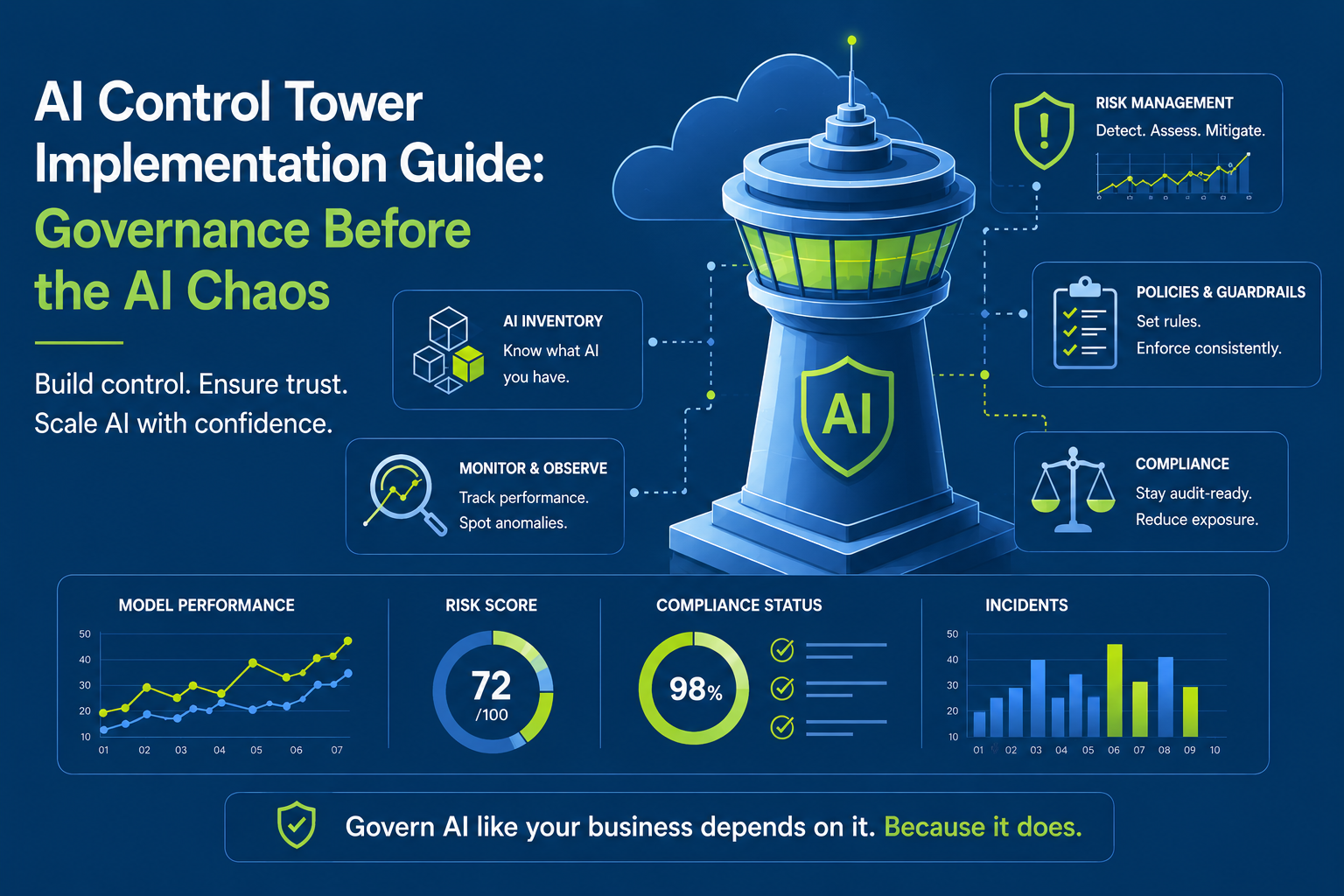
AI Control Tower: The Missing Layer Between AI Innovation and Enterprise Governance
This is the implementation guide: what a working AI Control Tower looks like, the five capabilities it needs, the five-stage maturity model, and exactly how ServiceNow delivers each layer.
“The biggest AI risk isn’t using artificial intelligence. It’s deploying artificial intelligence without knowing what it does, who owns it, or how it’s making decisions.”
Artificial intelligence has entered a new phase of enterprise adoption. Organisations are no longer experimenting with isolated chatbots—they are embedding AI across core business operations through autonomous agents that write code, resolve incidents, analyse financial reports, generate marketing campaigns, and orchestrate end-to-end workflows. AI is evolving from a productivity tool into a strategic operational capability, transforming how organisations work, make decisions, and deliver value across every business function.
However, as AI adoption accelerates, governance often struggles to keep pace. Business units adopt AI independently, each solving local challenges with different tools, models, and workflows.
Marketing deploys AI assistants. Engineering builds custom copilots. HR automates onboarding. Finance introduces intelligent procurement agents. Before leadership has a complete picture, dozens of disconnected AI systems are operating across the enterprise—accessing business data, making decisions, and automating critical processes without consistent policies, clear ownership, or central oversight.
This widening gap between AI innovation and governance is where enterprise risk begins to emerge. As AI adoption scales, this lack of oversight increases operational, security, and compliance risks—making governance an essential enabler of safe and sustainable AI adoption, not a barrier to innovation.
As AI adoption accelerates, organisations need a dedicated governance framework that provides visibility, accountability, and control across every AI workload.
To address these challenges, forward-thinking organisations are adopting AI Control Towers as the operational backbone of enterprise AI governance. By combining visibility, identity, policy enforcement, runtime observability, and auditability into a single governance layer, they gain the control needed to deploy AI at scale without sacrificing security or compliance. Rather than slowing innovation, governance becomes its accelerator—giving organisations the confidence to innovate faster, operate more securely, and realise the full business value of enterprise AI.
AI Adoption Doesn’t Create Chaos — Lack of Visibility Does
Many executives assume AI itself introduces risk. In reality, unmanaged AI introduces risk.
Without centralised governance, leaders cannot answer fundamental questions:
If you cannot answer all six questions today, you have an AI governance gap:
→ Which AI agents currently operate across the organisation?
→ What business data do they access?
→ Who owns them?
→ How models do they use?
→ Where decisions require human approval?
→ What policies protect sensitive information?
If organisations cannot answer these questions, scaling AI becomes increasingly risky. Enterprise AI failures rarely result from a single catastrophic event. Instead, risk accumulates quietly with every new agent, model, and automation deployed without visibility or governance. Over time, unmanaged AI creates hidden dependencies, expands access to sensitive data, and increases operational complexity. Eventually, a compliance audit, security incident, or board-level inquiry exposes the governance gaps that have been building all along. By then, the cost of reacting is far greater than the cost of governing proactively.
“Organisations don’t lose control overnight. They lose it one AI deployment at a time.”
Most organisations overestimate how well they understand their enterprise AI landscape. While platform teams may believe they have visibility into the AI tools running in production, a structured discovery process often uncovers two to three times more AI assets than expected.
Shadow AI is not a future concern—it already operates across the enterprise, accesses sensitive data, influences business decisions, and automates critical workflows without consistent oversight. As AI adoption continues to accelerate, this hidden ecosystem expands rapidly, increasing operational, security, and compliance risks. Consequently, organisations need complete visibility before they can govern AI effectively. An AI Control Tower addresses this challenge by creating a comprehensive inventory of AI assets that uncovers previously unknown systems and hidden dependencies. With that visibility, organisations can assign ownership, classify risk, enforce policies, and apply consistent controls across every AI workload. Ultimately, this foundation enables organisations to govern AI proactively, strengthen compliance, and scale AI with confidence.
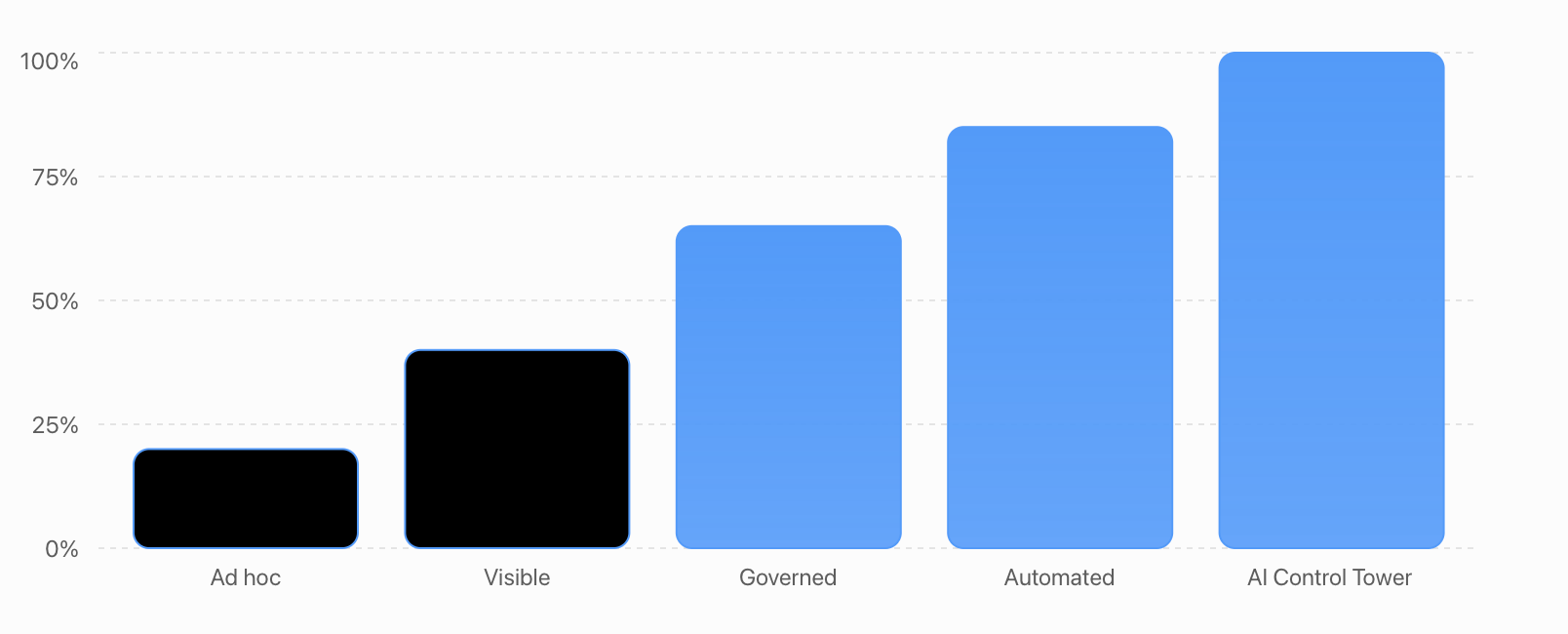
Enterprise AI Governance Maturity
Organisations typically evolve through five governance stages before reaching enterprise-scale AI adoption. Each stage has a specific AI Control Tower action that moves the organisation forward:
| Stage | Active governance | What this looks like | AI Control Tower action |
| 1Invisible | Ad-hoc AI tools, no central inventory | AI operates without governance. Shadow AI accumulates. No ownership, no policies, no audit trail. Leaders cannot answer: what AI do we have? | Activate Discover mode. Build first AI asset inventory. This alone moves you to Stage 2. |
| 2Inventoried | AI assets catalogued. Ownership assigned. | Tools are known. Owners are named. Data access is partially documented. Policies exist but are not enforced at tool level. | Add Govern dimension. Define risk tiers. Build approval workflow for new AI intake. |
| 3Governed | Policy enforced. Role-based access. Approval flows. | New AI deployments go through a defined intake process. Permissions are scoped. Human approval required for high-risk agents. | Activate Secure (Veza access graph). Configure tool packages per agent identity. |
| 4Observed | Runtime monitoring active. Kill switch live. | Every agent action is logged. Anomalies are detected in real time. Kill switch policy is documented and tested. Governance is an operating model. | Activate Observe mode. Configure anomaly rules. Test kill switch in non-production. |
| 5Optimised | ROI tracked. Continuous improvement. | AI value is measured against business outcomes. Quarterly re-certification for Tier 3–4 agents. Governance enables acceleration, not just control. | Activate Measure dashboards. Link AI KPIs to business outcomes. Governance is competitive advantage. |
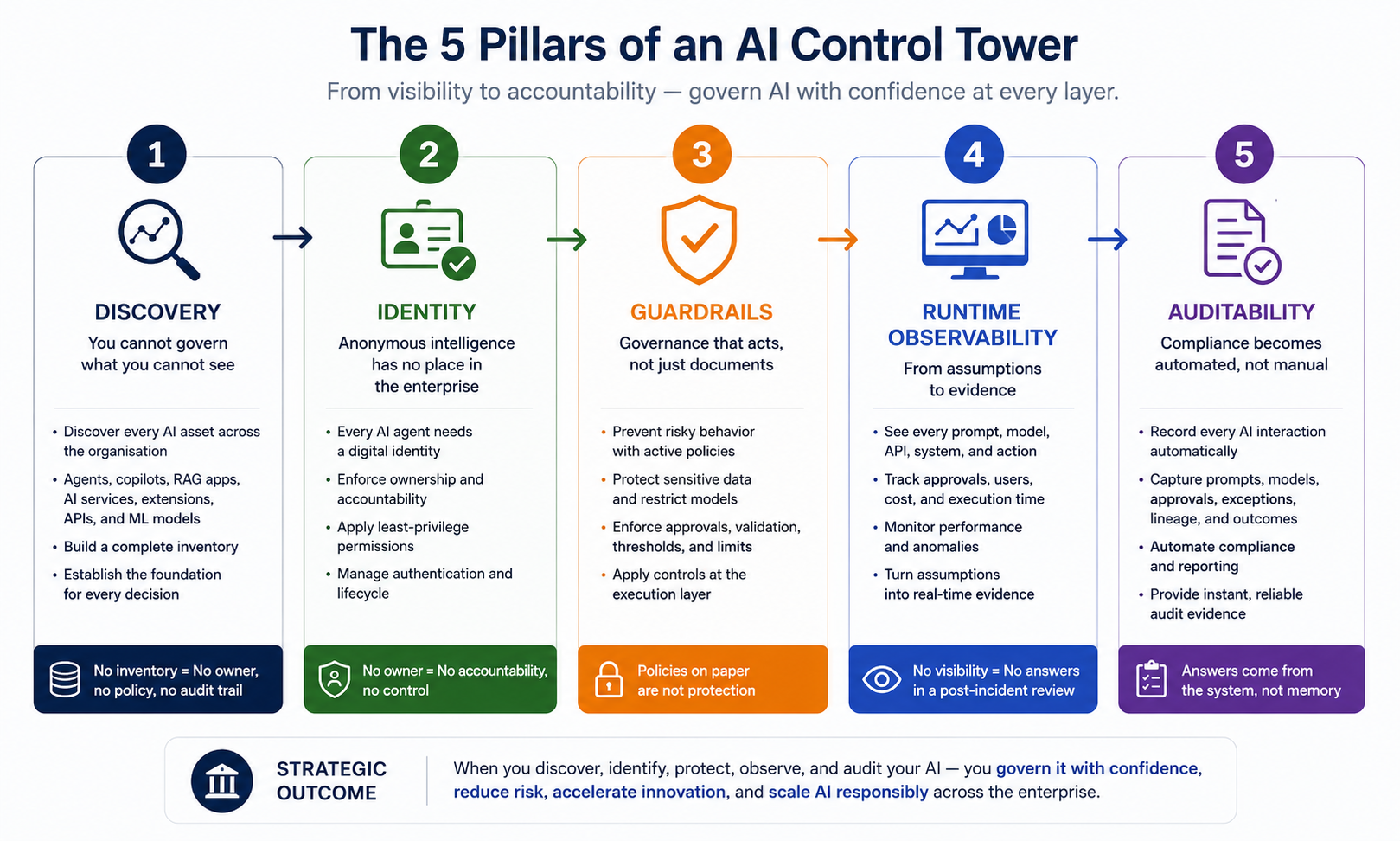
The Five Capabilities Every AI Control Tower Needs
An effective AI Control Tower extends far beyond governing large language models. Instead, it provides a unified governance framework for the entire enterprise AI ecosystem—including AI copilots, autonomous agents, RAG applications, external AI services, browser extensions, LLM APIs, and custom machine learning models. As AI adoption continues to accelerate, every system that accesses enterprise data, automates business processes, or influences business decisions should operate within the same governance framework. Consequently, organisations gain consistent visibility, enforce policies uniformly, establish clear ownership, and maintain end-to-end auditability across every AI workload. Ultimately, this unified approach transforms AI governance from a collection of disconnected controls into a scalable operating model that supports secure innovation across the enterprise.
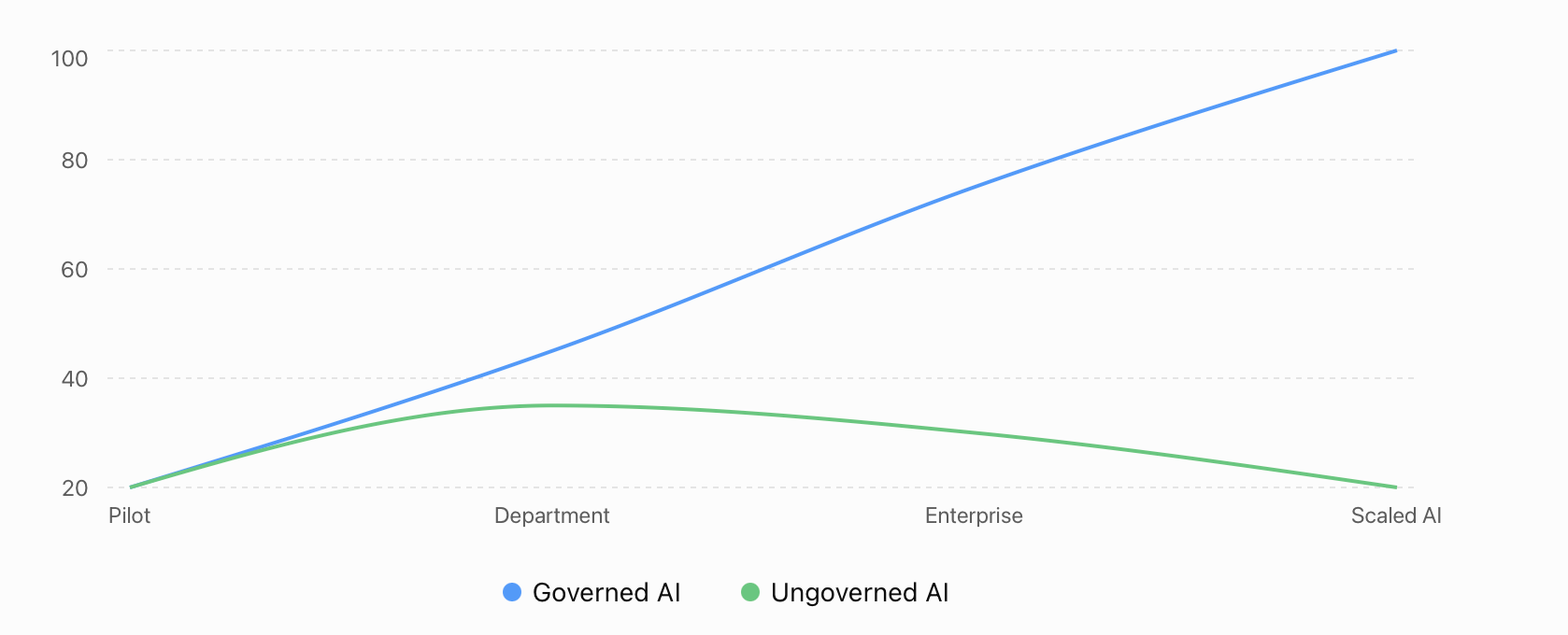
Governance Changes the AI Risk Curve
Many organisations believe governance slows innovation. The opposite happens.
Strong governance reduces enterprise risk while allowing AI adoption to accelerate. Organisations that implement governance early typically deploy more AI — not less — because security, compliance, and business teams trust the operating model.
| Without AI Control Tower ❌ | With AI Control Tower ✔ |
| Shadow AI accumulates invisibly across departments | Every new AI asset enters a governed intake process from day one |
| Risk compounds with every new deployment — unknown agents, unknown access | Risk is classified early — proportional controls applied immediately |
| First compliance incident triggers reactive governance scramble | Governance evidence is available before any compliance request arrives |
| Incident investigation takes weeks — no audit trail, no ownership records | Incident investigation takes hours — full log, named owner, kill switch active |
| Leadership imposes AI moratorium, slowing all deployment | Security and compliance teams trust the operating model — approve faster |
| Trust in AI programme damaged — hard to rebuild | AI adoption accelerates because governance removes the objections |
AI adoption with and without governance
Why ServiceNow Is a Strong Foundation
An AI Control Tower requires more than dashboards. It requires operational workflows.
An effective AI Control Tower goes far beyond a collection of dashboards—it serves as the operational foundation for enterprise AI governance. ServiceNow delivers the core capabilities organisations need to govern AI at scale. Instead of introducing another disconnected governance platform, organisations can build on existing workflows, data models, and automation to create a unified operating model. As a result, they gain consistent visibility, enforce policies, manage identities, monitor AI activity, and maintain auditability across every AI workload. The following capabilities demonstrate how ServiceNow supports each layer of an AI Control Tower—from discovery and identity to policy enforcement, runtime observability, and auditability.
| ServiceNow capability | What it does for AI governance | Governance purpose |
| CMDB | AI asset discovery — CI class for AI agents, relationships to services and owners | Foundation: every AI asset exists as a governed record |
| AI Control Tower | Discover, Govern, Secure, Observe, Measure — native governance platform | The control layer: visibility, policy, runtime, audit |
| Workflow Automation | Approval flows for AI agent intake, exception handling, kill switch execution | Governance made operational — not just documented |
| Identity orchestration | Named owner per agent, OAuth via Action Fabric, Veza 30B-permission graph | Every agent action is attributable to an identity |
| Integrated Risk Management | Risk classification, policy assignment, compliance workflow | Regulatory exposure managed within ServiceNow |
| Audit logging | Full execution chain: prompt, retrieval, tool call, approval, action, outcome | Evidence for compliance reviews and incident investigations |
| Performance Analytics | AI KPI dashboards: deflection rate, MTTR, cost per transaction, ROI | AI value tracked against business outcomes |
Enterprise AI has already moved beyond experimentation.
The real competitive advantage no longer comes from deploying the most AI agents. Instead, it comes from deploying AI responsibly, securely, and at scale.
Organisations that invest in an AI Control Tower gain far more than governance. They build the operational foundation for trusted innovation, faster adoption, stronger compliance, and measurable business value.
As AI becomes embedded in every business function, governance must evolve accordingly—from a reactive compliance exercise into a strategic business capability. Consequently, organisations can move beyond simply managing risk to building the operational confidence required to deploy AI responsibly, securely, and at enterprise scale.
The conversation is no longer about whether organisations should govern AI. It is about how quickly they can move from invisible AI to governed AI operations—before a compliance incident, a security event, or a board-level question forces the conversation on terms they did not choose.
The organisations that establish governance early will not only reduce risk—they will earn the confidence to innovate faster than their competitors.
“The winners of the AI era won’t be the companies with the most AI. They’ll be the companies that can govern AI at enterprise scale.”
Oleksii Konakhovych, CTO, Jul 08, 2026
Eager to take the next step? Contact us today!
Latest Articles
ServiceNow Lux vs UI Builder and Service Portal: What Enterprises Need to Know
Does Lux replace UI Builder or Service Portal? Short answer: no. The full answer depends on what you are building. The way enterprises build experiences on ServiceNow is changing. For years, Service Portal has handled employee and customer self-service, while UI Builder has powered modern workspaces and configurable applications.
read more
Teiva Systems at ServiceNow World Forum 2026 — London
On October 20, 2026, Teiva Systems attended ServiceNow World Forum London at ExCeL London, where industry leaders, technology experts, and the ServiceNow community came together to explore how AI, intelligent automation, and digital workflows are transforming enterprise operations.
read more
ServiceNow Intelligent Approvals: How AI Turns Policies Into Approval Decisions
What if your approval policies could make decisions, instead of sitting in documents waiting for someone to interpret them? For years, approval automation has followed the same pattern. Business teams write policies. Developers translate them into workflow conditions. Employees wait for someone to approve or reject their request, even when the outcome is obvious.
read more