
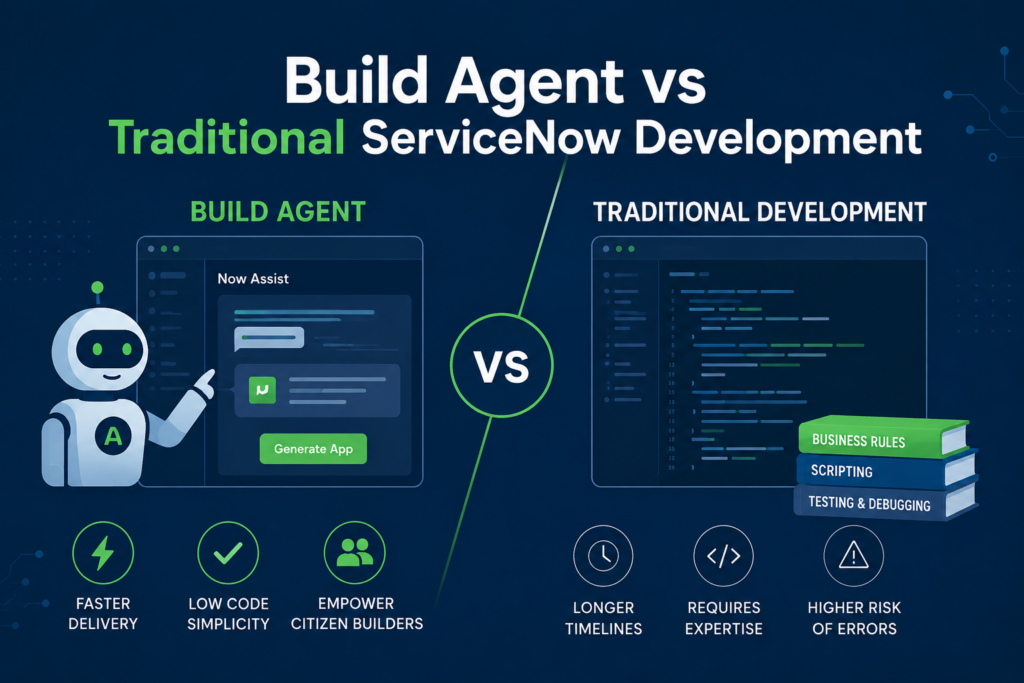
Build Agent vs. Traditional ServiceNow Development: When to Use Each
ServiceNow Build Agent is moving from limited preview toward mainstream adoption. It changes the development loop — but it does not change what good ServiceNow development looks like. Here is an honest comparison: what Build Agent actually does, where it genuinely saves time, where traditional development still wins, and what governance you need before any AI-generated code reaches production.
“The future of ServiceNow development is not replacing developers with AI — it is enabling developers to build faster, govern better, and deliver greater business value.”
ServiceNow Build Agent is transforming enterprise software delivery by shifting development from manually building every workflow to orchestrating intelligent AI agents that can reason, plan, and execute tasks. Within the ServiceNow ecosystem, Build Agent represents the next evolution of development. Instead of manually configuring every table, flow, business rule, or UI component, developers now collaborate with AI-powered assistants that generate artifacts, recommend best practices, create documentation, and accelerate testing. As a result, teams deliver solutions more efficiently while maintaining development quality.
Nevertheless, traditional ServiceNow development remains essential because enterprise platforms require strong governance, security, scalability, and long-term maintainability. As organisations adopt AI-assisted development, they face an important question: when should teams rely on Build Agent, and when should they continue using traditional development? Rather than choosing one approach over the other, successful organisations understand how both methods complement each other and deliver the greatest value when used together.
At Teiva, we already integrate Build Agent into selected phases of ServiceNow development. However, we use it as an accelerator—not as a replacement for our developers. Instead, we apply Build Agent where it delivers measurable productivity gains while allowing experienced developers to retain responsibility for architecture, governance, security, and final implementation decisions. In the following sections, we examine where Build Agent creates real value, where its limitations remain, and which governance practices organisations should establish before introducing AI-assisted development into production workflows.
Traditional ServiceNow Development
Traditional ServiceNow development follows a structured lifecycle that includes requirements gathering, architecture, configuration, scripting, testing, deployment, and ongoing maintenance. Throughout this process, developers manually build catalog items, Flow Designer automations, integrations, ACLs, UI Builder experiences, and custom applications. As a result, teams maintain complete visibility and control over every stage of development.
Because of this level of control, traditional development remains the preferred approach for highly regulated workflows, complex integrations, mission-critical enterprise services, and large-scale architectural decisions. Every developer creates each artifact, every decision remains traceable, and teams can manage upgrade risks more effectively because they fully understand the code and configurations they implement.
However, traditional development does not struggle with quality—it struggles with time. Senior ServiceNow developers often spend a significant portion of every project completing repetitive, well-defined tasks that closely resemble work they have already completed many times. For example, they repeatedly build similar form layouts, write nearly identical transform scripts, and document standard catalog items. Consequently, these routine engineering activities consume valuable time that developers could otherwise dedicate to architecture, innovation, and solving complex business challenges. This is exactly where Build Agent delivers the greatest value by accelerating repetitive work while allowing developers to focus on higher-value activities.
What Is a ServiceNow Build Agent?
Build Agent combines generative AI with deep ServiceNow platform knowledge to accelerate enterprise development. Instead of starting from a blank page, developers describe business requirements in natural language, and the agent generates data models, workflows, scripts, documentation, and test scenarios. As a result, teams move from ideas to working solutions much faster.
However, Build Agent does not replace developers. Instead, it automates repetitive engineering tasks, enabling experienced professionals to focus on architecture, governance, security, integrations, and business outcomes. By reducing manual effort, it increases developer productivity while allowing teams to spend more time on strategic decision-making and solution quality.
In practice, Build Agent serves as an AI-powered development collaborator within App Engine Studio. For example, it assists developers throughout the development lifecycle by generating artifacts, recommending best practices, creating documentation, suggesting code, and supporting testing. Consequently, developers retain full control over the final implementation while delivering projects more efficiently.
Artifact generation
Describe a table structure or workflow in natural language and Build Agent proposes a schema, field list, and initial Flow Designer configuration. The developer reviews, adjusts, and accepts.
Documentation
As artifacts are built, Build Agent generates inline documentation — field descriptions, flow annotations, integration notes — without a separate documentation sprint.
Test scenario creation
Build Agent generates unit test scenarios and edge cases based on the workflow logic, reducing the time developers spend writing test scripts manually.
Code suggestions
For script includes, business rules, and client scripts, Build Agent proposes logic based on platform conventions and the surrounding configuration context.
Codebase explanation
For new team members or external reviewers, Build Agent can explain what an existing implementation does and why specific design decisions were made — accelerating knowledge transfer.
Development Comparison: Traditional vs. Build Agent
An expanded comparison across the dimensions that matter most in enterprise ServiceNow delivery:
| Capability | Traditional ServiceNow development | Build Agent — AI-assisted development |
| Starting point | Blank page — architect from requirements | Natural language description — AI proposes initial structure |
| Development speed | Medium — every artifact hand-built | High — boilerplate generated; developer reviews and refines |
| Documentation | Manual — often incomplete or outdated | AI-assisted — generated alongside artifacts, stays current |
| Unit test creation | Manual — developer writes test scenarios | AI generates test scenarios and edge cases automatically |
| Code governance | Excellent — every line is developer-authored | Requires review — AI output must be validated before commit |
| Upgrade risk | Managed — follows platform upgrade patterns | Watch closely — AI-generated custom code still carries upgrade risk |
| Complex integrations | Preferred — full control over error handling | Hybrid — agent scaffolds, developer owns integration logic |
| Security controls | Preferred — developer controls ACL logic precisely | Requires validation — AI-generated ACLs must be reviewed |
| Onboarding new devs | Slower — knowledge transfer is manual | Faster — AI explains existing patterns and guides new devs |
| Innovation surface | Developer-driven — constrained by individual time | Developer + AI — broader exploration in less time |
| Best for | Mission-critical systems, regulated workflows, architecture | Prototyping, documentation, repetitive config, developer productivity |
Where Build Agents Deliver the Most Value
The greatest gains appear during rapid prototyping, documentation, knowledge transfer, code generation, unit test creation, workflow recommendations, and solution modernisation. New developers also onboard significantly faster because AI explains existing implementations and recommends improvements.
Breaking this down by phase of a typical ServiceNow project:
Rapid prototyping
Build Agent can turn a requirements description into a working prototype significantly faster than traditional development. This is particularly valuable in discovery phases where stakeholders need to see something real before they can articulate what they actually want. Prototypes built with Build Agent should be treated as exploratory — to be validated and then rebuilt with proper governance for production.
Documentation sprint elimination
Documentation is consistently the most deferred and least complete phase of traditional ServiceNow projects. Build Agent generates documentation alongside artifacts rather than after them — reducing documentation effort by an estimated 60–70% in early pilot data. The result is not just time saved; it is documentation that actually exists when a project closes.
Developer productivity on repetitive configuration
Catalog item layouts, standard approval flows, basic transform maps, notification rules — these are structurally similar across projects and well within Build Agent’s most reliable output range. Developers who would otherwise spend three hours on a catalog item can spend 45 minutes, spending the remaining time on the architectural decisions the platform cannot make for them.
New developer onboarding
Build Agent dramatically compresses the time it takes a new developer to understand an existing ServiceNow implementation. Rather than reading through undocumented configurations, they can ask the agent to explain what an existing flow does, why a particular business rule is structured the way it is, and what conventions the project follows. This is one of the most immediate productivity gains in client environments.
Estimated Delivery Effort Distribution
Where Build Agent compresses time — and where the governance overhead increases it:
| Development phase | Traditional % | Build Agent % | Effort saving | Where the difference shows |
| Requirements & architecture | 20% | 20% | 0% | Same effort — human-led |
| Configuration & scripting | 40% | 18% | ~55% | Biggest compression — AI scaffolds |
| Documentation | 10% | 3% | ~70% | AI generates alongside artifacts |
| Testing & review | 15% | 18% | – | Increases slightly — AI output needs validation |
| Deployment & governance | 15% | 41% | – | Increases — AI code requires extra review |
The effort table surfaces the critical nuance: Build Agent saves significant time in the middle of a project (configuration, scripting, documentation) but adds oversight effort at the end (testing, governance, deployment review). The net saving is real — but only if the governance investment is made properly.
Challenges and Governance
However, AI-generated configurations still require careful review before deployment. Organisations must validate security controls, data access, performance, compliance requirements, and long-term maintainability. In addition,experienced developers should review every AI-generated artifact to confirm that it aligns with business requirements and platform best practices. Most importantly, organisations should require human approval before deploying any AI-generated configuration to production.
To achieve this, successful organisations establish clear guardrails for AI-assisted development. For example, they implement prompt governance, structured approval workflows, peer code reviews, version control, comprehensive audit trails, and continuous monitoring. As a result, they accelerate development while maintaining security, compliance, transparency, and enterprise-grade governance.
The specific risks that require governance attention in AI-assisted ServiceNow development:
Security and access control
AI models generating ACL logic tend to default to permissive access patterns. An ACL that should restrict access to a specific role will often be generated with broader access than intended. Every security control in AI-generated code needs explicit human review before it is trusted in production.
Upgrade risk from custom code
AI-generated custom scripts carry exactly the same upgrade risk as hand-written custom scripts. The fact that a developer did not write the code does not reduce its maintenance burden. Build Agent outputs that include custom scripting should be flagged in your technical debt register and reviewed at each upgrade cycle.
Compliance alignment
Build Agent does not know your regulatory context. If you are building for financial services, healthcare, or public sector workflows, AI-generated logic must be validated against your specific compliance requirements. The agent generates to ServiceNow best practices, not to your industry’s regulatory obligations.
Governance checklist before any AI-generated code reaches production:
→ Security review: does the generated ACL logic correctly restrict access? AI models default to broad access patterns.
→ Custom code audit: flag every AI-generated script for upgrade risk analysis. Custom code from AI carries the same technical debt as custom code from humans.
→ Performance validation: test AI-generated queries and scripts at production data volumes, not just in developer instances.
→ Compliance alignment: for regulated workflows, verify that generated logic meets your specific regulatory requirement — AI does not know your compliance context.
→ Version control: AI-generated artifacts must be committed to source control with the same discipline as hand-written code. No exceptions.
→ Human approval gate: no AI-generated configuration deploys to production without a named developer signing off.
Choosing the Right Approach
When making architectural decisions, choose traditional development for highly customised enterprise applications, sensitive security controls, regulated environments, complex integrations, and large-scale platform architecture. In these scenarios, experienced developers maintain full control over design, security, compliance, and long-term maintainability.
On the other hand, use Build Agents for repetitive configuration, documentation, rapid prototype generation, workflow acceleration, automated test creation, and developer productivity improvements. By automating routine engineering tasks, Build Agent enables developers to focus on high-value work, including solution architecture, governance, security, and business outcomes. As a result, teams deliver projects faster without compromising enterprise quality or control.
The decision framework in practice:
| Use traditional development when… | Use Build Agent when… |
| Mission-critical enterprise applications (ITSM core, HRSD lifecycle) | Rapid prototyping to validate requirements before full build |
| Sensitive security controls and ACL logic | Documentation of existing implementations |
| Complex integrations with error handling requirements | Repetitive configuration (catalog items, form layouts, basic flows) |
| Large-scale architecture decisions and data model design | Unit test scenario generation |
| Regulated workflows where every line of logic needs sign-off | New developer onboarding and codebase explanation |
| Anything that has failed an upgrade in the past | First-draft workflow generation for review by a senior developer |
Ultimately, the future of ServiceNow development is collaborative rather than competitive. AI Build Agents accelerate delivery, while experienced developers drive architecture, governance, security, and quality assurance. Together, they create a development model that delivers both speed and enterprise-grade reliability.
As a result, organisations that combine human expertise with intelligent automation shorten delivery cycles, improve consistency, and unlock greater innovation without sacrificing control. Rather than choosing between AI and developers, successful enterprises empower developers with AI to enhance productivity, strengthen governance, and deliver higher business value. In other words, AI works alongside developers—it does not replace them.
So where should organisations begin? Start by introducing Build Agent into the phases where it delivers the greatest value: documentation, rapid prototyping, unit test generation, and developer onboarding. At the same time, establish a governance framework before expanding AI-assisted development into production workflows. Most importantly, never let faster AI-generated output justify skipping human review. Every configuration, workflow, and script still requires expert validation to ensure security, compliance, maintainability, and long-term platform stability. After all, enterprise success depends not on how quickly AI generates a solution, but on how confidently your team can trust and govern it.
“Build Agent is not a shortcut to production. It is a shortcut to a better draft. The quality gate stays exactly where it always was.”
Key takeaways:
→ AI accelerates development but does not replace enterprise architects or the governance decisions only humans can make.
→ Governance becomes more important as automation increases, not less. AI-generated code needs the same review gates as hand-written code.
→ Human review remains mandatory for production deployments. Zero exceptions.
→ The highest ROI comes when AI handles repetitive engineering tasks and experienced developers focus on architecture, security, and business outcomes.
→ Split projects into Build Agent tracks and traditional tracks per artifact — not per project.
Slava Trotsenko, CEO, Jul 06, 2026
Eager to take the next step? Contact us today!
Latest Articles
Teiva Systems at ServiceNow World Forum 2026 — London
On October 20, 2026, Teiva Systems attended ServiceNow World Forum London at ExCeL London, where industry leaders, technology experts, and the ServiceNow community came together to explore how AI, intelligent automation, and digital workflows are transforming enterprise operations.
read more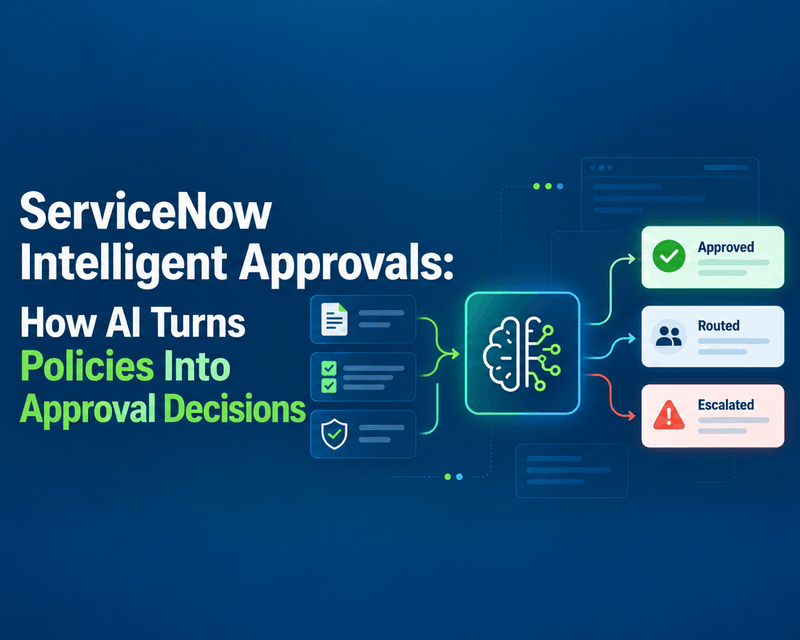
ServiceNow Intelligent Approvals: How AI Turns Policies Into Approval Decisions
What if your approval policies could make decisions, instead of sitting in documents waiting for someone to interpret them? For years, approval automation has followed the same pattern. Business teams write policies. Developers translate them into workflow conditions. Employees wait for someone to approve or reject their request, even when the outcome is obvious.
read more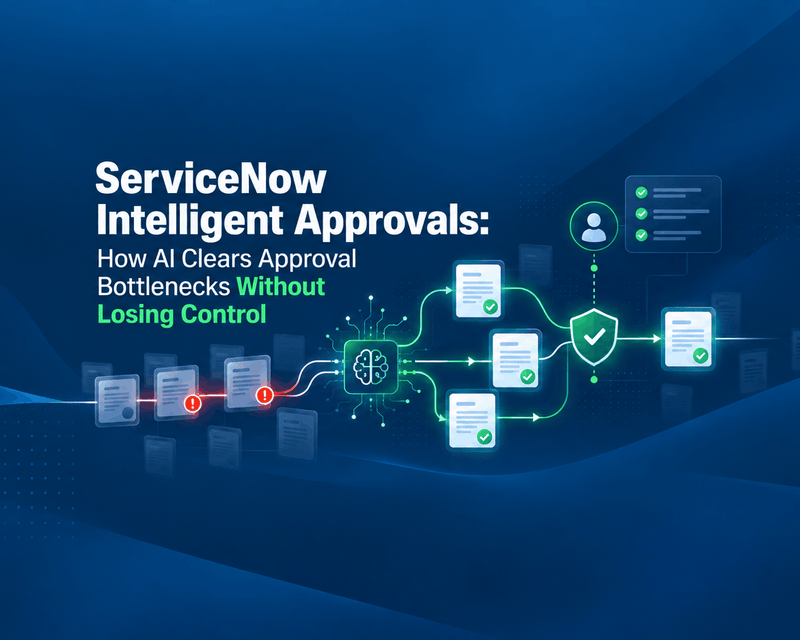
ServiceNow Intelligent Approvals: How AI Clears Approval Bottlenecks Without Losing Control
Your automation is fast. Your approvals are not. Organizations invest heavily in automation, AI and digital transformation. Yet many business processes still stall at the same point: waiting for someone to click “Approve.”
read more